Archive for the ‘dx’ Category
 Japan on 15m
 September 11th, 2010 |
  Author:
 This morning I worked Kei, JI1BBN, on 15m PSK31 using 50W to the MFJ magnetic loop in the attic.
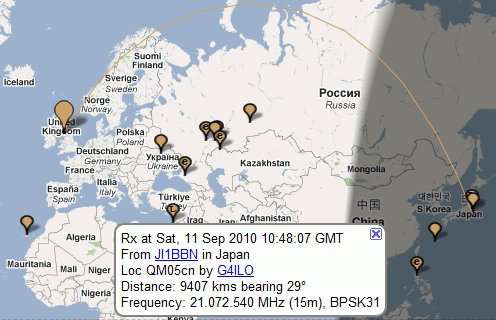
I heard several other DX stations on both the loop and the dipole, including DU3MEL in the Philippines whom I last worked in 2003, also on 15m. That was also the last time I worked Japan. Then I would only have been using QRP with my Elecraft K3, and the antenna would have been a horizontal loop of wire round the perimeter of the attic, with a 4:1 balun at the centre of one side, tuned using the K2 internal ATU.
What’s that about stealth antennas not working?

2010 SCC RTTY Contest
It seems that I’ve been doing more RTTY contesting lately, and on Saturday, I spent about 8 1/2 hours participating in the SCC (Slovenia Contest Club) RTTY Championship contest. This was a 24 hour contest, running from 8AM Saturday to 8AM Sunday (local time), and it’s one of the contests where anybody can work anybody. I like those, because even if propagation isn’t cooperating, I can usually work someone in the US. This is a good thing, because propagation wasn’t all that great, and as it turns out, just about 50% of my contacts were with US stations.
There are some interesting scoring rules in this contest that I haven’t seen before. In many DX contests, you get more points for working DX which favors certain parts of the world where there are literally dozens of countries in an area the size of the US. However, for this contest the rules are set up so that within “big” counties (like the US, Canada, Australia, Japan, Argentina, and others) you get extra points for working stations within that country but who are in different call areas, provinces, or oblasts. I wish that some of the other DX contests would use this system which seems to level the playing field a bit. One other scoring rule that is fun is that the multipliers are the year that you were first licensed. I worked a few stations who were first licensed in 2010 (all of which were, I believe, specially issued callsigns), but it was fun working stations who were licensed in the 1940s and even in the 1930s. I worked a couple of stations who were licensed in the 40s, but both of them turned out to be using club callsigns, which of course were issued when the club was originally founded. (Still quite impressive to be sure). The oldest non-club call that I worked was Charles, W0HW, who was first licensed in 1937. According to the information on qrz.com, he was born in 1922, so Charles, who is now 88 (and obviously still active on the air) got his first license at age 15. I’m sure he’s got a lot of interesting stories to tell.
As with a lot of my contesting, I tend to fit it into the “space available” on a weekend. For this contest, I didn’t get started until around 3:30PM (local time), at which point I configured my contest logging program for this contest and got on the air. I listened briefly on 15m but since I only heard one very weak signal, I decided to start off on 20m. For about the first half hour, I ran in Search & Pounce (S&P) mode, working just under 20 stations. As I was tuning, I found an open frequency right at the lower end of the 20m RTTY sub-band (14.084Mhz), and I figured that I’d try to see if I could switch to Run mode. As I’ve mentioned previously, being able to run stations really improves you rate and it’s also a lot more fun. It’s usually difficult for a low-power station like mine to hold a run frequency for long (because usually a higher-power station will just sort of take over, despite the fact that it’s poor operating practice, at best, so do so; it’s arguably illegal as well), but I was thrilled to be able to stay on that same frequency for around 4 hours. I can’t say that I had huge numbers of stations calling me the entire time, but there were periods where I was working about 2 stations per minute continuously for several minutes. For this contest, it seems that 2 per minute was about the maximum achievable because the rate of information exchanged is fixed (a characteristic of RTTY), and the amount of information that had to be exchanged was of a certain length. Unlike a CW or Phone contest, you simply can’t go much faster. (Yes, there are some shortcuts, but they don’t make that much difference, especially when you don’t have a continuous pileup.) I was very pleased to be able to continue my run for that amount of time.
I took a break and went out to dinner with Sharon (who, as usual, was being very understanding about the contest), and got back to the radio at around 9:30PM, worked a few stations on 20m, then moved down to 40m. The conditions on 40m seemed to be surprisingly good, and I was able to work a good number of European stations first running S&P and then later when I had a run frequency. (That run wasn’t nearly as good as the 20m run, but it was still quite productive). After a while, I seemed to have run out of stations on 40m, so I moved down to 80m to see what I could find. During the summer, 80m isn’t great for DX because it’s noisy due to the thunderstorms that are common during that time of the year. After a while, including a period where I had a rather unsuccessful attempt and running station (plenty of frequencies were available, but apparently nobody could hear me), I moved back to 40m again. Somewhat to my surprise, the propagation had improved, and by that time, some of the early-risers in Europe were awake to work the night-owls in North America. (It was around 1AM at that point.) I continued to work stations on 40m, but at 2AM, I finally threw in the towel and finished up with 207 (non-duplicate) QSOs in the log. As it turns out, I was up for over an hour after that acting as the family “IT guy”, fixing a problem with Sharon’s BlackBerry. Needless to say, I didn’t get up early enough to put a few more QSOs in the log the next morning, so that was my final total.
Here’s my detailed score summary for the contest:
Band QSOs Pts Sec
3.5 29 57 25
7 67 168 42
14 111 268 50Total 207 493 117
Score : 57,681
This was my first effort in this contest, so I don’t have anything to compare it to, but I was very happy with the results.

So that’s what it sounds like
While most of you reading this are hams, I have a number of readers who aren’t and who probably haven’t heard what things sound like on the radio. There are also some hams who aren’t active on the HF bands for any number of reasons who might not have had an opportunity to listen to DX. DX, meaning “distance”, is what hams use to refer to a “far away” contact. The definition of “DX” varies, but in this case I’m talking about a contact with a ham in a foreign country. What I’d like to do is present a short (42 second) clip of a DX station and explain what’s being heard.
First, I’ll note that what you’ll hear is typical of a DX station making brief contacts. There’s not a lot of chat back and forth, but the goal here is to make as many contacts as possible. Second, I picked this clip (recorded earlier today) because the station I was listening to happened to have an exceptionally strong signal and conditions were very good. (For those of you interested, the DX station was using a 2KW amplifier into a 6 element cubical quad. My station is an Icom 756 Pro II with a G5RV antenna up about 10 m in the backyard. I worked him a few minutes before this recording was made.)
With that said, here’s the link to the audio file that I’ll be describing: http://k2dbk.com/rl3a.mp3 (you may need to right-click and save that to your computer, or you may just be able to click on it to play, depending on how your computer is set up.)
I’ll give a start time in seconds for each description to help you follow along, here’s what you’re hearing:
:00 – “Q R Zed stateside, Radio LimaThree Alpha” – QRZ (hams pronounce the letter “Z” like “Zed” because it’s so similar to other letters like C, etc.) is a sort of shorthand for “Who is calling me?”. He uses the term “stateside” because he’s just interested in making contacts with stations in the United States (though often that really includes Canada and Mexico as well.) Radio Lima Three Alpha are the radio phonetics for the callsign RL3A, who is the DX station that I referred to earlier. I’ll explain more about him later, but what’s happening here is that he’s saying “This is RL3A and I’m ready for another contact”.
:03 – At this point various stations are giving their callsigns phonetically (kind of like kids raising their hands in class and saying “pick me, pick me!”). Because of the way radio propagation works, you can’t hear everyone calling him, but you can hear Whiskey Alpha Eight Lima Oscar Whiskey (WA8LOW) along with what sounds like a bunch of other people calling all at once. (In fact, that’s exactly what’s happening).
:07 – “Victor Echo United, what’s the prefix?” Although we heard WA8LOW, RL3A has heard part of a callsign that ends in VUE and he’s asking for the beginning of it.
:10 – First a bit of just noise, then “Roger, roger, Victor Echo Three Victor Echo United fifty-nine, QSL?” The noise (most of which I’ve edited out) is where VE3VEU is giving his complete callsign to RL3A. The reason you can’t hear VE3VEU is because of propagation. That’s a station in Canada and his signal is probably passing right over me, but was mostly likely very strong as heard by RL3A. RL3A acknowledges that he’s heard the complete callsign and gives him a standard signal report, 59. The report is given using the RST (Readability, Signal, Tone) system, but in many cases a simple 59 report is used where the exact value of the report isn’t important. QSL is a shorthand way of saying “Did you get the information that I sent you?”
:16 – More noise while VE3VUE is talking, then at about :21 “Seventy Three Bill, good luck Q R Zed Radio Lima Three Alpha” Seventy-Three (73) is another ham radio “code” which means “best regards” and is a common way to say “so long” at the end of a contact. If you’ve been keeping track, you’ve figured out that the next part is RL3A asking “who wants to be next?”
:25 – More stations calling, then “Whiskey Delta Eight Japan Papa something fifty-nine, over”. This is pretty much the same as the previous contact, but in this case RL3A sent the 59 signal report right away. He’s got most of WD8JP’s call but thinks he might be missing a letter. “Over”, as you might expect, just means that he’s telling the other station to go ahead and talk.
:34 – I cut quite a bit of the noise out here since it was rather long, and then we hear “QSL John, I am Dima, Delta Italy Mike Alpha and the QTH Moscow. Thank you John for the QSO 73 good luck”. In this case, RL3A is using QSL to acknowledge that he has heard the information sent (it can be used either as a question, as in the clip started at :10, or as an answer). Obviously the WD8 station operator has said his name is John (and it turns out that the complete station call was in fact WD8JP, that’s why RL3A didn’t respond with the full callsign again, since he had received it correctly the first time), and RL3A’s name is Dima, which he spells phonetically. You have probably guessed that QTH is a shorthand for “location”, and Dima is located in Moscow. He then closes out the contact with the usual “so long” and after that (though not recorded), he repeated the “loop” of working stations.
I hope you’ve found this informative, if a bit lengthy. If for some reason you have a problem downloading the MP3 file (it’s a bit over 500k bytes in size), please let me know and I’ll help you out.

Sometimes three strikes is a good thing
For those of you outside the US who might not be familiar with baseball, there’s a common saying that says “three strikes and you’re out”. This refers to the fact that you are allowed to “miss” a pitch three times before you are no longer allowed to bat. (For you purists, given that this isn’t a baseball blog, I’m going to ignore foul balls, etc.) Taken figuratively, the expression is often used to mean that you only get so many tries at something before you have to stop. In my case, I had the opposite happen over the last week.
About a week ago I wrote about how I’d contacted my first new DXCC entity of 2010, BX5AA in Taiwan. Strike one. Earlier this week, I wrote about my second new DXCC this year, VR2XMT. Strike two. Now I’m very happy to be able to write about strike three.
On Friday morning, I was again working from home, this time because I had some reports to complete that had to be done by the end of the day. It’s often easier to do these kinds of things from home since I get disturbed less often. (And yes, I actually got everything done.) P29TL, Tom had been spotted quite a bit recently on 20m, and while I’d heard him a bit earlier in the morning, he wasn’t really coming in strong enough to work. On top of that, given the location (Papua, New Guinea) the folks on the west coast had a much better path to him and were apparently working him easily. As with my contact with VR2XMT a few days earlier, I turned down the volume on the radio while I worked on my reports, until I realized that I could hear Tom more clearly and there were fewer folks calling him. In fact, the folks that were working him seemed to be mostly on the east coast, meaning that the band conditions had changed. Sure enough, I called him a few time (he was using upper sideband on 20m), and after a while he replied to my call and gave me a 5×5 signal report (I gave him 5×7). Strike three!
Fortunately, in the DXing game, I’m not limited to just three strikes, so I’m looking forward to working some more “new ones” this year. It just goes to show that even though over the last couple of weeks the conditions have taken a dip, it’s still possible to make some really good contacts. (For reference, PNG is around 9,000 miles from my location.)

Today’s silver lining
Today’s bad news is that the toothache that I’d had for about a week hadn’t gone away this morning, and after my dentist took a look yesterday and tried one thing to fix it that didn’t work, this morning I made an appointment with an endodontist to see if I needed to have a root canal on that tooth. The folks in his office were nice and managed to get me a late-morning appointment, which meant that I’d work from home in the morning (the endodontist’s office is only about 10 minutes from home, so going all the way to work in Secaucus and coming back made no sense) then head to the appointment. (The other bad news is that I did indeed have the root canal procedure done. The procedure itself wasn’t so bad, but now that the anesthetic has worn off it’s pretty uncomfortable.)
As usual, when I work from home I usually leave that packet cluster up and running, and this morning was no exception. I saw a spot for Charlie, VR2XMT in Hong Kong on 20m, which is another entity that I still needed to work. I’ve heard Charlie before and even tried working him but hadn’t had any success. While working on some emails for work on my laptop, I tuned to the spot frequency and heard Charlie’s very strong signal. I called him several times but wasn’t able to get through, so I turned down the volume a bit and kept listening while working. After a while it seemed that there weren’t as many callers, and in fact it got to the point where there seemed to be nobody calling at all, so I gave my callsign a few times in response to Charlie’s “CQ”, and he responded to “the station ending in Echo Bravo Kilo”. I figured that he might have been calling me so I called phonetically a few more times and sure enough, he was calling me. We exchanged 5×5 signal reports, I thanked him, and I had a new one in the log!
Unfortunately, Charlie doesn’t participate in Logbook of the World, but since this is an all-time new entity I would have been sending for a paper QSL card anyway, which I will get in the mail very soon. It’s always great to work a new DXCC entity, and it was especially great to have worked my 2nd new one this year within less than a week of working the previous one.

LHS Episode #038: XDX ‘n Stuff
 The season of Linux fests is now under way. The Texas Linux Fest took place a couple of weeks ago. By all accounts, the turnout was excellent, the educational opportunities were plentiful and fun was had by all.
Oggcamp in the UK is next on the list. Then there will be ham fests and Linux fests all over the country and the rest of the world for the rest of the spring, summer and early fall. Linux in the Ham Shack will be represented at the Dayton Hamvention in May and at the Southeast Linux Fest in June. I’m also trying to start a new Linux fest called the Mid-America Linux Fest which will be held in early November. It’s possible that could be November of 2010, but it’s more likely to be November 2011. If you want more information about the Mid-America Linux Fest or are willing to volunteer your time or services, please check out the Web site at http://midamericalinuxfest.org.
And yes, I know this episode of Linux in the Ham Shack is late. Life has been very busy of late and I think all of our listeners for your eternal patience. We hope to see you at the live recording of Episode #037 on April 27th at 8:00pm.
73
My first new entity for 2010
Yesterday morning, I got a nice surprise. I was working from home in the morning and chatting on the computer with Larry, N4VA. He was also at home and told me that Jimmy, BX5AA was coming in very strong on 20 meters. Jimmy is located in Taiwan, and that’s a DXCC entity that I’d never worked before, so I was anxious to try to make a contact. I tuned to the frequency and at first, I only heard a very weak station, which I assumed was Jimmy, and figured that I wasn’t going to have a chance to work him. It wasn’t surprising that he’d be louder to Larry, since he’s got a beam on his tower instead of just a G5RV (wire) up in the air.
However, it turns out that I was hearing a local station that Jimmy was working, and when it was Jimmy’s turn to transmit I heard him very well. (I had heard him and tried to work him in the past, but the signals were much weaker.) Although he had a pretty good pileup, he heard part of my callsign (the “BK” part always seems to get through), and he asked just for the “Bravo Kilo” station. It took a few tries, but he was patient and eventually he got the complete and correct callsign, and gave me a 5×5 signal report. (I gave him a 5×9). That was that, and he moved on to working other stations.
I noticed on his website that he uses Logbook of The World, so that night I uploaded my contact with him, and to my surprise I found that he’d already uploaded his contacts and there was a confirmed QSL record generated. The time from contact to confirmation was probably under 12 hours. Not bad for a station from Taiwan!
I’ll be sending for a paper card anyway, as while I think LoTW is fantastic, there’s nothing like having an old-fashioned QSL card to look at.














