Archive for the ‘dx’ Category
 A little contesting this weekend
 November 1st, 2010 |
  Author:
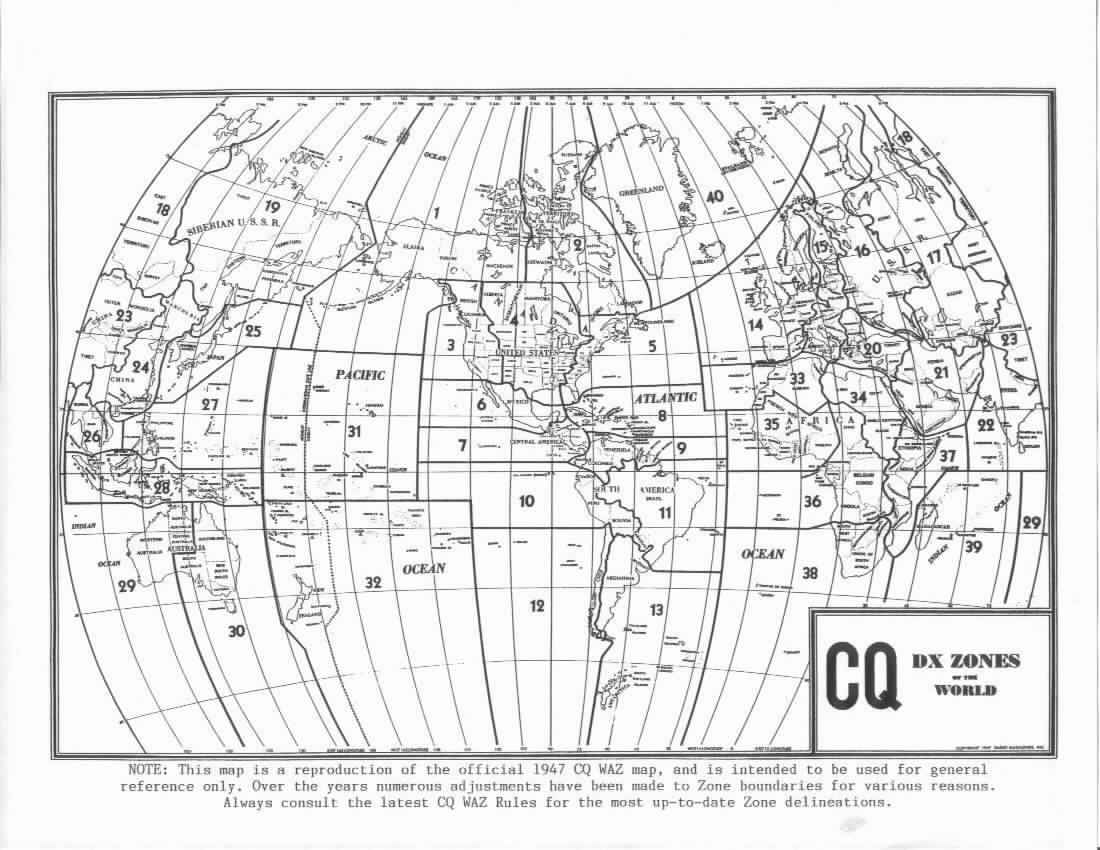
 I spent about 10 hours Saturday and Sunday making some contacts in the CQ WW SSB contest. This is one of the biggest contests, where the goal is to work stations, for the most part, outside of your own country. You get two points for working a station on your own continent (if you’re in North America, one point elsewhere) and three points for working stations on another continent. There are also multipliers for each different country and CQ Zone that you contact. As with other contests, your score is computed by multiplying the number of points by the multipliers. World-class competition stations typically have scores in the millions or even tens of millions for the high-power multi-operator stations. My score was quite a bit more modest, just a bit under 115,000 points. That beats my score from last year, though I’ve done better in the past. (Though I’ve also spent more time in the past.)
This isn’t one of my favorite contests specifically because it is so popular. Because it is so popular, there are almost always a lot of stations calling, which makes it harder for a small station like mine to be heard. As a result, stations that I’m hearing very well just can’t hear me, and it often took several minutes to work stations that under non-contest conditions could be very easy. In a lot of cases, I’d just give up and move on, sometimes coming back to try to work the stations again later.
Partway into the contest, I came up with a technique that made things a little less frustrating: I intentionally made my station “hard of hearing”. Normally, although I’ve got a very modest antenna (my G5RV), my radio is quite good at pulling in relatively weak stations. However, in this case, there was little point in trying to work very weak stations because they weren’t going to hear me. What I did was to turn off any pre-amplification (kind of like a “hearing aid”) for all bands, and on some bands (particularly 40m and 80m), I put in 8db or more of attenuation. (Kind of like putting in earplugs.) There were still plenty of stations to hear, and with my self-imposed handicap, I found that I was a lot more likely to work these stations.
This technique isn’t something that I’d normally recommend, but for this particular contest, it kept me from wasting time on stations that I really had no chance of working.
Here’s my score breakdown for the contest. One interesting thing is that this is one of a very few contests where I’ve actually worked stations on all six possible HF bands.
Band QSOs Pts Cty ZN
1.8 2 2 2 2
3.5 22 50 17 11
7 62 172 39 12
14 87 223 45 18
21 45 113 25 16
28 8 22 7 3
Total 226 582 135 62
My total score was 114, 654 points, which, as always, is subject to adjustment for any errors that I (probably) made.

A little contesting this weekend
I spent about 10 hours Saturday and Sunday making some contacts in the CQ WW SSB contest. This is one of the biggest contests, where the goal is to work stations, for the most part, outside of your own country. You get two points for working a station on your own continent (if you’re in North America, one point elsewhere) and three points for working stations on another continent. There are also multipliers for each different country and CQ Zone that you contact. As with other contests, your score is computed by multiplying the number of points by the multipliers. World-class competition stations typically have scores in the millions or even tens of millions for the high-power multi-operator stations. My score was quite a bit more modest, just a bit under 115,000 points. That beats my score from last year, though I’ve done better in the past. (Though I’ve also spent more time in the past.)
This isn’t one of my favorite contests specifically because it is so popular. Because it is so popular, there are almost always a lot of stations calling, which makes it harder for a small station like mine to be heard. As a result, stations that I’m hearing very well just can’t hear me, and it often took several minutes to work stations that under non-contest conditions could be very easy. In a lot of cases, I’d just give up and move on, sometimes coming back to try to work the stations again later.
Partway into the contest, I came up with a technique that made things a little less frustrating: I intentionally made my station “hard of hearing”. Normally, although I’ve got a very modest antenna (my G5RV), my radio is quite good at pulling in relatively weak stations. However, in this case, there was little point in trying to work very weak stations because they weren’t going to hear me. What I did was to turn off any pre-amplification (kind of like a “hearing aid”) for all bands, and on some bands (particularly 40m and 80m), I put in 8db or more of attenuation. (Kind of like putting in earplugs.) There were still plenty of stations to hear, and with my self-imposed handicap, I found that I was a lot more likely to work these stations.
This technique isn’t something that I’d normally recommend, but for this particular contest, it kept me from wasting time on stations that I really had no chance of working.
Here’s my score breakdown for the contest. One interesting thing is that this is one of a very few contests where I’ve actually worked stations on all six possible HF bands.
Band QSOs Pts Cty ZN
1.8 2 2 2 2
3.5 22 50 17 11
7 62 172 39 12
14 87 223 45 18
21 45 113 25 16
28 8 22 7 3
Total 226 582 135 62
My total score was 114, 654 points, which, as always, is subject to adjustment for any errors that I (probably) made.
C’mon people, listen!
A lot has been written recently (including by me) about the general conduct of hams on the airwaves. Over the last few days, I’ve seen something that has just been so absurd that I had to vent here.
I’ve discussed operating in pileups before, and how it’s important to listen to the operator’s instructions to understand where they are listening. It’s frustrating when an operator doesn’t listen and calls right on top of the DX station instead of on his split frequency. While there’s really no excuse, the occasional call or two can be understood by operators who just send 5NN TU (on CW) or just “Thanks” on phone without giving the split often. The same can be said for those operators who don’t ID often.
What I cannot understand, and to me what’s totally inexcusable was the behavior that I’ve seen on RTTY in the pileups for the folks operating from the new PJ entities recently. The vast majority of operators at the DX end seem to be really top-notch operators and are doing their best to control the pileup. They leave nothing to chance when, at the end of a contact, they send something like “K2DBK TU DE PJ7E UP 2-4”. You know who the station is, and you know that they are listening for your transmission 2-4 up. In spite of this, operators repeatedly (and I don’t mean once or twice, but dozens of times) continue to call on the operators transmit frequency, not where he’s listening.
I believe in Heinlein’s Razor: Never attribute to malice that which is adequately explained by stupidity. I don’t believe that most of these operators are calling just to QRM (create noise) on the DX station. For one thing, they are all using their callsigns, so we know who they are. (There is a chance that they are using someone else’s callsign to intentionally make them look bad, but I don’t think that’s the case.) I think that either they don’t have a good enough copy on on the DX station to be able to understand that he’s listening on a different frequency, or they don’t understand what “UP” means. In the former case, they shouldn’t be calling at all. If you don’t have a good enough copy on a station to receive what they are sending, how on earth are you going to know if you’ve worked them? If it’s the latter, and you don’t know that “UP” means that the operator is working stations using split operation, then ask someone what it means, don’t just ignore it.
Incidentally, I want to mention that I’ve looked up a number of callsigns that are guilty of this behavior. There is a mix of stations, but a significant number of stations seem to be US Amateur Extra class, and, as best I can tell, they have been Extras for quite some time. This isn’t a case of “no-coders” not knowing how to operate. It may well be that RTTY, which has increased in popularity recently, is new to these operators, but like any mode you need to learn how to use it.
When in doubt, refer to the DX Code of Conduct.

C’mon people, listen!
A lot has been written recently (including by me) about the general conduct of hams on the airwaves. Over the last few days, I’ve seen something that has just been so absurd that I had to vent here.
I’ve discussed operating in pileups before, and how it’s important to listen to the operator’s instructions to understand where they are listening. It’s frustrating when an operator doesn’t listen and calls right on top of the DX station instead of on his split frequency. While there’s really no excuse, the occasional call or two can be understood by operators who just send 5NN TU (on CW) or just “Thanks” on phone without giving the split often. The same can be said for those operators who don’t ID often.
What I cannot understand, and to me what’s totally inexcusable was the behavior that I’ve seen on RTTY in the pileups for the folks operating from the new PJ entities recently. The vast majority of operators at the DX end seem to be really top-notch operators and are doing their best to control the pileup. They leave nothing to chance when, at the end of a contact, they send something like “K2DBK TU DE PJ7E UP 2-4”. You know who the station is, and you know that they are listening for your transmission 2-4 up. In spite of this, operators repeatedly (and I don’t mean once or twice, but dozens of times) continue to call on the operators transmit frequency, not where he’s listening.
I believe in Heinlein’s Razor: Never attribute to malice that which is adequately explained by stupidity. I don’t believe that most of these operators are calling just to QRM (create noise) on the DX station. For one thing, they are all using their callsigns, so we know who they are. (There is a chance that they are using someone else’s callsign to intentionally make them look bad, but I don’t think that’s the case.) I think that either they don’t have a good enough copy on on the DX station to be able to understand that he’s listening on a different frequency, or they don’t understand what “UP” means. In the former case, they shouldn’t be calling at all. If you don’t have a good enough copy on a station to receive what they are sending, how on earth are you going to know if you’ve worked them? If it’s the latter, and you don’t know that “UP” means that the operator is working stations using split operation, then ask someone what it means, don’t just ignore it.
Incidentally, I want to mention that I’ve looked up a number of callsigns that are guilty of this behavior. There is a mix of stations, but a significant number of stations seem to be US Amateur Extra class, and, as best I can tell, they have been Extras for quite some time. This isn’t a case of “no-coders” not knowing how to operate. It may well be that RTTY, which has increased in popularity recently, is new to these operators, but like any mode you need to learn how to use it.
When in doubt, refer to the DX Code of Conduct.
Arctic DXpedition
Over the weekend sunspot 1112 erupted and produced a strong solar flare. Now according to Space weather sites there’s a 25-35% chance of high latitude auroras on 19-20 October.
And right now a group of four Norwegian friends are enjoying their annual DXpedition to Kongsfjord – well and truly in the high latitudes – at 70°43′N 29°21′E at the top of Norway.

Kongsfjord, Norway - a nice place to set up your 500 metre Beverage antenna
Four of the main participants are Arnstein Bue, from Trondheim, Bjarne Mjelde (host), from Berlevåg, Odd-Jørgen Sagdahl, from Trondheim and Tore Johnny Bråtveit, from Trondheim. As you’ll see if you visit their pages these men are serious medium wave and short wave DXers, with impressive equipment racks and listening achievements to match.
Arnstein Bue’s blog DX Paradise gives a sense of some of the QSL trophies. DXpedition host, Bjarne Mjelde’s blog Arctic DX has an entry logging their first day last Friday anticipating the weather awaiting them:
“+2 Celsius, 15-20 m/s (35-45 mph) northerly winds, rain and sleet showers…”
As I write this it’s early afternoon there and according to their website it’s warmed up to +4 Celsius!
They also appear to operate remotely from this spot. Their antennas include a new 500 metre long Beverage aimed at the North Island of New Zealand which is clearly working very well. Two shorter Beverages (225m & 330m) and a Quad Delta Flag Array complete this dream DXing antenna farm.
And if you visit the site you’ll see ample evidence that they clearly know how to enjoy themselves at the dining table as well. Local King crabs are accompanied by the finest New Zealand wines. Their dining notes are as tempting as their DX!
Main course was pork sirloin marinated in garlic and chili, served with tagliatelle, basil, leeks and cherry tomatoes. With the pork we tried Kim Crawford’s Pinot Noir. Maybe a bit light for the quite tasty meat, but absolutely a super wine!
For dessert we had local blueberries with grappa – another Kongsfjord signature dish! And now we are off to listen to more recordings and prepare for another – hopefully eventful night. The solar indexes are going down and the K-index for Tromsø is now 0, and we hope that it will remain like this!
The main website is also the repository of a number of documents on DXing issues by Dallas Lankford. There are also data sheets for a large number of receivers (including AOR, Racal, Rohde & Schwarz, R L Drake Company, Siemens, Harris, TenTec, Icom etc) and information about antennas. Bjarne Mjelde has distilled his experience into a definitive article about the best antenna wire. The conclusion? A thumbs up for galvanised steel and aluminium. A number of his reviews are also aggregated on the site, including reviews of the IC-703 and the Perseus SDR.
Their sites demonstrate how much a part SDR plays in modern DXing and monitoring. There are some huge SDR recordings and mp3 files available as well. Retrospective analysis of these files enables them to find rare stations as well as – presumably – traditional live listening.
It’s been a delight checking in on their site each day to catch up with the activities of such a convivial group of friends. Truly inspiring to this reader on the other side of the globe.
P5? Nope, PJ
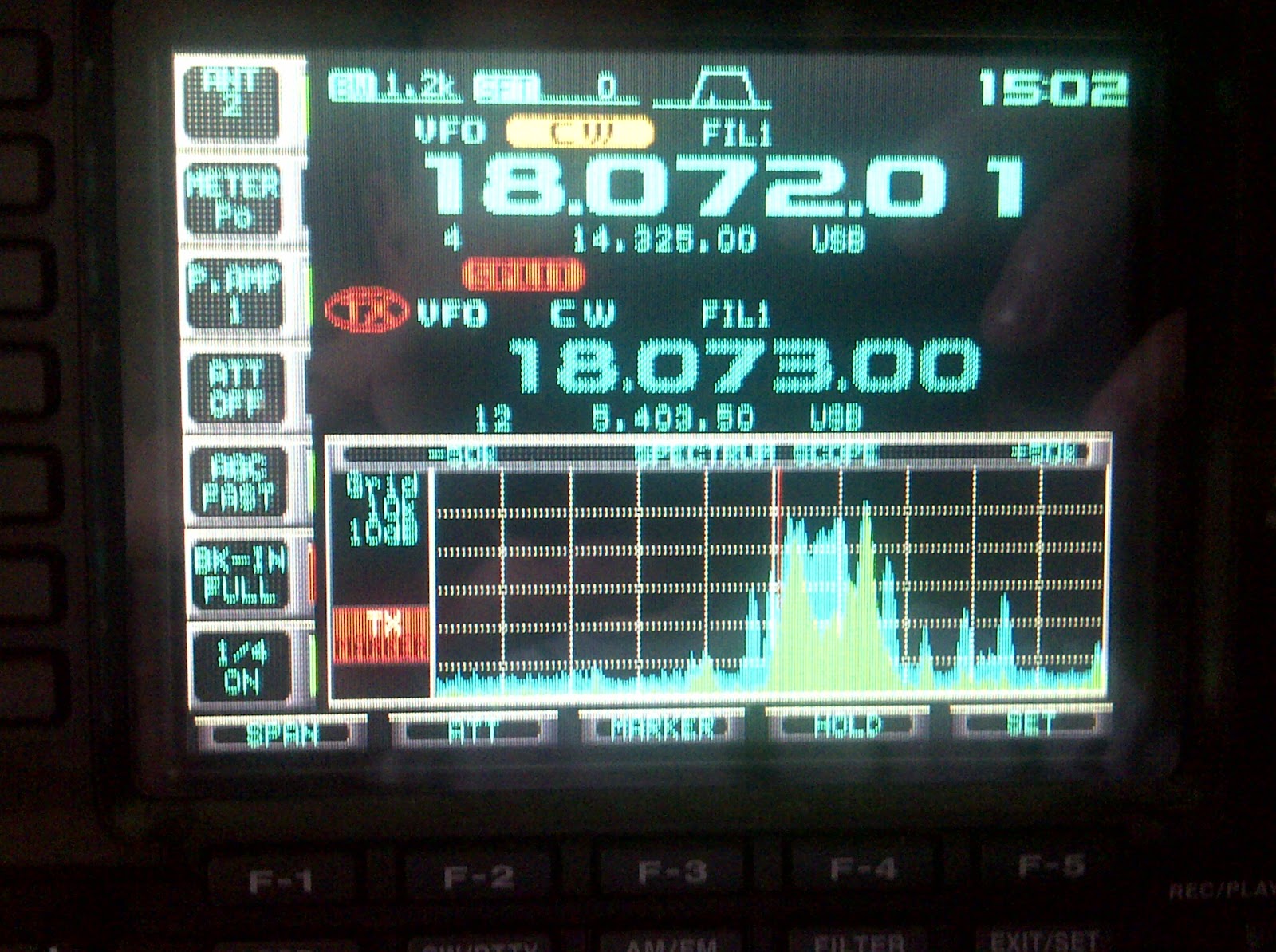 Now that the PJ operations have been underway for a while, you’d think that the pileups would have started to die down a bit. In some cases they have, but I was kind of surprised to see how big some of them remained. I guess it varies depending on band, propagation, and where you’re located, but this morning I saw PJ2T spotted on 17m CW and I figured I’d give him a call. He nice and loud, but he had a huge pileup. This is what my bandscope looked like.
By way of explanation, what you’re seeing is that I was tuned to 18.07201 MHz, which was where PJ2T was transmitting. I was set to call him split on 18.073Mhz. The big pile of green and light blue on the scale represents the other stations that are calling him. The scope was configured so that each white vertical line represents 10KHz of space. What you can see is that the callers for PJ2T were spread out over around 20Khz of space. Those of you who are DXers will appreciate how big that is, but normally for a “routine” DX operation you might see callers spread out to 2, 3, or maybe 5KHz. It’s only when a really “rare one” comes on that you typically see something like this. (Hence my reference to P5, North Korea, in the subject.) Oh, and keep in mind that these are only the callers that my radio can hear. Imagine what it must sound like on his end? I do want to say that the operator is doing a terrific job.
As a reminder, I’ve been collecting web sites and other internet presence information for the PJ DX operations on a special page here.

P5? Nope, PJ
Now that the PJ operations have been underway for a while, you’d think that the pileups would have started to die down a bit. In some cases they have, but I was kind of surprised to see how big some of them remained. I guess it varies depending on band, propagation, and where you’re located, but this morning I saw PJ2T spotted on 17m CW and I figured I’d give him a call. He nice and loud, but he had a huge pileup. This is what my bandscope looked like.
By way of explanation, what you’re seeing is that I was tuned to 18.07201 MHz, which was where PJ2T was transmitting. I was set to call him split on 18.073Mhz. The big pile of green and light blue on the scale represents the other stations that are calling him. The scope was configured so that each white vertical line represents 10KHz of space. What you can see is that the callers for PJ2T were spread out over around 20Khz of space. Those of you who are DXers will appreciate how big that is, but normally for a “routine” DX operation you might see callers spread out to 2, 3, or maybe 5KHz. It’s only when a really “rare one” comes on that you typically see something like this. (Hence my reference to P5, North Korea, in the subject.) Oh, and keep in mind that these are only the callers that my radio can hear. Imagine what it must sound like on his end? I do want to say that the operator is doing a terrific job.
As a reminder, I’ve been collecting web sites and other internet presence information for the PJ DX operations on a special page here.