Archive for the ‘dx’ Category
 Weird things heard on the radio
 March 13th, 2011 |
  Author:
 As I was sitting next to my radio this afternoon, I had tuned to a frequency on 12 meters sideband where I’d seen a spot for a station in Madagascar (5R). I need 5R on 12m so I was listening to see if the station would build (grow in strength) to the point where I could attempt a contact. While waiting for that to happen, I heard another US station call him, giving his callsign properly. Although I couldn’t hear the 5R station, what I did hear was this (callsign changed mostly because I don’t remember exactly what it was, and to protect the not-so-innocent): “5R8UI, did you come back to my-callsign question mark?“. The US station literally said the words “question mark“!
Ok, while I can understand that had this happened on CW, the operation would have sent the code for “question mark”, but given that this was a voice contact, wouldn’t you think that the tone of voice and the fact that the sentence was actually a question would have been sufficient?
There’s been a lot written about the overuse of the CW Q-signals when using a voice mode, and while you can debate some of those (saying “My QTH is River Vale” rather than saying “I live in River Vale”), it just struck me as pretty funny to hear someone actually say the words “question mark“.
By way of explanation, the reason the Q-codes were invented was to provide a shorthand way to send information over telegraph lines and later wireless. It does make sense in particular on CW, where the operators at both ends of the conversation might not both be fluent in a common language. So on CW, it does make sense to say “QTH River Vale New Jersey” rather than spelling it out. It becomes, along with some other abbreviations, it’s own common language.

Weird things heard on the radio
As I was sitting next to my radio this afternoon, I had tuned to a frequency on 12 meters sideband where I’d seen a spot for a station in Madagascar (5R). I need 5R on 12m so I was listening to see if the station would build (grow in strength) to the point where I could attempt a contact. While waiting for that to happen, I heard another US station call him, giving his callsign properly. Although I couldn’t hear the 5R station, what I did hear was this (callsign changed mostly because I don’t remember exactly what it was, and to protect the not-so-innocent): “5R8UI, did you come back to my-callsign question mark?“. The US station literally said the words “question mark“!
Ok, while I can understand that had this happened on CW, the operation would have sent the code for “question mark”, but given that this was a voice contact, wouldn’t you think that the tone of voice and the fact that the sentence was actually a question would have been sufficient?
There’s been a lot written about the overuse of the CW Q-signals when using a voice mode, and while you can debate some of those (saying “My QTH is River Vale” rather than saying “I live in River Vale”), it just struck me as pretty funny to hear someone actually say the words “question mark“.
By way of explanation, the reason the Q-codes were invented was to provide a shorthand way to send information over telegraph lines and later wireless. It does make sense in particular on CW, where the operators at both ends of the conversation might not both be fluent in a common language. So on CW, it does make sense to say “QTH River Vale New Jersey” rather than spelling it out. It becomes, along with some other abbreviations, it’s own common language.
Unwanted
Charles M0OXO laments the fact that England is 334th in the list of the most wanted 338 DXCC entities, in other words the fifth least wanted. Isn’t it a sad waste of a hobby not to mention the vast sums of money people spend on equipment and antennas if the main interest in making a contact is just to be able to tick off a new country? I guess that’s why I find DXing and DX blogs boring. I’d rather read about what people are building, new things that they are experimenting with or how far (even if it isn’t all that far) someone manages to work with a peanut whistle.

Warbler exceeds 1000 miles per Watt
This evening conditions were good and I managed to have a nice QSO with Jaume, EA3NE in Terrassa, near Barcelona, Spain on 80m PSK31 using the Warbler. That is nice DX for a such a simple rig as the Warbler, although Jaume’s station clearly helped.

From Greely, ON, Canada to Terrassa, Spain
Copy was good as can be seen in the screenshot below.

Screenshot of QSO with EA3NE
The distance comes in at around 6027 km or 3745 miles. Given the Warbler puts out 3W then this QSO exceeds 1000 miles per Watt. Very pleasing!
Distance calculators can be found using Google Maps, Open Street Maps as well as a useful ‘miles per Watt’ calculator at the QRP ARCI website.


In contrast
In contrast to my giving up the frequency for a DX station while in the middle of a “run” during a contest (as I recently mentioned), I heard a particularly bad bit of operating on last Sunday while trying to work Bob, VP8LP in the Falkland Islands. I’ve worked Bob before on several bands but needed a contact from him on 15m. He had an excellent signal and was steadily working stations, the vast majority of which were good operators, standing by when Bob was working another station and not responding when Bob wasn’t calling them. (Please see my post about The DX Code of Conduct if you haven’t already.) There was, unfortunately, one exception to the “good guys” on the frequency.
As Bob was steadily working the pile, a ham started calling K7NRA on the frequency. After he did this once or twice, assuming that perhaps he was unaware that there was another station on the frequency, I responded to him and said that the frequency was in use and gave my callsign. (The other ham was using his callsign, or what I presume was his, though I neglected to note it. While normally I don’t like to “pick on” people in a public forum, what was going on was heard by dozens of other hams, and if I could remember what it was, I’d post it here.) The other ham said “Well, there’s supposed to be a special event for K7NRA on this frequency and I’m going to call him, this is his announced frequency”.
It was pretty clear that the guy calling wasn’t hearing K7NRA, and aside from that fact that he refused to stop interfering with an active frequency, his general technique was awful. He was calling “blind” (meaning he didn’t hear the other station), and kept calling “CQ CQ CQ CQ CQ CQ K7NRA”, which doesn’t actually make a lot of sense. CQ generally means “calling all stations”, thus saying “CQ K7NRA” means “calling all stations with a callsign of K7NRA”; by definition there will only be one. There are exceptions to using a “directed CQ”, such as when calling “CQ DX” (looking for any DX station) or “CQ NJ” (looking for a station in New Jersey), but proper procedure when calling a particular station is to simply call the station. If I were to call that station, I’d say “K7NRA this is K2DBK” or, if K7NRA was listening for other stations, I would likely just give my callsign only.
Several other stations responded to the caller (some more politely, and some, unfortunately much less so), and he refused to move, insisting that he had “as much right to the frequency as anyone”. Unless he had an emergency (which clearly was not the case), what he said was not true. The FCC rules governing the amateur radio service state that nobody can “own” a particular frequency (including by “publishing” use of a particular frequency at a particular time), and further, if any frequency is in use, with the exception of use in an emergency, nobody is required to relinquish the frequency for another station. Thus, the caller was not only wrong, but he was violating the rule that says “No amateur operator shall willfully or maliciously interfere with or cause interference to any radio communication or signal.”
The guy would not give up, and continued to attempt to call K7NRA repeatedly. The worst of it was when one station was speaking with Bob, and was showing ham radio to a young Boy Scout for the first time. All the others stations on the frequency patiently stood by while Bob spoke with the youngster, all except the guy calling K7NRA, who simply wouldn’t stop. Several hams were telling him (in language that probably violated another part of the FCC rules) exactly what they thought of him, to no avail. While this was happening, it occurred to me what a terrible impression this was making on the young Scout. Is this how we want to entice others into our hobby?
After the contact with the scout was over, Bob, who could hear the guy calling the K7 station, finally said “The station calling CQ, this is VP8LP, please go ahead”. That did the trick, the station stopped calling. Bob called several more times with no response, and finally said “well, I guess I’ve figured out how to shut him up!” and went back to working the pileup.
I would like to say that Bob’s comment had a permanent effect, but unfortunately that was not the case. The caller kept coming back, Bob would respond to the “gentleman calling CQ”, which would usually shut him up for a while, and so on. This went on for a while, with the occasional argument back and forth between the guy calling K7 and others on the frequency, until finally propagation changed enough that he was no longer heard on the frequency.
After this was over, I did a little research to see what “special event” he was talking about, since an initial check of the spot clusters didn’t show any activity for K7NRA. After a little digging I discovered that in fact the Yavapai Amateur Radio Club was, in fact, doing a special event to celebrate the “birthday” of the NRA, as described on their website. The frequency occupied by VP8LP was also one of the frequencies advertised (21.355mHz), but what our caller failed to notice was that the event was scheduled for the 17th of November, not the 14th of November, when this all occurred. This caller was not only wrong from a legal and ethical standpoint, he managed to get a lot of people annoyed at him by trying to work an activity that wasn’t even happening. As they say, you can’t outlaw stupidity.

In contrast
In contrast to my giving up the frequency for a DX station while in the middle of a “run” during a contest (as I recently mentioned), I heard a particularly bad bit of operating on last Sunday while trying to work Bob, VP8LP in the Falkland Islands. I’ve worked Bob before on several bands but needed a contact from him on 15m. He had an excellent signal and was steadily working stations, the vast majority of which were good operators, standing by when Bob was working another station and not responding when Bob wasn’t calling them. (Please see my post about The DX Code of Conduct if you haven’t already.) There was, unfortunately, one exception to the “good guys” on the frequency.
As Bob was steadily working the pile, a ham started calling K7NRA on the frequency. After he did this once or twice, assuming that perhaps he was unaware that there was another station on the frequency, I responded to him and said that the frequency was in use and gave my callsign. (The other ham was using his callsign, or what I presume was his, though I neglected to note it. While normally I don’t like to “pick on” people in a public forum, what was going on was heard by dozens of other hams, and if I could remember what it was, I’d post it here.) The other ham said “Well, there’s supposed to be a special event for K7NRA on this frequency and I’m going to call him, this is his announced frequency”.
It was pretty clear that the guy calling wasn’t hearing K7NRA, and aside from that fact that he refused to stop interfering with an active frequency, his general technique was awful. He was calling “blind” (meaning he didn’t hear the other station), and kept calling “CQ CQ CQ CQ CQ CQ K7NRA”, which doesn’t actually make a lot of sense. CQ generally means “calling all stations”, thus saying “CQ K7NRA” means “calling all stations with a callsign of K7NRA”; by definition there will only be one. There are exceptions to using a “directed CQ”, such as when calling “CQ DX” (looking for any DX station) or “CQ NJ” (looking for a station in New Jersey), but proper procedure when calling a particular station is to simply call the station. If I were to call that station, I’d say “K7NRA this is K2DBK” or, if K7NRA was listening for other stations, I would likely just give my callsign only.
Several other stations responded to the caller (some more politely, and some, unfortunately much less so), and he refused to move, insisting that he had “as much right to the frequency as anyone”. Unless he had an emergency (which clearly was not the case), what he said was not true. The FCC rules governing the amateur radio service state that nobody can “own” a particular frequency (including by “publishing” use of a particular frequency at a particular time), and further, if any frequency is in use, with the exception of use in an emergency, nobody is required to relinquish the frequency for another station. Thus, the caller was not only wrong, but he was violating the rule that says “No amateur operator shall willfully or maliciously interfere with or cause interference to any radio communication or signal.”
The guy would not give up, and continued to attempt to call K7NRA repeatedly. The worst of it was when one station was speaking with Bob, and was showing ham radio to a young Boy Scout for the first time. All the others stations on the frequency patiently stood by while Bob spoke with the youngster, all except the guy calling K7NRA, who simply wouldn’t stop. Several hams were telling him (in language that probably violated another part of the FCC rules) exactly what they thought of him, to no avail. While this was happening, it occurred to me what a terrible impression this was making on the young Scout. Is this how we want to entice others into our hobby?
After the contact with the scout was over, Bob, who could hear the guy calling the K7 station, finally said “The station calling CQ, this is VP8LP, please go ahead”. That did the trick, the station stopped calling. Bob called several more times with no response, and finally said “well, I guess I’ve figured out how to shut him up!” and went back to working the pileup.
I would like to say that Bob’s comment had a permanent effect, but unfortunately that was not the case. The caller kept coming back, Bob would respond to the “gentleman calling CQ”, which would usually shut him up for a while, and so on. This went on for a while, with the occasional argument back and forth between the guy calling K7 and others on the frequency, until finally propagation changed enough that he was no longer heard on the frequency.
After this was over, I did a little research to see what “special event” he was talking about, since an initial check of the spot clusters didn’t show any activity for K7NRA. After a little digging I discovered that in fact the Yavapai Amateur Radio Club was, in fact, doing a special event to celebrate the “birthday” of the NRA, as described on their website. The frequency occupied by VP8LP was also one of the frequencies advertised (21.355mHz), but what our caller failed to notice was that the event was scheduled for the 17th of November, not the 14th of November, when this all occurred. This caller was not only wrong from a legal and ethical standpoint, he managed to get a lot of people annoyed at him by trying to work an activity that wasn’t even happening. As they say, you can’t outlaw stupidity.
Two new continents on 40m
I popped up to the shack after watching some evening TV and decided to have a listen to what was happening on JT65A on 40m. I tuned my K3 to 7.076MHz and had only been listening for a couple of minutes when I saw a CQ call from VK6BN appear on the screen. I only just managed to set up a reply before the start of the transmit period and you could have knocked me down with a feather when he came back with a report! We completed the QSO in the minimum 6 minutes.
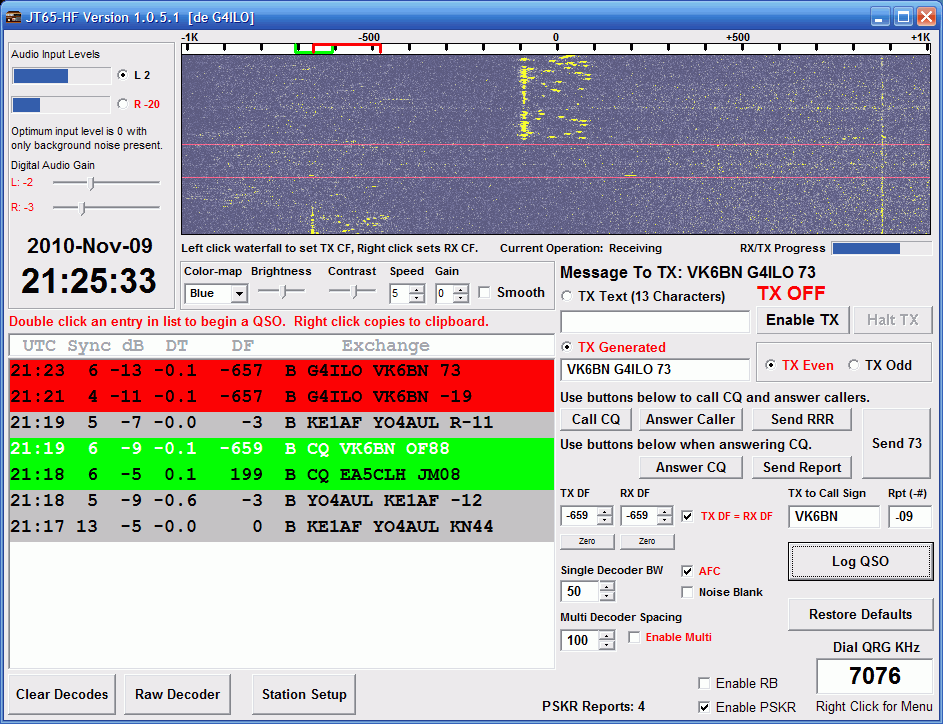
I’ve been reported in VK before using WSPR, that’s nothing unusual, but this is my first ever two-way contact with Australia on any band or mode and I’m pretty amazed to have achieved it on 40m of all bands using just 30 watts to my attic dipole. JT65A really is amazing!
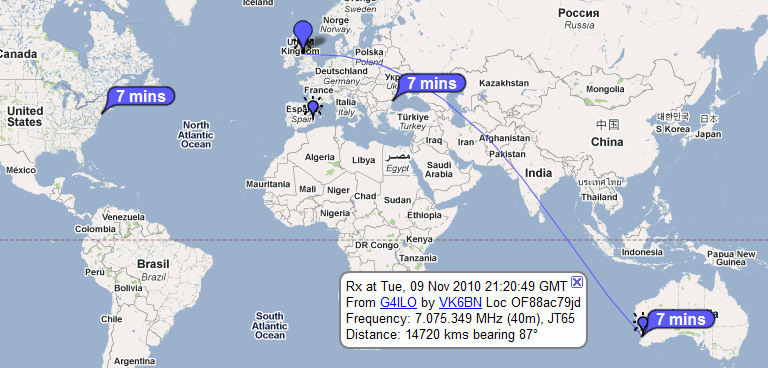
As if that wasn’t enough, I then worked KE1AF for my first contact with North America on 40m. So I shall be going to bed this evening feeling pretty pleased!














