Archive for the ‘dx’ Category
 Strange
 August 24th, 2012 |
  Author:
 Lots of yard work today. As a reward, I put some time in behind the key tonight. All the bands seemed to have a lot of background noise tonight for some reason. Last night, while listening on 20 Meters during the QRP Fox hunt, the background noise was almost non-existent.
Anyway, I worked OK1DX on 30 Meters at 10.120 MHz. He was calling “CQ DX” and wasn’t getting any takers. So I threw my call out there and got an immediate response. Pavel was 579 here and I got a 559 in return. No surprise there. The QSO was a bit more than your normal run of the mill DX QSO; and by the end, Pavel had told me that I had also come up to 579.
Here’s the kicker. I was running 5 Watts to my 88′ EDZ antenna. He was pushing 400 Watts into a dipole. My first inclination at learning he was pushing 400 Watts, was to wonder why he was only 579 here. I would have thought at that power he would have been 599+.
Of course, there are reasons for that, I know. But sometimes, even as a QRPer, I fall into that “more power equals louder” trap myself.
72 de Larry W2LJ
QRP – When you care to send the very least!

Happy Dance Time!
Turned on the radio to around 14.060 MHz, hoping to hear some QRPers, only to hear “CQ NA”. I didn’t remember that the North American QSO Party was this weekend. Regular readers of this blog know that except for short QRP Sprints, W2LJ is not big into contests. I have nothing against them; just can’t force my butt into a chair for a long enough period of time to make it interesting for myself.
So instead of kvetching, I pushed the band button on the K3 and took ‘er up the road to 17 Meters. I love 17 Meters! When the band is open there is usually all kinds of good DX. Tonight was no different – and since 17 Meters is a WARC band – no contesting!
So, as is my usual routine, I started at the bottom of the band at 18.068 MHz and slowly twiddled the VFO dial upward. I came to a stop at around 18.074 MHz. D3AA calling “CQ UP” – not too many takers, a small pile up building, but still not bad yet.
Where the heck is D3AA? I quickly plop D3AA in to AC Log. Angola. Hot dog – Angola is a new one! Never worked Angola – QRP or QRO (100 Watts) before.

I throw my call out a couple of times; but no dice. D3AA is up and down. One time he calls, he’s 599 – next time, 569. So I’m thinking to myself that he’s going to fade and that I missed the best propagation (as usual). But no! As time goes along, he’s actually getting louder; but the pile up is also growing, commensurately. The K3 makes it pretty easy to figure out where he’s listening as he stated he was listening up. So I go to where I heard the last few stations he worked and figured out that for the time being, he was staying put and not drifting up after each contact.
Patience and persistence are a big part of QRP and this time was no different. I stayed at it for about 15 minutes and finally, I interjected “W2LJ” at just the right moment and was rewarded with “W2LJ 599 TU”, to which I responded in return, of course.
Coolest of the cool beans! A new African country – a new country via QRP (or ANY power level for that matter). I opened up Chrome on my netbook and figured I would post this to QRPSPOTS. Most of the time I figure that if I was able to work a station with my simple antennas, then a lot of other QRPers should be able to, also. I posted anyway, but saw that I was beat to the punch by my good bud, John AE5X – Amateur Radio op, DXer and QRPer and photographer extraordinaire
Anyway, that’s the reason for “The Happy Dance” tonight.
72 de Larry W2LJ
QRP – When you care to send the very least!

The "other" side of the pile up!
Daunting, isn’t it? Just goes to show that there were some superb ops up there on CY9M!
72 de Larry W2LJ
QRP – When you care to send the very least!

Knock me over with a feather!
I had two nice DX QSOs tonight on 20 Meters and you could have knocked me over with a feather. Both ops actually carried on somewhat “normal” QSOs with me! Ivan EA2NN and Jean F6HFX (who was also QRP, BTW).
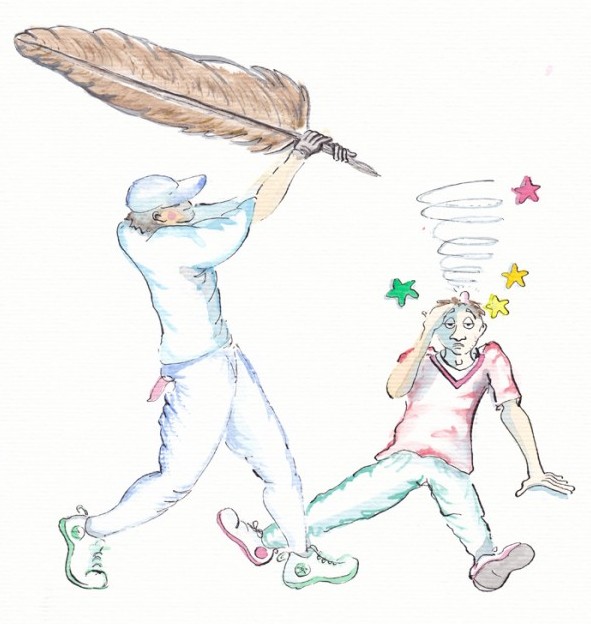
Now mind you, due mainly to QSB, these weren’t long rag chews by any means; but we did exchange (besides RST), rig, antenna, weather information – that kind of thing. Wow! DX QSOs that were heckuva lot longer than “TU 599 QRZ?” !!!
Man, that takes me back to my Novice days when QSOs with DX stations were like any other. In fact, I still have QSLs where in addition to the card, I got letters and photos!
I really, really miss that; and it was nice to get just a teeny taste of that again, tonight.
72 de Larry W2LJ
QRP

CY9M in the log!

On 30 Meters tonight at 00:52 UTC. Figured out that he was creeping up a few kHz after each station worked. Got in his path, and got in the log!
A good end to a pretty good day!
72 de Larry W2LJ
QRP – When you care to send the very least!

Getting ready
The battery is charging and my Lowepro 150 with the KX3 station is ready and raring to go for FOBB tomorrow.
I sincerely hope the weather is better tomorrow, compared to today. We’ve had heavy, gray, overcast skies all day. It was threatening to rain all day and in fact, did. from about 2:00 PM to 3:30 PM or so. No heavy downpours; but if I were outside operating, it would have been enough to force me indoors.
This afternoon, I was able to break the pileup and work 2012L, the Olympics Special Event station on 17 Meters. I heard them again tonight on 30 Meters; but their signal was not as strong as on 17 Meters this afternoon.
So I decided to frustrate myself for a while and try to bust the pileup working CY9M on 30 Meters. The pileup covered a 10 kHz patch of spectrum and after a while, I realized I wasn’t going to cut it this night with 5 Watts. I have worked St. Paul Island years ago; but never QRP. They’re there till Wednesday, so I have a few more times to give it a shot. I have them for DXCC credit already, so if I don’t get them in the log, I won’t lose any sleep.
72 de Larry W2LJ
QRP – When you care to send the very least!

A virtual pipeline
I tell ya!
I had a virtual pipeline into Northern Europe tonight on 20 Meters. I worked Latvia, Denmark and a whole bunch of Ham friends from European Russia. I was consistently getting 579 reports, and I will take those at face value. Whenever I don’t get that automatic “599”, I figure any other report is probably pretty honest.
Hey, 5 Watts to the Butternut and I’m getting 579 from over across all that water that’s separating us? I’ll take THAT any day of the week! If I wasn’t so tired from work, I’d do the Happy Dance.
I’ve got a bunch of yard work planned for tomorrow, so that I can have Sunday free for Flight of the Bumblebees. Fresh air, trees, sunshine, wire and a radio. You can’t beat that with a stick!
Since portable ops seems to be the thing that a lot of folks associate with QRP, I’m attempting to boil the essence of that down into a design for a T-shirt. This is what I’ve come up with so far:
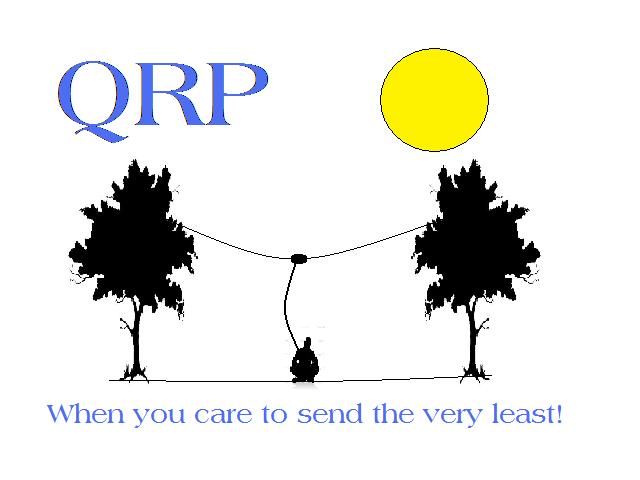
I’ve put this design on some stuff at Cafe Press. I think I’ll order myself up a few shirts so that I can wear them while I’m Skeeter hunting (too late for FOBB). I’ll have to see if I can’t find a real graphic artist who can improve on the execution of my idea – but for now – not too shabby (at least I think so!)
72 de Larry W2LJ
QRP – When you care to send the very least!














