Archive for the ‘dx’ Category
 Hunting For NDBs In CLE 213
 November 24th, 2016 |
  Author:
 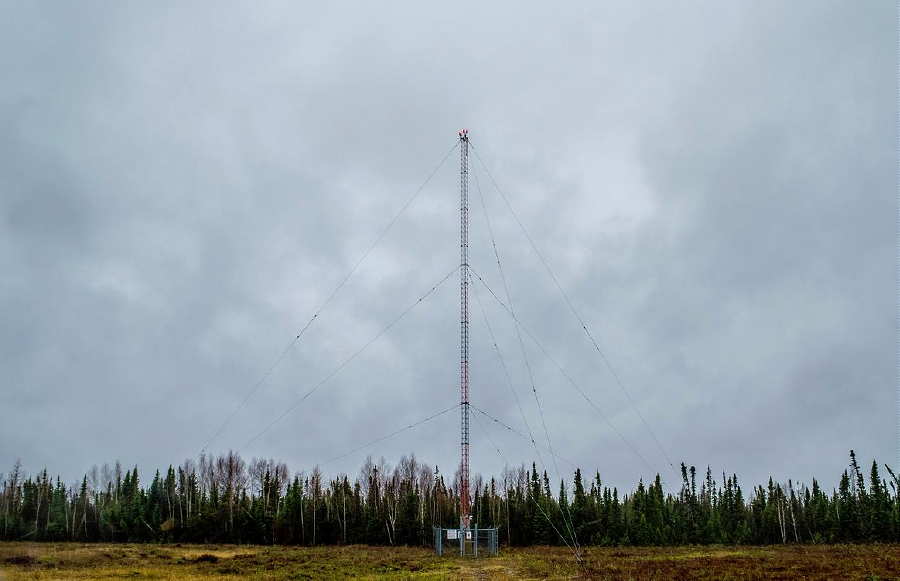 |
| 'YLH' - 247 courtesy: http://www.ve3gop.com/ |
This coming weekend will see another CLE challenge, this time in two ranges: 240.0 - 259.9 kHz plus 420.0 - 439.9 kHz.
A 'CLE' is a 'Co-ordinated Listening Event', as NDB DXers around the world focus their listening time on one small slice of the NDB spectrum.
A nice challenge in this one is to hear the Lansdowne House, Ontario, NDB, 'YLH' on 247 kHz. This one runs 250 watts and gets out well, having been logged from coast to coast. Listen for it on 247.417 kHz with your receiver in the CW mode.
From CLE organizer Brian Keyte, G3SIA, comes the usual 'heads-up':
Hi all,
Here are the final details for our 213th co-ordinated listening event this
weekend. First timer logs too? Yes, please!
Days: Friday 25 Nov. to Monday 28 Nov.
Times: Start and end at midday, your LOCAL TIME
Range: 240.0 - 259.9 kHz plus 420.0 - 439.9 kHz
(BOTH ranges are for ALL listeners)
Please log NDBs that you can positively identify in the ranges, plus any
UNIDs that you come across there.
The lower frequency range will be really hard for most Europe listeners,
the higher range not at all easy for most others.
Send your CLE log to the List, if possible as a plain text email and
not in an attachment, with CLE213 at the start of its title.
Show on EVERY LINE of your log:
# The Date (or day 'dd') and UTC (the day changes at 00:00 UTC).
# kHz - the beacon's nominal published frequency (if you know it).
# The Call Ident.
Please show those main items first on each line, BEFORE any optional
details (Location, Offsets, Cycle time, Distance, etc.)
If you send interim logs, do make sure that you also send a 'Final' log
containing all your loggings. As always, please make your log useful and
interesting to everyone by including your own location and brief details
of your receiver, aerial(s) and any recording equipment that you used.
I will send the usual 'Any More Logs?' email at about 18:00 UTC on
Tuesday so that you can check that your Final log has been found OK.
Do make sure that your log has arrived on the List at the very latest
by 09:00 UTC on Wednesday 30th November.
I hope to complete the combined results later on that day.
To help you with your search you can find lists of your target NDBs at
http://www.ndblist.info/cle.htm Select the SEEKLIST link there.
(To also see a MAP of the seeklist NDBs, just change 'List' to 'Map',
select 'All Results' and uncheck 'Clustering')
Good listening
Brian
----------------------------------------------------------
From: Brian Keyte G3SIA ndbcle'at'gmail.com
Location: Surrey, SE England (CLE co-ordinator)
----------------------------------------------------------
(Reminder: You could use any one remote receiver for your loggings,
stating its location and owner - with their permission if required.
A remote listener may NOT also use another receiver, whether local or
remote, to obtain further loggings for the same CLE).
These listening events serve several purposes. They:
- determine, worldwide, which beacons are actually in service and on-the-air so the online database can be kept up-to-date
- determine, worldwide, which beacons are out-of-service or have gone silent since the last CLE covering this range
- will indicate the state of propagation conditions at the various participant locations
- will give you an indication of how well your LF/MF receiving system is working
- give participants a fun yet challenging activity to keep their listening skills honed
Final details can be found at the NDB List website, and worldwide results, for every participant, will be posted there a few days after the event. If you are a member of the ndblist Group, results will also be e-mailed and posted there.
The very active Yahoo ndblist Group is a great place to learn more about the 'Art of NDB DXing' or to meet other listeners in your region. There is a lot of good information available there and new members are always very welcome. As well, you can follow the results of other CLE participants from night to night as propagation is always an active topic of discussion.
If you are contemplating getting started on 630m, listening for NDBs is an excellent way to test out your receive capabilities as there are several NDBs located near this part of the spectrum.
You need not be an ndblist member to participate in the CLEs and all reports, no matter how small, are of much value to the organizers.
'First-time' logs are always VERY welcome!
Reports may be sent to the ndblist or e-mailed to either myself or CLE co-ordinator, Brian Keyte (G3SIA), whose address appears above.
Please ... give the CLE a try ... then let us know what NDB's can be heard from your location! Your report can then be added to the worldwide database to help keep it up-to-date.
Good hunting!
Upcoming Solar Years … Can They Be Too Quiet?

Most of us LF/MF and topband diehards have been looking forward to the next several years of low solar activity ... maybe even 'ultra-low' as some of the solar gurus are predicting.
An interesting posting on the Topband reflector a few weeks ago by noted propagation expert, Carl, K9LA, made me re-think my expectations!
I flagged the post for a later blog topic but have since seen the information pop-up on a couple of other reflectors as well as on the ARRL News page. Apparently I wasn't the only one to give the posting a double-take. If you missed it, here is Carl's post:
About a week ago Wolf DF2PY posted a message here commenting on the recent adverse levels of geomagnetic field activity and how it will now change for the good - giving us good 160m propagation.
We'll certainly see less geomagnetic field activity as we move into winter,
but there's another issue we should be aware of. The Sun's magnetic field
is weakening - probably to the lowest levels in our lifetime. With a weak
solar magnetic field, more galactic cosmic rays will be able to get into
the Earth's atmosphere. We are now seeing unprecedented high neutron counts (neutrons are one of the by-products of cosmic rays)
Since galactic cosmic rays are mostly *very energetic* protons, they can
get down to low atmospheric altitudes, causing collisional ionization in
the D region (and lower E region). A cursory estimate using cosmic ray
ionization rates confirms more ionization in the lower atmosphere. 160m is
not very tolerant of more absorption, so we may see an adverse effect of
the weakened solar magnetic field.
Many of us think that "solar min is solar min is solar min". But maybe a
solar minimum can be too deep for 160m. A good question to ask in the early 2020s will be "how was 160m?" So stay active on 160m and let's see what happens.
Carl K9LA
My initial response was to think that perhaps there wouldn't be as much to look forward to as I had been hoping for, when it came to improved LF, MF and 160m propagation. Carl's postulation was also backed-up by another mention on the Spaceweather site, although the influence of cosmic ray bombardment on radio propagation was not discussed.
As I thought more about this unfortunate possibility actually coming to pass, I thought back to my own on-air and listening experiences during previous solar-low years ... particularly the unprecedented low between our most recent cycle and its predecessor, Cycle 23.
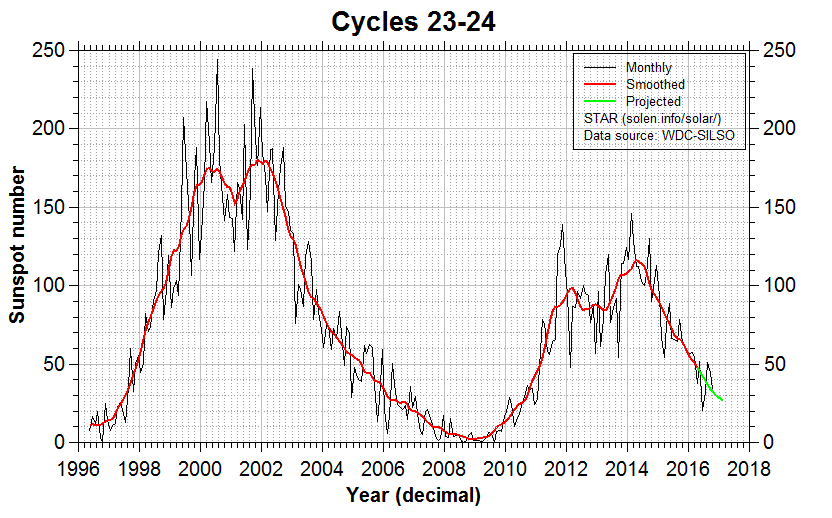
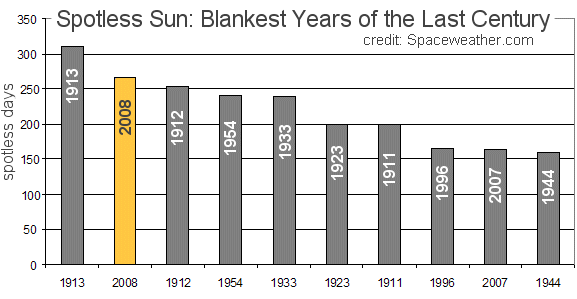
The low period between these two cycles, as most will likely recall, saw the quietest solar conditions observed in the past 100 years. The solar-low winters saw week after week of a blank Sun, with solar activity virtually flatlining for the entire period. In 2008 there were 265 'zero sunspot' days and the following year saw another 262 days of blank suns!
These effects were well noted here for two winters that are usually prime 'DX times' ... if ever there were a period when cosmic ray bombardment should negatively impact low frequency propagation, surely it would have been then.
So just what did I observe?
What I saw was not only what I had been expecting but was much much better than I had ever believed possible. For west coast topband operators, the 'holy grail' of propagation is working Europe. Working Europe from here means that signals must travel through the polar regions, usually the kiss-of- death for weak signals, as the severe attenuation through the auroral zone means that it just doesn't happen very often ... except for this prolonged period of ultra lows. In a word, conditions to Europe were 'spectacular' ... night-after-night, for several weeks over a period of two winters, working Europe on 160 became normal.
On most nights, European signals could be heard before local sunset, and on several occasions, CW contacts with Europeans, were completed up to one and a half hours before my local sunset. As darkness set in, more signals would appear and the band would rapidly become populated with Europeans ... and only Europeans.
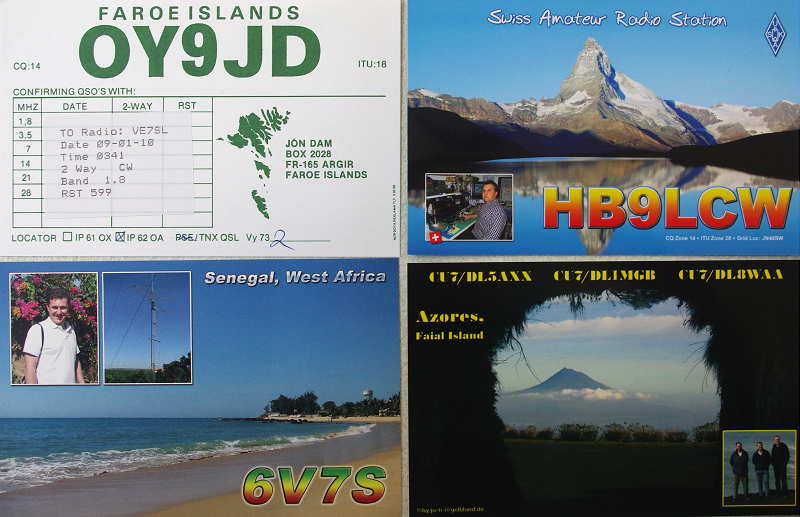
Most of the time there were no signals from North America evident, just Europeans ... a condition that had me shaking my head in disbelief night after night. It was something I had never observed before, as I watched 160m behaving more like 20m CW on a good day to Europe! During this period, my DXCC totals skyrocketed from 99 to 143 worked, as new Europeans and Africans were added to my logbook.
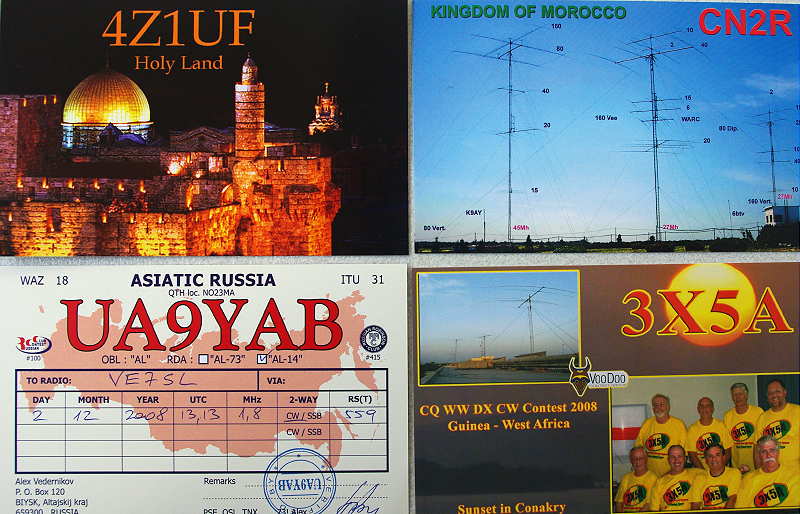
Signal levels were also outstanding, often pushing the FT-1000 S-meter well past the S9 level. On one particular night, I recall hearing an SM4 calling CQ, with just such a signal. I set my output power level at 10 watts and gave him a call, to which he quickly responded. If cosmic ray bombardment was at a high level, it was not reeking any havoc as far as the west coast path to Europe was concerned! For the record, my topband system is nothing special, consisting of a simple 'half-sloper' over a poor ground and a very old amplifier running about 500W output.
My other favorite winter pastime is chasing NDBs in the MF range between 200-500 kHz. Exceptional east west conditions were evident throughout the two winters of ultra-lows.
On one such night, I noted a new strong signal where none had been previously heard. Because of its strength, I surmised that it was probably a new NDB in nearby Washington state. Noting its ident ('NYA' on 414 kHz), I was not able to find any reference to such a beacon being previously reported and turned to the Yahoo ndblist group for help, posting my catch as 'unidentified'. Almost immediately I received a response, telling me that the signal I was hearing was located in Europe ... Svalbard to be exact, located midway between Norway and the North Pole!
Now, European NDBs have never been heard from the west coast, other than occasional signals from some of Greenland's powerhouses, so this represents a very rare event. Although I have often listened for this signal, it has yet to be heard here again and my logging of remains its only reported foray into any part of North America. Unfortunately, in 2015, it was listed as 'decomissioned'. I have no doubts that this rare propagation was a result of the solar flatlining conditions of the time.
As chilling as Carl's warning sounds, he himself admits uncertainty with a 'let's wait and see' attitude and after reviewing my own experiences under what surely must be similar conditions, I'm still very optimistic over what might be in store. Hopefully we shouldn't have to wait too much longer to find out!
Upcoming Solar Years … Can They Be Too Quiet?
Most of us LF/MF and topband diehards have been looking forward to the next several years of low solar activity ... maybe even 'ultra-low' as some of the solar gurus are predicting.
An interesting posting on the Topband reflector a few weeks ago by noted propagation expert, Carl, K9LA, made me re-think my expectations!
I flagged the post for a later blog topic but have since seen the information pop-up on a couple of other reflectors as well as on the ARRL News page. Apparently I wasn't the only one to give the posting a double-take. If you missed it, here is Carl's post:
About a week ago Wolf DF2PY posted a message here commenting on the recent adverse levels of geomagnetic field activity and how it will now change for the good - giving us good 160m propagation.
We'll certainly see less geomagnetic field activity as we move into winter,
but there's another issue we should be aware of. The Sun's magnetic field
is weakening - probably to the lowest levels in our lifetime. With a weak
solar magnetic field, more galactic cosmic rays will be able to get into
the Earth's atmosphere. We are now seeing unprecedented high neutron counts (neutrons are one of the by-products of cosmic rays)
Since galactic cosmic rays are mostly *very energetic* protons, they can
get down to low atmospheric altitudes, causing collisional ionization in
the D region (and lower E region). A cursory estimate using cosmic ray
ionization rates confirms more ionization in the lower atmosphere. 160m is
not very tolerant of more absorption, so we may see an adverse effect of
the weakened solar magnetic field.
Many of us think that "solar min is solar min is solar min". But maybe a
solar minimum can be too deep for 160m. A good question to ask in the early 2020s will be "how was 160m?" So stay active on 160m and let's see what happens.
Carl K9LA
My initial response was to think that perhaps there wouldn't be as much to look forward to as I had been hoping for, when it came to improved LF, MF and 160m propagation. Carl's postulation was also backed-up by another mention on the Spaceweather site, although the influence of cosmic ray bombardment on radio propagation was not discussed.
As I thought more about this unfortunate possibility actually coming to pass, I thought back to my own on-air and listening experiences during previous solar-low years ... particularly the unprecedented low between our most recent cycle and its predecessor, Cycle 23.
The low period between these two cycles, as most will likely recall, saw the quietest solar conditions observed in the past 100 years. The solar-low winters saw week after week of a blank Sun, with solar activity virtually flatlining for the entire period. In 2008 there were 265 'zero sunspot' days and the following year saw another 262 days of blank suns!
These effects were well noted here for two winters that are usually prime 'DX times' ... if ever there were a period when cosmic ray bombardment should negatively impact low frequency propagation, surely it would have been then.
So just what did I observe?
What I saw was not only what I had been expecting but was much much better than I had ever believed possible. For west coast topband operators, the 'holy grail' of propagation is working Europe. Working Europe from here means that signals must travel through the polar regions, usually the kiss-of- death for weak signals, as the severe attenuation through the auroral zone means that it just doesn't happen very often ... except for this prolonged period of ultra lows. In a word, conditions to Europe were 'spectacular' ... night-after-night, for several weeks over a period of two winters, working Europe on 160 became normal.
On most nights, European signals could be heard before local sunset, and on several occasions, CW contacts with Europeans, were completed up to one and a half hours before my local sunset. As darkness set in, more signals would appear and the band would rapidly become populated with Europeans ... and only Europeans.
Most of the time there were no signals from North America evident, just Europeans ... a condition that had me shaking my head in disbelief night after night. It was something I had never observed before, as I watched 160m behaving more like 20m CW on a good day to Europe! During this period, my DXCC totals skyrocketed from 99 to 143 worked, as new Europeans and Africans were added to my logbook.
Signal levels were also outstanding, often pushing the FT-1000 S-meter well past the S9 level. On one particular night, I recall hearing an SM4 calling CQ, with just such a signal. I set my output power level at 10 watts and gave him a call, to which he quickly responded. If cosmic ray bombardment was at a high level, it was not reeking any havoc as far as the west coast path to Europe was concerned! For the record, my topband system is nothing special, consisting of a simple 'half-sloper' over a poor ground and a very old amplifier running about 500W output.
My other favorite winter pastime is chasing NDBs in the MF range between 200-500 kHz. Exceptional east west conditions were evident throughout the two winters of ultra-lows.
On one such night, I noted a new strong signal where none had been previously heard. Because of its strength, I surmised that it was probably a new NDB in nearby Washington state. Noting its ident ('NYA' on 414 kHz), I was not able to find any reference to such a beacon being previously reported and turned to the Yahoo ndblist group for help, posting my catch as 'unidentified'. Almost immediately I received a response, telling me that the signal I was hearing was located in Europe ... Svalbard to be exact, located midway between Norway and the North Pole!
Now, European NDBs have never been heard from the west coast, other than occasional signals from some of Greenland's powerhouses, so this represents a very rare event. Although I have often listened for this signal, it has yet to be heard here again and my logging of remains its only reported foray into any part of North America. Unfortunately, in 2015, it was listed as 'decomissioned'. I have no doubts that this rare propagation was a result of the solar flatlining conditions of the time.
As chilling as Carl's warning sounds, he himself admits uncertainty with a 'let's wait and see' attitude and after reviewing my own experiences under what surely must be similar conditions, I'm still very optimistic over what might be in store. Hopefully we shouldn't have to wait too much longer to find out!
First VK-VE 630m Contact!
 |
| courtesy: https://www.google.ca/maps |
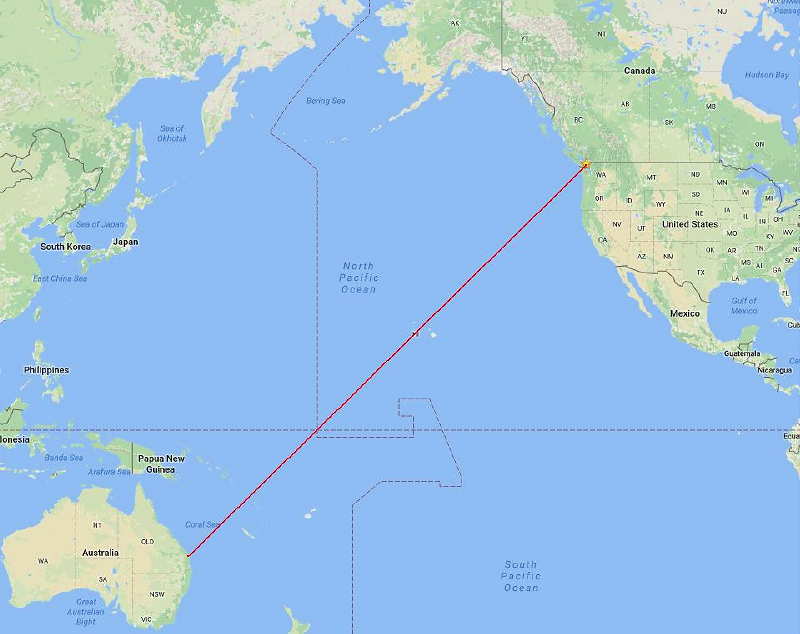
Shortly before sunrise yesterday morning, VK4YB (Roger) and I were able to work each other on 630m ... 475.300 kHz to be exact!
This is the first-ever QSO between North America and Australia on the relatively new 630m MF band. As well, at 11,802km, it presently represents the furthest two-way contact on this band, worldwide ... but I don't expect this record will last very long once the U.S. gets the band as I believe Roger's fine station is very capable of reaching much further afield.
Our contact on JT9, the WSPR QSO mode, was made at 1319Z, about 30 minutes before my local sunrise with the sky surprisingly bright. Blog readers will know that Roger and I have been carefully watching the pre-dawn Trans-Pacific propagation path for the last week. I have been checking-in with him via the ON4KST LF/MF chat page every morning at around 0345 local time at which point a decision is made ... "get out of bed and head for the shack" or "go back to sleep". Each morning's (or in Roger's case, each evening's) propagation quality is assigned a code number by Roger, based upon what he has been hearing during the early evening hours ... a '6' or below is 'sleep-time', a '7' is a 'you decide' while an '8' or above is 'get your butt moving'.
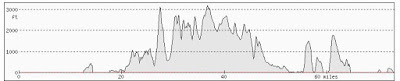
Yesterday, Roger issued a 'code 7' but as I joked with him later, I think he tricked me as it seemed more like a '6.5' from this end! Trans-Pacific conditions were very good about 500 miles to my south but seemed to drop-off quickly much further to the north. I also need to get over a significant obstruction immediately to the SW of me and in line with Roger. That's me directly at the base of the hill on the right while the remaining peaks are on nearby Saltspring Island and then Vancouver Island before reaching the open Pacific.
 |
| courtesy: http://www.heywhatsthat.com/profiler.html |
I believe this requires some enhancement of high-angle arrival (and departure) which often occurs around dawn due to a short period of ionospheric 'tilting'. This is often noted by topband operators near their local sunrise, who regularly observe stronger signals on low (cloud-warming) dipoles than they do on their normal large (low-angle) verticals or beverage antennas.
We enjoyed significantly stronger conditions a week ago, but unlike Thursday when I could run at full 5W EIRP, I was only able to generate a little less than 1W EIRP at the time. So far, this week, conditions have been improving steadily each day, from a 'code 3' to a 'code 7'. Hopefully they will continue to improve and we can do it all over again sometime soon.
With my new antenna / transverter / amplifier relay control box working nicely, it seems that Roger and I can now fully take advantage of TP propagation from 'mediocre' to 'excellent' but we have yet to see just how good it can get.
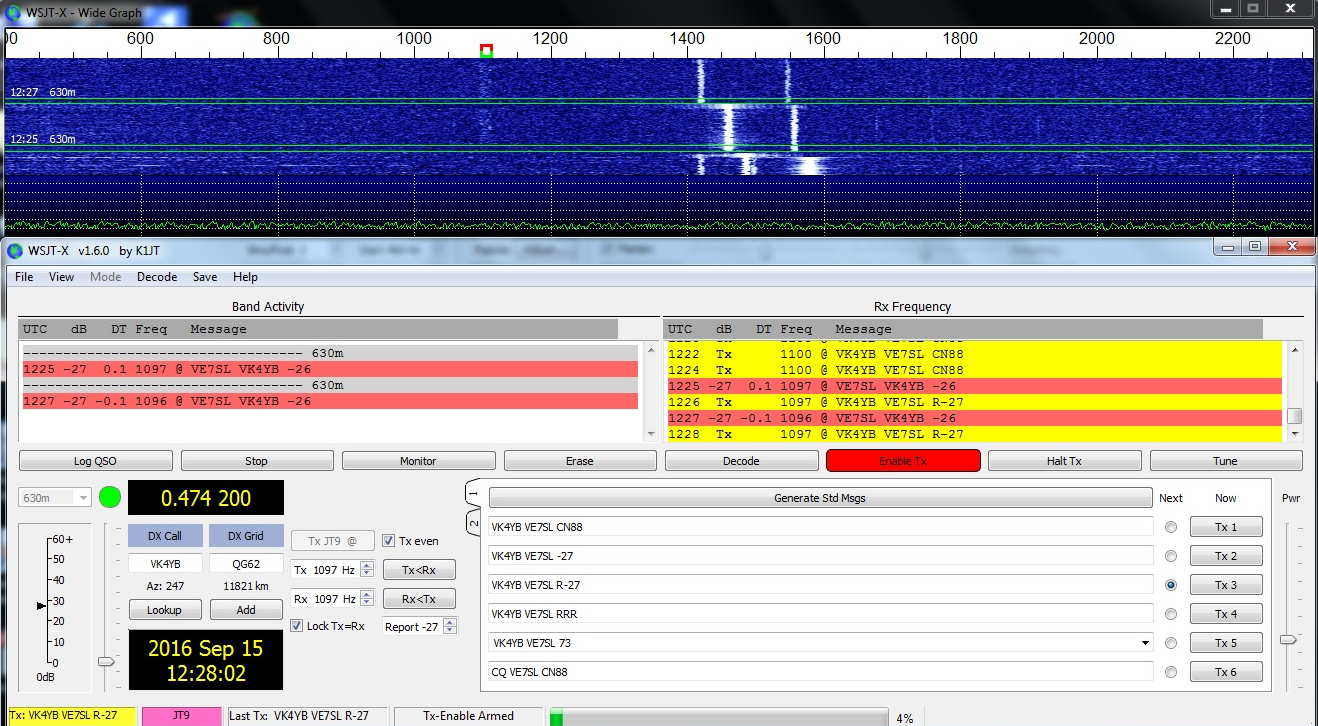 |
| Roger's signal is at +1100Hz |
It is hoped that our contact will inspire new interest among amateurs worldwide and particularly in North America. If you are planning a station, it seems that the main mode of two-way communications will be CW or JT9 ... a simple transverter would allow both modes as well as the use of the WSPR beacon mode. More information may be found here as well as in earlier 630m blogs.
See also: http://www.arrl.org/news/a-record-breaker-on-630-meters
Hunting For NDB’s In CLE 210
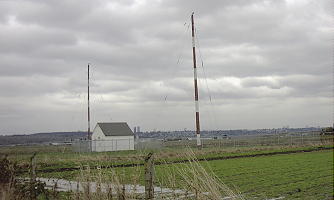 |
| 'VR' - 266kHz |
This coming weekend will see another CLE challenge, this time in the MF band from 260 - 269.9 kHz plus 440 - 1740 kHz.
'CLE's' are 'Co-ordinated Listening Events', and NDB DXers around the world focus their listening time on one small slice of the NDB spectrum ... but this time around, the range has been expanded.
The lower frequency range covers one my very strong locals, 'VR' on 266 kHz. 'VR' is an outer marker approach to Vancouver International's 'two-sixes' and is located a few miles east of the main runways in a farmer's field. Although running just 50 watts, it is widely reported (as far east as North Carolina), probably due to the excellent soggy ground beneath its somewhat unusual delta-shaped loop.
From CLE coordinator Brian Keyte (G3SIA), via the Yahoo ndblist Group, comes the following reminder:
Hello all,
Our end-of-August Co-ordinated Listening Event will soon be here.
We'll be hunting for normal beacons in two contrasting frequency ranges
and there is also the possibility of hearing several amateur beacons.
As always, first-time CLE logs will be extra welcome.
Days: Friday 26 August - Monday 29 August
Times: Start and end at midday, your local time
Frequencies: 260.0 - 269.9 kHz
plus: 440.0 - 1740.0 kHz
These are interesting frequencies, the same ones that we last used for
CLE191 in February 2015 when 45 of us joined in.
Many of us should be able to hear beacons in both ranges, though Europe
only has a handful in the '260s'. From 440 onwards, North America has a
few, mostly around 520 kHz, while Eastern Europe has several beacons
and some regular UNIDs. Some of the NDBs can also be found among
Europe's Medium Wave Broadcast Stations.
Many of us are within range of amateur beacons on frequencies mainly
around 474 - 478 kHz. We'll be listening for ANYTHING OPERATING IN
BEACON MODE, preferably with normal speed Morse.
(We ask operators who sometimes use QRSS, PSK, WSPR, etc.,
which need software to receive them, to PLEASE CHOOSE THE
SIMPLER MODE during the CLE so that we shall all be able to
receive them and make reports).
Please look out for my final details with advice about log-making, etc.
in a few days.
73
Brian
----------------------------------------------------------
From: Brian Keyte G3SIA ndbcle'at'gmail.com
Location: Surrey, SE England (CLE co-ordinator)
----------------------------------------------------------
These listening events serve several purposes. They:
- determine, worldwide, which beacons are actually in service and on-the-air so the online database can be kept up-to-date
- determine, worldwide, which beacons are out-of-service or have gone silent since the last CLE covering this range
- will indicate the state of propagation conditions at the various participant locations
- will give you an indication of how well your LF/MF receiving system is working
- give participants a fun yet challenging activity to keep their listening skills honed
Final details can be found at the NDB List website, and worldwide results, for every participant, will be posted there a few days after the event. If you are a member of the ndblist Group, results will also be e-mailed and posted there.
The very active Yahoo ndblist Group is a great place to learn more about the 'Art of NDB DXing' or to meet other listeners in your region. There is a lot of good information available there and new members are always very welcome. As well, you can follow the results of other CLE participants from night to night as propagation is always an active topic of discussion.
If you are contemplating getting started on 630m, listening for NDBs is an excellent way to test out your receive capabilities as there are several NDBs located near this part of the spectrum.
You need not be an ndblist member to participate in the CLEs and all reports, no matter how small, are of much value to the organizers. 'First-time' logs are always VERY welcome!
Reports may be sent to the ndblist or e-mailed to either myself or CLE co- ordinator, Brian Keyte (G3SIA), whose address appears above.
Please ... give the CLE a try ... then let us know what NDB's can be heard from your location! Your report can then be added to the worldwide database to help keep it up-to-date.
6m Es – Is It Changing?

With the summer Sporadic-E season now approaching its midpoint, it looks as though this year may be another poor one. Having been operating on 6m every summer since the early 70's, I'm beginning to believe that we may be seeing some changes in what was once the normal summer pattern.
This summer, I can count on one hand, the number of good solid openings ... openings lasting for several hours. Over the past forty plus years, summers on 'six' for me, here in southwestern BC, were usually very predictable. The last week of May would usually see the start of regular band openings that would quickly escalate to almost daily openings through June and July. It was not uncommon to see the band open all day, into the very late hours and then still be open the next morning. Intense Es from California predominated the 70's and 80's ... much different than the past several summers here. The stronger openings now, when they occur, seem to be more to the southeast, favoring Colorado and other nearby central states. At times, this will turn into double-hop to the southeastern states, usually favoring the 'EM' grids.
Really long-haul openings have also taken on a different flavor. For more than two decades, openings to Japan on Sporadic-E almost always occurred late at night, near midnight ... late afternoon for the JAs'. The openings rarely favored anything other than the west coast. Openings to Europe from the west coast were, for the most part unheard of, and any claims of summer-time EU contacts were often dismissed as 'wishful thinking' and not taken too seriously.
A huge shift in long haul Es over the past decade has pretty much re-written the rules of what we have always taken to be 'normal'. Summertime openings to Europe, from the west coast, have now become a regular expectance and, although still rare and usually short-lived, somewhat dependable. Our midnight openings to Japan have largely disappeared ... replaced by hour-long, mid-afternoon or dinner-hour JA runs, and more often than not, right over our west coast heads to any U.S. call district fortunate enough to be in the propagation's hot-spot. All of this is so very different than the 70's and 80's!
So why are things different now? Is it subtle influences from our ever-changing sun?

We are now heading into our sixth straight day of a spotless sun, but in reality, solar activity has been slowly winding down for the last several years. Long term studies tend to show that the solar cycle has little effect on summertime Es, but maybe not.
Is it climatic change ... global-warming? The e-layer is supposedly high above any weather influence yet there is evidence pointing to Es being associated with lightning storms and high altitude plasma-driven sprite activity. Maybe global-warming includes ionospheric changes as well and perhaps weather plays more of a role than previously thought.
 |
| Courtesy: http://www.astrosurf.com/luxorion/qsl-perturbation.htm |
Is it changes in equipment, with an ever-increasing number of 6m stations sporting huge antenna systems and higher ERPs' than ever before?
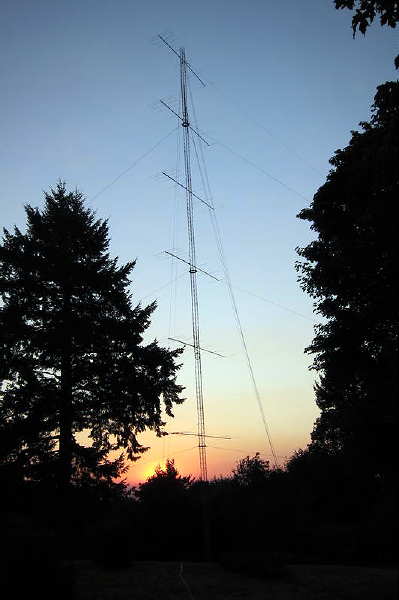 |
| Six 7-el Stacked Yagis At W7EW |
Maybe it's the influence of the Internet on operating practices? There is no doubt that having the ability to watch and follow realtime propagation paths, by the very minute, has made a huge difference in operating strategies ... along with big payoffs when it comes to catching those fleeting openings that would likely otherwise have gone unnoticed. On more than one occasion, I have worked Europeans on a seemingly 'dead band', with no propagation indicators at all ... just an announcement on the Internet that said station was calling 'CQ' at the time. Perhaps nowadays, there are just more savvy operators with good stations and a much better understanding of the DX possibilities ... slowly wringing out the best of what 6m has to offer. Maybe it's a combination of several factors.
Let me qualify my observations by saying that these have been my experiences and perhaps unique to the PNW and southwest VE7 only. Longtime Es data-collector, WA5IYX (Pat) in Texas, graphically shows the yearly Es variance in his region. The pattern appears somewhat sinusoidal in nature over the past few decades, but except for the occasional 'stinker', the variances from one summer to the next are not huge.
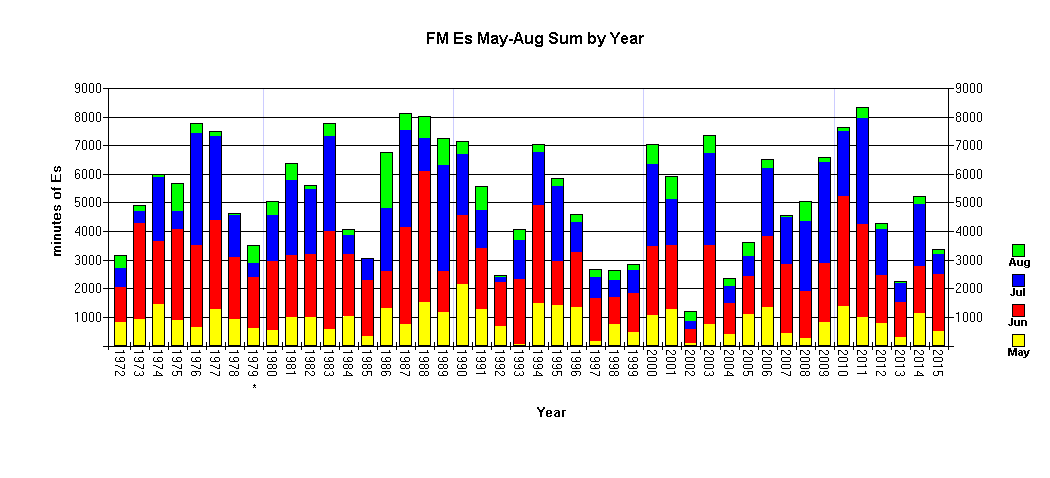 |
| Annual Es At WA5IYX courtesy: http://www.qsl.net/wa5iyx/ |
Are my observations similar to what you may have observed over the past many years? Are the changes real or only imagined? As with most global events being driven by mother nature and continually dynamic, I see no reason why 6m propagation should remain constant from decade to decade ... but I'd sure like to see a little more of it.
Now, usually when I voice complaints about our bad 6m propagation, it seems that things often flip from terrible to amazing soon after. The best Es of the summer often peaks in or close to the first week of July, now fast approaching. Let's hope that this is one 'constant' that hasn't changed as well!
**********************************
Wouldn't you know it. I put above blog together on Tuesday evening, intending to publish it on Wednesday. Early Wednesday morning, before 0900 local time, several Europeans were worked on CW ... perhaps the propagation gods were looking over my shoulder?
As is so often the case with these relatively new types of openings between EU and the west coast, there were no particular propagation clues from this end, other than a brief reception of the KØGUV/b in Minnesota. I was only alerted by the EU propagation reaching as far west as Colorado (KØGU) and a posting on the ON4KST 6m propagation logger that K7RWT in Oregon was hearing the VA5MG/b, sometimes a precursor to PNW propagation over the pole. The propagation map at the time shows no real indicators out this way ... once again, the value of realtime prop-watching via the Internet seems to have played a big role in finding these types of openings.
 |
| courtesy: http://www.on4kst.org/ |
Deceptive Sun
 |
| courtesy: http://sdo.gsfc.nasa.gov/data/ |
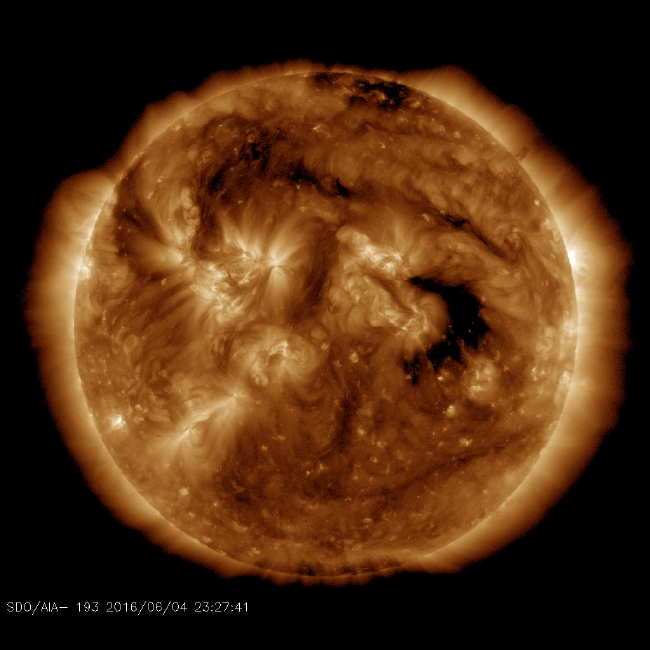
A quick glance at Sunday's sun reveals a spotless environment, something we will likely be seeing more often in the years to come as the Solar Minimum arrives around 2020. The last minimum in 2009 saw a total of 260 days of spotless suns and long periods of very little geomagnetic activity.
Incredibly, during the minimum in the 28 year period between 1672 and 1699 there were 50 sunspots total. That's not a week or a month but two 11 year cycles worth. The normal expectation would be 40,000 - 50,000 spots within a 28-year period.
But the present, apparently quiet-looking sun, is not all as it appears as a look at today's satellite data and magnetometer readings indicate we are in the midst of a pretty good disturbance, driving the planetary K-index to level 5.
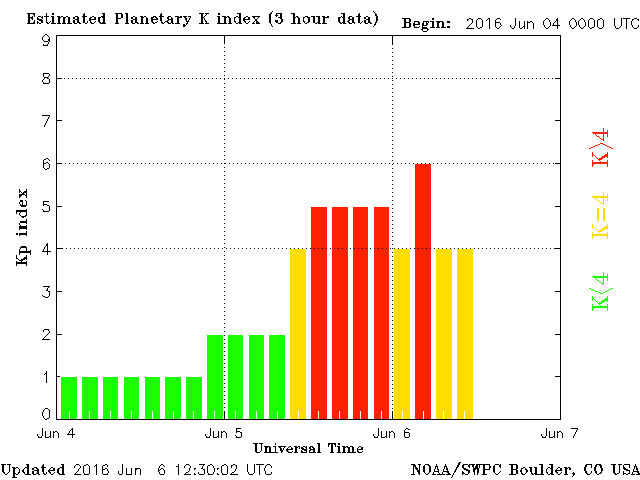 |
| courtesy: http://www.swpc.noaa.gov/ |
 |
| courtesy: http://sdo.gsfc.nasa.gov/data/ |
With the vast array of solar instrumentation available to us online, much of the mystery involving propagation has been removed, making the tracking and even the predicting of geomagnetic activity, very much easier nowadays.
 |
| Kiruna Magnetometer: http://www.irf.se/maggraphs/ |
From my location on the west coast of North America, my main 6m interest over the past several summer seasons has been focused on the short-lived and exciting sporadic-e openings over the pole to Europe ... but today's sun is not helping. Most of these fleeting openings seem to require undisturbed fields in the polar regions ... geomagnetic quiet. Once CH738 rotates out of view, hopefully the polar activity will subside and maybe, just maybe, the magical 6m polar path to Europe will tease us once again.
 |
| The July 8th, 2014 magic - West Coast to Europe on 6m |













