Archive for the ‘antennas’ Category
 My New 80 / 40m Antenna
 July 12th, 2018 |
  Author:
 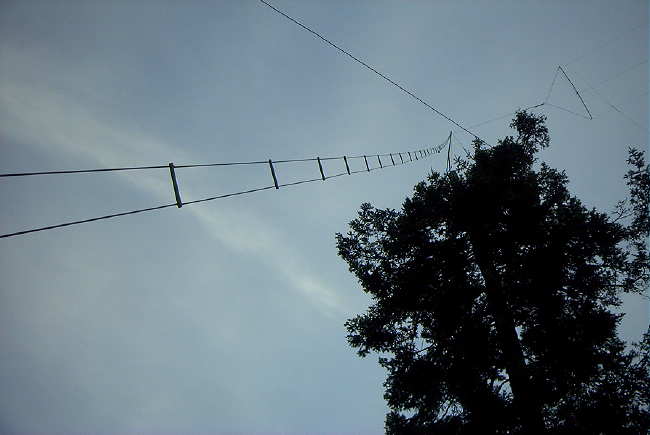 |
| 80 / 40m wire vertical groundplanes, now removed |
For the past several years I have employed wire vertical groundplane antennas for both 80 and 40m, mounted a few feet from the ocean.
In the fall I layout the ground radials on the grass and in the spring, roll all of them up again. The main reason for going to the vertical was to eliminate problems with my 80 / 40m half-slopers when using my 1929 single tube power oscillators during the windy conditions usually encountered during the mid-winter '29 BK QSO Party.
The flexing between the tower's telescoping mast sections and the Yagi antennas that form part of the sloper's 'top hat' , cause the half-sloper's impedance or resonance to change ever so slightly. The directly-coupled oscillators respond to these minute antenna changes by constantly shifting frequency by several hundred Hertz, as their output load changes. These high winds can make the low-power oscillator difficult to copy under weak signal conditions as it suddenly jumps frequency. The verticals were immune to this 'wind effect' and performed very well ... sort of.
I've noticed, over the years, that the verticals seemed to produce a much better signal out on the eastern edges of the continent than they do in the central states and in the closer western (PNW) states. I decided to see if an inverted-V might produce a higher takeoff angle and give me a better signal in mid-continent and an 'OK' one on the east coast. The half-slopers on the other hand, always seem to produce a good signal both near and far, but could usually not be used with the one-tube power oscillators when it was windy ... which, during winter here on the coast, is a lot of the time!
Following the removal of the old wire verticals and several days of antenna building, the new 80 / 40m dual inverted-Vs were hoisted to the top of my 85' Balsam. After pruning for resonance, I have been able to run some comparisons between the 40m V and my present 40m half-sloper. The 80m half-sloper had already been decommissioned as it required the changing of a jumper to use and I was never able to resonate it properly for some reason. Oddly there was no problem with either the 40m or 160m half slopers, fed at the same point, as both resonated easily.
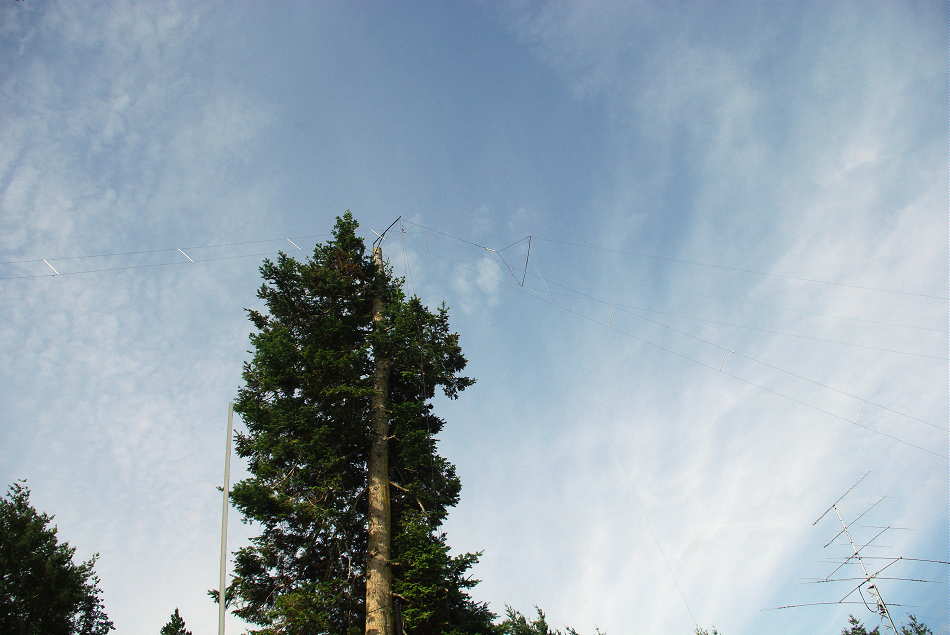 |
| The new 80 / 40m dual inverted-V dipoles |
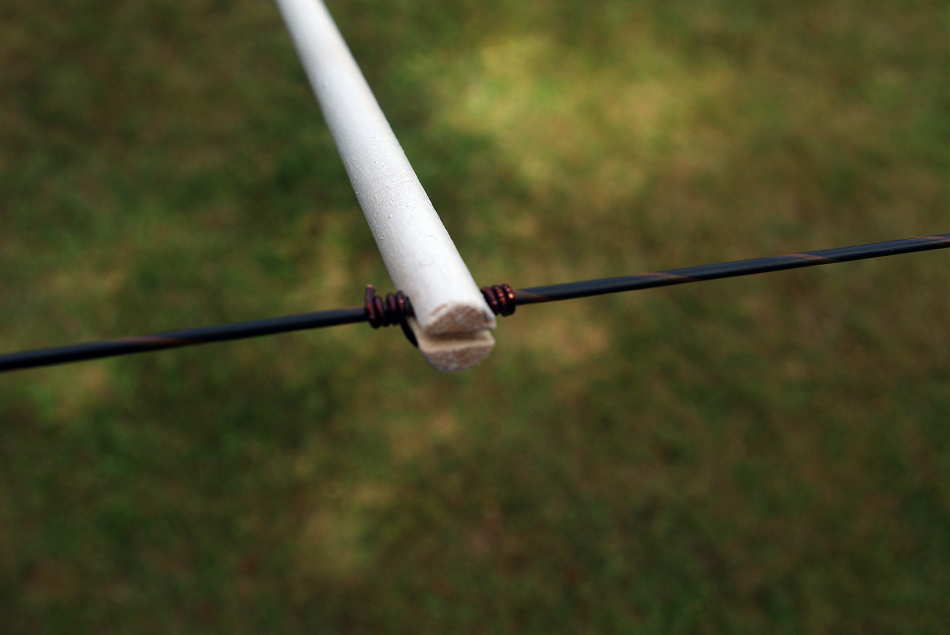
The dual dipoles, both resonated to the CW portion of each band, are separated every 10' by 24" varnished and painted hardwood spreaders.
The old 40m sloper has always been a really great performing antenna (except for the power oscillator / mast flexing problem) and it was the one used for my 300mW Tuna Tin Worked All States, back in the fall of 2000. I've had good success with both the 40m version and the 160m version, with 159 countries now confirmed on topband using the diminutive 130' wire.
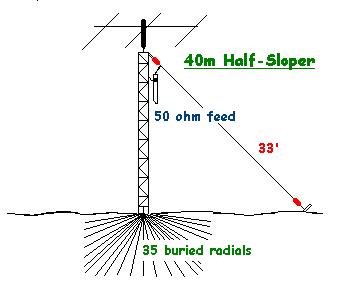
The 'Half-Sloper' was given a close analysis by antenna guru Jack Belrose, VE2CV, and described in QST of May, 1980. In his article, "The Half Sloper - Successful Deployment is an Enigma", he found that the radiation pattern was almost identical to that of a top-loaded monopole, fed against ground. The radiation field was largely vertically polarized and omni-directional while a lesser component, about 10db down, was horizontally polarized and coming from the sloping wire. The horizontal component had a figure-eight radiation pattern, slightly favoring the direction of the wire. He suggests that this antenna should be avoided due to the difficulty in getting it properly tuned.
My own experience with half-slopers have been mostly very positive, in spite of the tuning problems with the 80m version. To me, it seems like an ideal low band antenna for the small backyard, if you can get it to tune correctly. Assuming you already have a tower with some beams to add top-loading, hanging half slopers for the low bands takes up very little space. With omni-directional low angle radiation along with some higher angle horizontal radiation, all in a small footprint, what could be better for a simple wire antenna? Well, hopefully, my new high inverted-V!
For the past couple of weeks, as described earlier, I have been comparing the new 40m inverted-V against my 40m half-sloper, 'A-B' style, in real time, using the KiwiSDR network of online receivers. It seems that about 75% of the time, my old half-sloper, is just a few db better than the new V ... after all of the work involved, these results were both surprising and somewhat disappointing!
Perhaps I shouldn't be surprised after all, since the inverted-V configuration for a dipole is certainly less than ideal and the included angle in my antenna's normal position is only about 90 degrees. As well, the feedline attenuation losses for the new antenna are about 1db higher than those of the sloper. During the winter, I will be able to move one leg over to the far side of my neighbour's property which will open the apex up to a full 180 degrees. Recent testing at this angle has made the antennas neck and neck with one beating the other about 50% of the time, but the inverted-V is always better to the closer states.
Unfortunately, I have nothing to compare the new 80m antenna against but from listening to the signal on various SDR's around the continent and into the Caribbean, I have every confidence in it providing a much better signal than I have previously been able to muster on that band ... it should really help during the '29 BK QSO Party and the next NRR CW Party.
So what has been accomplished with the new installation? I have gained what appears to be a very good performer on 80m, as well as a 40m antenna that seems to be as good as the known good performing half-sloper, and should not cause any frequency-hopping with the one-tube power oscillators. My signal into the nearby PNW and central states has been improved. As well, now I can also avoid the annual radial deployment and retrieval needed for the wire verticals.
I'm still testing both antennas but conditions have been less than co-operative over the past few weeks. Hopefully when propagation picks up again, some of the European and far out Pacific SDRs can be used to further compare the two antennas ... there may yet be more to come!
An Online Alternative For Comparing Antenna Performance
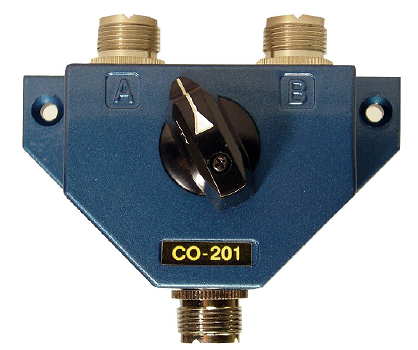
Over the past few years, the Reverse Beacon Network (RBN) has been utilized by thousands of amateurs to gauge the performance of their antenna systems, to check propagation or to compare their station's antenna performance against another nearby amateur's system.
For those not familiar with the RBN, it is the opposite of a network of 'on-air beacons' and consists of a network of 'on-air receivers', usually SDRs, that automatically skim a wide range of frequencies within the CW bands and report back what they hear, along with a definitive signal strength report ... all posted immediately back to a central website where you can read the data from the various stations that have heard your signal. Calling 'CQ' or sending a few 'TEST de' signals, followed by your call sign, will trigger the desired network response.
 I have recently been testing a new 40m antenna, an inverted-V dipole at 80', against my long-used half-sloper, but have been using a different online receiver network to make my real-time comparisons ... the KiwiSDR receivers, mentioned in previous blogs. I'll have more to report about the new antenna and its performance in an upcoming blog, once everything is finished and the antenna is fully optimized.
When it comes to real-time 'A-B' antenna comparisons, I found the KiwiSDR network much more interesting and informative than using the RBN. If hard data is what you want, then the RBN will provide it, but not in the same real-time, 'A-B' style that the Kiwis can offer. Once set up so that the two antennas may be fast switched, 'A-B' style, you can actually hear the difference immediately, with your own ears, as if sitting at the online receiver hundreds or even thousands of miles away. By sending a continuous series of dashes while switching between antennas, the comparison can be strikingly obvious, as the propagation variances experienced in an RBN comparison are no longer a factor. One might argue that using longer RBN comparisons, averaging the signal strength over a period of minutes, may yield a truer picture of antenna performance ... but this method lets you hear the second-by-second differences as they happen.
My antenna testing is not yet complete, as much of the initial time was spent trying to determine which online receivers were suitably quiet enough to utilize. Many of them were rejected for being far too noisy to be useful while many others were found to be ideally quiet. I am slowly working my way through the list!
So far, I have been able to listen to my transmitted signal and compare the two 40m antennas on numerous receivers from coast to coast, both near and far, as well as into the Caribbean and South America. I have found the best power to use is between 1 and 5 watts, as making the signal intentionally weak at the receiver end makes subtle differences of just a few db easier to detect.
The gathering comparisons are fascinating as often the signal strengths between my two antennas are very different. Often the sloper and the inverted-V are neck and neck, while in different directions or at different distances, one or the other is a clear winner. On many far-off receivers, I was easily able to detect my signal with all power controls set to '0' with no indication of any output showing on my meters, a rather surprising observation and another reminder of how RF just loves to radiate ... even at very low levels!
If you want to try this yourself and can quickly switch antennas 'A-B' style, here are the direct links to a few of the receivers that I have found to work very well so far ... with low noise levels and no man-made crud, while listening on 40m.
KA7U SDR - Idaho
K1RA/KW4VA - Virginia
W0AY - Montana
K2SDR - New Jersey
G8JNJ - England
K2ZN - New York
WA2ZKD - New York
KD4HSO - Kansas
VE6JY - Alberta
W3SWL - Pennsylvania
N6GN - Colorado
N8DTT/6 - California
VE6JW - Alberta
Kingwood - Texas
TWR - Bonaire
EA8DGL - Canary Islands
Wellbrook ALA1530LNP - Southern Finland
NO2CW - Florida
Pardinho - Brazil
I will continue to update this list as more receivers are tested ... now back to some outdoor antenna tweeking!
Trouble Free HF Antenna For The Apartment Dwelling Ham
 Unfortunately we all know of or hear about hams that have given up all hope of getting on the air, once moving into an apartment or condo, where antennas are normally prohibited. One enterprising local amateur has combined early established antenna fundamentals along with sound engineering, to arrive at an elegant and highly successful solution. If you are also a 'location challenged' amateur, it may just be the thing that will help you, and others, take back your hobby and get on the air!
John, VE7AOV, has been operating from his apartment, in the heart of the very large and noisy greater Vancouver, for several years now ... not simply 'operating', but thriving, from his cozy fourth-floor apartment radio station. The wallpaper shown below would not usually be expected to grace the shack walls where antennas are not permitted!
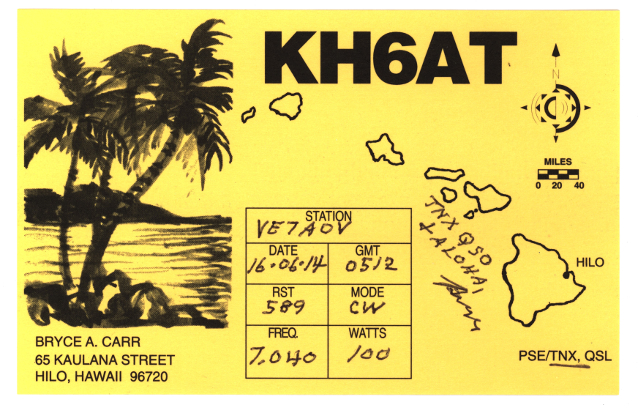


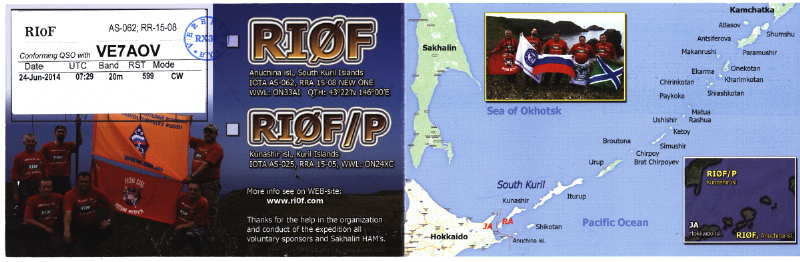
It's soon apparent that John has also overcome the usual problem of noise ingression, from every appliance and random RFI generator in the complex. This is no lucky fluke but all by design, and delivered via an all but invisible classic antenna system made of #26 wire and a few Starbuck's stir-sticks!
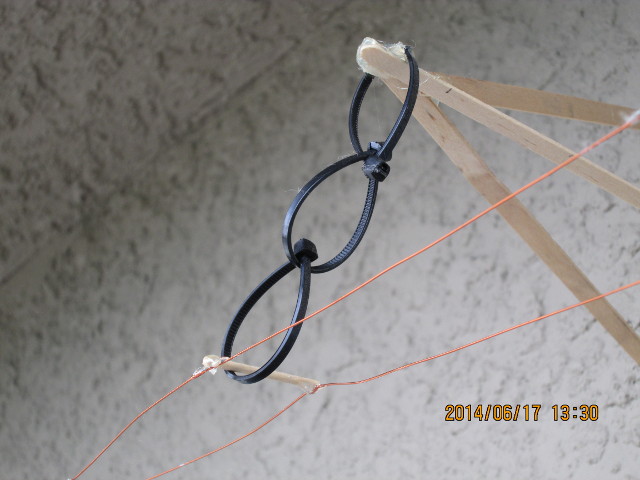 |
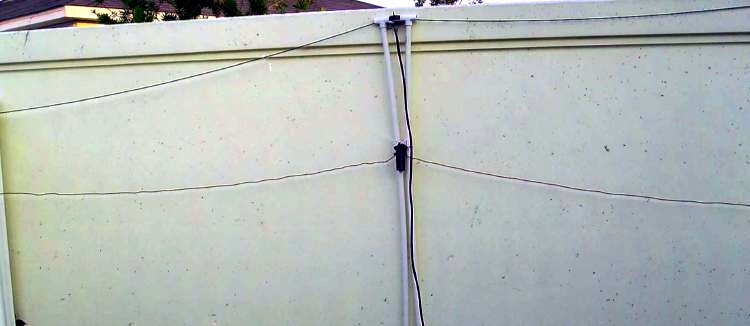
| 600 ohm #26 balanced line |
I'll let John tell you a bit more before sending you to his fascinating website, Intuitive Electronics, where you can learn more about his system and the engineering behind his successful, low-noise installation.
When it comes to a high frequency ham station, the antenna alternative chosen by most apartment dwellers is no antenna at all. The design here is a wisp of an antenna that bothers no one and which can work Japan, Australia, France, European and Asian Russia, the Caribbean, Central America, Polynesia and South America from the Pacific coast of Canada. It is a simple solution for apartment dwellers, it is a cheap solution and it causes no t.v.i. or other r.f. problems. It is far preferable to the alternative selected by so many fellow apartment dwellers: no antenna at all.
An implication that it seems to be impossible to rid from the minds of fellows using a Marconi antenna is that they are not just pumping 100 watts of r.f. into their antenna but that they are also pumping that same 100 watts of r.f. into their ground, that is to say the building’s wiring, the safety ground wiring. R.f. in the safety ground is well coupled into the power and neutral conductors of a residence and, in North American code, is even hard connected to the neutral line at the service entrance. The house wiring becomes part of the antenna system.
The ground wiring and everything connected to it is every bit as much a part of the antenna as is the live element. Both radiate just the same amount of r.f. power, fellows. The ground wiring along with every electrical power consumer in the building is worked against the live element. Thinking of what is connected to ground in your house is thinking about one side of your antenna. It’s not just appliances that get the “benefit” of r.f. The land line telephone system, the cable television system, the garage door opener, the security lights and…you name it. They are all “feeling” that 100W of r.f. With regard to r.f., there is no distinction whatsoever to be made between “hot” and “ground”.
You know the reason why vertical antennas have gained a reputation for being noisy on receive now, too. Most verticals are Marconi antennas. Both the safety ground and the neutral serve all the houses in the neighbourhood. The receiver is wired into the electrical appliances of the entire neighbourhood.
This radio station, located four stories above grade and in a wooden building full of apartments would be a worst case for r.f. in “ground”. This station has no r.f. in the station. It has no r.f. in “ground”.
The station has no interference issues. The Building Manager, the Building Superintendent and the administrator for this building’s cablevision have been aware of the station from the beginning. There has not been a single complaint of t.v.i. or any other complaint about the station. That’s a clean record extending back to 2006. There are no red faced, spluttering tenants hammering on the door of this station! At this station, all the r.f. produced by the transmitter makes its appearance out on the antenna. The radio station’s r.f. is not referenced to station ground. Station ground “knows nothing” about the r.f. being generated.
In the present case, that is to say a station to be operated in an apartment building, it is required to have an antenna that is “invisible”. Now it’s not possible to achieve that literally but at least the antenna should be so inconsiderable that there will be no complaints from neighbours about having to look at it. The antenna here is made of #26 A.W.G. wire. That’s wire that is 0.40mm, 0.016 of an inch, in diameter. Four stories up, it’s difficult to see the antenna and that’s even when knowing where to look for it. Part of the antenna’s run is through trees and in among the tree branches it pretty much is invisible. It does not annoy neighbours by casting a shadow; there is no shadow.
In spite if the naysayers, John's small gauge antenna has survived years of winter storms, regular occurrences here on Canada's western edge ... simply because it presents such a low cross-section compared to most conventional antenna wires.
To read more about enjoying your hobby again from your new 'restricted' location and more than likely, learn something new about old fundamentals, give John's website a very close inspection ... there is much wisdom and many gems to be found, even if you don't live in an apartment!
Keep The Faith, Having Fun With No Sunspots
I was motivated to write this today after looking at the solar flux number which sat at 67. I don't know if I've ever seen the flux this low. I think I've seen 68 a lot, but not 67. Truly, things must be really bad.
As it would happen today, with the flux at 67, I did my 258th SOTA activation on a summit near Santa Fe, NM that has no name, but goes by it's elevation, 8409. There are beautiful views in every direction, from the summit of 8409, and I enjoyed them immensely. With me, on my trek up the mountain, was my KX2, a 21ft. collapsible pole to support a 29 ft. piece of wire through an 81 to 1 transformer. I feed the antenna about a foot above the ground and run the wire up the pole in an inverted L configuration. The pole was propped up among the branches of a pine tree and I tied off the antenna to a close-by pine branch. I had the power set to 5 watts and tuned the wire with the KX2. I operated CW using the Elecraft plug-in paddle and I logged with a golf pencil on a, write in the rain, index card. The temperature was a crisp 39 degrees, but the sun was shining and not wisp of a breeze. It was a good day to be on the mountain top.
I was on the air from 1642z - 1722z. I operated on 40, 30m, 20m and 17m and completed 40 QSO's in the 40 minutes that I was on the air from 8409. Also, with the flux at 67, I managed to work two EU stations, ON and EA. I heard a 9A calling me but we couldn't complete the contact. So, 40 QSO's, coast to coast in the US and 2 DX QSO's from EU was my catch for the day. Not bad for a short QRP/portable outing. Keep in mind that's with the flux at 67. I'm glad I didn't look at the numbers before I left or I might have been a bit discouraged and perhaps wouldn't have gone out at all. I would have missed the beautiful views, the warming sunshine and a QSO a minute QRP operation. I wouldn't have worked EU with 5 watts and a wire. I would have had to put off my 258th SOTA activation for another day.
The moral of this story is simple, don't look at the numbers. In fact I would recommend that you ignore them. There is plenty of fun to be had keying up your radio even when conditions, or at least the numbers, are this bad.
Keep the Faith. Go call CQ. I was glad I did.
As it would happen today, with the flux at 67, I did my 258th SOTA activation on a summit near Santa Fe, NM that has no name, but goes by it's elevation, 8409. There are beautiful views in every direction, from the summit of 8409, and I enjoyed them immensely. With me, on my trek up the mountain, was my KX2, a 21ft. collapsible pole to support a 29 ft. piece of wire through an 81 to 1 transformer. I feed the antenna about a foot above the ground and run the wire up the pole in an inverted L configuration. The pole was propped up among the branches of a pine tree and I tied off the antenna to a close-by pine branch. I had the power set to 5 watts and tuned the wire with the KX2. I operated CW using the Elecraft plug-in paddle and I logged with a golf pencil on a, write in the rain, index card. The temperature was a crisp 39 degrees, but the sun was shining and not wisp of a breeze. It was a good day to be on the mountain top.
I was on the air from 1642z - 1722z. I operated on 40, 30m, 20m and 17m and completed 40 QSO's in the 40 minutes that I was on the air from 8409. Also, with the flux at 67, I managed to work two EU stations, ON and EA. I heard a 9A calling me but we couldn't complete the contact. So, 40 QSO's, coast to coast in the US and 2 DX QSO's from EU was my catch for the day. Not bad for a short QRP/portable outing. Keep in mind that's with the flux at 67. I'm glad I didn't look at the numbers before I left or I might have been a bit discouraged and perhaps wouldn't have gone out at all. I would have missed the beautiful views, the warming sunshine and a QSO a minute QRP operation. I wouldn't have worked EU with 5 watts and a wire. I would have had to put off my 258th SOTA activation for another day.
The moral of this story is simple, don't look at the numbers. In fact I would recommend that you ignore them. There is plenty of fun to be had keying up your radio even when conditions, or at least the numbers, are this bad.
Keep the Faith. Go call CQ. I was glad I did.
Condo Hamming, The NRR and Ron’s Logs
 |
| courtesy: K4VRC Group |
Rick, KB2NAT, describes the learning curve in his 'How To Overcome Some Condo Issues' post.
Amateurs contemplating downsizing to a restricted development or those finding themselves in a similar situation to Rick will likely soon be subjected to more noise, less space, more neighbours and an abundance of rules. Hopefully the comments of Rick and others will be helpful if this is your situation.
For many restricted hams, Mag loops appear to be a popular choice and one of the comments points to a good deal of information on building one for yourself. The Villages Amateur Radio Club (K4VRC) group's 'resources' link will provide some interesting ideas for restricted antenna builders. As well, they have put together an informational presentation, full of great antenna ideas for those contemplating ways to get on the air from antenna-restricted locations.
If you live in the USA, the 'Freedom to Display the American Flag Act of 2005' has been used by many antenna-restricted hams, to legally erect their own 'antenna flagpole'! It may be an easy route for a nice antenna system for you as well.
The 'Novice Rig Roundup' Starts Tomorrow!
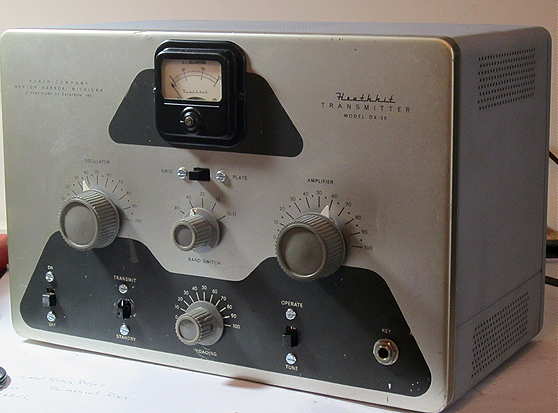
Just a reminder that 9 days of CW operating fun begins tomorrow afternoon. After last year's most enjoyable event, the NRR is now one of my 'must do' operating activities. You can read all about it here.
Ron's Logs
 |
| courtesy: California State Parks |
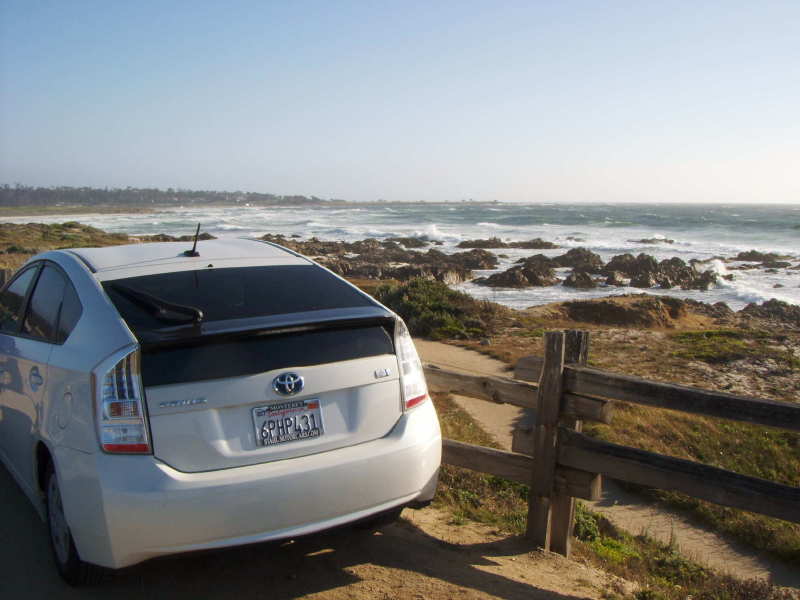
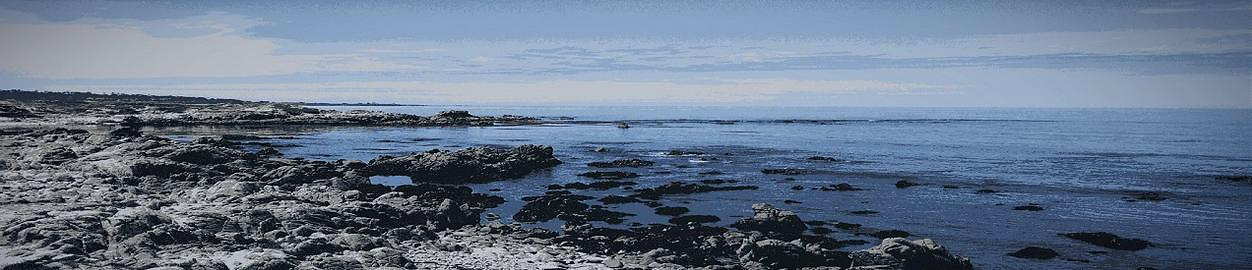
Ron lives in the seaside city of Monterey (CA) and on most mornings he makes the short pre-dawn drive to Asilomar State Beach (CA), a spectacular location on the coast.
After stringing out his 100' wire antenna on the nearby fence posts, Ron proceeds to log and record some truly exotic stuff before heading home.
Early last Fall, before being aware of Ron's daily regime, I had visited his exact location and after watching the big sea lions playing in the surf, had drooled over the location's great DX potential, little knowing that Ron had likely packed his gear up a headed home just a few hours before my arrival! I'm sure you'll be inspired to tune around the SW broadcast bands after checking out theses Group's daily posts.
The FA-VA4 Vector Antenna Analyzer (LF-100MHz)

For some time I had been considering the purchase of the MFJ259 antenna analyzer but after a little online sleuthing, came across this little beauty, the FA-VA4 Antenna Analyzer by Funk Amateur in Germany and available through their Box73 website here.
I liked the fact that the cost of the analyzer was about half that of anything else comparable ($140 US including shipping) and that it covered the new 2200 / 630m bands!
I think many amateurs planning on building a system for either of these new bands will find the very affordable FA-VA4 a handy piece of equipment when it comes to working on their LF / MF antenna since most available SWR meters do not cover these frequencies accurately.
Delivery time was fast and everything was very well packaged. The FA-VA4 comes in partial kit form and requires only a short amount of time to put together.
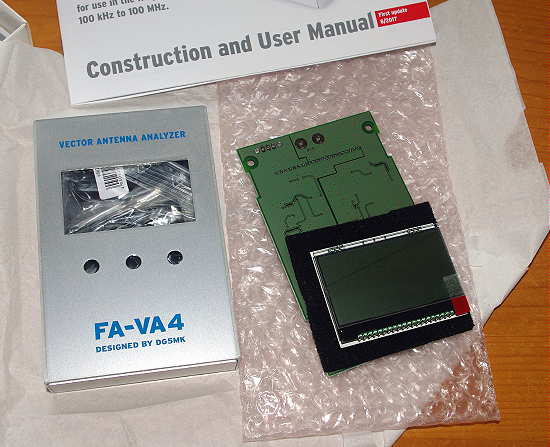
The necessary assembly consists of soldering pin strip connectors, switches, AA cell holders, and the BNC connector. All of the tricky SMD components have been pre-mounted ... total assembly time was less than 60 minutes and everything fired-up nicely, without problems, thanks to the well written instruction / user manual.

Included with the kit are three BNC connectors needed to calibrate the instrument for the highest accuracy. These consist of a 'Shorted' connector, an 'Open' connector and a 50 ohm 'Load' connector (SOL). A simple three-part calibration procedure for all frequencies takes about 15 minute to complete, while the instrument calibrates itself as it scans through all frequency ranges with each connector plugged into the output. Once this task is completed, the analyzer is ready for use.

If you're like me, I think the main use will be to check out and tweak some of your HF antennas using the SWR or Z sweep function. This allows you to set a desired 'center' frequency along with a + / - sweep range and have the display draw a nice plot of your system.
Had my 630m antenna not already been tuned and matched, I would have found the analyzer to be a great help but, thanks to my 'scopematch', that antenna has already been optimised.
All menu features and data entry is via three momentary-contact push switches. Although this might initially seem awkward, it is not, and operation is pretty intuitive.
The main modes of operation are:
Single Frequency SWR Measurement
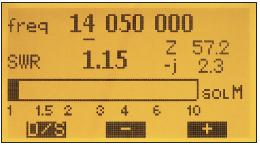 |
| courtesy: http://www.box73.com/product/5 |
Single Frequency Impedance Measurement
 |
| courtesy: http://www.box73.com/product/5 |
Single SWR Measurement Run
 |
| courtesy: http://www.box73.com/product/5 |
Single Run For Impedance Measurement (Resistance and Reactance)
 |
| courtesy: http://www.box73.com/product/5 |
SWR Measurement On Five Frequencies (5 Band Measurement)
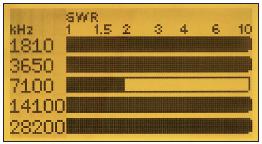 |
| courtesy: http://www.box73.com/product/5 |
As well, all of the above can be viewed in a continuous 'cycle' mode, as inputs are changed and all screens can be saved for future reference.
Additional capabilities include use in an HF Signal Generator Mode (~ 1V square wave @50 ohms), the ability to measure C and L at a given frequency, as a 'dip meter' and to measure cable resonances and determine lengths.
The complete manual may also be downloaded from their website here.
I will soon put all of my antennas to the test and see what work might need to be done to optimize them, particularly my HF half slopers, which, in spite of their great performance, have always proven a bit of a mystery when it comes to pruning them to resonance ... I rather suspect that the sloping wires are more of an impedance tuning stub than a radiator and that most radiation comes from the vertical support tower, not the sloping wire.
All-in-all, the FA-VA4 appears to offer very good value for the money and is a well built, quality test instrument. I think it will become a popular choice among hams, especially those on LF / MF. The only thing different that I would have liked, would be to have a UHF (SO 239) connector rather than a BNC on the output, since most amateurs are using these on their HF systems ... or, the inclusion of a BNC-to-UHF adapter.
If you already use this device, please feel free to add your comments below!
It’s been a long, long time.
It has indeed been a long time since I've moved to this new work location. The old work QTH was in Warren, NJ and the new is in Whitehouse Station, NJ. Same job, same company, different campus. I am about 10 miles (more or less) farther west into the interior of New Jersey than I used to be. It adds about another 10 minutes to my commute.
There are two of us in my department. Things were easier in Warren, as we both worked from the same (and only) building on campus. We staggered our lunch breaks so that one of us was always on duty. Here, at the new work QTH, we are split between two buildings, each one of us minding our own store, so to speak. Unless you master bi-location, you can't manage both buildings at the same time with one man.
That led towards a hiatus in lunchtime QRP operations as it just seemed not the greatest idea to spend so much time away from the desk. I know, it's time I'm entitled to (it's only an hour) and I really should get away from the desk to remain fresh in the afternoon.
So I decided to take advantage again, beginning this week.
I went out to the car yesterday and hooked up the KX3 to the Buddistick. I heard a lot of stations on 20 Meters, but got no answers to any of my calls. I know the equipment works, I figured it was just a bit of "rust" on my part. But, boy howdy, was it hot yesterday! It reached into the upper 80s (about 30C) here at lunchtime and since I was parked outside, it was hot like an oven in the car. It was a double negative experience - too hot and skunked on contacts.
Not one to be deterred, my little eye spied on something that I had forgotten. This campus has picnic tables! Many of the employees go out to eat outdoors on the nice days. There are plenty of tables, they are spaced widely enough apart where conversations cannot encroach on one another.
It dawned on me that this would be the perfect place to set up the KX3 and the magloop! Sure, I'd probably get some stares from the other lunchers, and maybe from some of the employees who take advantage of their lunch break to walk the perimeter of the campus - but what they heck? Right? It's not like I haven't been stared at before. It's not like people haven't come up to me to ask, "What is that?" before, so tossing self-consciousness into the wind, I decided to set up at one of the tables today.
I chose a table towards the end of the line of tables, the one with no umbrella. Sure, it would be a little hotter with no shade, but it's less than an hour and besides, there's be no metallic umbrella ribs to possibly interact with the magloop.
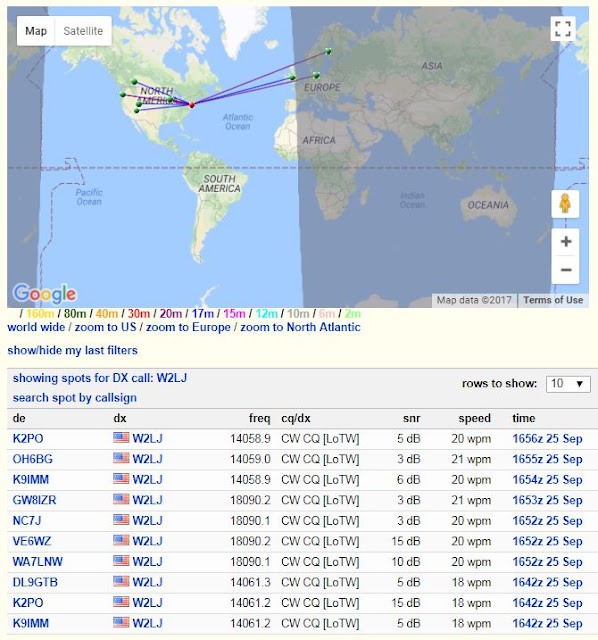
Before hunting for a QSO, I decided to call CQ for a bit on both 20 and 17 Meters. I really didn't expect anyone to answer, although there's no reason why anyone wouldn't. I just wanted to conduct a little Reverse Beacon Network experiment.
Experiment done, I went back to 20 Meters and found the "sweet spot" with the loop's tuning capacitor. (I was able to set up in under four minutes, by they way. Almost as fast as setting up the Buddistick on the car.) Tuning the KX3 around, there were a bunch of loud stations. Finally, I came upon GI4DOH, Rich in Northern Ireland. He had a strong signal and a great fist, so I gave him a call. He came back to me on the first shot! He was 559+ here in NJ, and I got a 559 in return.
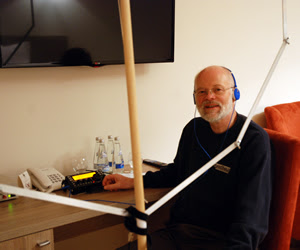
According to his QRZ page, the loop that Rich is using is a receive only loop. This was not a loop to loop QSO.
After working Rich, I popped on up to 17 Meters. There I heard OE3DXA, Wern in Austria calling CQ. Again, loud signal, great fist, so I gave him a call. Just as with GI4DOH, I gave him a 599+ report but this time I got a 599 in return. Both QSOs were solid with no repeats asked for with regard to info, so I am assuming I was at or near Q5 copy. (Even if the 599 in return wasn't exactly accurate.)

It was time to pack it in, and I was satisfied with the two DX QSOs for the day. With regard to my Reverse Beacon Network experiment, this was where the loop was allowing my signal to be heard:
As for spectators, I did get one guy who stopped to ask, "What is that? And what are you doing?" I explained that it was Amateur Radio and an Amateur Radio antenna. In response, I got the (what seems to be standard) "People still do that?" question.
I went into "pitch" mode and explained that yes, Amateur Radio is alive and well, and that for a lot of people in the Caribbean right now it's the only way they can get word out to their families abroad, that they are OK after the hurricanes.
So it was a successful day, I'm happy and it looks like there might not be rain for the rest of the work week.
72 de Larry W2LJ
QRP - When you care to send the very least!
There are two of us in my department. Things were easier in Warren, as we both worked from the same (and only) building on campus. We staggered our lunch breaks so that one of us was always on duty. Here, at the new work QTH, we are split between two buildings, each one of us minding our own store, so to speak. Unless you master bi-location, you can't manage both buildings at the same time with one man.
That led towards a hiatus in lunchtime QRP operations as it just seemed not the greatest idea to spend so much time away from the desk. I know, it's time I'm entitled to (it's only an hour) and I really should get away from the desk to remain fresh in the afternoon.
So I decided to take advantage again, beginning this week.
I went out to the car yesterday and hooked up the KX3 to the Buddistick. I heard a lot of stations on 20 Meters, but got no answers to any of my calls. I know the equipment works, I figured it was just a bit of "rust" on my part. But, boy howdy, was it hot yesterday! It reached into the upper 80s (about 30C) here at lunchtime and since I was parked outside, it was hot like an oven in the car. It was a double negative experience - too hot and skunked on contacts.
Not one to be deterred, my little eye spied on something that I had forgotten. This campus has picnic tables! Many of the employees go out to eat outdoors on the nice days. There are plenty of tables, they are spaced widely enough apart where conversations cannot encroach on one another.
It dawned on me that this would be the perfect place to set up the KX3 and the magloop! Sure, I'd probably get some stares from the other lunchers, and maybe from some of the employees who take advantage of their lunch break to walk the perimeter of the campus - but what they heck? Right? It's not like I haven't been stared at before. It's not like people haven't come up to me to ask, "What is that?" before, so tossing self-consciousness into the wind, I decided to set up at one of the tables today.
I chose a table towards the end of the line of tables, the one with no umbrella. Sure, it would be a little hotter with no shade, but it's less than an hour and besides, there's be no metallic umbrella ribs to possibly interact with the magloop.
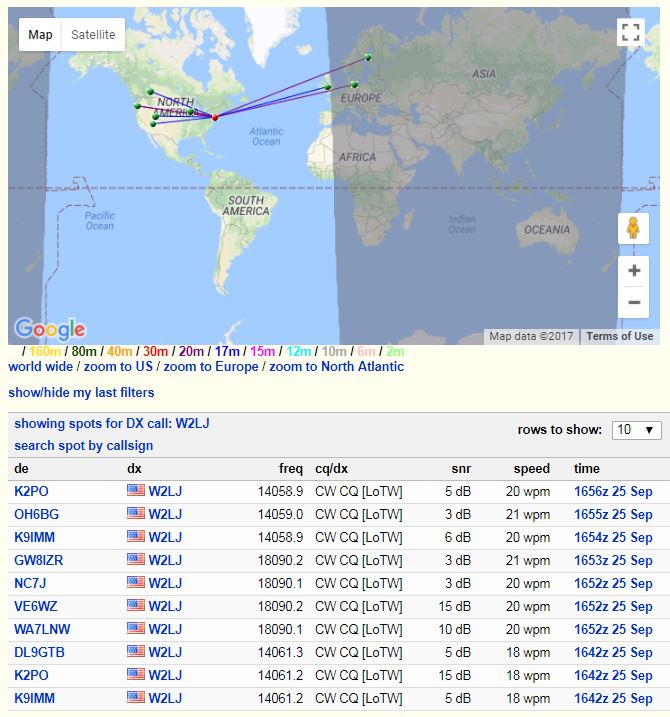
Before hunting for a QSO, I decided to call CQ for a bit on both 20 and 17 Meters. I really didn't expect anyone to answer, although there's no reason why anyone wouldn't. I just wanted to conduct a little Reverse Beacon Network experiment.
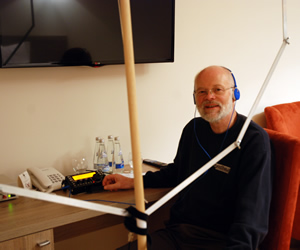
Experiment done, I went back to 20 Meters and found the "sweet spot" with the loop's tuning capacitor. (I was able to set up in under four minutes, by they way. Almost as fast as setting up the Buddistick on the car.) Tuning the KX3 around, there were a bunch of loud stations. Finally, I came upon GI4DOH, Rich in Northern Ireland. He had a strong signal and a great fist, so I gave him a call. He came back to me on the first shot! He was 559+ here in NJ, and I got a 559 in return.
According to his QRZ page, the loop that Rich is using is a receive only loop. This was not a loop to loop QSO.
After working Rich, I popped on up to 17 Meters. There I heard OE3DXA, Wern in Austria calling CQ. Again, loud signal, great fist, so I gave him a call. Just as with GI4DOH, I gave him a 599+ report but this time I got a 599 in return. Both QSOs were solid with no repeats asked for with regard to info, so I am assuming I was at or near Q5 copy. (Even if the 599 in return wasn't exactly accurate.)

It was time to pack it in, and I was satisfied with the two DX QSOs for the day. With regard to my Reverse Beacon Network experiment, this was where the loop was allowing my signal to be heard:
As for spectators, I did get one guy who stopped to ask, "What is that? And what are you doing?" I explained that it was Amateur Radio and an Amateur Radio antenna. In response, I got the (what seems to be standard) "People still do that?" question.
I went into "pitch" mode and explained that yes, Amateur Radio is alive and well, and that for a lot of people in the Caribbean right now it's the only way they can get word out to their families abroad, that they are OK after the hurricanes.
So it was a successful day, I'm happy and it looks like there might not be rain for the rest of the work week.
72 de Larry W2LJ
QRP - When you care to send the very least!













