Archive for the ‘antennas’ Category
 QRP TTF 2012
 April 29th, 2012 |
  Author:
 Great weather here in Orlando for a good afternoon of QRP Portable. The QRP To The Field contest is always a good time to get out and give out a few more points to the serious contesters. I enjoy the concentrated QRP contacts and hearing my virtual friends once again. Every QRP event has a few regulars that are almost always heard. This year the bands were only so-so in Florida with lots of QSB on 20m which was by far the best for the day. It was solid at times and then signals would suddenly drop to the noise level which made RST reporting fun!

Mt. Cedar Tree: Just above sea level
Because of band conditions, I spent most of the 4 hours on 2om, but I did check 15 and 10m on an hourly basis. To do that, I pulled out my Ten Tec Argonaut 509 and used a Buddistick with the base up about 12 ft. I called CQ about 50 times on 15 m but heard almost nothing on 10m all day. On 15m I heard a couple Eu (IV4 and DK) stations but was not getting a response to my calls and only heard 1 or 2 US stations so I assume the band conditions here weren’t quite right for those two bands.
Managed 18 QSO’s in 4 hrs of switching between my Wilderness Sierra to an EFHW, Delta Loop for 20m, and the Buddistick / Argonaut combo for 15 and 10m. 40 m was full of Florida QSO Party stations and a couple of nearby (within 4 miles) stations were pounding my receiver and causing the AGC to go nuts when I tuned across them so I only managed a single contact on 40 before retreating back to 20m.
I’ll be looking to give out more points in upcoming contests. So call CQ and I’ll be out there lookin’ fer ya!
72,
Kelly K4UPG

Buddistick on the way up
Trip #4 to Lido Key, IOTA NA-034
In just over a week, I’ll be heading down to Florida to visit family, and, as I’ve done on previous trips, I plan to be operating from Lido Key, IOTA # NA-034 from March 21 to 23. My current plans are to be on the air during my local afternoon between around 1700 – 2200 GMT, on 14.260 or 21.260 (the standard IOTA frequencies), phone only. This is very much a “holiday style” operation, so those operating times may vary, and depending on band conditions, I might set up elsewhere.
For this trip, I’ll be taking my Buddipole and using it on top of the same 8-foot mast that I used last summer in Costa Rica. When I was in Costa Rica, I was able to bungee cord the mast to the railing of the balcony, but since I’m not sure that I’ll be able to do the same with the picnic tables at the park where I’m planning to operate, I figured out how to guy the mast using some lightweight tent stakes, some line, and some small carabiners that I picked up at a local outdoor store. The folks who sell the Buddipole do make a guying kit, but I thought it would be nice to see if I could make something myself.
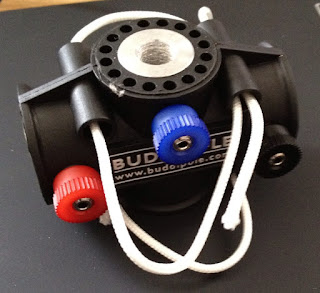
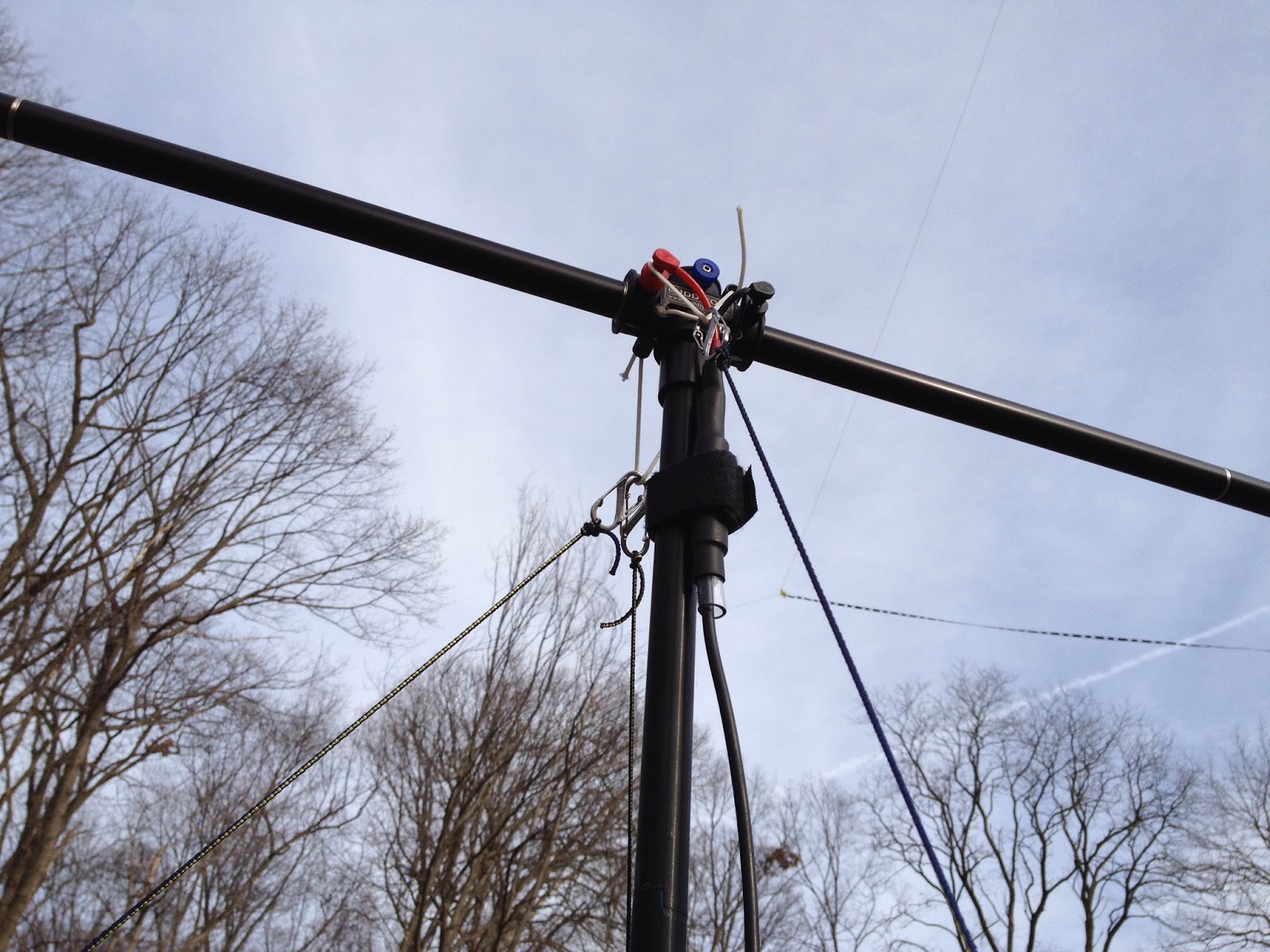
Because I learned the hard way that it’s pretty easy to break a whip if the antenna isn’t supported properly, I first made sure that I could connect the Versatee to the mast (without the arms or whips), attach the lines to that, then stand it up and tension the guys so that the mast seemed stable. I realized that I needed to keep the guy lines probably a bit closer than I would have liked to the mast or I wouldn’t be able to reach the hitch knots to adjust them. While I could have used adjustable knots to connect to the carabiners, in use those would be at the top of the mast and would be unreachable. As it turned out, it worked out pretty well the way I set it up. I had to first roughly estimate the 120 degree separation between the stakes around the mast, and I got lucky on my first try.
 After seeing that this seemed to be pretty stable once I put some tension on the guy lines, I took it down and screwed in the antenna arms, coils, and whips, though I left the whips fully collapsed. I raised it back up, tightened up the guys (actually I just had to tighten one guy because of the way I’d lowered things), and it still seemed pretty stable, so I lowered everything once again, extended the whips (I’d already connected the wander leads to the proper location on the coils) and raised everything up. (If you’re viewing this on my blog page, you can click on the pictures to see a bit more detail, which is particularly helpful for the one showing the antenna fully deployed).
I connected the feedline to my radio (I’d brought my Icom 706MkIIG and a small power supply outside) and the built-in SWR meter in the’706 showed good SWR over the phone portion of 15 meters. I tuned around to see if I could find a station to work and I came across was Pedro, EC8AUZ. We had a nice little chat and he told me that my setup was working well, which was all that I could ask for.
At only 8 feet above ground, I know that the pattern for the antenna is going to be distorted. As I was set up with the broad side of the antenna roughly aligned Northeast/Southwest, it was good to know that I could make a 3500 mile contact due east with that setup.
I still have a few things to do before leaving, but it looks like I should be all set as far as the antenna goes. I hope to work some of you while I’m in Florida. If you’re in the Sarasota area, drop me and email and maybe we can get together for a bit while I’m there.
Lightweight 50Mhz Yagi
Building antennas seems to be getting to be a bit of a habit for me. This time I’ve bought a kit, for evaluation purposes. No really it is.
I was trying to think of a project that I could use at MX0WRC (Workington and district amateur radio club) to help give some direction to some of the members who may never have built anything other than the kit they built for their intermediate licence. So, as I’ve been roped in to give a talk on my portable set up, which consists of what I thought were low cost antennas I thought I’d found the right direction.
Low cost is not what I came across when researching simple antennas. It seemed that I was way off the mark for commercial offerings until I found a company in Germany called Nuxcom.  They supply what look like simple yagi kits at realistic prices. By which I mean the cost of the materials isn’t prohibitive (For example from a raw material supplier 25mm box section can be bought for as little as £6-8 for a 1m length, enough for a 3 element 2m yagi and round tube for similar cost – and this isn’t cheap Chinese metal this is western European fully traceable materials! Don’t even get me started on the price of pipe clamps)
So, to placate my ever growing concern that prices are rising higher than a bankers bonuses, without any real justification I ordered one of the larger kits from Nuxcom, a 2 element lightweight 6m yagi. Purchasing was a bit drawn out as I placed an order and the ‘quote’ was returned with shipping costs added in a few hours later. But at £35 I was prepared to take a gamble, even is a third of the cost was shipping.
I’m expecting the kit before the weekend and I’ll do a little write up when it arrives. On the face of it the kit looks fairly simple in design without any bells and whistles, just what we need to add to the J pole, vertical and dipole designs that I plan on demonstrating.
What I’m really hoping for is a good value, simple lightweight antenna than doesn’t cost the earth so that the club members can learn and experiment without breaking the bank. More later.
Weekend 50Mhz vertical antenna
One of the enduring aspects of amateur radio is the emphasis on ‘experimentation’ and ‘homebrew’. To many people this means designing innovative circuits for their own transceivers, amps or whatever floats their boat.
My area of interest is in collecting either bent wire, off cuts of cable and odd shaped plastic parts scavenged from just about any skip or rubbish bin I can find. Some people like to call this antenna experimentation. My XYL likes to call it ‘That junk in the garage’. I like to call it my continued education. Below is a teaser!

The latest in my armoury of ‘stuff I’ve done’ will never help anyone chase DX or bust a pile up for a little activated square or something else. But it will give me another band to work with when I’m away from home, either on top of a summit, at the mother in laws or operating portable in the summer Es season (I say summer because the top of St Bees head isn’t very welcoming in the winter as I found out whilst operating GB4LBC).
My take on the 5/8 wave 6m vertical originally published by the UKSMG by Mike, G3JVL took a little over a weekend and was made relatively cheaply from scrounged resources. I enjoyed the job so much I’ve added a little project page here which I hope you enjoy.
Feel free to try it out yourself and improve on the design path I took, let me know how you got on with the manufacturing of what should be a nice project (that can also be cheap if you’re scrounging skills are up to scratch)
QRP Antennas
I guess in all reality, that’s a misnomer. There are antennas – period. I often get asked, “What’s the best antenna for a budding QRPer?” Without a doubt, this is:

But if you’re like the rest of us mere mortal human beings, you don’t have the real estate, money or insurance agent for one of these. But you do want to get involved in QRP on the HF bands. What should you use? Again, my friends – that’s the $64,000 dollar question; and there as many answers as there are Hams.
But the main thing to remember is this. In the end, you have to determine this for yourself, as everyone’s situation is different. Here are some questions that you can ask yourself:
1) Can you even put up an outdoor antenna?
2) How much do you want to spend?
3) How much room do you have?
4) Do heights scare the living heck out of you?
5) Are you handy?
6) What bands do you wish to operate on?
If you cannot put up an outdoor antenna, then you will have to end up with a real “compromise antenna”. That may sound really crummy, but don’t be discouraged! There are lots of folks out there who have earned Worked All States and DXCC using indoor or stealth antennas. Dipoles can be strung up in attics and be quite effective. Also, keep in mind that if your antenna is not going to be exposed to the elements, then you can lash up something quite often using lighter duty wire and components. Another antenna to investigate are the magnetic loop antennas. Use Google to invest yourself with the wealth of information on these babies. I have a friend AF2Q who lives in an apartment that is more like a Faraday Cage than anything else. He uses a magnetic loop from inside his apartment and works juicy DX all the time – even with 5 Watts. Other folks with antenna restrictions use the Buddipole and Buddistick for temporary installations and have great success. My friend Bob W3BBO just finished WAS for the umpteenth time – but this time using a Buddistick mounted to a mobile mount on his car – and he got HK0NA in his log before I got them in mine. So, there’s a lot to be said for his set up, even though it’s not considered to be “ideal”.
If you have access to the outdoors then your choices are greater; but they can still be dependent on the size of your lot. I would love to have a full sized 160 Meter loop antenna; but this postage sized New Jersey suburban lot just does not allow for it. In my case, I have two antennas – an 88′ Extended Double Zepp (EDZ) wire antenna and a Butternut HF9V antenna. With these two, I can operate anywhere from 80 to 6 Meters with no problems. The 88′ EDZ was homebrewed and the Butternut is a commercial antenna, of course. The EDZ fits nicely. I had a G5RV for 12 years and one leg had to be zigged and zagged to get it to fit within my property lines; but it worked well. The only reason I took it down was that it physically degraded between the harsh summer sun and the harsh New Jersey winters.
If you’re going to operate on just a few bands, individual resonant half wave dipoles might be your answer. If you want to operate on most, if not all the bands, then a non-resonant antenna like my EDZ and a tuner will allow you to do that. I can work all the bands on the Butternut, too. If space is at a super premium, keep in mind that a vertical will require ground radials. I have about 25 (25′) radials currently attached to the Butternut and I want to add more. It works very well; but I want to add even more.
If real estate is not a problem, the a 160 Meter full sized loop might be the way to go. Even if you’re not going to operate on 160 Meters, you can operate on all bands if you use a tuner. And loop antennas tend to be quiet and sensitive. The point is, if you have a very spacious backyard with plenty of trees, then there’s no reason to put up as much wire as you can, as high as you can. Individually tuned dipoles will eliminate the need for an antenna tuner, if that’s something you wish to avoid. The great thing about wire antennas is that they are fairly cheap, if you go the homebrew route. Again, there is a wealth of information about them on the Internet. Utilize Google to investigate dipoles, doublets, loops, long wires (Zepp antennas), W3EDP, bazookas, etc, etc, etc. While Amateur Radio gear is becoming increasingly more complex and expensive, wire antennas still provide an area for low cost experimentation.
If price is a MAJOR factor, please go to my links section and click on the link for the $4 “Special” antenna. I used one of these for years at my old East Brunswick QTH. It may not be pretty; and it may not be fancy; but it works and gets results. Ham friends would come over to my house and laugh at it, “How does THAT thing work?”- then they’d walk inside my shack and see a ton of QSL cards on the wall. Which would you rather look at – your antenna or a wall filled with QSL cards? I think you’re thinking that you’d rather look at the cards and of using the wire to get the cards. Pretty antennas are nice; but antennas were never meant to be aesthetic works of art.
If you’re deathly afraid of heights, then you’re either going to need some help getting wires up or you can use a ground mounted vertical – just keep in mind the radials deal. If you’re all thumbs, or building and experimenting is not your thing, then you’ll just have to resort to commercial antennas for all your needs. Hey, just about everything that you can possibly think of is offered commercially, it just depends on how much you’re willing to spend. If you have really deep pockets, you can always invest in a tower and a beam and have them commercially installed and maintained, but then you’re getting closer to the picture above. And if you have THAT much money, would you consider adopting me?
So in the end, after answering the necessary questions, and doing a lot of Web surfing, you’ll probably come up with a half dozen or so solutions that will work for you. Don’t be afraid to experiment, modify or change. Keep thinking outside the box!
72 de Larry W2LJ
QRP – When you care to send the very least!

Close one!
I really thought my MOCAD streak for 2012 was going to come to an end.

Last night, I could not participate in the 40 Meter QRP-L Fox hunt due to rally bad local QRN. 80 Meters was like a desolate, deserted island. No QRN; but no signals either. Checking the Reverse Beacon Network, my CQs were being heard all up and down the Eastern Seaboard. There were just no takers.
Fortunately, I was able to get on this morning between dropping off Joey and Cara at school and leaving for work. I heard Eduardo CO8LY on 17 meters calling “CQ DX” and gave him a call. I got an answer, so Eduardo in the log (for the umpteenth time, probably) and the streak lives another day.
And if I didn’t make any contacts, it would have been a disappointment – BUT ….. the world will still have kept on turning, the sun still shining, the bunnies and birdies would still be dancing on the lawn. In the grand scheme of Things, this miniscule streak means nothing. But human nature being what it is ……..
Tomorrow is FYBO. I hope to get on for an hour or two in the afternoon. The forecast is for partly cloudy skies and a high in the low to mid 40s. I will be using the PFR3A and the Buddistick on the magmount on top of the Jeep. Not a true mobile set up as there’s NO WAY that I would drive around with that antenna on my car. First underpass I tried to navigate would be a disaster! I will be restricted to 20 and 40 Meters as that’s what the PFR3A has. If 15 Meters is way open and all the action is there, it looks like I will be SOL. But if that’s the case, then them’s the breaks.
The other thing I want to do this weekend, if I get the time, is to play around with a new acquisition. Through my good friend Bob W3BBO, I was able to get my mitts on a “pre-owned” MFJ-1026 unit. I would like to hook that up see if it helps give the knock out punch to this local QRN. I will have to utilize the K2’s two antenna connectors now as one for transmitting and the other for listening. According to the 1026 unit’s instructions, you really shouldn’t use it with a rig that has a built in autotuner. But, if I use “A” to listen with and “B” to transmit with, I should be OK. Just have to be careful and pay attention to what I am doing.
Good luck to all the QRPers who will be participating in FYBO. Hope to hear and work you tomorrow.
72 de Larry W2LJ
QRP – When you care to send the very least!

Breaking News…Grinches ALMOST Stole My Favorite SDR Site
BREAKING NEWS! Mack has rebooted and W4AX.com is back online. It is a huge blessing and thanks again to Mack and the host of others who serve all of us! YAHOOO>>> Grinches lose! W4AX.COM is online again! Belay my last!
A few years ago, we did not know the term, Software Defined Radio but now it has become one of many new technologies that we hams are learning to adapt to our needs. As an antenna restricted condo dweller, I’ve found it most helpful for being able to listen to the bands at various times through the day.

W4AX.com during IARU CW contest
Yesterday I learned my favorite site, W4AX.com is shut down due to abuse by non-hams and other constraints. A big thanks to Mack, W4AX and others who are the unsung heros that provide services like these and have allowed access to others over the years. The Reverse Beacon Network is another great service and we often forget the time and expense that our fellow hams have put into keeping them going. As a blogger with multiple sites, I understand the challenges and resources it takes all too well.
I’ll miss being able to check the bands 24 x 7 on my favorite site, but perhaps it will prompt me and others to set up our own SDR site and share it with others. I salute those who like Mack paved the way for new technology to provide access to so many hams. Sorry that the burden got too heavy to keep it going, but know your work was appreciated by many. I’ll be sure to let others who are working behind the scenes know that they are appreciated too.
Blessings gang of pioneers and Happy Holidays to you all!
72,
Kelly K4UPG













