Archive for the ‘antennas’ Category
 Lest you think
 August 17th, 2012 |
  Author:
 that we bloggers never get on the air and just sit behind the keyboard all the time ……
I had a very FB QSO with fellow blogger Dan KB6NU on 30 Meters tonight. I was calling CQ and Dan answered. Dan is working on his Extra Class study guide, so we chatted for a bit and reminisced about our own exam experiences. Dan and I have actually worked numerous times on the HF bands – it’s always nice to run into him.
That was followed by two more rag chews, one with Tom, N8TL and Jim NH4C. Both were on 30 Meters, also. The 88′ EDZ antenna seems to do a very good job for me on 30 Meters. A far cry from the G5RV. Not to say that the G5RV wouldn’t load on 30 Meters – it did. But I get much better signal reports with the EDZ and I feel like I’m warming up the ionosphere instead of just the antenna wire.
I was going to go to the NJQRP meeting tomorrow; but received a request to help out at a VE session with the Raritan Valley Radio Club at the Somerset County Fire Headquarters building in Hillsborough, NJ. It’s been a while since I have participated in a VE session and I do want to keep my credentials up. Besides, it’s a much closer trip for me to Hillsborough, than it is to the NJQRP meeting. I’d say the trip to the VE session is about a 1/2 hour to 40 minute (if there’s traffic) ride from here. The ride to the NJQRP meeting is an hour and a half from here – easy. With gas prices going up yet again, I think I’ll stay closer to home.
72 de Larry W2LJ
QRP – When you care to send the very least!

The $3.79 antenna
 |
| The $3.79 antenna |
Among users of the Baofeng dual band UV-5R HT a popular topic of discussion is what antenna to buy for improved performance. The general consensus sees to be that the stock Baofeng antenna is not much good. But no-one wants to spend $30 on a $40 radio to buy an antenna made by Diamond or Comet. The trouble is that half the antennas sold on eBay seem to be fakes that are about as much use as a piece of wet string.
A popular choice recently is known as the “$3.79 antenna.” This antenna – which also goes by the name “$3.42 antenna” after a recent price cut by one eBay vendor, has an SMA-F connector and a very flexible 6.5″ whip. It’s very similar to the Nagoya NA-666 but with a different base. You can find sellers by searching eBay for “female universal antenna for Kenwood”.
Both the Baofeng stock antenna and the $3.79 jobbie appear to be made by the same manufacturer. Printed round the SMA connector of the Baofeng antenna is the words “FM/136-174/400-480MHz”. The $3.79 antenna has the wording “FM/136-174/400-470MHz” in identical print but on a red not a black background.
 | |
| UV-5R stock antenna |
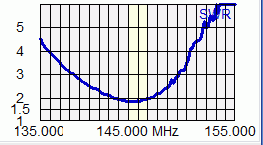
Despite the aspersions cast on the effectiveness of the UV-5R stock antenna, I found that it isn’t half bad. In fact, it is one of the most accurately tuned rubber duck antennas I have come across and performs remarkably well for a 12cm (4.5in.) long antenna. As the SWR plot shows, the VHF resonant point is exactly at 145MHz. I am unable to plot SWR at UHF but I can measure it at a fixed frequency and it was 2:1 at both 145MHz and 433MHz.
 |
| $3.79 antenna |
The $3.79 antenna appeared to be tuned to 154MHz. The tuning is not as sharp as the Baofeng antenna and the SWR at 145MHz was just over 3:1. I measured a similar SWR at 433MHz. The actual SWR of handheld antennas will vary depending on whether the radio is standing on a desk, being held in the hand or worn on your belt so an SWR of 3:1 is nothing to be alarmed about. Even the best HT antenna will exhibit a poor match in some situations.
Measuring SWR can tell you whether an antenna is working as well as it should but it is no guide to on-air performance. After all, a dummy load will have a perfect 1:1 SWR and yet radiate nothing.
I measured the field strength of the signal radiated by the UV-5R at a distance of 1m using both antennas. I also tried a known genuine Nagoya NA-701 which is about the same length as the $3.79 antenna. There was nothing to choose between any of the three antennas at UHF. On 2m the $3.79 antenna was possibly marginally worse than the Baofeng UV-5R standard antenna. The Nagoya NA-701 was 3dB better, equivalent to doubling the transmitter power.
My conclusion after performing these tests is that buyers of the UV-5R (and the UV-3R which comes with an identical stock antenna) should save their money and use the antenna that came with the radio. To try to improve on this involves dabbling in the shark-infested waters of eBay and risking ending up with a worthless fake antenna that will need to be larger to give any improvement in performance. The $3.79 antenna is easily worth its price but it is 3 inches longer than the stock antenna and offers no significant improvement.

Double Dip Weekend August 2012

Homebrew Buddipole inspection
Great weekend of QRP Portable fun. Saturday our Central FL QRP group had some new ops join us and we had a good time comparing antennas and rig setups at Sylvan Lake Park in Sanford, FL. As is typical, we did more talking than operating but did manage to sneak a few qso’s in on 20 and 17 meters. The contesters in Europe were hot and heavy on 15 m too so made for a fun day despite the heat and high humidity. I was a bit disappointed to not be able to snag any fellow Polar Bear QRP ops on 30m but the band did not stay open long and the other stations were operating on alternative bands.
Sunday after church was the first annual NJQRP Skeeter Hunt. So glad to work Skeeter Hunt promoter and fellow Polar Bear, Larry, W2LJ before the lightning ran me off. Larry was my last QSO of the day as a thunderstorm started making LOTS of noise and it was my signal to pull down the 31 ft Jackite and wire and get out from under the shade of the 50 ft tall pine trees down by the lake! YIKES… just made it too!
I ran my Sierra at 2.4 watts out into an end fed half wave suspended as a sloper from the 31 ft Jackite pole in a WNW direction. I normally use the trees to get a bit more height for my wire, but the Jackite goes up and down faster and with storms coming, I chose the simple and fast way to git ‘er done. Turned out to be a good choice. Band conditions were pretty good on 20m and I was hearing a good bit of activity. After 1800 the Caribbean, Central and South American SSB stations were causing a good bit of QRM down here in FL. They all seem to run power and gain antennas so we learn to listen through the chatter here in FL. The approaching storm was obvious as QRN increased with distant lightning stirring up the noise and crashes. Nonetheless, the signals were pretty good despite the distractions and there were some SKCC, FISTS and other cw fans out there having fun too which made the band busy.
I built a simple key and am posting a photo of my K4UPG Knee Cap Key. Used the lid of a bulk black peppercorn jar and made a simple non-iambic key with paper clips, standoff and a bit of wire. It actually worked fairly well, but not good enough to use for the whole contest. As a long time CPG (Contest Point Giver) I decided that was a good way to give myself some points so took advantage of the bonus points! It did inspire me to try a more substantial lid and make a strap to use it as a leg key for portable ops.


Umbrellas for the rig and the op!
It was fun to hear so many familiar calls and work a few of our fellow Polar Bear Ops who were out for the fun too. Sure appreciate the effort to put this event on the calendar and process the results. Thanks to the NJQRP group for the support of our niche in the hobby and to you Larry for the time you devote to contests, blogs and getting us all out and on the air.
Here’s my results before the storm drove me for cover:
| Date | Time | Call | Band | Pwr | RST | RCV | SPC | Nr | |
| 8/12/2012 | 17:12 | N0SS | 20 | CW | 2.4 | 559 | 579 | MO | #122 |
| 8/12/2012 | 17:17 | W0EA | 20 | CW | 2.4 | 559 | 559 | IA | #22 |
| 8/12/2012 | 17:23 | NK9G | 20 | CW | 2.4 | 559 | 559 | WI | #75 |
| 8/12/2012 | 17:25 | VE3WDM | 20 | CW | 2.4 | 559 | 559 | ON | #15 |
| 8/12/2012 | 17:37 | KQ2RP | 20 | CW | 2.4 | 449 | 439 | NJ | #27 |
| 8/12/2012 | 17:39 | AB4PP | 20 | CW | 2.4 | 579 | 599 | NC | #79 |
| 8/12/2012 | 17:42 | N0JRN | 20 | CW | 2.4 | 559 | 559 | MO | 5W |
| 8/12/2012 | 17:46 | N3AO | 20 | CW | 2.4 | 449 | 559 | VA | #109 |
| 8/12/2012 | 17:49 | W4MPS | 20 | CW | 2.4 | 599 | 559 | NC | 5W |
| 8/12/2012 | 18:00 | KR9Z | 20 | CW | 2.4 | 449 | 449 | IL | #10 |
| 8/12/2012 | 18:06 | AA4GA | 20 | CW | 2.4 | 579 | 569 | GA | #2 |
| 8/12/2012 | 18:08 | N7UN | 20 | CW | 2.4 | 579 | 559 | NJ | 5W |
| 8/12/2012 | 18:14 | WF4I | 20 | CW | 2.4 | 559 | 559 | NC | #71 |
| 8/12/2012 | 18:18 | K3RLL | 20 | CW | 2.4 | 449 | 339 | PA | #21 |
| 8/12/2012 | 18:31 | KX0R | 20 | CW | 2.4 | 449 | 359 | CO | #69 |
| 8/12/2012 | 18:36 | W2LJ | 20 | CW | 2.4 | 579 | 599 | NJ | #4 |
A good time was had by me!
72,
Kelly K4UPG
Skeeter hunting fun
I had a real good time during the 1st Annual Skeeter Hunt today, although the outlook appeared bleak from the very beginning. Just as I was heading out the door to go to the park, our vacuum cleaner decided to give up the ghost. It made a real funny noise and a burning smell. I tried troubleshooting it quickly; but it turned out we needed a new one. Of course, my XYL didn’t want to wait; so it was off to Target to buy a new one.
That chore taken care of, I headed to the park (dressed in my WGØAT “Old Goats Rule – QRP Adventures” T-shirt!) – nearly an hour and a bit into the contest. Fortunately, everything after the vacuum cleaner incident went as smooth as butter!
The weather here in Central NJ was gorgeous! A high of about 84F with sunny, blue skies and lots of white, puffy clouds. The humidity was not bad, and the only Skeeters that I had to worry about were the ones on the airwaves.
The wrist rocket got a line up over a pretty high tree branch on my first attempt. The PAR antenna went up without any trouble at all and and didn’t even cause the KX3’s autotuner to even so much as burp – 1:1 SWR on both 20 Meters and 40 Meters. The little box to the right of the KX3 is the PAR matchbox. I used my Whiterook single lever paddle today. And of course, you can see Ol’ Blue, my battery, up there in the upper left hand corner of the camping table.
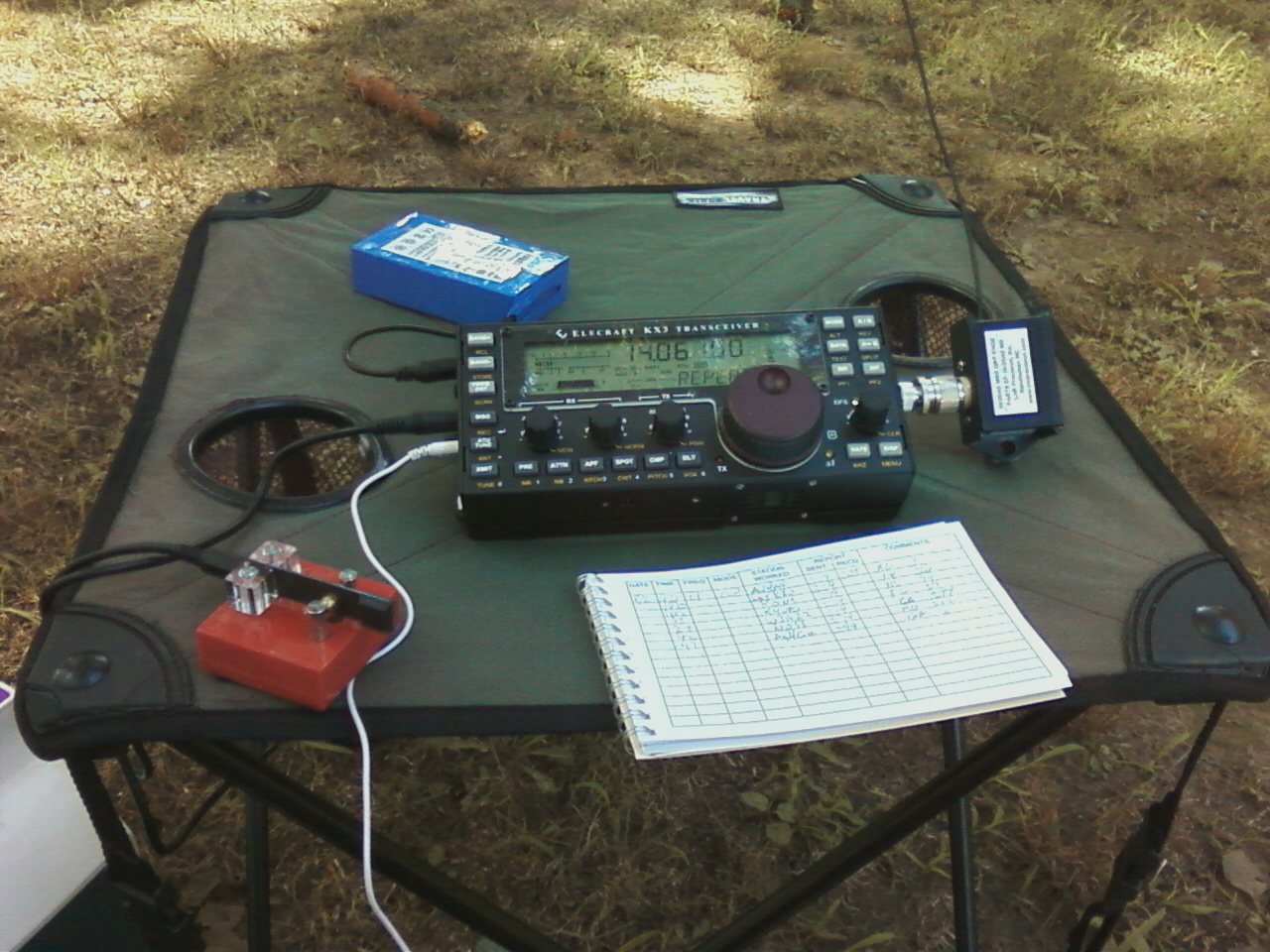
And the good SWR on 20 and 40 was a very good thing, because unlike the Flight of the Bumblebees, I was to find a lot of activity on 40 Meters. In fact, a little after 20:00 UTC, 20 Meters became dominated by European stations and I was barely able to hear any Skeeters on that band after that point.
In all, I managed 28 QSOs – 13 were on 20 Meters and 15 were on 40 Meters. Best DX was working Mike DJ5AV from Germany on 20 Meters at 18:55 UTC. I only got a 529 from him; but there were a lot of strong signals on both bands and I received quite a few 579s to 599s in addition to the “normal” 559s.
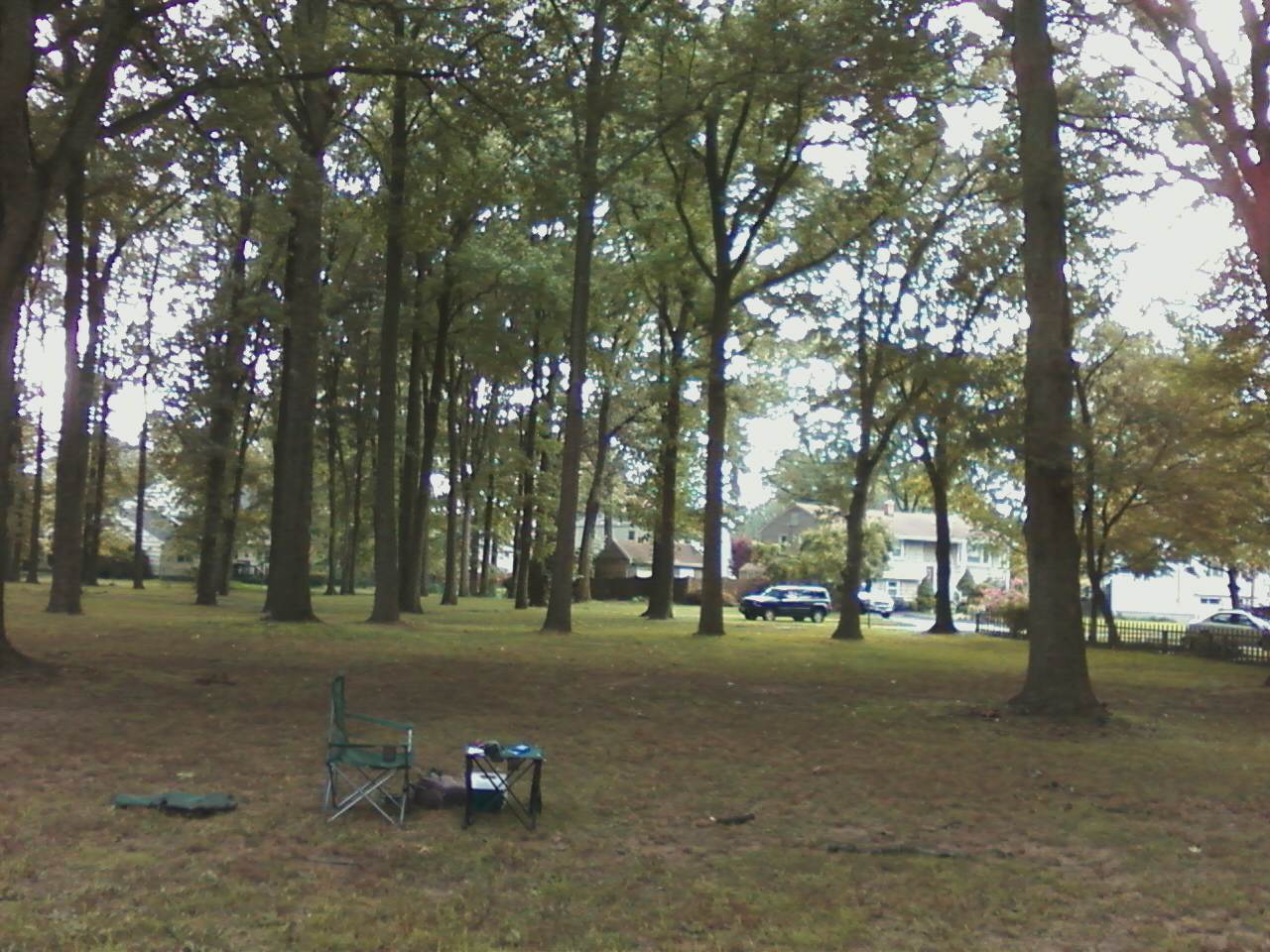
Tear down was just as easy as set up. After the contest ended, I was able to pack up things and be out of the park in less than 10 minutes.
I would like to thank all of you who took the time to participate in this first ever NJQRP Skeeter Hunt. I think a good time was had by all; and this will definitely become an annual Summer QRP event.
Remember, logs are due by September 12th, after which I will post results. Log summaries are fine – details of each QSO are not necessary – but if you want to send a log in that way, that’s OK, too! And any pictures, especially those of you who home brewed keys for the event will be greatly appreciated!
I’ve gotten a few logs in already and I hope to get many, many more. In fact, Jim W1PID, posted another of his great stories today – this one about the Skeeter Hunt:
http://www.w1pid.com/skeeter/skeeter.html
72 de Larry W2LJ
QRP – When you care to send the very least!

Fake or genuine?
Buying radio gear on eBay is like gambling. It’s addictive, but often you lose. You win often enough to keep you coming back in the hope of finding that absolute bargain.
 |
| Is the antenna on the right a fake? |
I thought that I would buy a dual-band handheld antenna that was long enough to have a bit of gain but not too long to use in the shack. (I have several gain antennas but at over a metre in length they are not suitable for indoor use.) I have a Nagoya NA-701 which works very well for its length (22cm) so I thought I would get a NA-771 which is 40cm in length and ought to perform a couple of dBs better. I know only too well that there are a lot of fake antennas on eBay so I bought this one from 409shop, or rather from radiobanker which is one of the eBay IDs used by 409shop. The general consensus is that 409shop is a trustworthy trader and doesn’t sell fake stuff.
When the antenna arrived I was concerned to see that instead of the silver-on-black label showing the make and model number the details were printed on in blue. I have had other fake antennas with printed-on labels, even ones with the same shade of blue so it was not a good omen. When I tried the antenna on one of my handies I found that it performed no better than the much shorter NA-701.
 |
| SWR of the alleged NA-771 |
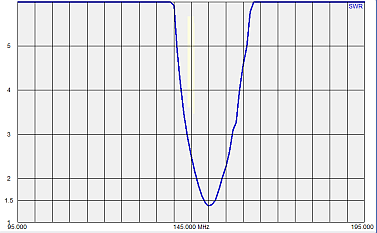
I put it on my AA-200 antenna analyzer and found that the SWR at 145.000MHz was about 4:1. There were two dips to the HF of the 2m band, the best of which was at 195.000MHz with 2.7:1. This is not the worst I have found but it explains why the antenna did not perform optimally.
 |
| SWR of Nagoya NA-701 |
For comparison I looked at the SWR of the NA-701 with the silver-on-black label. This was a really good match – better than 1.5:1 at 150.000MHz though closer to 2:1 at 145.000MHz. Given that the resonance at any given time will be affected by conditions surrounding the hand-held antenna that’s close enough.
So is the NA-771 from radiobanker a fake or not? The plastic sleeve the antenna came in bears a silver hologram label that says “Nagoya”, and the name “Reuex Industrial Co. Ltd.” That is the name of the company that manufactures Nagoya antennas and apparently they do use blue lettering.
So I conclude that this antenna is probably genuine and performs as well as it was meant to, which unfortunately happens to be not as well as I hoped. The Nagoya NA-771 is not worth its extra length.
FYI using an SWR/power meter I measured the SWR of the two antennas at 433.000MHz to be: NA-701 3.4:1, NA-771 4:1.

FOBB 2012
Ol’ Man Murphy seemed to be my constant companion today! I foolishly thought I had everything under control. I was given yet another lesson in humility today.
I got to the park right at about 12:45 – a lot later than intended. Some home things came up, and I had to take care of them first. Really no biggie, but still, an unintended delay.
So I get to the park, and get out the wrist rocket. Load the pouch with my 1 ounce fishing weight, pull back and aim for a convenient branch. Instead of “BWWWWAAAANG”, I got a loud “SNAP”. One of the elastic bands broke. OK, take a deep breath, examine the situation. Thanks to the Swiss Army Knife that I always carry, I was able to make some field repairs that would hold me over. I finally got the wire up like I had it last year. I hooked up the KX3 and could not get a decent match! I have no idea why; but I figured I would worry about that later as I was already seriously into the first hour of the contest.
ALWAYS have a back up! I ran over to the Jeep and pulled out the Buddistick. W3FF’s antenna literally saved my bacon this afternoon. I got it set up and got going, one hour into the proceedings.
After that, the afternoon went well and was a success. I’m never in these things to win – just to have fun and rack up some QSOs. In all, I made thirty contacts. Twenty six were on 20 Meters and four were on 40 Meters. I was a bit disappointed with the lack of activity on 40 Meters. I thought there would be a lot more, especially as the afternoon wore on. I kept checking 7.040 MHz as well as 7.030 MHz, but except for the four QSOs that I made, there was nothing to be heard.
Something to do before the Skeeter Hunt in two weeks.
Figure out why the wires wouldn’t match. AND, make new wires out of something more flexible and light. I was using some wire that I had gotten from an SK’s estate sale that would have been more appropriate for a permanent wire antenna. I need to get something better for portable ops.
The little blue LiPO battery held up great! No problems with it going low voltage on me. By making sure the KX3’s LCD backlight was off, I was able to stay at the full “QRP Gallon” of 5 Watts out for the entire time I operated.
The filtering in the KX3 made an easy job out of working stations that were right on top of each other. In fact, at one point, John K4BAI came back to me informing me that we had already worked each other. John, if you’re reading this, I was working someone else who was so close to you, it was ridiculous. Yet, the KX3 was able to single the other op out for me with no problem.
Even though there was some frustration, the day turned out well. And, no more than a half hour after I got home, the skies got dark, the lightning and thunder started and we had real heavy downpours. But by that time, I was already adding my QSOs to AC Log on this netbook.
Hope you had a great time with FOBB today! Looks like Jim W1PID did – here’s his report:
http://www.w1pid.com/fobb12/fobb12.html
72 de Larry W2LJ
QRP – When you care to send the very least!

Tripod for a WalkHam
Having got an AlexLoop WalkHam antenna I needed some way of holding it up whilst it was in use. After considering ideas like a guyed mast made from plastic pipe I decided the best solution would be a photographic tripod, if only I could devise a way of mounting the antenna on it.
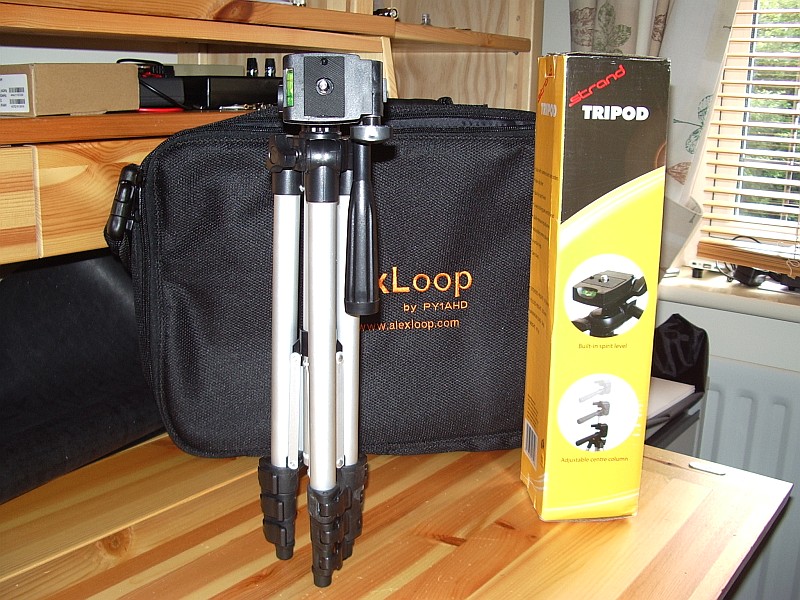
After scouring eBay for a suitable tripod I came across this one from British firm Strand Europe. Unfortunately this won’t be much help if you’re not in Britain as the seller will only post to the United Kingdom.
The tripod is short enough when collapsed to fit inside the WalkHam carrying case – the stumbling block for most of the ones I looked at which were just a bit too long. What’s more, the panning handle can be secured in the vertical position and fits inside the WalkHam’s mounting pole like it was made for it! So no modifications are needed and you can still use the tripod for photography if you want.
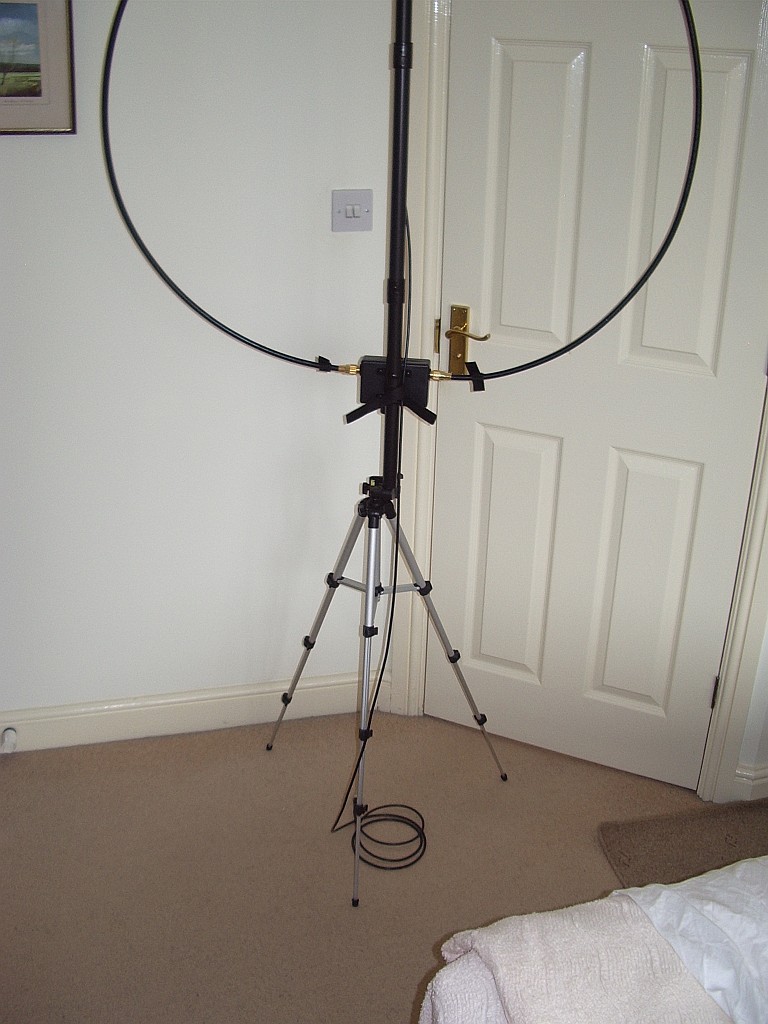
The same day that the tripod arrived I received an email from Alex giving details of his own tripod recommendation. He wrote:
“The perfect tripod is the VIVITAR VIV-VPT-1250. It is a 50” unit and the lightest and most inexpensive VIVITAR unit that can be found for less than U$ 10.00. The secret is take off the camera head with a Phillips screwdriver and leave the aluminum tube on the top. It must be marked with a pencil at 4 inches (12 cms): that is the maximum extension that can be used to introduce something to avoid any pressure on the antenna elements. Without the camera head the tripod can be collapsed and carried inside the antenna bag.”
I couldn’t find the Vivitar for as little as $10 in the UK so I’m content with my purchase. My only reservation is that the tripod is much lighter than the antenna (a good point for the person carrying it of course) and might be inclined to blow over if used in much of a breeze. I’ll find out when I manage to try it! I can’t say whether Alex’s recommended model would be any better in that respect.














