Archive for the ‘antennas’ Category
 More Low Noise Vertical Info
 March 4th, 2015 |
  Author:
 MW DXer, John Bellini in Colorado, has recently posted another interesting set of YouTube videos describing the mechanical construction and operation of his cool, and somewhat stealthy, Low Noise Vertical (LNV) as well as his phaser in action against some IBOC and local blowtorch signals.
His use of the phaser is particulary interesting. Here he demonstrates what two LNV's can do when phased correctly. The second antenna being used is one of his wire LNV's located further back in the yard.
The first video shows phasing against local IBOC crud.
The second video shows the phaser in use to knock down the sideband hash from a strong local (KOA) signal, 25 miles away.
For those that like to DX in real time (unlike those using SDR overnight samplings), the phaser has much to offer.
The one being used in the videos is the Quantum Phaser and more information about it may be found here.
More on phasers next time.
The first video shows phasing against local IBOC crud.
The second video shows the phaser in use to knock down the sideband hash from a strong local (KOA) signal, 25 miles away.
For those that like to DX in real time (unlike those using SDR overnight samplings), the phaser has much to offer.
The one being used in the videos is the Quantum Phaser and more information about it may be found here.
More on phasers next time.
Mission half accomplished
Not really believing it myself, I sit here in the shack at 4:42 AM (0942 UTC), coffee-less and typing into this computer. My plan of getting up early and losing very precious moments of sleep did pan out. I now have K1N in the log!
Knowing I was going to be up super early, I decided to leave the shack computer running, after last night's failed attempt on 40 Meters. We must have had a power failure during the night, because when I got down here, the computer was off. So I re-booted and while waiting for the microprocessor to do it's thing, I turned on the KX3. Lo and behold, K1N had not budged from the frequency that they were on when I left them last night.

On a hunch, I decided to activate the KX3's dual watch, sub receiver. This time, after listening for a bit, I was able to determine the split was a manageable "up 5" (not like last night, where the split was something like "up 10-15 and everywhere in between") and I started sending my call. Within 12 minutes at 0912 UTC, I was in the log. As an aside, let me state outright - my fist at 4:00 AM without coffee was NOT a thing of beauty. Not at all - it was almost like I couldn't get my hand to work right. I was actually staring at it for a few moments wondering "What's going on here? You know how to do this!"
After a few seconds of happy dancing, the shock wore off. "What do I do now? Go back to bed?" I really hadn't expected to be successful so soon. Better judgement was telling me to go back and get a few more Z's before beginning the work day, but Ham judgement took over. "No, since I'm up this early, let's try 80 Meters." You'd do the same thing, right?
K1N's signal was a tad weaker on 80 Meters as compared to 40 meters, but I decided to give it a go, anyway. After listening with the KX3's sub receiver, I was able to determine that again, the split was manageable, and not all over creation. Even better, the K1N op's movements were steady and predictable. At 0938 UTC, I was in the log on 80 Meters! Holy cow! Two bands, within a half an hour of each other! The rest of my day is either going to go extremely well, or it's all downhill from here. The KX3, KXPA100 and my W3EDP did their job for me - thanks Elecraft, and mucho thanks to the K1N ops for digging me out of the pileup.
And yes, as per this blog post title, the mission is only half accomplished. With the remaining time that they are there on Navassa, W2LJ will make another attempt, on another band, to get into their log once again - this time with QRP power. Since K1N probably won't be activated for another 25 years or so, the first goal was just to get them in the log with my new DX Rule - WFWQL (Work First Worry About QRP Later). With that monkey off my back, I can relax somewhat and now try to beat the pileups with 5 Watts.
Hopefully, that will be another interesting story that I will be able to write about.
72 de Larry W2LJ
QRP - When you care to send the very least!
Knowing I was going to be up super early, I decided to leave the shack computer running, after last night's failed attempt on 40 Meters. We must have had a power failure during the night, because when I got down here, the computer was off. So I re-booted and while waiting for the microprocessor to do it's thing, I turned on the KX3. Lo and behold, K1N had not budged from the frequency that they were on when I left them last night.
On a hunch, I decided to activate the KX3's dual watch, sub receiver. This time, after listening for a bit, I was able to determine the split was a manageable "up 5" (not like last night, where the split was something like "up 10-15 and everywhere in between") and I started sending my call. Within 12 minutes at 0912 UTC, I was in the log. As an aside, let me state outright - my fist at 4:00 AM without coffee was NOT a thing of beauty. Not at all - it was almost like I couldn't get my hand to work right. I was actually staring at it for a few moments wondering "What's going on here? You know how to do this!"
After a few seconds of happy dancing, the shock wore off. "What do I do now? Go back to bed?" I really hadn't expected to be successful so soon. Better judgement was telling me to go back and get a few more Z's before beginning the work day, but Ham judgement took over. "No, since I'm up this early, let's try 80 Meters." You'd do the same thing, right?
K1N's signal was a tad weaker on 80 Meters as compared to 40 meters, but I decided to give it a go, anyway. After listening with the KX3's sub receiver, I was able to determine that again, the split was manageable, and not all over creation. Even better, the K1N op's movements were steady and predictable. At 0938 UTC, I was in the log on 80 Meters! Holy cow! Two bands, within a half an hour of each other! The rest of my day is either going to go extremely well, or it's all downhill from here. The KX3, KXPA100 and my W3EDP did their job for me - thanks Elecraft, and mucho thanks to the K1N ops for digging me out of the pileup.
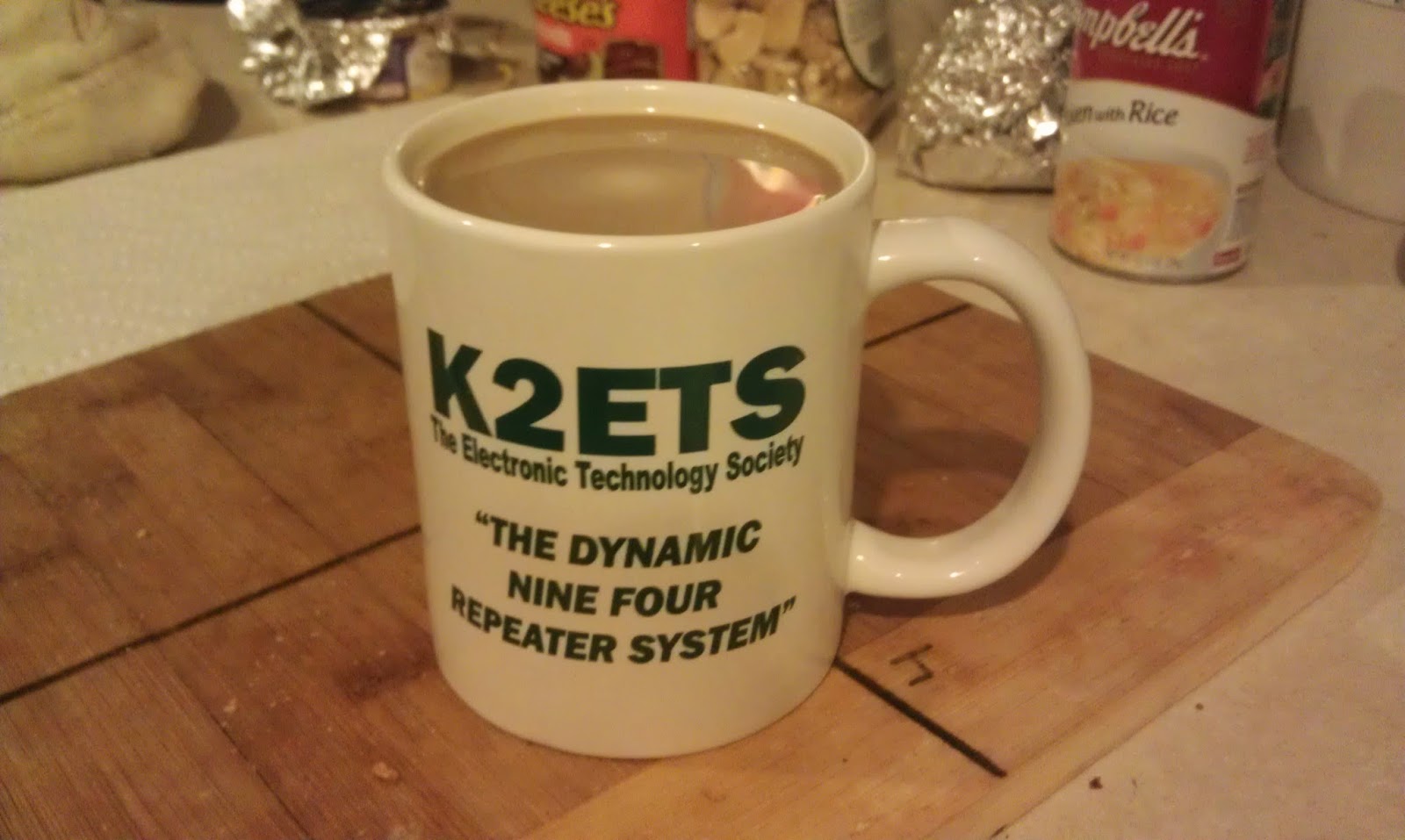
Enjoying a well deserved "Cuppa Joe" after some early morning success!
And yes, as per this blog post title, the mission is only half accomplished. With the remaining time that they are there on Navassa, W2LJ will make another attempt, on another band, to get into their log once again - this time with QRP power. Since K1N probably won't be activated for another 25 years or so, the first goal was just to get them in the log with my new DX Rule - WFWQL (Work First Worry About QRP Later). With that monkey off my back, I can relax somewhat and now try to beat the pileups with 5 Watts.
Hopefully, that will be another interesting story that I will be able to write about.
72 de Larry W2LJ
QRP - When you care to send the very least!
FYBO 2015 – this Saturday!
Freeze Your B____ Off 2015 is this coming Saturday - the opening event of the 2015 Outdoor QRP Operating season! If the weathermen are correct, and these days, who knows? Anyway, if the weathermen are correct, Saturday will be the last day before a significant three day snow event here in Central New Jersey. As of right this second, the forecasted high temperature for Saturday is expected to be 39F (4C), with overcast skies. That would be a 4X multiplier at the very least.
So I have several options. I can operate from outdoors - probably the picnic table in the back yard, but that's still covered with ice from last Monday's ice storm - it's never gotten above freezing since that nasty little clipper came through here. I can also operate from inside the Jeep. The advantage there is that all I have to do is plop the Buddistick on the roof - after I chip away the ice that's still on the top of it! But, with the heat off, the temperature inside the Jeep will be the same as the outdoors. Operating in this manner wouldn't qualify for the Mobile category, but it would be much dryer than the picnic table. I have time to decide - there's no hurry, and it will depend how adventurous I feel and how clogged up my head is on Saturday. Don't want this slight head cold that I am dealing with to develop into bronchitis or something worse.
FYBO rules haven't changed much, with the exception that this year, teams are being allowed. Here's the URL for the page with the latest rules posting: http://www.azscqrpions.com/fybo2009rules.html
I guess I should make sure all my batteries are charged up for this weekend!
72 de Larry W2LJ
QRP - When you care to send the very least!
So I have several options. I can operate from outdoors - probably the picnic table in the back yard, but that's still covered with ice from last Monday's ice storm - it's never gotten above freezing since that nasty little clipper came through here. I can also operate from inside the Jeep. The advantage there is that all I have to do is plop the Buddistick on the roof - after I chip away the ice that's still on the top of it! But, with the heat off, the temperature inside the Jeep will be the same as the outdoors. Operating in this manner wouldn't qualify for the Mobile category, but it would be much dryer than the picnic table. I have time to decide - there's no hurry, and it will depend how adventurous I feel and how clogged up my head is on Saturday. Don't want this slight head cold that I am dealing with to develop into bronchitis or something worse.
FYBO rules haven't changed much, with the exception that this year, teams are being allowed. Here's the URL for the page with the latest rules posting: http://www.azscqrpions.com/fybo2009rules.html
I guess I should make sure all my batteries are charged up for this weekend!
72 de Larry W2LJ
QRP - When you care to send the very least!
The storm that wasn’t
By now, most of you have heard that, at least in the New Jersey area, "The Blizzard of 2015" has turned out to be a big bust. The forecasters were warning us of 18-24 inches (45-60 cm), plus. Instead what we actually received was about 4 inches (10 cm).
I am one of the ones who is not disappointed. I would much rather have the weatherman tell me I am going to get 24 inches of snow, and only get 4, as opposed to the other way around. Meteorology is an art, even to this day. To anyone who is forcing the weather people to eat crow today, I say, "Let's see YOU try it for a while!". I am hearing so many people say, "Oh yeah, I knew from the beginning it wasn't going to be that bad." Yeah ..... right.
Listening to New England stations coming through Echolink on the local repeater, I understand they are getting hammered, as predicted. Stay safe, warm and dry, my friends.
Even though we didn't get the snow, we did get the cold and the winds. Not gale force winds, but when I was out there shoveling snow, I was chilled to the bone. And the whole time I was removing snow, I was dreaming of something like this:
Thanks to Sean KX9X for posting this. Some portable outdoor QRP in a nice, warm sunny location is EXACTLY what the doctor ordered, right about now.
On a side note, the office was declared closed for the day last night, when the ominous forecast was still hovering over us. So when the snow stopped this afternoon, having some time available, I went out and switched the coax from the EDZ over to the W3EDP. Much to my relief, the W3EDP hears fine again! It loads up easily on every band and the KX3's auto tuner handles it with nary a whimper.
As it turns out, the coax problem on the W3EDP was entirely may fault. When I went to disconnect the coax from the balun at the end of the W3EDP, I noticed to my horror, that I had never sealed the connection. It's no wonder that water got in there. This time, I double coated the connection with tape, added some plumber's putty over that, and added a final layer of tape. If the W3EDP plays as well as I think it will, I may just end up taking down the EDZ this Spring and keeping the W3EDP as my primary wire antenna.
72 de Larry W2LJ
QRP - When you care to send the very least!
I am one of the ones who is not disappointed. I would much rather have the weatherman tell me I am going to get 24 inches of snow, and only get 4, as opposed to the other way around. Meteorology is an art, even to this day. To anyone who is forcing the weather people to eat crow today, I say, "Let's see YOU try it for a while!". I am hearing so many people say, "Oh yeah, I knew from the beginning it wasn't going to be that bad." Yeah ..... right.
Listening to New England stations coming through Echolink on the local repeater, I understand they are getting hammered, as predicted. Stay safe, warm and dry, my friends.
Even though we didn't get the snow, we did get the cold and the winds. Not gale force winds, but when I was out there shoveling snow, I was chilled to the bone. And the whole time I was removing snow, I was dreaming of something like this:
Thanks to Sean KX9X for posting this. Some portable outdoor QRP in a nice, warm sunny location is EXACTLY what the doctor ordered, right about now.
On a side note, the office was declared closed for the day last night, when the ominous forecast was still hovering over us. So when the snow stopped this afternoon, having some time available, I went out and switched the coax from the EDZ over to the W3EDP. Much to my relief, the W3EDP hears fine again! It loads up easily on every band and the KX3's auto tuner handles it with nary a whimper.
As it turns out, the coax problem on the W3EDP was entirely may fault. When I went to disconnect the coax from the balun at the end of the W3EDP, I noticed to my horror, that I had never sealed the connection. It's no wonder that water got in there. This time, I double coated the connection with tape, added some plumber's putty over that, and added a final layer of tape. If the W3EDP plays as well as I think it will, I may just end up taking down the EDZ this Spring and keeping the W3EDP as my primary wire antenna.
72 de Larry W2LJ
QRP - When you care to send the very least!
Good TP On Medium Wave (BCB)
 Early morning (Jan 22) saw BCB conditions vastly improved over what they have been for most of the season. Because I am on the wrong (none-Pacific) side of Vancouver Island, as well as on the eastern shores of Mayne Island, I usually don't listen for Asian signals on my Perseus recordings but a quick check of Thursday's recordings revealed some very solid signals from many Japanese stations, as well as Korea. Most signals were strongest at around 1500Z (7 a.m. local) but were first audible from about 1200Z.
Three of the good performers are shown in the video below:
- JOBB 828KHz NHK2 Osaka
- JOAK 594KHz NHK1 Tokyo
- HLAZ 1566KHz Jeju, South Korea / Far Eastern Broadcasting Company
Numerous other signals, reaching similar strengths were audible throughout the broadcast band on their 9KHz-spaced channels. Interestingly, I had configured my LF inverted-L into a temporary version of a low noise vertical (LNV) by removing all of the loading coil and feeding with an isolating impedance matching transformer. I rather suspect that in this mode it is acting as a normal quarter-wave inverted-L however as its self-resonant frequency, without any loading, is around 1200KHz. Today's conditions were much poorer but several Asian signals were heard once again.
Should conditions improve, the next time I will use my large loop oriented to favor Japan and also take advantage of its ability to null many of the local blowtorch signals from Vancouver, off to the side.
Ring that school bell!
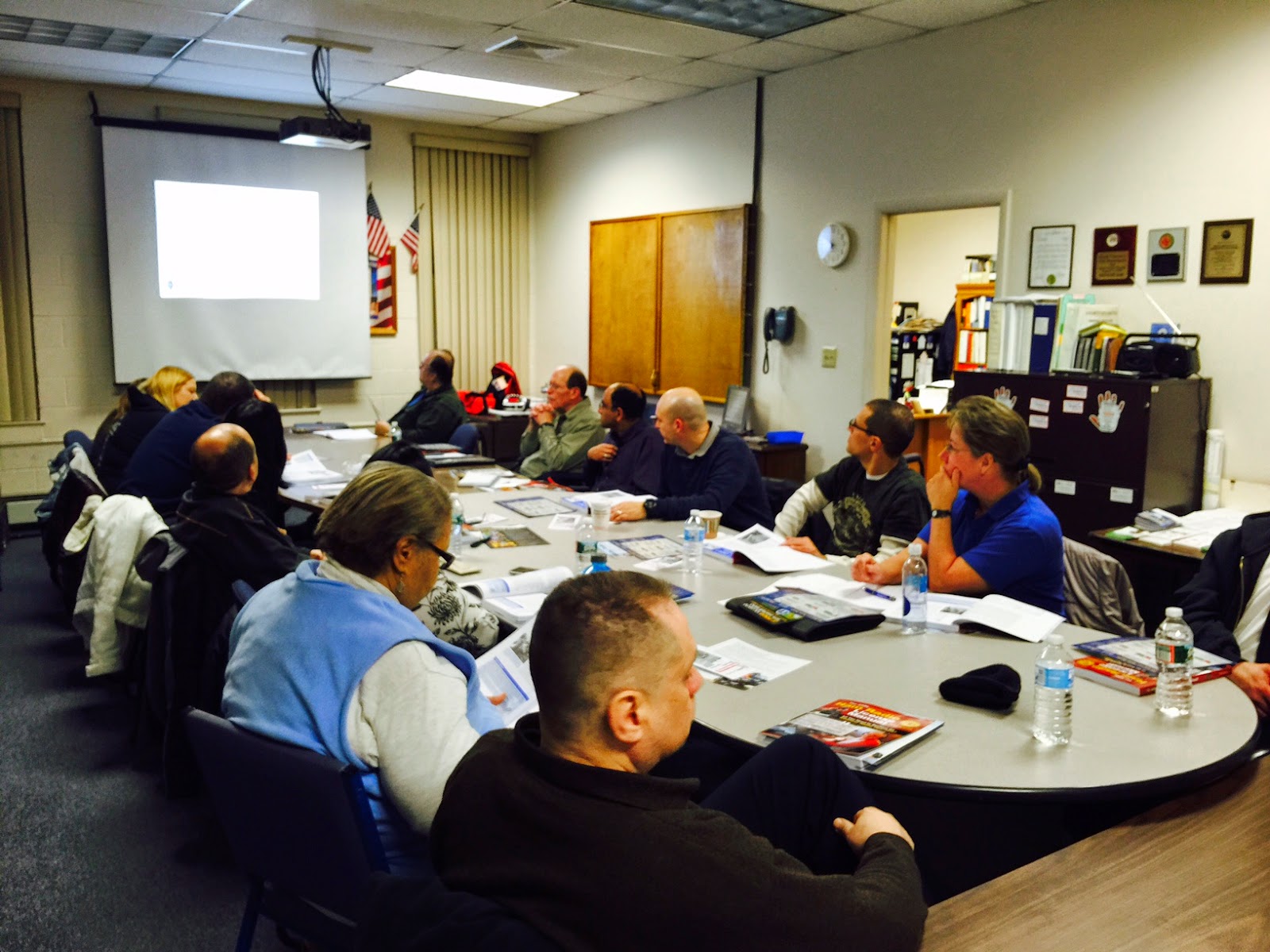
Our second Technician License class started last evening. This time, instead of being open to just the "public", this one is primarily intended for the Clark, NJ CERT Team. Drew W2OU, Marv K2VHW and yours truly met with, introduced ourselves to, and began the process of instructing 15 potential new Hams.
.jpg)
It's always fun and exciting to be with a group of people who show genuine interest in Amateur Radio, as was the case last night. All of these folks showed enthusiasm and curiosity and an eagerness to learn.
We will become "buddies" over the course of the next seven Tuesday evenings, and hopefully after that, we will add more people to the ranks of Amateur Radio.
And if the teaching gig isn't enough, I was thinking of home brewing a magnetic loop this winter. My line of thinking is that I could build one for let's say 40-10 Meters. From what I understand they're not huge. Then, when it gets really frosty in the basement, I could just set the loop up on the main floor and operate temporarily from the dining room table or something like that. Just a thought, though, as funds are kinda tight. I have some spare coax (enough for a loop), and I think the only expense at this point would be the tuning capacitor. It doesn't need to be one of those expensive vacuum jobs, so maybe I can find something reasonable on eBay.
My inspiration for this has been Greg, N4KGL. I've been following his posts on Google+ and through his blog. He seems to be having so much success with his loop that it seems like a worthwhile endeavor. That, and the fact that I feel like building something.
72 de Larry W2LJ
QRP - When you care to send the very least!
It's always fun and exciting to be with a group of people who show genuine interest in Amateur Radio, as was the case last night. All of these folks showed enthusiasm and curiosity and an eagerness to learn.
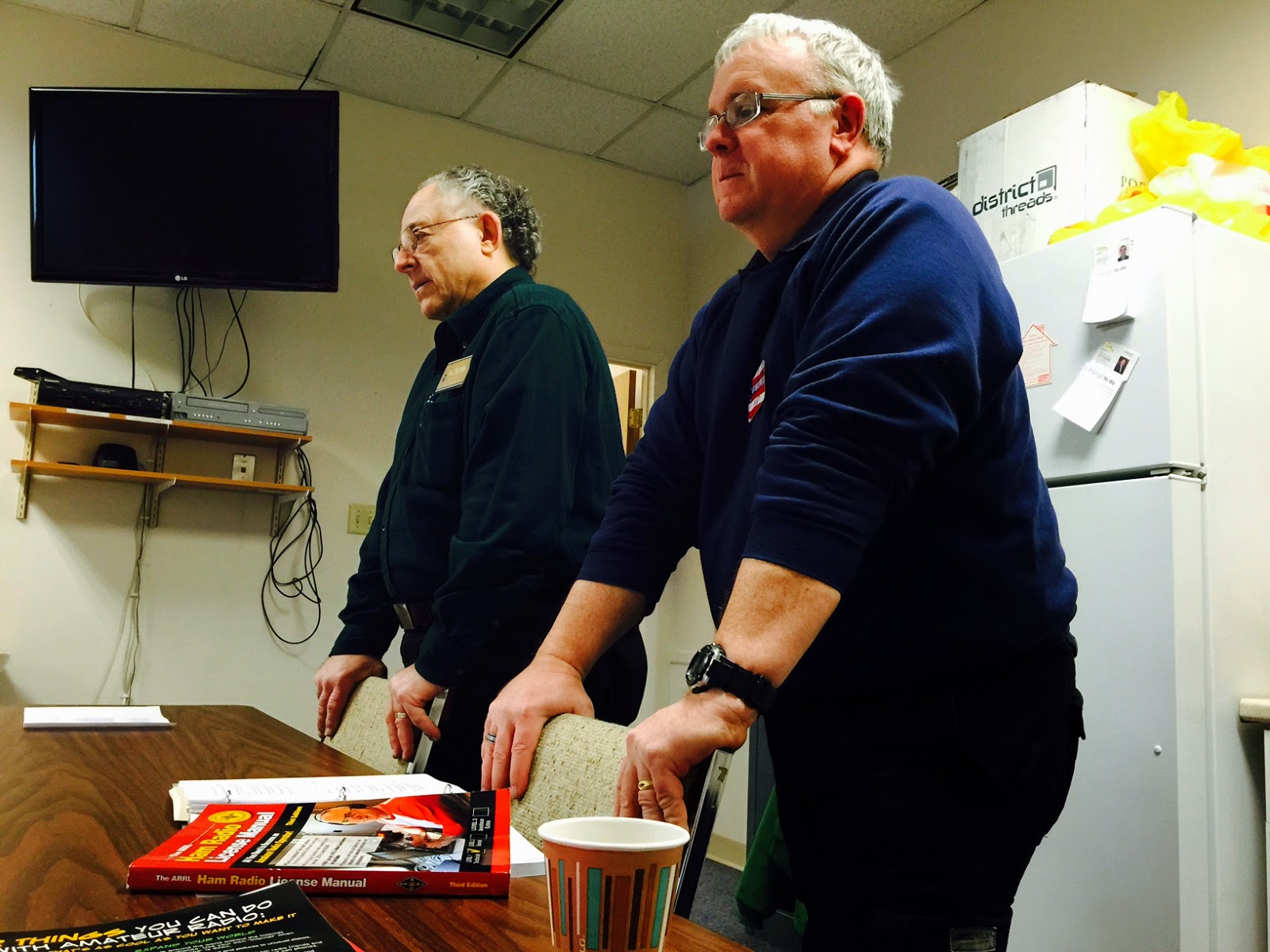
That's Marv K2VHW on the left and W2LJ on the right.
Notice the coffee cup - gotta have cup of coffee before class, after a long day at work!
Notice the coffee cup - gotta have cup of coffee before class, after a long day at work!
We will become "buddies" over the course of the next seven Tuesday evenings, and hopefully after that, we will add more people to the ranks of Amateur Radio.
And if the teaching gig isn't enough, I was thinking of home brewing a magnetic loop this winter. My line of thinking is that I could build one for let's say 40-10 Meters. From what I understand they're not huge. Then, when it gets really frosty in the basement, I could just set the loop up on the main floor and operate temporarily from the dining room table or something like that. Just a thought, though, as funds are kinda tight. I have some spare coax (enough for a loop), and I think the only expense at this point would be the tuning capacitor. It doesn't need to be one of those expensive vacuum jobs, so maybe I can find something reasonable on eBay.
My inspiration for this has been Greg, N4KGL. I've been following his posts on Google+ and through his blog. He seems to be having so much success with his loop that it seems like a worthwhile endeavor. That, and the fact that I feel like building something.
72 de Larry W2LJ
QRP - When you care to send the very least!
The Low Noise Vertical
 There's been a lot of discussion lately on the Yahoo Groups ndblist regarding the "low-noise vertical" (LNV) and it's seemingly excellent performance. Originally described by Dallas Lankford as a good performer from LF to SW, ndblist member, Phil (KO6BB), recently refurbished his earlier built 'LNV', but this time with better feedline and appropriate ferrite cores for the antenna's matching transformers. Some of his description appears below.
To recap. I put the LNV up last spring to overcome the bad IMD products
from local BCB stations I was seeing in the LF region when using the
Roelof Active Whip located about 36 feet AGL. The low noise vertical is
... about 30 feet of antenna, set at roof-line level in this mobile home. As I wasn't sure how well the antenna would perform, I first made it a "Zero Dollar" project, using items I had on hand. Those items included two toroid cores salvaged from a defunct computer PS. I figured that since the supplies operate in the kHz range (as witness what a dirty supply will do to your LF reception), they would be suitable for at least a trial run of the antenna. The balanced feedline was some CAT6 cable I had on hand.
The antenna was a great success, because while it had much lower signal
output than the active whip, it also had ZERO IMD from the BCB stations,
and also less local 'junk' (read noise). The tunable pre-amp I use more
than made up for the lower output of the antenna, after all Signal/Noise
ratio is EVERYTHING in this hobby, NOT how high you can make the "S"
meter read.
The central valley summer heat (often in the 100's) took it's toll on
the CAT6 feedline outer jacket insulation, and while it still seemed to
work OK, I figured that it wouldn't be long before water started to get
into the line and probably degrade it in rainy/foggy weather.
Anyway, I went ahead and ordered the proper toroid coils I needed along
with 25 feet of nice 300 Ohm foam twinlead, and got a couple plastic
boxes to put it all in and made the toroid units. While I was at it ordered
two Amidon FT193-J toroid cores to complete the LNV the way I REALLY wanted to.
Today I installed it all, putting a heavy twist in the feedline to try
to reduce any stray noise pickup on the balanced feedline. I'd say
probably not likely but why take a chance.
OK, here are the results. I took signal level readings of eight 24/7
stations, both before and after changing out the wiring/baluns. The
bottom line is, the new antenna IS an improvement in the NDB range,
tapering off slightly at the high end of the broadcast band. Yeah, it's
'only' a couple "S" units at it's best, but when you're digging for that
weak NDB even 1 "S" unit is a LOT! I'm going to 'assume' 6dB per "S"
unit as I have calibrated the "S" meter of the R-71A receiver.
NOTE: This is 'fuzzy' math, don't take them as 'exact' on the dB readings.
FREQUENCY BEFORE AFTER DIFFERENCE
203 TCY S2 S4 2 S units (12dB)
205 COT S3 S5 2 S units (12dB?)
344 FCH S9+7 S9+15 (8dB)
374 LV S6 S7 1 S unit (6dB)
580 BCB Sta S9+35 S9+38 (3dB)
770 BCB Sta S9+32 S9+32 No Change
880 BCB Sta S9 S9 No Change
1450 BCB S9+10 S9+5 (-5dB)
SO, it looks like the antenna is definitely an improvement where I'm
REALLY interested in it (the NDB band). I could have probably tailored
the toroids for maximum performance, but just used the 81:9 turns ratio
on the outdoors (antenna) and 9:9 on the indoor unit as I'm FAR too lazy
to run up and down the ladder to remove the toroid box, change turns and
retry it again!!!
Some additional notes.
NOTE 1. I have three ground rods dedicated to just this antenna, two 8
footers and a 4 footer. While I was playing with the antenna taking
readings AFTER the work, I disconnected one of the 8 foot rods to see
what effect that had. Signal levels dropped approximately an "S" unit
across the board. So GOOD grounding on this antenna does make a difference!
NOTE 2. I'm NOT exactly sure why it happened, but after the antenna
work here, there was even LESS "local grunge" in the background than
before, even with the stronger signals, making for even better copy on
weak ones than I otherwise expected. . . It DOESN'T make sense to me,
but then, antennas ARE the magic art.
It appears that the grounding plays some importance in the performance of this "non-resonant" aperiodic antenna and the fact that it is non-resonant on the frequencies of interest likely also plays an important part in its good S/N performance.
Several years ago I noticed something similar. My own 10' tuned air-core loop made an excellent receive antenna on 160m, even though the loop was tuned to around 300KHz! Although signal strength was several S-units below my transmitting antenna, the loop was extremely quiet and weak signals were much easier to copy ... In fact I often heard signals on the mis-tuned loop that I could not hear on my resonant half-sloper radiator.
Another ndblist proponent of the low noise vertical is John, in Colorado, who employs three ... one of them a great-looking tilt-over version. The tilt-over is nicely demonstrated in his short you tube video below.
The antennas are also used in combination via his Quantum Phaser, when DXing the broadcast band. The excellent phasing results can also be seen in his short video, while using a wonderful, like new, Hammarlund SP-600 JX.
Dallas Lankford's original article may be found here, while an earlier more encompassing discussion will be found here. A third Lankford article, discussing 'Signal To Man Made Noise Ratios' and comparisons of various receiving antennas, also makes for interesting reading.
Perhaps the 'LNV' might be the antenna you're looking for to boost your LF/MW reception.













