Author Archive
 1937 Marconi Restoration
 July 3rd, 2014 |
  Author:
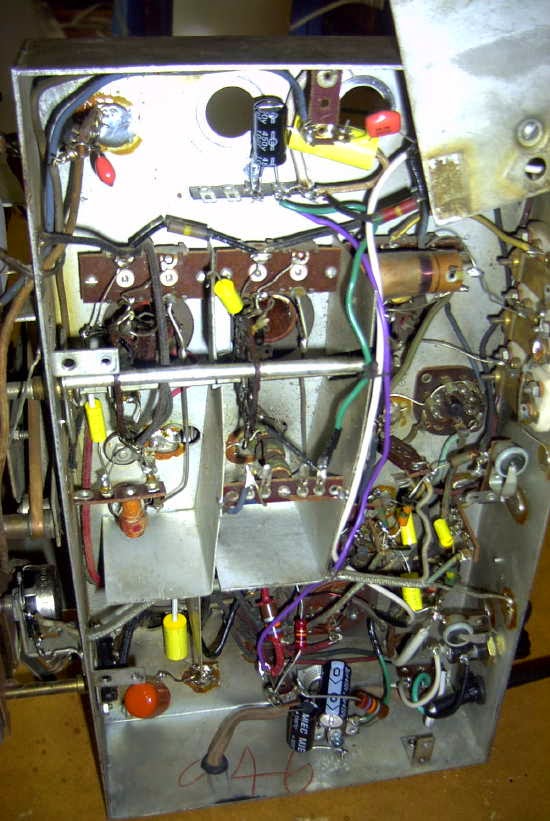
The radio also had two small fixed bias cells....small 1.25V cells for supplying grid bias voltage to the AVC/IF stages.
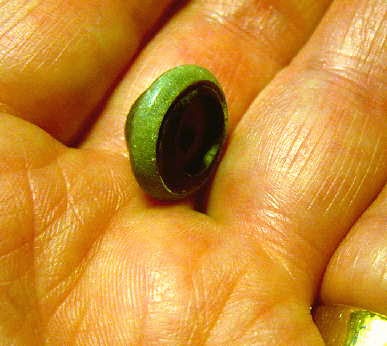
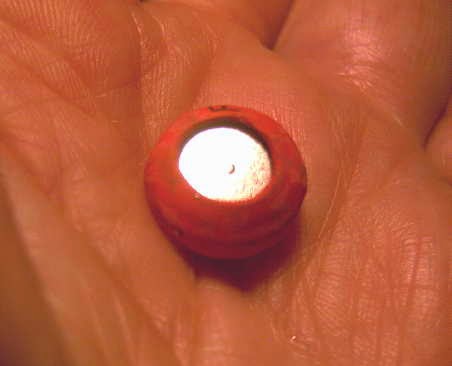
Both cells had long ago dried so I tried to rejuvenate them by following a procedure found on the web. The zinc casing was carefully pried up to remove the carbon covering disc and a few drops of distilled water were added to the dried-up crystals inside before re-sealing the case. The initial cell voltage of .11 VDC rose to 1.2 VDC after the procedure but I wasn't confident that the new 'seal' would keep air from drying the electrolyte out.
I decided to use small camera batteries (1.5VDC) in place of the original cells since they were very close to the same size. With heat shrink tubing surrounding the edges and bottom lip, they readily installed on top of the original holder and clamped solidly in place.
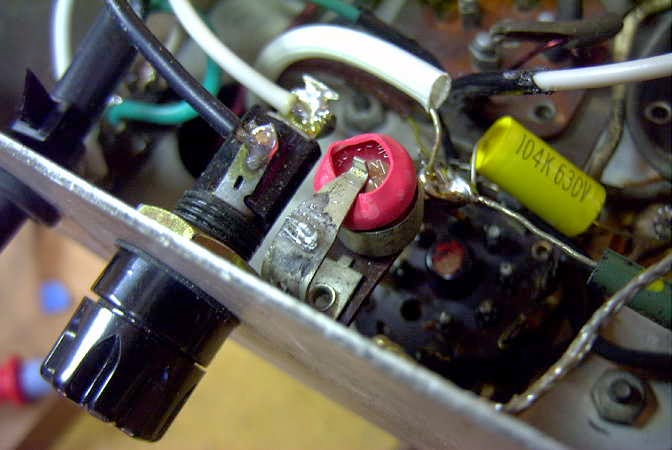
A small brass spacer was inserted into the cell holder to make contact with the bottom of the new cell.
I was pleased to hear how well the radio performed after all of the changes. I have attempted to record a short video (for the first time) using my I-Pad and then converting the video to mpeg format as well as trimming it slightly in newly-installed Windows Moviemaker freeware. Hopefully my videos will get better with practise!
Marconi Model 83 with 3' wire antenna
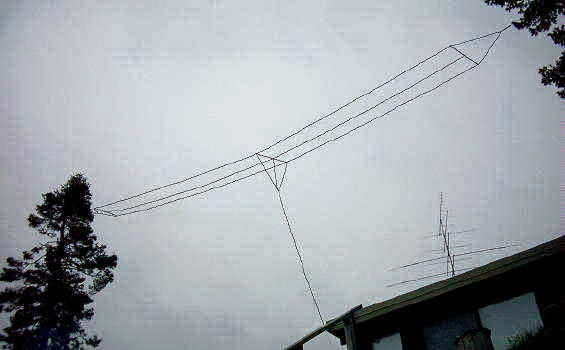
My neighbour will be pleased as the radio belonged to her grandfather and she remembers listening to it a lot as a child. She has been kind enough to let my hang my 100' three-wire LF flattop over the top of her house and property to a tree on the far side of her lot....now that's a good neighbour!
While on a roll I also cleaned and re- capped a mid 50's 'All American Five', Sylvania (model 515) that another neighbour had given me several years ago. It was so dirty and grimy when first received that it was hard to even tell what color it was. Two tubes were also replaced. It now resides on the kitchen counter and is sounding great, playing oldies only!
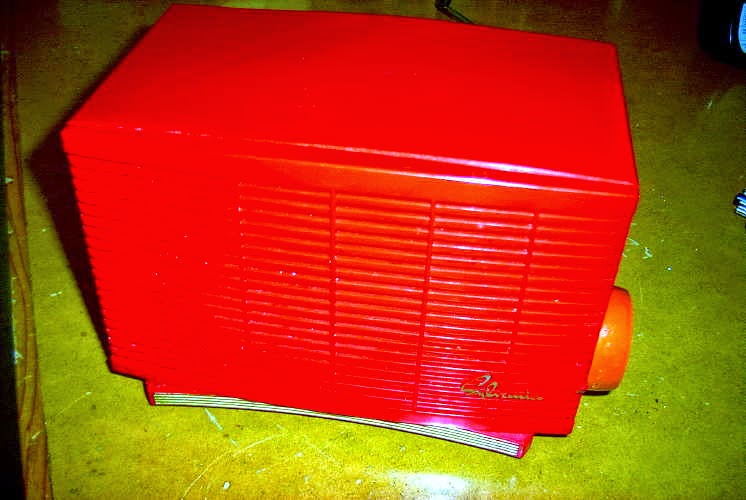 |
| My restored Sylvania 515 |
Happy Canada Day!

We always celebrate Canada Day with a large block party in our front yard by the beach, every July 1st.....pot-luck and lots of good food. The normal attendance is around seventy people but this year we may have a few less as it falls on an odd day. We have done this for the past 23 years and so far have never had rain. Today the weather is perfect once again here on Mayne Island.
Happy Canada Day Canada!
6m Action
It seems that my whining about the poor Es this season has paid off. This afternoon we had the best east-west opening of the season with strong signals from all U.S. mainland call districts. The opening lasted for several hours and into the early evening with many 1's, 2's and 3's worked as well as several VE3's, which is always a rare treat. During openings like this, I always monitor the rising Es muf with a separate R-7000 receiver, squelched on one of the normally quiet FM channels. At times the Es muf was well into the FM broadcast band but despite watching 144.200 and calling CQ regularly, there was no sign of 2m Es today.
Hopefully the good propagation will continue during the next few weeks and our somewhat disasterous season can yet be saved.
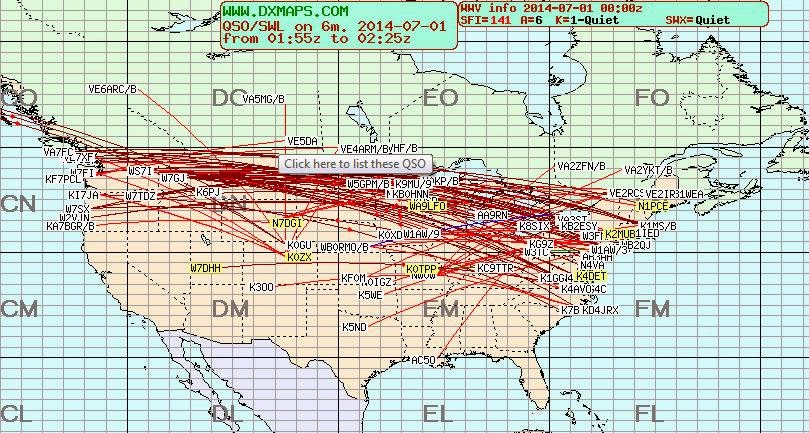 |
| Courtesy: DXMAPS.COM |
Where Are The Es ?
 |
| Courtesy: DXMAPS.COM |
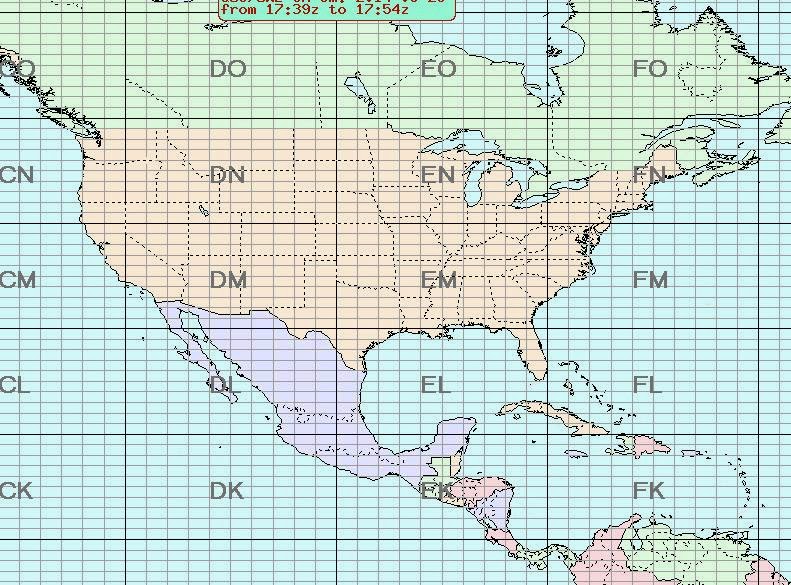
Having been on 6m now for over 40 years (yikes!), like most 6m operators I've come to expect a fairly good number of Es openings by the end of June. This summer's Es season has been beyond poor, with far too many days looking much like Saturday morning's 6m propagation map (above) from DX Sherlock.
So far, the only bright spot for me has been a very short twenty-minute opening to Argentina and a CW QSO with LU5FF on May 24 at around 1500 hours local time.

Most 6m ops feel that sunspot cycle peak years also produce poorer than normal Es activity so maybe this is all just normal...or perhaps our global climate shifts are having an effect on the triggering mechanisms for Sporadic-E, just 60 miles above our heads.
Real-time 6m propagation can be followed here; Region 2 for North America and Region 3 for Europe.
After so many summers on six, I personally believe that the best propagation usually happens during the first week of July, so there is still hope for a really terrific month ahead and still time for whoever controls the magic to yet redeem themselves.

630m….Our Newest Band’s Great Heritage
Listening and working on 630m over the past few weeks was not my first exposure to this part of the spectrum. Years ago I spent many hours listening to maritime traffic on 500KHz CW on a little Sony ICF-2010 and an outboard ferrite bar loop antenna. 500KHz was the International MF distress frequency as well as the calling frequency for ship-to-shore CW traffic. Ships calling land stations would be directed to 'QSS' to a working frequency once they had established contact on 500. These working frequencies were smack in the middle of what is now our 630m amateur band.
On winter nights with good propagation, I could often hear ships out near Hawaii or down in the Gulf of Mexico. Even better nights would produce ships along the eastern U.S. seaboard. Our new band has great potential for some exciting DX opportunities...much more so than the 2200m LF band. Hopefully the U.S. will get the band soon. In the meantime, it is up to Canadians to get the North American ball rolling!
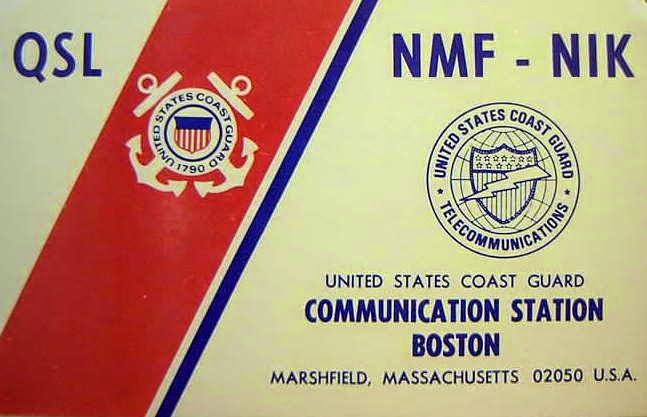
Big signals from the land stations, particularly those operated by the USCG, dominated the band. Digging into my old QSL collection turned up a number of cards from '500'.

From what I could tell, most of the ship Radio Officers used a hand key on the MF transmitter while on HF, most used bugs or keyers. The quality of hand-keyed CW ranged from perfection to abysmal and some nights it sounded as though the ship's oiler had been strapped to the seat and told to send CW. Most traffic consisted of provisioning requests or berthing information, as ships usually only used MF when arriving or departing their port.
The ship's RO would often respond to a 'reception report' and happily fill in a prepared QSL. The cards were often returned with pictures and long handwritten letters, describing their radio equipment or life at home.
Although CW Maritime operations have long been discontinued, the 'Primary' user of the 630m band is still the Maritime Service!
In the US and in Canada, the 472-479 kHz band is part of the larger 435-495 kHz segment allocated on a primary basis to the Maritime Mobile Service and on a secondary basis for government Aeronautical Radionavigation.
I'm not exactly sure what the Maritime is doing on MF these days or what they plan to do, but I suspect it may be related to DGPS activity down the band. Canadian amateurs are Secondary users of 630m and as such, must not create interference with the primary user. I suspect that it might not be a great idea to create interference with the secondary users as well, although there are no NDB's in this section of the band in North America.
On winter nights with good propagation, I could often hear ships out near Hawaii or down in the Gulf of Mexico. Even better nights would produce ships along the eastern U.S. seaboard. Our new band has great potential for some exciting DX opportunities...much more so than the 2200m LF band. Hopefully the U.S. will get the band soon. In the meantime, it is up to Canadians to get the North American ball rolling!
Big signals from the land stations, particularly those operated by the USCG, dominated the band. Digging into my old QSL collection turned up a number of cards from '500'.
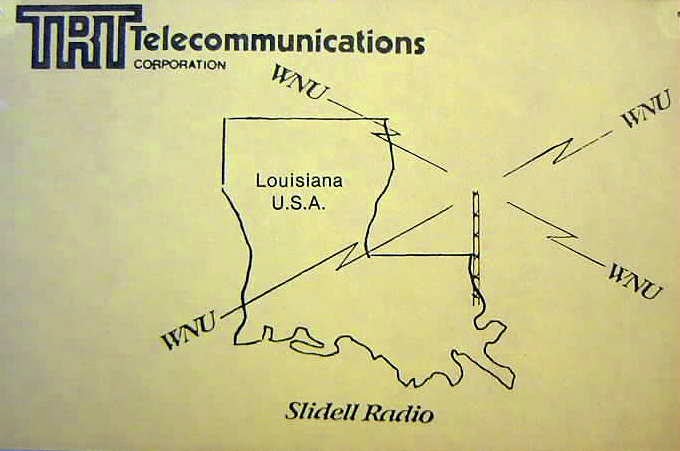 |
| WNU - Slidell Louisiana |
From what I could tell, most of the ship Radio Officers used a hand key on the MF transmitter while on HF, most used bugs or keyers. The quality of hand-keyed CW ranged from perfection to abysmal and some nights it sounded as though the ship's oiler had been strapped to the seat and told to send CW. Most traffic consisted of provisioning requests or berthing information, as ships usually only used MF when arriving or departing their port.
The ship's RO would often respond to a 'reception report' and happily fill in a prepared QSL. The cards were often returned with pictures and long handwritten letters, describing their radio equipment or life at home.
 |
| M/V Belforest - Bulk Carrier |
Although CW Maritime operations have long been discontinued, the 'Primary' user of the 630m band is still the Maritime Service!
In the US and in Canada, the 472-479 kHz band is part of the larger 435-495 kHz segment allocated on a primary basis to the Maritime Mobile Service and on a secondary basis for government Aeronautical Radionavigation.
I'm not exactly sure what the Maritime is doing on MF these days or what they plan to do, but I suspect it may be related to DGPS activity down the band. Canadian amateurs are Secondary users of 630m and as such, must not create interference with the primary user. I suspect that it might not be a great idea to create interference with the secondary users as well, although there are no NDB's in this section of the band in North America.
Using The KØLR ‘Antenna Meter’ on 630m
If you plan to become active on Canada's new 630m ham band, one of the first things you're probably thinking about is an antenna and how to make it resonant. Without the proper instruments, determining antenna resonance below the broadcast band can sometimes require a combination of good luck and black magic!
One of the most useful pieces of gear for me has been a simple 'antenna meter' designed by Lyle Koehler, KØLR, who was very active at one time on the 185KHz 'lowfer' band. Although the original circuit was designed to cover a lower frequency range, it can easily be modified to cover the 2200m and 630m bands.
The device is actually a low power (~1/2w) VFO-controlled transmitter designed to look into a 50 ohm antenna system. Since most LF antennas are matched to 50 ohms, either through a separate matching transformer or by tapping up from the bottom of the antenna's loading coil, the 50 ohm feedline from the antenna system is simply connected to the antenna meter's output and the VFO tuned for maximum deflection of the meter. The resonant frequency is then directly read from the calibrated scale of the antenna meter's dial. With most backyard LF antennas having a very narrow bandwidth along with a high-Q, the meter peak is quite sharp and easy to find. Look for a peak meter reading between 50-70ma as you sweep the VFO across the antenna. Normal current values will be very low until resonance is hit.
KØLR's original article gives more details and can be found here.
The 470pf capacitor (C in my diagram) determines the basic frequency range. To modify the circuit for dual range (both 2200m and 630m), I added a SPDT switch at pin 1 of the IC so that I could switch the value of "C". For coverage down to and below 136KHz, I used ~ 725pf (a 680pf + 47pf in parallel) while high end coverage up past 500KHz required just 250pf (220pf + 27pf in parallel). These values should get you very close to the required ranges and once installed it is an easy task to calibrate the tuning scale by listening to the signal on a receiver or measuring it with a frequency counter. I also chose to install the 1M 'modulation' resistor that gives the signal a distinctive FSK note.
The meter will quickly tell you if your antenna is too high in frequency (capacitive) or if it is too low (inductive) so that the proper corrective measures may be taken to resonate it within the 630m band. Once resonant, attention can then be paid to bringing the impedance match as close as possible to 50 ohms and a 1:1 match. Depending on your method of impedance matching, there may be some interaction between tuning for resonance and impedance matching but a perfectly resonant 50 ohm system can be achieved with a little juggling.
Although not updated for several years, KØLR's website contains much good information regarding simple backyard LF antenna systems (both transmitting and receiving), preamps and weak signal receiving techniques. It is well worth a close look if you are designing a new 630m station.
One of the most useful pieces of gear for me has been a simple 'antenna meter' designed by Lyle Koehler, KØLR, who was very active at one time on the 185KHz 'lowfer' band. Although the original circuit was designed to cover a lower frequency range, it can easily be modified to cover the 2200m and 630m bands.
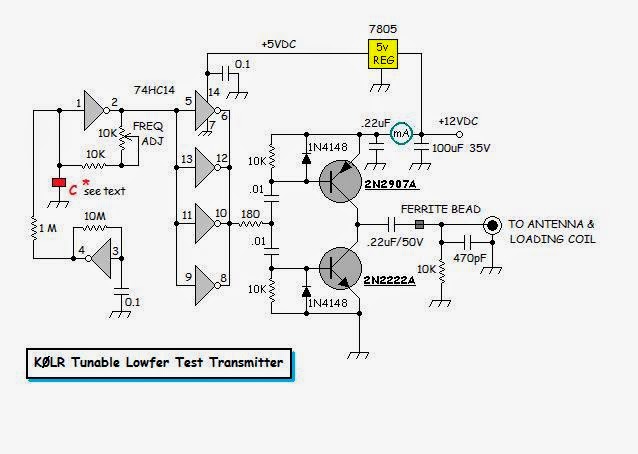 |
| The KØLR LF Transmitter |
The device is actually a low power (~1/2w) VFO-controlled transmitter designed to look into a 50 ohm antenna system. Since most LF antennas are matched to 50 ohms, either through a separate matching transformer or by tapping up from the bottom of the antenna's loading coil, the 50 ohm feedline from the antenna system is simply connected to the antenna meter's output and the VFO tuned for maximum deflection of the meter. The resonant frequency is then directly read from the calibrated scale of the antenna meter's dial. With most backyard LF antennas having a very narrow bandwidth along with a high-Q, the meter peak is quite sharp and easy to find. Look for a peak meter reading between 50-70ma as you sweep the VFO across the antenna. Normal current values will be very low until resonance is hit.
KØLR's original article gives more details and can be found here.
The 470pf capacitor (C in my diagram) determines the basic frequency range. To modify the circuit for dual range (both 2200m and 630m), I added a SPDT switch at pin 1 of the IC so that I could switch the value of "C". For coverage down to and below 136KHz, I used ~ 725pf (a 680pf + 47pf in parallel) while high end coverage up past 500KHz required just 250pf (220pf + 27pf in parallel). These values should get you very close to the required ranges and once installed it is an easy task to calibrate the tuning scale by listening to the signal on a receiver or measuring it with a frequency counter. I also chose to install the 1M 'modulation' resistor that gives the signal a distinctive FSK note.
The meter will quickly tell you if your antenna is too high in frequency (capacitive) or if it is too low (inductive) so that the proper corrective measures may be taken to resonate it within the 630m band. Once resonant, attention can then be paid to bringing the impedance match as close as possible to 50 ohms and a 1:1 match. Depending on your method of impedance matching, there may be some interaction between tuning for resonance and impedance matching but a perfectly resonant 50 ohm system can be achieved with a little juggling.
Although not updated for several years, KØLR's website contains much good information regarding simple backyard LF antenna systems (both transmitting and receiving), preamps and weak signal receiving techniques. It is well worth a close look if you are designing a new 630m station.
NDB DXing & The CLE183 Results
 |
| WC - 332KHz White Rock, B.C. |
 |
| source:http://www.spc.noaa.gov |
One of the beacons in my log this weekend is pictured above - 'WC' in White Rock, B.C. The beacon is located in a residential neighborhood, with homes on both sides...not a typical NDB location.
Here is my short log, all captured using Perseus:
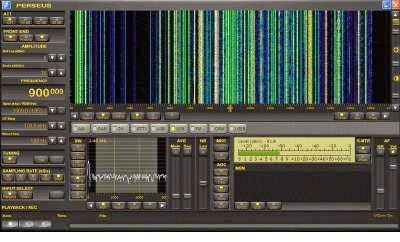
06 21 0600 323 W4 Jenpeg, MB
06 21 0600 325 YJQ Bella Bella, BC
06 21 0500 326 DC Princeton, BC
06 21 0600 326 XJ Fort St. John, BC
06 21 0500 328 5J Coronation, AB
06 21 0600 328 LAC Fort Lewis, WA
06 21 0701 328 YTL Big Trout Lake, ON
06 22 0846 329 PJ Whitehorse, YT
06 21 0600 329 TAD Trinidad, CO
06 21 0600 329 X2 Athabasca, AB
06 21 0600 329 YEK Arviat, NU
06 21 0500 329 YHN Hornepayne, ON
06 21 0600 330 3G Peggo, BC
06 21 0600 332 LBH Portland, OR
06 23 1130 332 POA Pahoa, HI
06 21 0600 332 VT Buffalo Narrows, SK
06 21 0500 332 WC White Rock, BC
06 21 0500 332 XH Medicine Hat, AB
06 21 0700 332 XT Terrace, BC
06 21 0600 333 STI Mountain Home, ID
06 21 0600 334 P2 Wetaskiwin, AB
06 21 0700 334 YER Fort Severn, ON
Some might wonder why listening for NDB's would be of any interest. For me, there are a number of reasons:
- the challenge of hearing distant low-powered transmitters below the broadcast band, particularly from one region...for me it is Alaskan NDBs
- the necessity to develop an efficient receiving antenna has led to numerous antenna trials using loops and wires in various configurations
- learning about LF propagation and how it compares with HF
- the ability to compare what is being heard at my location with what is heard just a few hundred miles away can often be surprising (and humbling)
If you are planning a 630m station, listening for NDB's is a good way to test your system's receive capability as there are hundreds of signals to be heard, many of them very close to our new 472KHz band.
An informative Introduction To Beacon DXing by Alan Gale may be found here. To find the location of any NDB's that have been heard in North America, check the always accurate RNA database by Martin Francis.













