Author Archive
 Cycle 24 6m F2!
 December 21st, 2014 |
  Author:
 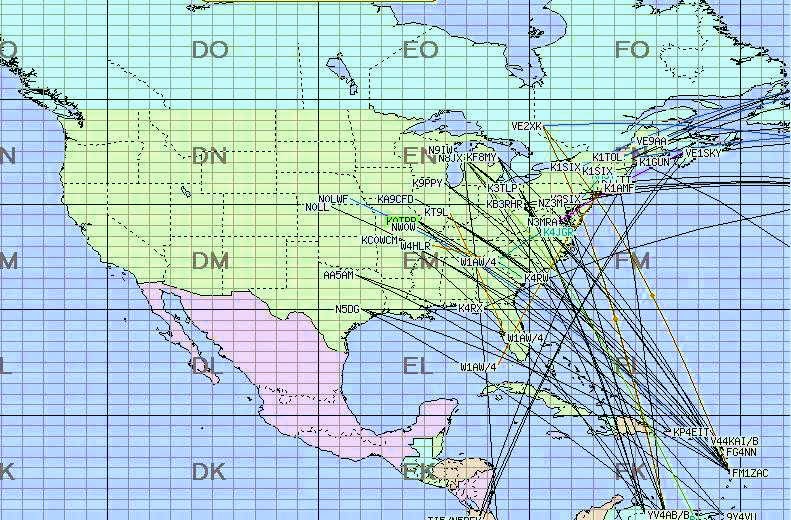 |
| Courtesy: http://www.dxmaps.com |
It's still one hour from sunrise here on the west coast but the 6m fireworks have started on the east coast....Cycle 24 F2 ! Will it reach us today?? ...fingers are crossed.
Large Loop On The Broadcast Band
Those of you following my blog will know that I spent some time this fall designing and building a large rotatable loop for LF and MF (BCB) work. So far the loop has met my expectations and is working well. In spite of several strong storm blasts from the southeast (70-90km), the lightweight PVC frame has shown little desire to grab the wind and destroy itself. For anyone seeking a simple and inexpensive method of mounting a rotatable loop or Flag type of antenna, I believe this mounting system would be excellent.
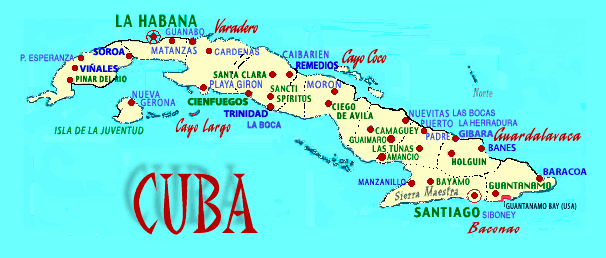 Over the past few weeks I have logged several new catches on the BCB with three of the highlights shown below. The two stations on 530KHz are both from Cuba...Radio Rebelde at 1Kw (Gauntanamo) and Radio Enciclopedia at 10Kw (Villa Maria). Note how the propagation this night almost puts the two signals, from opposite ends of the island, on a level playing field.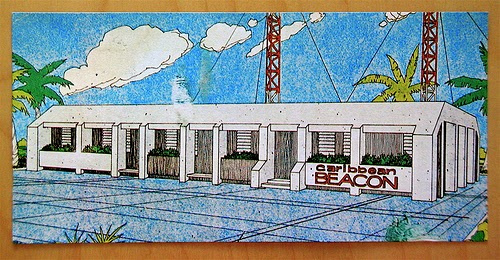
At the other end of the band, the Caribbean Beacon on 1610, from The Valley, Anguilla, has been making regular appearances with a strong signal as well.
A nice domestic catch was one-kilowatt CJEU, Radio Jeunesse in Gatineau, Quebec, operating on 1670KHz.
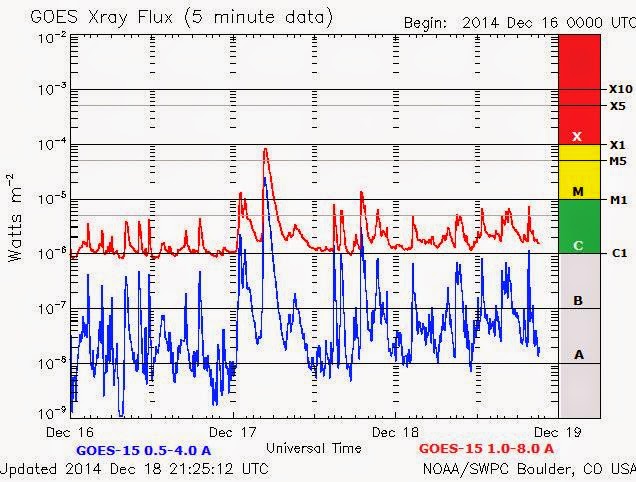
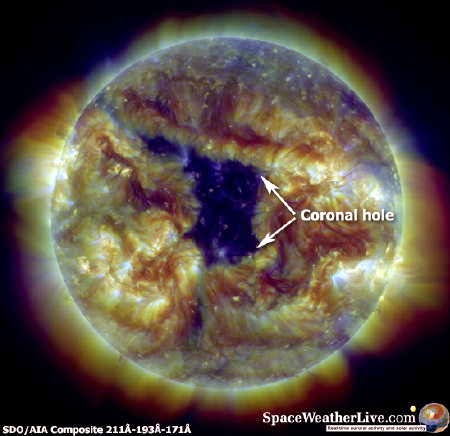
With the recent surge in solar flaring, the band has not been its normal December self over the past few nights...hopefully the sun will calm down and things can return to normal soon.
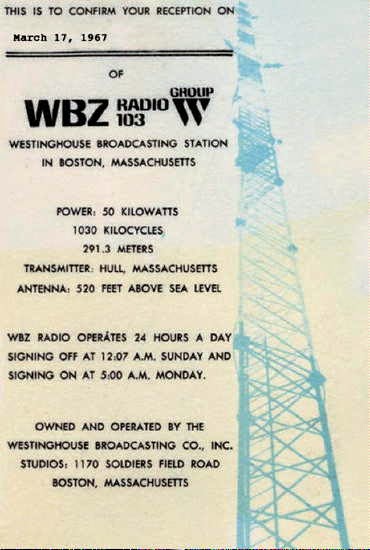
I vividly recall my excitement after catching WBZ-1030 in Boston, MA on my little 5 tube AC/DC radio and loose-coupled longwire. I had been hoping to catch an ID from them after listening for them for several Saturday nights! I even managed to get a QSL for my wall, similar to this one, shortly after the big event.
It's great getting back to my radio "roots" although DXing on the BCB has changed so much over the years, with fewer stations regularly identifying and no longer signing-off at midnight. Using the Perseus SDR has also made catching idents much easier, with the ability to record the entire band for hours at a time...or as long as one's hard-drive will allow.
Waiting For The Magic
 |
| Courtesy: http://www.noaa.gov/ |
The last time the sun did this, at the end of November, I was able to work two stations in Florida on F2 during a short surge in the MUF that had been hovering in the 46-47MHz range. Maybe we'll all get lucky again soon if solar activity continues to climb.
 |
| Courtesy: http://www.noaa.gov/ |
Today's rise in the MUF was a disappointment as the highest I saw was about 43MHz, for a brief few moments. The MUF then dropped back below 37MHz but continued to surge into the high 39's.
This short video, made today at around noon, shows the MUF surging....the band full of signals one moment and then empty the next. The region between 10m and 6m is chalk-full of commercial FM activity (police, fire, utility, etc) and makes and excellent way of monitoring the trend in MUF growth...at times it seems that the F layer is alive and breathing as it trys, usually without success, to climb higher and higher. One of stations in the video appears to be from Maryland, on the typical E-W propagation path seen at this time of the year. My receiving antenna is my normal 4-el 6m Yagi, which must be horribly inefficient at this frequency yet...notice how strong signals can be when they are propagating right at the edge of the MUF:
1929 BK QSO Party Fun

 |
| Courtesy: http://www.spaceweatherlive.com |
Not to disappoint, the usual BK winds came up, right on schedule as well, almost coincidental with the start of the Party. Thankfully, weekend number two saw no wind whatsoever....a rare event in December....but, from the sound of many other notes, I wasn't the only one having windy weather.
Some of this year's highlights were working my usual "must contact" stations back east....N1BUG (Paul, in Maine), NE1S (Larry, also in Maine), VE3AWA (Lou, in Ontario), K4JYS (Bill, in NC) and WØVLZ (Niel, in MN). It's particularly fun to work Niel as it was the fine Youtube video of his 1929 station that got me started in vintage building.
Two newcomers made this affair even better, with the addition of John, VE7BDQ,along with his nice three-band Colpitts and 12-year old Joe, KC9WYV, operating at KBØROB's station in MN. He has a fist as smooth as silk and will be a wonderful asset to our hobby. Kudos to Harold for the "Elmering" of this young ham.
I made a very short recording of 40m early on the first weekend, just after the 3PM start.... but there wasn't much to hear at this early hour. On the video below you can see (and hear) the signals of (in order): K4JYS (NC) being answered by KK7UV, W7LNG (OR), WB2AWQ (Reno, NV), VE7BDQ (working WA1JAS in Maine). The 8W signal of WA1JAS is amazing, considering the hour....still daylight here on the west coast.
My BK log is rather skimpy, considering that it represents two Saturday-nights of activity. In terms of fun, it is very much larger. I rather suspect that this may have been the last outing for my Hull Hartley, as work has now begun on a MOPA rig for next year....hopefully I won't have to worry about the wind weather any longer!
Of particular interest are the rig descriptions and input power levels. I also see Hartley's having a slight-edge over TNT's in terms of usage. It was disappointing to have only 3 contacts on topband, but conditions were just not going to let it happen....maybe next year.
DE6 2302 40 KK7UV 589c 558 HART 28 9 STEVE MT
DE6 2317 40 N1BUG 568 449 TNT 29 10 PAUL ME
DE6 2322 40 WA1JAS 569 559 HART 29 8 MIKE ME
DE6 2347 40 W7LNG 567 578 TNT 29 6 BUD OR
DE6 2352 40 VE7BDQ 599 599 COLP 29 10 JOHN BC
DE7 0014 40 K7SF 578 579 TNT 29 10 STEVE OR
DE7 0105 40 NE1S 449 449 TNT 29 9 LARRY ME
DE7 0120 40 WB2AWQ 579 569 HART 29 10 HOWIE NV
DE7 0133 40 K4JYS 449 449 TNT 29 10 BILL NC
DE7 0145 40 WB8APR 559 449 MOPA 29 5 JOHN MI
DE12 2257 40 K0KP 579 559 HART 29 9 REX MN
DE6 0202 80 AB0CW 559 549 HART 29 5 MARK CO
DE6 0317 80 KK7UV 599 599 HART 28 9 STEVE MT
DE6 0329 80 KE0Z 559 559 HART 29 8 WILL SD
DE6 0356 80 N1BUG 449 559 TNT 29 10 PAUL ME
DE6 0403 80 KC9WYV 579 539 MOPA 29 9 JOE MN
DE6 0415 80 VE7BDQ 599 599 COLP 29 10 JOHN BC
DE6 0422 80 AA2YV 439 449 HART 29 10 BILL NY
DE6 0438 80 N8YE 559 569 TPTG 25 9 STEVE OH
DE6 0442 80 W7LNG 578 588 TNT 29 9 BUD OR
DE6 0524 80 K0KP 599 589 HART 29 9 REX MN
DE6 0530 80 W2ICE/0 579 339 COLP 29 10 SCOTT MN
DE6 0539 80 VE3AWA 578 339 TNT 29 10 LOU ON
DE6 0548 80 KI0DB 559 579 MOPA 29 10 MARK MN
DE6 1229 80 W0LGU 559 559 MOPA 29 9 TOM MN
DE6 1240 80 K0KCY 559 449 MOPA 29 10 TONY MN
DE12 0352 80 KB0ROB 569 569 MOPA 29 9 HAROLD MN
DE12 0427 80 W8KGI 559 448 MOPA 29 10 JIM NM
DE12 0440 80 W0VLZ 559 339 TNT 29 10 NIEL MN
DE12 0509 80 K4JYS 559 559 HART 29 15 BILL NC
DE12 0512 80 WB9WHG 569 449 MOPA 29 20 DAVE WI
DE12 0524 80 W0LS 599 579 HART 29 9 HARRY MN
DE12 0401 160 KK7UV 579 559 HART 28 10 STEVE MT
DE12 0539 160 VE7BDQ 599 599 COLP 29 10 JOHN BC
DE12 0542 160 W0LS 559 559 HART 29 9 HARRY
DE6 2317 40 N1BUG 568 449 TNT 29 10 PAUL ME
DE6 2322 40 WA1JAS 569 559 HART 29 8 MIKE ME
DE6 2347 40 W7LNG 567 578 TNT 29 6 BUD OR
DE6 2352 40 VE7BDQ 599 599 COLP 29 10 JOHN BC
DE7 0014 40 K7SF 578 579 TNT 29 10 STEVE OR
DE7 0105 40 NE1S 449 449 TNT 29 9 LARRY ME
DE7 0120 40 WB2AWQ 579 569 HART 29 10 HOWIE NV
DE7 0133 40 K4JYS 449 449 TNT 29 10 BILL NC
DE7 0145 40 WB8APR 559 449 MOPA 29 5 JOHN MI
DE12 2257 40 K0KP 579 559 HART 29 9 REX MN
DE6 0202 80 AB0CW 559 549 HART 29 5 MARK CO
DE6 0317 80 KK7UV 599 599 HART 28 9 STEVE MT
DE6 0329 80 KE0Z 559 559 HART 29 8 WILL SD
DE6 0356 80 N1BUG 449 559 TNT 29 10 PAUL ME
DE6 0403 80 KC9WYV 579 539 MOPA 29 9 JOE MN
DE6 0415 80 VE7BDQ 599 599 COLP 29 10 JOHN BC
DE6 0422 80 AA2YV 439 449 HART 29 10 BILL NY
DE6 0438 80 N8YE 559 569 TPTG 25 9 STEVE OH
DE6 0442 80 W7LNG 578 588 TNT 29 9 BUD OR
DE6 0524 80 K0KP 599 589 HART 29 9 REX MN
DE6 0530 80 W2ICE/0 579 339 COLP 29 10 SCOTT MN
DE6 0539 80 VE3AWA 578 339 TNT 29 10 LOU ON
DE6 0548 80 KI0DB 559 579 MOPA 29 10 MARK MN
DE6 1229 80 W0LGU 559 559 MOPA 29 9 TOM MN
DE6 1240 80 K0KCY 559 449 MOPA 29 10 TONY MN
DE12 0352 80 KB0ROB 569 569 MOPA 29 9 HAROLD MN
DE12 0427 80 W8KGI 559 448 MOPA 29 10 JIM NM
DE12 0440 80 W0VLZ 559 339 TNT 29 10 NIEL MN
DE12 0509 80 K4JYS 559 559 HART 29 15 BILL NC
DE12 0512 80 WB9WHG 569 449 MOPA 29 20 DAVE WI
DE12 0524 80 W0LS 599 579 HART 29 9 HARRY MN
DE12 0401 160 KK7UV 579 559 HART 28 10 STEVE MT
DE12 0539 160 VE7BDQ 599 599 COLP 29 10 JOHN BC
DE12 0542 160 W0LS 559 559 HART 29 9 HARRY
More information on '29 building may be found here in previous "'29-style blogs" and good project discussions always abound at the Yahoo "AWA Group" builder's site.
It's really not too early to start building for next year's BK!
The Importance of 1929 – Part 4
 |
| QST Feb 1931 Courtesy: http://www.arrl.org/ |
For North American hams, many of these had already been in place, but for much of the DX, this was all new.
Some of the more important changes are ones that we have come to recognize as "everyday practice" for the past several decades.
Like our friend below, and for all new amateurs worldwide, mastering CW would now be mandatory.
 |
| Courtesy: http://www.arrl.org/ |
" Article {6} (3) ...any person operating the apparatus...must have proved his ability to transmit passages in the Morse Code and to read...passages thus transmitted."
Licencing was also mandated.
" Article {2} (1) No radioelectric sending station shall be established or worked by a ...person...without a special licence issued by the Government..."
And hams would need to earn their tickets.
 |
| Courtesy: http://www.arrl.org/ |
Article 6 (4) Administrations...take such measures to verify the qualifications, from the technical point of view, of all persons operating the apparatus."
No longer would hams have the luxury of making up their own call signs, although not an issue in North America since the end of WW1. All calls would now be assigned by the government.
"Article {14} (13) ...private experimental stations must have a call sign taken from the international series assigned to each country."
 |
| Courtesy: http://www.steveirwinstamps.co.uk |
 |
| Courtesy: http://hamgallery.com |
No longer would hams be identified by the old style of call letters such as 'NU9AVZ' in the U.S., or as 'C5AU' in Canada. Country codes were changed internationally and U.S. hams became W's, K's and N's, as did commercial stations. Canadian hams became VE's, with both countries divided into numbered call-districts. This change was made several months before the end of 1928, well ahead of compliance.
The system of Q signals, as we know them today, were to be implemented for all users, both commercial and amateur. As noted in the September, 1928 QST, the signal for "QST" had been removed.
"The prefix for a general call to all stations has been changed from "QST" to "CQ" and the former is now blank in the international list of "Q" signals. That doesn't mean that QST is going to change its name though. If some uncomplimentary meaning has been assigned the letters "QST", such as "You interfere with me -- get out," we might have to." [QST September, 1928]
And no, the list did not include "QLF".
Although chiefly aimed at the commercial ops working mobile stations, such as maritime or aeronautical traffic, many of these new operating procedures filtered-down to amateurs very quickly and are still used today:
" Article {9} (6) When a station is uncertain of the call sign of the station calling...reply...using the signal .. _ _ .. "
" Article {9} (7-1) When it is necessary to make test signals...such signals...must be composed by a series of V's followed by the call letters of the station working. "
" Article {9} (3-1a) The station calling makes the call...not more than three times...and the word DE, followed...by its own call sign. "
" Article {9} (3-3) If the station called is not ready...it replaces the letter K by the signal . _ ... (wait)... "
 |
| Courtesy: http://www.arrl.org/ |
" Article {9} (3-9a) The transmission...is terminated by the signal . _ . _ . (end of transmission)... "
" Article {9} (10a) The acknowledgement of receipt...is given by the means of the letter R."
" Article {9} (11) The end of work between two stations is indicated by each of them, by means of the signal ... _ . _ "
" Article {10} (1-1) Stations desiring to enter into communications...may use the signal of inquiry CQ...followed by the letter K... "
Although they had already been operating from Washington, DC, on a limited schedule, Jan 1st, 1929, marked the expansion of WWV, which began a regular schedule, cycling through 40 different precise frequencies during a two-hour period. All transmissions were in CW. This would allow for all users, worldwide, to calibrate their receiving equipment to 1929 standards.
Compiled in November 1928, the January 1929 edition of QST carried these last hopeful words before the big day arrived:
"January 1st, 1929, magic date, is upon us...the dividing line between the old and the new in amateur radio...when we look back...we are going to wonder how we ever got along in 1927 and 1928 with those crude methods which we once employed...It is the duty of every amateur to prepare himself for the new life which exists on the other side of January 1st." [QST January, 1929]
The following month's editorial described the early days of 1929 activity and was somewhat surprsing, considering all of the hard work that had gone into preparing radio amateurs for the new era.
 |
| Courtesy: http://www.arrl.org/ |
And so, finally, the long anticipated day came and went, but it seemed the ARRL's task was far from over. Not everyone had gotten the message or, at least, the entire message. VE4GU was all prepared for 1929 with new QSL's for his Jan 22, 1929 QSO with W9DYV on 40m CW but apparently missed the 'other' announcement...his card reports using '500V' of raw AC on his 210 Hartley!

 |
| Courtesy: http://www.arrl.org/ |
Without question our cherished hobby was shaped forever by those well-considered pronouncements and the timely leadership of the ARRL during those tumultuous days, so long ago. We owe them a lot.
And for those who have asked...that...is the reason why, once every year, we light-up our old 210's and celebrate the boys of '29.
The Importance of 1929 – Part 3
 |
| Drum Dial Rx Tuning Courtesy: http://www.arrl.org/ |
As the leader of the ARRL's Technical Development Program and its assault on 1929 preparedness, Hull continued his relentless pace of construction and publication in the November 1928 issue of QST...turning now to receivers. The detailed article analyzed three receivers of varying complexity to see how they might fare in the busy "international bands" of 1929...and where improvements might be gleaned.
In "High-Frequency Receivers for the Coming Year / Incorporating Thoroughly Practical and Satisfying Selectivity, Open Scales, and a New Ease in Handling", editors proudly announced that,
"...practical selectivity for 1929 has been secured; it is within the reach of every amateur." [QST November, 1928]
 |
| QST Oct '28 Courtesy: http://www.arrl.org/ |
Another equally important issue was addressed in QST's October 1928 edition, once again by Ross Hull.
"In view of the present off-band operation, it is not surprising that amateurs have been wondering how it will be possible for them to stay within the relatively narrow confines of the 1929 bands and to know definitely and at all times that the frequency of their transmitters is legal." [QST October, 1928]
"The Frequency Measurement Problem / Applications of the Monitor in Transmitter Setting and Signal Checking" described, in exacting detail, the construction and calibration of a combined monitor and frequency meter that would fulfill the new rules regarding frequency allocations...but only if hams used them regularly.
 |
| QST Sept '28 Courtesy: http://www.arrl.org/ |
With the ARRL's reliance on QST's significant advertising revenue as a major source of income, the urgent 'need' to rebuild was not overlooked by the ad-men, as more building would mean that more parts had to be purchased. A skeptic might even suggest that the possibility of increased advertising revenue may have been just as much of a driving-force for the need of new construction than the new rules themselves!
 |
| QST 1929 Courtesy: http://www.arrl.org/ |
Advertisers in QST were not shy about reminding amateurs of the coming deadline as well as promising easy solutions to compliance.
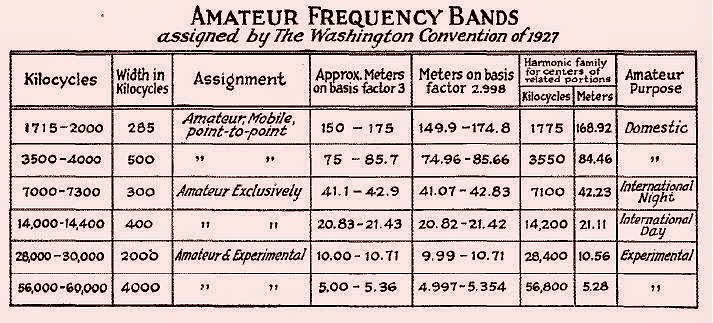
In early 1928, QST published several of the Convention articles that would apply to amateurs. Chief amongst them were the frequency allocations. North American amateurs lost about 40% of the spectrum space that they had previously enjoyed but...the harmonically-related bands, although slimmed-down, were retained along with exclusive access to the new and largely unwanted territory of 28-30mc.
Many amateurs at the time complained about the loss of older frequencies and that the League representatives had dropped the ball. In light of the times, and in view of the commercial feeding-frenzy for new broadcasting allotments, they fared very well.
 |
| 1929 Band Plan - QST Jan '28 Courtesy: http://www.arrl.org/ |
But it wasn't just frequency assignments that were changing...1929 operators would need to change their crummy old operating habits as well! ....(cont'd)
The Importance of 1929 – Part 2
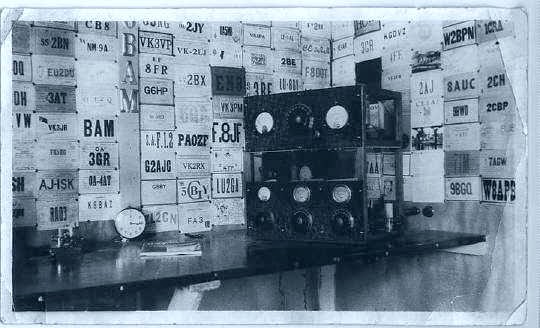 |
| W6BAM - 1929 Compliant. Courtesy : N7RK |
It wasn't long before the ARRL shifted its focus to the new days ahead and seemingly, every issue of QST leading up to the 1929 implementation date, addressed the topic. It is of interest to see how the ARRL interpreted the new rules and developed a strategy to meet the requirements. Many of the rules were broad enough to allow for varied interpretations, all of which could be compliant. In hindsight it seems they made a very good choice on the best way to tackle the present mess on the ham bands...to inform every ham possible of his or her responsibilities for meeting the coming challenge and to show them how.
As far as amateur 'experimental' radio was concerned, the delegates addressed several critical points...in fact, the very recognition of amateur radio itself was a significant step forward for hams worldwide:
"Article 1, {16} the term "private experimental station" means -- (2) a station used by an "amateur," that is, by a duly authorised person interested in radio technique solely with a personal aim and without pecuniary interest."
Although not as big an issue in North America, where governments had long-supported ham radio, for many countries it would mean operational status would now be recognized. The ARRL's campaign to convince hams that their stations must be 'DX-ready' was now given some teeth. Thus began the campaign to convince hams that their 1928 junk must go:
"...for the great average of American amateur stations...it is not a reassuring spectacle in view of next year's requirements. We seriously doubt if as many as one-half of one percent of the active stations to-day are good enough to offer their operators any reasonable chance of success in international work next year. The rest, we think, will have to be rebuilt....floppy waves, bum notes, crawling frequencies, too-big condensers, sloppy practices, haywire assembly, and lack of precision measurements...These must go.. " [QST Editorial, May, 1928]
It sounds alarmingly descriptive of our annual BK Party...but proclaiming that 99.5% of U.S. amateurs would need to rebuild was surely a bold statement and one, as time went on, was gradually toned-down in QST editorials.
Addressing the 'haywire assembly' issue, articles soon appeared showing better construction practices for earlier familiar designs, the self-excited favorites.
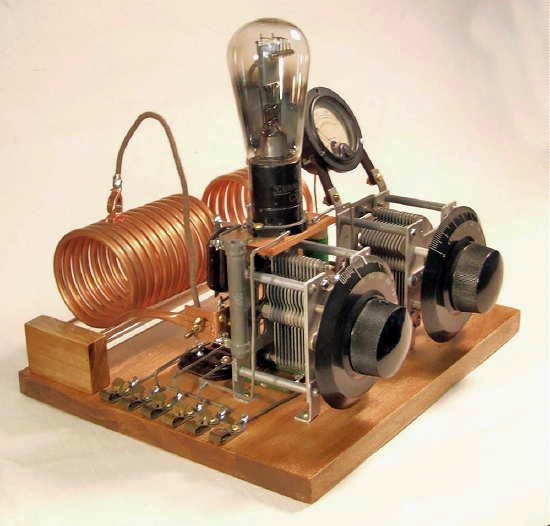 |
| Courtesy: WØVLZ |
Read with caution as you will likely be tempted to begin the parts-search for you own version soon after. It was Niel's superb series of videos that inspired my interest in 1929 construction.
 |
| Hull's 1929 MOPA. Courtesy: http://www.arrl.org/ |
 |
| Hull's High-Powered 1929 Self-Excited Transmitter. Courtesy: http://www.arrl.org/ |
The second article in the issue, "Adapting Medium and High-Powered Self-Excited Transmitters for 1929 Service / Some Design, Constructional and Tuning Considerations Involved", was described by Hull...
"For a week or more, the Laboratory was filled with odors of burning bakelite, hard rubber and wood, and at times whiffs of smoke drifted lazily across the tables -- but in the end our pulse had returned to normal, for we had found that even 250-watt self-excited transmitters can be made to behave in a 1929 manner with just the same treatment we had given the low-powered set".
As noted earlier, it was of interest to see how the men at ARRL interpreted the new rules to such an extent as to call for a complete overhaul of transmitter construction. The Washington delegation had only provided a broad hint as to what must be done regarding stability and spectral purity, while still craftily ensuring that transmitters would always be required to remain "state of the art":
"Article 5, {18} (3) ..the frequency of the waves emitted must be as constant and as free from harmonics as the state of technical development permits"
The ARRL took this opportunity to push the "state of technical development" as it concerned amateur radio. Hull defined the requirements for a 1929 signal as:
"...must be entirely within the limits of the band....its frequency 'flutter' due to irregularities of plate supply must not exceed about 1/30 of 1% (approximately 250 cycles at 40 meters). In addition, the frequency of the signal must be relatively constant. The signal must not 'shimmy' as the antenna vibrates, it should not 'chirp' as it is keyed, nor can it "creep" appreciably as...the tube heats. In short, the frequency of the first dot transmitted should be within 1/10 of 1% (about 750 cycles at 40 meters) of the hundredth dot, even if the plate has reddened...or the voltage drifted. At the end of a few hours of operation the frequency should not have strayed much further." [QST August, 1928]
By today's standards, not a tall order, but in 1928, there was much to be done.
With the deadline fast-approaching, the vigorous campaign to drag hams out of the cesspool of clicks, harmonics, wide signals, raw AC and into the promised land had begun....lead mainly by the hands of George Grammer, Ross Hull, James Lamb, Robert Kruse and Beverly Dudley, nirvana was just over the horizon and surely could be reached .....but only if they rebuilt their 1928 'heaps'. (cont'd)













