Author Archive
 Hunting For NDBs In CLE269
 June 23rd, 2021 |
  Author:
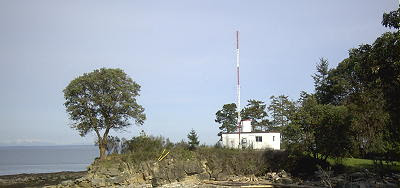 |
| AP-378 Active Pass, Mayne Island |
It's CLE time! 'CLE's are 'Co-ordinated Listening Events, and NDB DXers around the world focus their listening time on one small slice of the NDB spectrum.
Propagation on MF has been both hot and cold for the past few weeks, seemingly depending on where you live and the amount of geomagnetic activity affecting your region. Thankfully the Sun has ended, for now, its Coronal Hole Streams toward earth which had been causing so much disruption.
When tuning for NDBs, put your receiver in the CW mode and listen for the NDB's CW identifier, repeated every few seconds. Listen for U.S. NDB identifiers approximately 1 kHz higher or lower than the published transmitted frequency since these beacons are modulated with a 1020 Hz tone approximately.
For example, 'AA' near Fargo, ND, transmits on 365 kHz and its upper sideband CW identifier is tuned at 366.025 kHz while its lower sideband CW ident can be tuned at 363.946 kHz. Its USB tone is actually 1025 Hz while its LSB tone is 1054 Hz.
Often, one sideband will be much stronger than the other so if you don't hear the first one, try listening on the other sideband.
Canadian NDBs normally have an USB tone only, usually very close to 400 Hz. They also have a long dash (keydown) following the CW identifier.
All NDBs heard in North America will be listed in the RNA database (updated daily) while those heard in Europe may be found in the REU database. Beacons heard outside of these regions will be found in the RWW database. These databases have recently been re-vamped and are slicker than ever before!
From CLE organizers comes the following CLE info:
Hi all,
Please join us in our 269th Coordinated Listening Event which starts this Friday.
The CLE is open to everyone including new-comers.
It’s not a contest - but enjoy taking part and you will be a winner:
Days: Friday 25th June - Monday 28th June
Times: Start and end at midday, LOCAL TIME at the receiver
Frequencies: 370 - 384.9 kHz
Wherever you are, please join us and log all NDBs that you can positively identify with their nominal (listed) frequencies in the range (it includes 370 kHz but not 385 kHz) plus any UNIDs that you come across there.
Very short logs are as welcome as very long ones!
Please Send your CLE log to the List, preferably as a plain text email (not in an attachment) with ‘CLE269 FINAL’ at the start of its subject line.
Show on EVERY LINE of your log:
# The date (e.g. 2021-06-25, etc., or just 25)
# UTC (the date changes at 00:00 UTC)
# kHz (the nominal published frequency, if known)
# The Call Ident.
Show those main items FIRST - other optional details such as Location and Distance go LATER in the same line.
If you send interim logs, please also send a 'FINAL’ (complete) log!
As always, tell us your own location and brief details of the equipment that you were using during the weekend.
We will send the usual 'Any More Logs?' email at about 19:00 UTC on Tuesday 29th June - you can then check that your log has been found OK.
All logs must arrive on the list at the very latest by 08:00 UTC on Wednesday 30th June.
We hope to complete making the combined results within a few days.
To help you to plan your listening, seeklists and maps for your part of the World are available via the CLE page http://www.ndblist.info/cle.htm.
You can also access listings, seeklists, maps and export-files via REU/RNA/RWW by clicking on the “CLE” menu-item.
We last used this frequency range for CLE252 in January 2020.
Good listening - enjoy the CLE.
Joachim & Brian
Reminder:
If you wish you can use any one remote receiver for your loggings,
stating the location and owner and with their permission if required.
A remote listener may NOT also use another receiver, whether local
or remote, to make further loggings for the same CLE.
If you are interested in some remote listening - maybe due to local difficulties - you could use any one remote receiver for your loggings, stating its location and with the owner's permission if required.( e.g. see kiwisdr.com ) A remote listener may NOT also use another receiver, local or remote, to make more loggings for the same CLE.
These listening events serve several purposes. They
• determine, worldwide, which beacons are out-of-service or have gone silent since the last CLE covering this range
• will indicate the state of propagation conditions at the various participant locations
• will give you an indication of how well your LF/MF receiving system is working
• give participants a fun yet challenging activity to keep their listening skills honed
Final details can be found at the NDB List website, and worldwide results, for every participant, will be posted there a few days after the event.
The NDB List Group is a great place to learn more about the 'Art of NDB DXing' or to meet other DXers in your region. There is a lot of good information available there and new members are always very welcome. As well, you can follow the results of other CLE participants from night to night as propagation is always an active topic of discussion.
You need not be an NDB List member to participate in the CLEs and all reports, no matter how small, are of much value to the organizers.
Remember - 'First-time' logs are always VERY welcome!
Reports may be sent to the NDB List Group or e-mailed to CLE co-ordinator, Brian Keyte (G3SIA), whose address appears above. If you are a member of the group, all final results will also be e-mailed and posted there.
Please ... give the CLE a try ... then let us know what NDB's can be heard from your location! Your report can then be added to the worldwide database to help keep it up-to-date.
Have fun and good hunting!
Single-Yagi EME
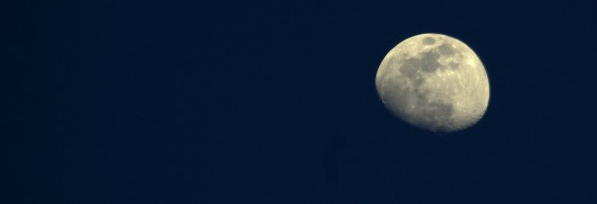
After being absent from 2m EME (moonbounce) for the past couple of years, I decided to spark-up again this spring to see if my simple system was still up to the task.
Pretty much every month, during the moon’s sweep through its northern declination, I get several days with moonrises right out in front of the house overlooking Georgia Strait. This is the large body of saltwater separating the British Columbian mainland (and the rest of North America) from Vancouver Island to my west.
Having an ‘over the ocean’ moonrise offers several advantages for me as it pretty well guarantees an extra 6db minimum of system gain (both on transmit and receive modes) and provides a noise-free environment for the antenna to look into.
Because of this advantage I’ve been able to get away with a very minimal system consisting of a single 9el Yagi and a small FM ‘brick’ amplifier which yields around 120W of output. The antenna is tower-mounted at 60’ and controlled in azimuth only. Without being able to track the moon as it rises, the Yagi is broad enough to give me about 2 hours of moon-time on each session before I start to lose signals. With most EME stations using four or more Yagis and high power, most of the heavy-lifting on my two-way work is being done by the other station. With the extra sea-gain here, my single 9el Yagi performs more like an array of four similar Yagis.
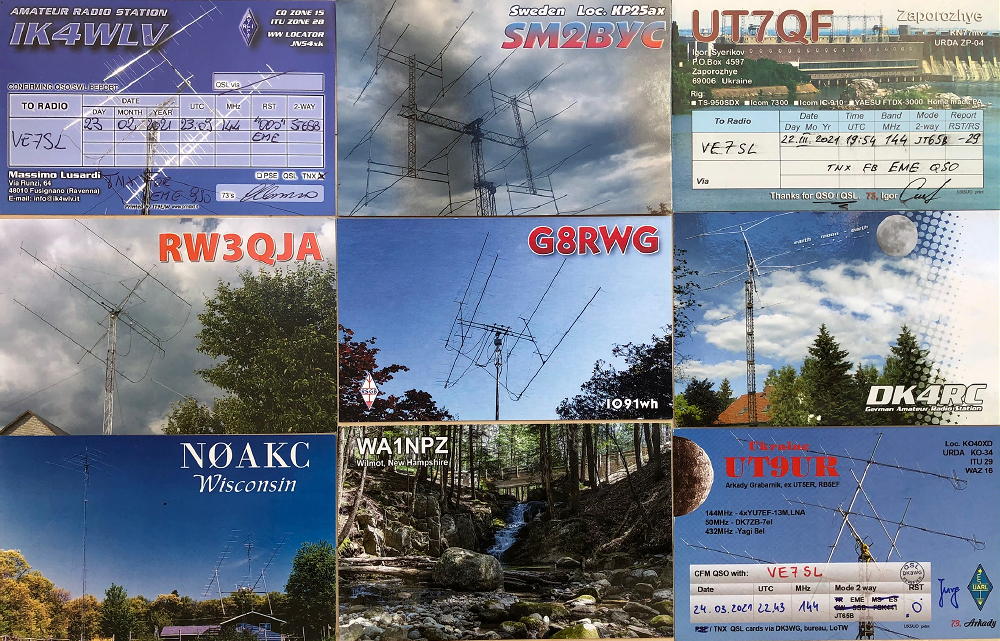
There always seems to be new stations to work whenever I get on the band and this spring was no exception. All told, I had 20 contacts, with 12 being new 'initials', bringing my total initials count to 130. The remaining 8 contacts were with stations I have worked previously. I was also able to add 2 new states, New Hampshire and Wisconsin, bringing my 2m WAS total to 30.
Conditions were poor to average, with one day in particular being excellent, when at one point I had a pileup of three callers!
Most of the stations contacted are always surprised to learn of my small system and comment that my station is the smallest one they have worked. I have worked a couple of two-Yagi stations over the years with one of them being worked several times.
Here are the cards that have arrived so far for this spring’s session:
If you haven’t given single-Yagi EME a try I would encourage you to test it out as you might be surprised at your results. Even without the added sea-gain, many of my contacts were loud enough to be easily workable with 6db less gain ... and there are dozens of big capable stations out there just waiting for new initials!
Hunting For NDBs In CLE268
 |
| LF-336kHz courtesy: http://www.ve3gop.com/ |
It's CLE time! 'CLE's are 'Co-ordinated Listening Events, and NDB DXers around the world focus their listening time on one small slice of the NDB spectrum.
Propagation on MF has been both hot and cold for the past few weeks, seemingly depending on where you live and the amount of geomagnetic activity affecting your region. As well, the Sun has been throwing a lot of Coronal Hole Streams toward earth which may or may not affect this weekend's propagation ... but this is all part of the radio-magic fun.
A 'challenge target' for listeners in North America is LF - 336kHz in La Salle, Manitoba, in the southern central part of the province. Even though running just 50 watts, it's widely heard throughout North America and is a good target for listeners everywhere. Listen for LF's upper sideband on 336.390 kHz.
When tuning for NDBs, put your receiver in the CW mode and listen for the NDB's CW identifier, repeated every few seconds. Listen for U.S. NDB identifiers approximately 1 kHz higher or lower than the published transmitted frequency since these beacons are modulated with a 1020 Hz tone approximately.
For example, 'AA' near Fargo, ND, transmits on 365 kHz and its upper sideband CW identifier is tuned at 366.025 kHz while its lower sideband CW ident can be tuned at 363.946 kHz. Its USB tone is actually 1025 Hz while its LSB tone is 1054 Hz.
Often, one sideband will be much stronger than the other so if you don't hear the first one, try listening on the other sideband.
Canadian NDBs normally have an USB tone only, usually very close to 400 Hz. They also have a long dash (keydown) following the CW identifier.
All NDBs heard in North America will be listed in the RNA database (updated daily) while those heard in Europe may be found in the REU database. Beacons heard outside of these regions will be found in the RWW database. These databases have recently been re-vamped and are slicker than ever before!
From CLE coordinator Brian Keyte (G3SIA), comes the following CLE info:
Hello all,
Our sixth special 'Channels Challenge' listening event is nearly here.
These are the full details.
Days: Friday 28 May - Monday 31 May
Times: Start and end at midday, your LOCAL time
Range: 275 kHz - 425 kHz (see below)
Target: Try to log ANY ONE NDB in each channel
The main challenge is to try and log ONE NDB in each of the
151 channels in the range from 275 kHz up to 425 kHz inclusive.
The last time we did this was in CLE248 in September 2019.
The 'channel' means the NDB's NOMINAL (published) frequency.
(It may not be quite where you hear the Morse ident of course).
In parts of the World some NDBs are on intermediate frequencies,
such as 321.5 kHz. Logging an NDB on a 'half frequency' would be OK.
E.g. OK for channel 321 would be EITHER one on 321.0 kHz
OR one on 321.5 (shown as 321.5 in your log of course).
Each NDB must be a 'normal' one - no DGPS, NAVTEX or amateur.
(If you hear any UNIDs, please show them in a separate list).
So it means a highest possible total of 151 CLE loggings in all - and that
will surely be impossible for everyone!
If you have extra time and want to make the challenge more interesting you
could include NDBs which:
Give you the greatest number of DIFFERENT RADIO COUNTRIES heard.
(See our Countries list at
http://www.ndblist.info/beacons/countrylist.pdf
Each State/Province in USA, CAN and AUS is a separate radio country)
OR give the greatest TOTAL DISTANCE from you to all of the NDBs.
OR include the greatest number of MIDDAY LOGGINGS
i.e. heard within 2 hours of midday by your local clock time.
Send your 'Final' CLE log to the List, ideally as a plain text email (not in
an attachment) and, IMPORTANT, with CLE268 and FINAL at the start of its
title.
Please show on EVERY LINE of your log:
# The full date or day no. e.g. '2021-05-29' or just '29', etc.
and UTC (the day changes at 00:00 UTC).
# kHz - the beacon's nominal published frequency.
# The Call Ident.
Show those main items FIRST on every line, before other optional details
such as Location, Distance, Offsets, Cycle times, etc.
Tell us your location of course and details of your receiver, aerial, etc.
We will send the usual 'Any More Logs?' email at about 19:00 UTC on Tuesday
so you can check that we have received your log OK.
Do make sure that your log has arrived on the List at the very latest by
08:00 UTC on Wednesday 2 June.
We'll try to complete making the combined results within a day or two.
Good hunting,
Brian and Joachim
-------------------------------------------------------------------
From: Brian Keyte G3SIA [email protected]
Location: Surrey, SE England (CLE coordinator)
-------------------------------------------------------------------
(Reminder: You could use any ONE remote receiver for your loggings,
stating its location and owner - with their permission if required.
A remote listener may NOT also use another receiver, whether local or
remote, to obtain further loggings for the same CLE).
If you are interested in some remote listening - maybe due to local difficulties - you could use any one remote receiver for your loggings, stating its location and with the owner's permission if required.( e.g. see kiwisdr.com ) A remote listener may NOT also use another receiver, local or remote, to make more loggings for the same CLE.
These listening events serve several purposes. They
• determine, worldwide, which beacons are out-of-service or have gone silent since the last CLE covering this range
• will indicate the state of propagation conditions at the various participant locations
• will give you an indication of how well your LF/MF receiving system is working
• give participants a fun yet challenging activity to keep their listening skills honed
Final details can be found at the NDB List website, and worldwide results, for every participant, will be posted there a few days after the event.
The NDB List Group is a great place to learn more about the 'Art of NDB DXing' or to meet other DXers in your region. There is a lot of good information available there and new members are always very welcome. As well, you can follow the results of other CLE participants from night to night as propagation is always an active topic of discussion.
You need not be an NDB List member to participate in the CLEs and all reports, no matter how small, are of much value to the organizers.
Remember - 'First-time' logs are always VERY welcome!
Reports may be sent to the NDB List Group or e-mailed to CLE co-ordinator, Brian Keyte (G3SIA), whose address appears above. If you are a member of the group, all final results will also be e-mailed and posted there.
Please ... give the CLE a try ... then let us know what NDB's can be heard from your location! Your report can then be added to the worldwide database to help keep it up-to-date.
Have fun and good hunting!
Using FT8 On 6m – The Magic Band
(The following blog, originally published last summer, is as relevant as ever. Please pass the link to those that you think may benefit from reading it.)
Today’s blog is directed to those that may be new to 6m or new to using FT8 on 6m. Some of the things discussed will make your experience on the magic band better for you and better for your neigbours.
Unlike using FT8 on the HF bands, 6m presents some different challenges, especially if you operate in a region where there may be a lot of other locals also using the band at the same time.
Although the weak-signal capability of FT8 has made it possible for many smaller stations or those with makeshift antennas to take advantage of the unique propagation 6m has to offer, it also can create problems for other users of the band when used inappropriately. In regions of dense population, even small stations can create very high local signal levels, often making it impossible for their neighbours to hear weak signals. This is not deliberately-caused QRM but arises when some operators operate 'against the flow’ and transmit on the opposite ‘sequence’ to everyone else in their local area.
If you are a new arrival, with a small or makeshift antenna for 6m, it's important to realize that you may not be hearing what others near you (with bigger antennas) are hearing and can easily mess things up when transmitting at the wrong time.
On HF, one can transmit or listen on whatever time sequence they wish. Chosing ‘TX 1st’ or ‘TX 2nd’ is usually determined by who you hear calling CQ or who you wish to work. On 6m however, in a densely-populated region of local operators, chosing to transmit whenever you want to is a luxury that can create big problems for your neighbour who may be trying to hear that weak DX signal while you are transmitting!
These problem will not occur if everybody in the region uses and follows the same transmit-receive periods, so that everyone is listening or everyone is transmitting at the same time ... one or the other. Unfortunately, this ‘ideal’ system falls apart easily when one or more of your neighbours is not using the same sequence as everyone else.
For the past few years, a protocol that seeks to alleviate this problem has become popular and well accepted by those familiar with it. Those new to 6m may not know about it or understand the reasoning behind it.
Above all, I would urge new users of the band, or to the FT8 mode, to first listen carefully for a few minutes, before beginning operation, to determine what the majority of stations in their local region are using for sequencing. If they are using ‘TX 1st’, then your choice of ‘TX 2nd’ will likely cause hearing difficulty for many others, as well as for yourself.
Although there are no strict rules, there is a very successful and well-practiced protocol, and it's that the ‘easternmost’ station transmits on ‘1st’ while the ‘western end’ goes 2nd’. This is why you will hear most eastern stations in the morning hours transmitting ‘2nd’, as they are usually calling or looking for Europeans to their east, who are transmitting ‘1st’. By the same token, you will also hear western stations transmitting on '2nd', who are also looking for Europe to their east, transmitting on ‘1st’.
This sequencing protocol usually reverses later in the day when signals from Asia become a possibility, and all North Americans then become the ‘easternmost’ stations and will transmit on the ‘1st’ sequence ... unlike in the morning. I can easily see how newcomers to the band could become confused, when they hear both sequences being used! The best thing, once again, is to listen carefully first and then ‘go with the flow’.
You can read about the UK's Six Metre Group's initiatives regarding these protocols HERE.
OK... so you’re not interested in EU or Asia? Then it shouldn’t matter to you which sequence that you use and best operating practice would again be to ‘go with the flow’ in consideration of other users.
A few days ago I saw a prime example of exactly what not to do, in too many respects. I made a posting on the ON4KST 6m chat page that VE1SKY in NS (Nova Scotia) was being decoded here, mainly to alert others in my region that European signals might be coming next, as hearing the VE1s in BC is often an indicator that the European path is building.
In less than a minute, an S9+ local began calling ‘CQ NS’ on the exact opposite sequence of all others ... effectively blocking the waterfall and any possible hope of hearing weak EU signals. I’m sorry, but this is just terrible operating procedure, with almost zero chance of success, while showing no consideration for nearby users.
Just like working DX on CW or on phone, the best way, as it always has been, is to ‘listen, listen and then listen some more’. You will work FAR more DX by listening and calling at the right time, than you will by calling CQ.
I also see some local stations everyday, calling endless CQs, often for over 60 minutes straight and often with many replies that go unnoticed. With FT8, one can check ‘work 1st’, go away, and return later to see who they might have ‘worked’. Perhaps this is what these operators are doing, but they should understand that they are also creating non-stop QRM for other users ... those that choose to listen carefully to the band rather than to endlessly CQ. Once again, this is just terrible practice.
You may argue that if nobody called CQ, then there would be no contacts made. There is nothing wrong with a few CQs but CQing for an hour? And don’t worry, there will always be other stations CQing endlessly for you to hear, even if it’s not a great way to operate.
With a little pre-planning for sequencing and consideration for your neighbours, everyone can and should be able to enjoy 6m FT8 with very few problems ... and that is my hope for all of us.
After forty-nine summers of CW and phone on 6m and two summers on FT8, these are some of my initial thoughts on how to best operate for maximum success and consideration for other band-users.
The latter is part of the basic framework upon which amateur radio was originally established, when back in 1914, the ARRL described in their 'Code of Conduct' for amateurs ... "The Amateur is Gentlemanly. He never knowingly uses the air for his own amusement in such a way as to lessen the pleasure of others."
Now, let the magic, and the pleasure, continue!
Hunting For NDBs In CLE267
 | |
| YUT - Replulse Bay, NU (courtesy: ve3gop.com) |
Propagation on MF has been both hot and cold for the past few weeks, seemingly depending on where you live and the amount of geomagnetic activity affecting your region. As well, the Sun has been throwing a lot of Coronal Hole Streams toward earth which may or may not affect this weekend's propagation ... but this is all part of the radio-magic fun.
A 'challenge target' for listeners in North America is YUT - 335kHz in Repulse Bay, NU, at the north end of Hudson Bay. Even though running just 25 watts, it's widely heard throughout North America and Europe and is a good target for listeners everywhere. Listen for YUT's upper sideband on 335.406 kHz.
When tuning for NDBs, put your receiver in the CW mode and listen for the NDB's CW identifier, repeated every few seconds. Listen for U.S. NDB identifiers approximately 1 kHz higher or lower than the published transmitted frequency since these beacons are modulated with a 1020 Hz tone approximately.
For example, 'AA' near Fargo, ND, transmits on 365 kHz and its upper sideband CW identifier is tuned at 366.025 kHz while its lower sideband CW ident can be tuned at 363.946 kHz. Its USB tone is actually 1025 Hz while its LSB tone is 1054 Hz.
Often, one sideband will be much stronger than the other so if you don't hear the first one, try listening on the other sideband.
Canadian NDBs normally have an USB tone only, usually very close to 400 Hz. They also have a long dash (keydown) following the CW identifier.
All NDBs heard in North America will be listed in the RNA database (updated daily) while those heard in Europe may be found in the REU database. Beacons heard outside of these regions will be found in the RWW database. These databases have recently been re-vamped and are slicker than ever before!
From CLE coordinator Brian Keyte (G3SIA), comes the following CLE info:
Hello all
Here are the full details for this weekend's co-ordinated listening event.
It is open to everyone including CLE new-comers:
Days: Friday 23 April - Monday 26 April
Times: Start and end at midday, your LOCAL time
Range: 335.0 - 349.9 kHz
Wherever you are, please join us and log the NDBs that you can positivelyidentify that are listed in this busy frequency range (it includes 335.0 kHz but not 350 kHz) plus any UNIDs that you come across there.
Very short logs and very long ones are welcome (in-between ones are OK too!)
Send your CLE log to the List, preferably as a plain text email (not in an attachment) with ‘CLE267 FINAL’ in its subject line.
Please show on EVERY LINE of your log:
# The date (e.g. '2021-04-23' or just the day no. '23') and UTC (the day changes at 00:00 UTC).
# kHz (the beacon's nominal published frequency, if you know it)
# The Call Ident.
Show those main items FIRST on each line, before other optional details such as Location, Distance, etc. If you send any interim logs to the List during the event, please also send your 'FINAL', complete one.
Always make your log interesting to everyone by giving details of the listening location and brief details of the receiver, aerial(s), etc.,that you were using.
We will send the usual 'Any More Logs?' email at about 19:00 UTC on Tuesday so that you can check that your log has been found OK.
Do make sure that your log has arrived on the List at the very latest by 08:00 UTC on Wednesday 28 April. Joachim and I will then hope to complete making the combined results within a day or two.
You can check on all CLE-related information from the CLE Page
http://www.ndblist.info/cle.htm
It includes a link to seeklists for the Event from the Rxx Database.
Good listening
Brian
-----------------------------------------------------------------------
From: Brian Keyte G3SIA ndbcle'at'gmail.com
Location: Surrey, SE England (CLE coordinator)
-----------------------------------------------------------------------
(REMINDER: You could use any one remote receiver for your loggings,
stating the location and owner - with their permission if required.
A remote listener may NOT also use another receiver, whether local
or remote, to make further loggings for the same CLE).
If you are interested in some remote listening - maybe due to local difficulties - you could use any one remote receiver for your loggings, stating its location and with the owner's permission if required.( e.g. see kiwisdr.com ) A remote listener may NOT also use another receiver, local or remote, to make more loggings for the same CLE.
These listening events serve several purposes. They
• determine, worldwide, which beacons are out-of-service or have gone silent since the last CLE covering this range
• will indicate the state of propagation conditions at the various participant locations
• will give you an indication of how well your LF/MF receiving system is working
• give participants a fun yet challenging activity to keep their listening skills honed
Final details can be found at the NDB List website, and worldwide results, for every participant, will be posted there a few days after the event.
The NDB List Group is a great place to learn more about the 'Art of NDB DXing' or to meet other DXers in your region. There is a lot of good information available there and new members are always very welcome. As well, you can follow the results of other CLE participants from night to night as propagation is always an active topic of discussion.
You need not be an NDB List member to participate in the CLEs and all reports, no matter how small, are of much value to the organizers.
Remember - 'First-time' logs are always VERY welcome!
Reports may be sent to the NDB List Group or e-mailed to CLE co-ordinator, Brian Keyte (G3SIA), whose address appears above. If you are a member of the group, all final results will also be e-mailed and posted there.
Please ... give the CLE a try ... then let us know what NDB's can be heard from your location! Your report can then be added to the worldwide database to help keep it up-to-date.
Have fun and good hunting!
An RF-Quiet LED ‘Fluorescent’ Bulb
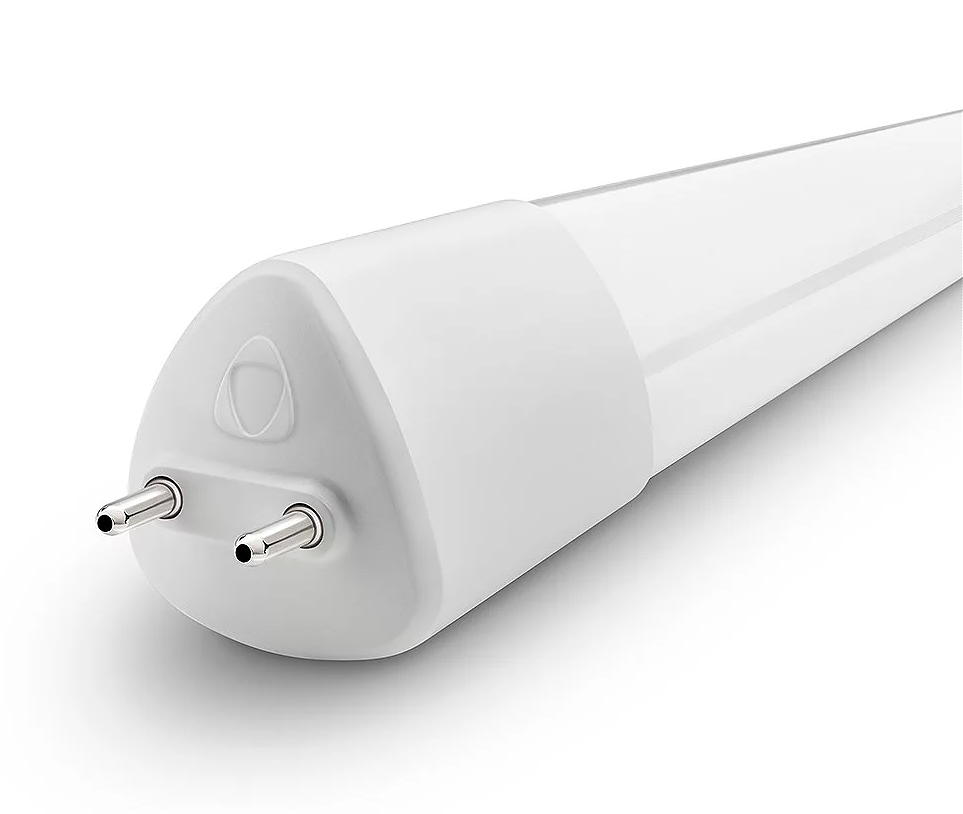
I recently had the fluorescent bulb in one section of the under-cabinet kitchen counter lighting fixture go dark. This wasn’t too surprising as the 24” bulb had been in place since the house was built in 1990!
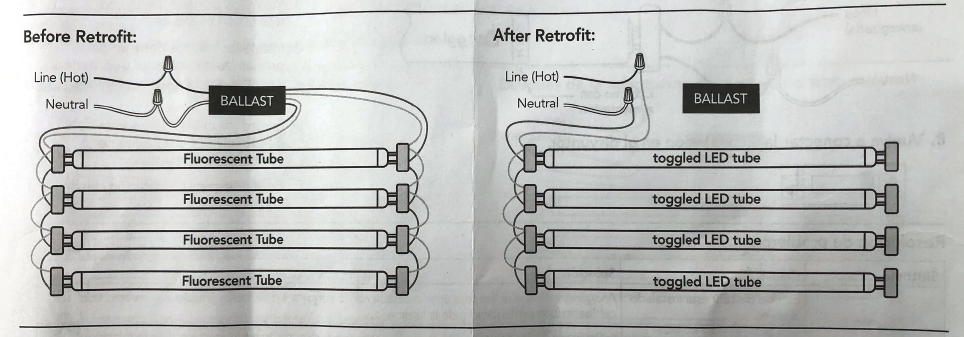 |

Hunting For NDBs In CLE266
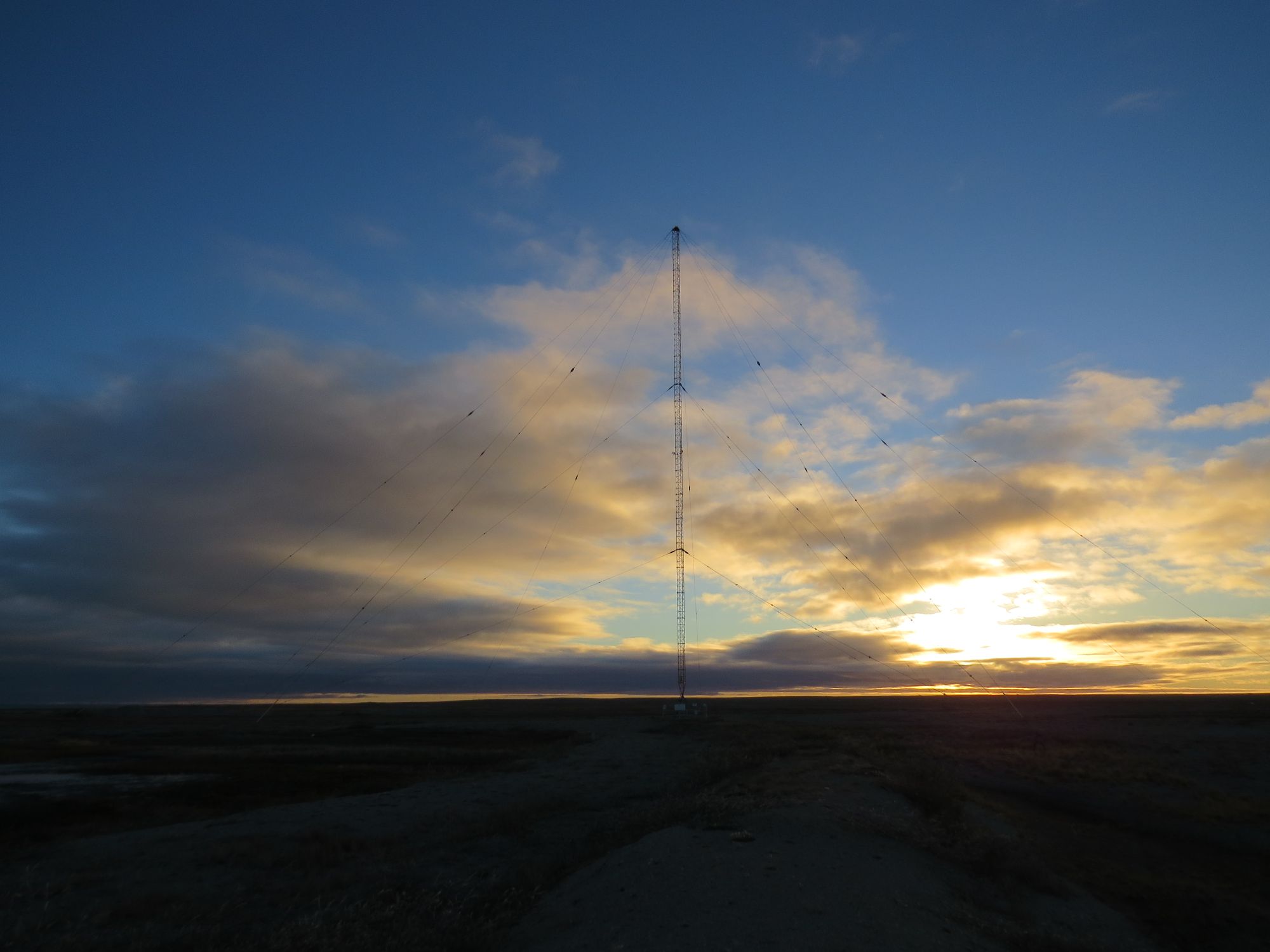 |
| YZS-362kHz Coral Harbour, NU (www.ve3gop.com) |
Propagation on MF has been both hot and cold for the past few weeks, seemingly depending on where you live and the amount of geomagnetic activity affecting your region.
A 'challenge target' for listeners in North America is YZS - 362kHz in Coral Harbour, NU, on Southampton Island at the north end of Hudson Bay. It's widely heard throughout North America and Europe and is a good target for listeners everywhere. Listen for YZS's upper sideband on 362.405 kHz.
When tuning for NDBs, put your receiver in the CW mode and listen for the NDB's CW identifier, repeated every few seconds. Listen for U.S. NDB identifiers approximately 1 kHz higher or lower than the published transmitted frequency since these beacons are modulated with a 1020 Hz tone approximately.
For example, 'AA' near Fargo, ND, transmits on 365 kHz and its upper sideband CW identifier is tuned at 366.025 kHz while its lower sideband CW ident can be tuned at 363.946 kHz. Its USB tone is actually 1025 Hz while its LSB tone is 1054 Hz.
Often, one sideband will be much stronger than the other so if you don't hear the first one, try listening on the other sideband.
Canadian NDBs normally have an USB tone only, usually very close to 400 Hz. They also have a long dash (keydown) following the CW identifier.
All NDBs heard in North America will be listed in the RNA database (updated daily) while those heard in Europe may be found in the REU database. Beacons heard outside of these regions will be found in the RWW database. These databases have recently been re-vamped and are slicker than ever before!
From CLE coordinator Brian Keyte (G3SIA), comes the following CLE info:
Hello all
Our 266th Co-ordinated Listening Event is almost here.
Can new 'listening eventers' join in too? YES, PLEASE!
Joachim and I are always pleased to help first-time CLE logs
through the harvester program.
Days: Friday 26 March - Monday 29 March
Times: Start and End at midday, your LOCAL time
Range: 350.0 - 369.9 kHz
Please log all the NDBs you can identify that are listed in this range (it includes 350 kHz but not 370) plus any UNIDs that you come across there.
You can find full information to help you, including seeklists made from
REU/RNA/RWW, by going to the CLE page http://www.ndblist.info/cle.htm and clicking on CLE SEEKLIST there.
Please send your 'Final' CLE log to the List, if possible as a plain text
email and not in an attachment and - important - with 'CLE266' and 'FINAL'
in its title.
Please show the following main items FIRST on EVERY line of your log:
# The full Date (e.g. 2021-03-26) or just the day (e.g. 26)
and UTC (the day changes at 00:00 UTC).
Many of us will be changing our house clocks during
the weekend, but UTC CONTINUES UNCHANGED.
# kHz - the beacon's nominal published frequency, if you know it.
# The Call Ident.
Optional details such as Location and Distance go LATER in the same line.
Please always include details of your own location and brief details of the
receiver, aerial(s) and any other equipment you were using.
Joachim or I will send the usual 'Any More Logs?' email at about 19:00 UTC
on Tuesday so you can check that your log has been found OK.
Make sure that your log has arrived at the very latest by 08:00 UTC on
Wednesday 31 March. We hope to make all the combined results within a day
or so.
Good listening
Brian
-------------------------------------------------------------------
From: Brian Keyte G3SIA ndbcle'at'gmail.com
Location: Surrey, SE England (CLE coordinator)
-------------------------------------------------------------------
If you are interested in some remote listening - maybe due to local difficulties - you could use any one remote receiver for your loggings, stating its location and with the owner's permission if required.( e.g. see kiwisdr.com ) A remote listener may NOT also use another receiver, local or remote, to make more loggings for the same CLE.
These listening events serve several purposes. They
• determine, worldwide, which beacons are out-of-service or have gone silent since the last CLE covering this range
• will indicate the state of propagation conditions at the various participant locations
• will give you an indication of how well your LF/MF receiving system is working
• give participants a fun yet challenging activity to keep their listening skills honed
Final details can be found at the NDB List website, and worldwide results, for every participant, will be posted there a few days after the event.
The NDB List Group is a great place to learn more about the 'Art of NDB DXing' or to meet other DXers in your region. There is a lot of good information available there and new members are always very welcome. As well, you can follow the results of other CLE participants from night to night as propagation is always an active topic of discussion.
You need not be an NDB List member to participate in the CLEs and all reports, no matter how small, are of much value to the organizers.
Remember - 'First-time' logs are always VERY welcome!
Reports may be sent to the NDB List Group or e-mailed to CLE co-ordinator, Brian Keyte (G3SIA), whose address appears above. If you are a member of the group, all final results will also be e-mailed and posted there.
Please ... give the CLE a try ... then let us know what NDB's can be heard from your location! Your report can then be added to the worldwide database to help keep it up-to-date.
Have fun and good hunting!













