Author Archive
 KL7 Tropo?
 July 3rd, 2015 |
  Author:
  |
| courtesy: http://www.nrlmry.navy.mil/ |
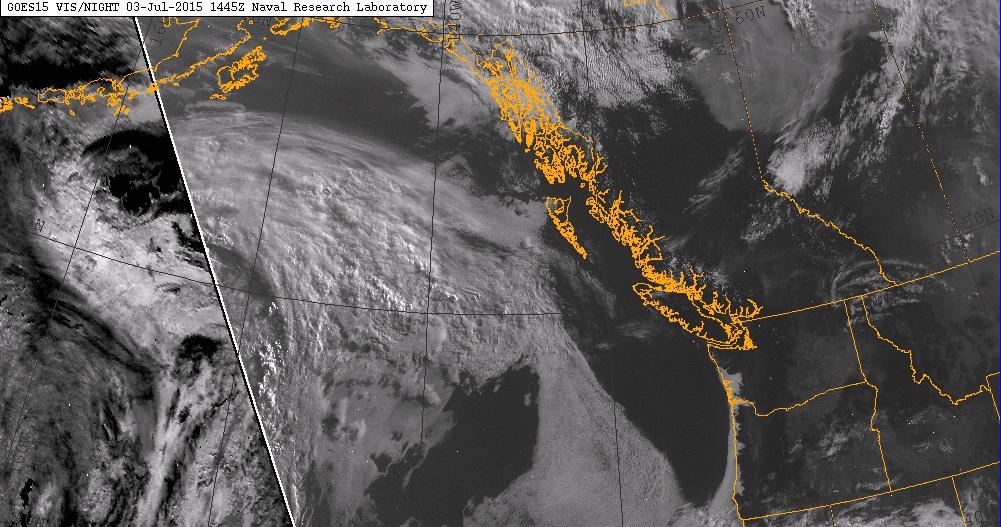
Like our unprecedented early hot and stable weather pattern over the West coast, this path is fairly rare and has never really been explored ... this one appears to be forming a stable path towards Alaska. The predicted conditions can be viewed on Bill Hepburn's World Wide Tropospheric Ducting Prediction page. Select the Eastern North Pacific from the 'Region' drop-down menu and see the map for Saturday.
Perhaps there are some KL7s near the water, or not too far inland and with a clear shot towards the southeast, that would be interested in running some possible tropo tests over the next few days if the path shapes up as predicted in the Bill Hepburn maps for the weekend. Not ever having explored this possible path before might yield some interesting results ... and who knows how far south into Puget Sound a tropo signal from the north might reach? Maybe it's time to find out. Of course, any stations between here and northern KL7 (Prince Rupert?... Juneau? ... Ketchikan?) might also be interested in trying a possible 2m path.
KH6 On VHF
 I notice that the long distance records for terrestrial QSO's on 2.3 and 3.4GHz were recently broken. The records were set by veteran VHFer N6NB, Wayne Overbeck and W6IT, Greg Campbell. N6NB was operating portable in Hawaii while W6IT was operating Wayne's home station near Orange, California. Both contacts were on SSB. In Overbeck's own words as posted on the Tropo Ducting Reports reflector:
I'd like to post something about my trip to Hawaii for the current tropo duct. This trip has really turned out well so far.
Last week the Hepburn forecast suggested that a duct might form in a few days. So I bought an airline ticket and packed a station for
all bands from 144 MHz through 10 GHz in two large suitcases plus a roll-aboard and a backpack (total weight: 150 pounds). When I got here, I rented a small SUV and built a station in/on it. I made several trips to Home Depot for parts to build a rotating roof platform.
When the duct began on Tuesday, I drove all over Mauna Loa while listening to my own 222.030 MHz beacon in Orange County, Calif. It was a thrill just to hear it 2,500 miles away. By Thursday, the duct seemed to be at its best. Greg, W6IT, activated my hilltop station near Orange, CA and we worked Thursday night on six bands, including 2304 and 3456 MHz, both for new world DX records. I heard Greg well on two more bands, 902 and 5.7 GHz, but so far local QRN in Orange County has prevented him from hearing me on those
two additional bands. Let's hope the duct continues for a little longer so we can try again and also work more stations on the west coast.
I intend to write at least a conference paper and create a PowerPoint show about what I've seen and heard in Hawaii. I've noticed that the KH6HME beacon site, as good as it is, sometimes seems to be above the cloud layer that forms the top of the duct. Thursday night it was about 2,000 feet above the cloud tops. Seeing that, I drove down to 5,200' elevation to work Greg on all those bands. (The beacon site is about 8,200 feet above sea level.) My 222 beacon was definitely louder at lower elevations than at the beacon
site at that time. Friday night I operated at 7,300', which was near the cloud tops and where my beacon seemed loudest then. The size and elevation of the duct seems to vary a lot, perhaps explaining the way the KH6HME beacons vary in relative signal strength, with 432 being a louder at certain times while the 144 beacon is louder at other times. There are some very interesting natural phenomena at work here.
If anyone would like to watch a video of the record-setting 2304 QSO with W6IT, it's online on my website:
www.n6nb.com/2304rcrd.mp4 Thanks to Greg, W6IT, for his able operating on the other end of these QSOs.
73, Wayne, N6NB/KH6
With the present extremely hot stable weather on the west coast, chatter on the PNWVHF reflector suggested that operators on the coast as far up as Washington state should be watchful of any possible DX opportunities should a suitable ducting pattern form between KH6 and the coast.
The difficult and rare path between Washington state and Hawaii has been worked in the past ... lastly in 1995, when some alert '7's' found themselves in KH6HME's logbook. Paul, K7CW and Merle, W7YOZ described an exciting day from Washington state:
I'll never forget that event. On June 30, 1995, KH6HME was worked by two guys in the Aberdeen, Washington area on 2m. The next day, July 1, I drove my pickup down to the area and went to a place suggested by one of the guys (this place now has the Langley Hill weather radar installation). I had a partial contact with KH6HME, but he got my call wrong and I couldn't easily reposition my antenna as it was fixed on the vehicle, and we couldn't complete. I sat back and listened to the other guys make contact with Paul. Dejected, I drove back home. Next day, July 2, though, I got my reward. Six meters opened to Japan in a nighttime sporadic E opening. I had my first QSO with a JA. It was with a JA6 in the far southwest of Japan. And I subsequently had 150 more QSOs with JA stations during that opening. I worked all 10 JA call districts, qualifying for the AJD award. My rig was running 80 watts and my antenna was a home brew 5-element yagi about 15 feet above the ground. This was a huge opening and there have been very few like it since.
So, after the big 2m tropo event, switch to 6m for another biggie.
73, Paul K7CW
Indeed an unforgettable time. W7FI first worked KH6HME, then phoned me and I got out of bed and heard WM7A (K7NQ) working him and then I worked him followed by N7MWV after I called and got him out of bed. K7CAI had a partial but was at the edge of the duct and Paul could never quite get Ozzie's quirky phonetics " K7 Cowboys And Indians" - a lesson for me to always use standard phonetics. KH6HME was S7 and over with his 60 Watts at my Kirkland, WA QTH for nearly an hour - long enough for me to call KK7B in MI and got him out of bed to listen over the phone. Paul's QSL along with that of WA4CQG in AL who I worked on 2 Meter double hop E's on another unforgettable evening in 1988 occupy a prime spot in my Ham Shack
Then the JA's on 6 the following evening was almost too much to believe.
Merle W7YOZ
Although the KH6HME VHF/ UHF beacons are still in operation, sadly, there appears to be no VHFers able to visit the beacon site and work the mainland, should an opening occur. Fred, KH7Y, the most recent beacon caretaker, has since moved back to California, leaving a giant hole in the VHF scene on the big island. I wonder if there is a replacement capable of activating the station?
Even without any operators at the far end, it would be exciting to just hear the VHF beacon(s) in this region. The 2m beacon, now on 144.277MHz, has even been heard here in BC, by Mike, VE7SKA, listening from his hilltop location on SaltSpring Island. Unfortunately no two-way contact was established at the time. Tropo of any kind is a rare event east of Vancouver Island's west coast because of the mountainous terrain.
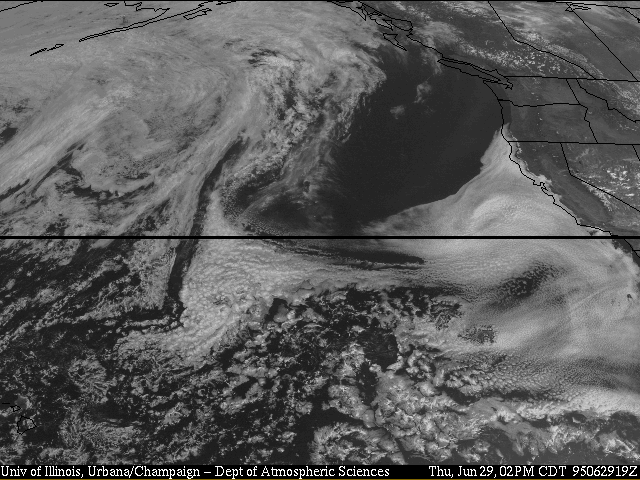
One of the best ways to follow the formation of favorable conditions is to watch the tropo prediction maps on Bill Hepburn's website as well as the visible west coast weather patterns available here.
An interesting summary of the 1995 openings, as well as the associated weather pattern pictures, makes for fascinating reading on the PNWVHF Society's website, A Brief History of the KH6 Duct Into The Pacific Northwest.
Field Day Memories
 |
| courtesy: arrl.org |
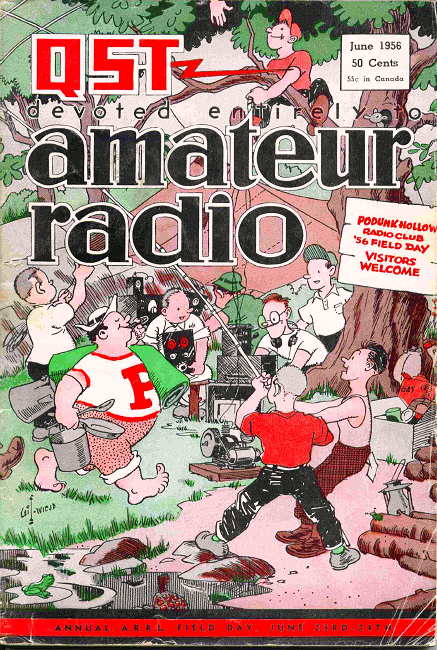
Field Day always followed the end of school and the start of the summer holidays so it was always a weekend that I looked forward to, months in advance.
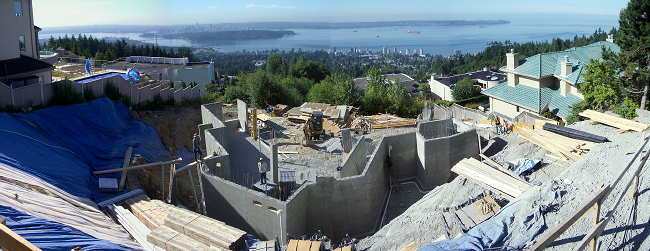
I always went out with the Vancouver Amateur Radio Club (VE7ARV) who used the same spot each year, just above the last street of homes high up on the slopes of West Vancouver ... it was at the base of Hollyburn Mountain and was a spectacular visual site, giving southerly views from east through west. At times it seemed like you could almost see California from up there ... it was a great spot for both HF and VHF. Our Field Day site has long been reclaimed by palatial-sized home in the prestigious 'British Properties' region of Vancouver's North Shore.
Sadly many of the organizers and operators that I remember from my youth are now long gone but they were an enthusiastic group of old-time hams that always had the time to make a young kid feel welcome and part of an important operation. Many of the same fellows were responsible for a lot of teens getting their ticket back in the late 50's and 60's. Tuesday nights were always spent in the basement 'classroom' of Hedley Rendell, VE7XW, who gave so much of his time to Elmering prospective hams as well as providing the trailored crank-up towers for our FD operations. He later established Rendell-Paret Electronics in partnership with Bill Paret, VE7AM, and the contents of Hedley's vast basement collection of parts was the beginning of a business that still flourishes to this day.
Field Day always had many high points for me. One of the best was being able to operate some top-notch equipment compared to my humble home station which consisted of an old Heathkit AT-1 and VF-1 VFO and then later, a much-used DX-35, purchased on one of the family's summer shopping trips to Seattle. In those days, the city was home to several ham radio shops and at least a dozen radio-surplus stores, all now long gone.
There were usually a couple of Collins 75A4's and later, state-of-the-art Drake 2B's. The Johnson Ranger was always reliable and such a pleasure to operate but there were always a few hundred-pound hernia-makers like the Heathkit DX-100's and the Johnson Viking II's that had to be lugged from back seats to tents every year. That's where us young guys came in handy.
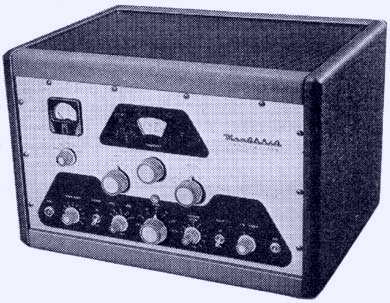
VHF activity back then was mainly FM (at least in the Vancouver area) and every year we would manage to work down to the weekend hilltopers in Oregon, mainly due to our elevated location. 2m FM rigs in those days were all converted taxi rigs, mainly Motorola 5V's, run on their built-in DC vibrator supply or on a homebrewed power supply. There were at least a hundred guys on 147.33 FM, all with old taxi rigs and the frequency was busy 24/7 it seemed. These were the days before repeaters and working 50 miles was a real accomplishment.
I usually took the 40m CW shift and would operate all night. The band was always amazingly crowded with nothing but FD stations throughout the entire activity ... even the 40m phone band was plugged solid with AM action, all working the FD contest. I would never ever sleep at Field Day and would go home exhausted, usually sleeping an entire Monday, to recharge my battery ... fun days.
I haven't been out on Field Day since my late teens as other things in life became more important but I'll never forget those wonderful weekends and the great fun that was had, so many years ago
CLE 195 Results
Propagation conditions co-operated for the recent CLE weekend but the weather did not. The high level of lightning activity resulted in some stations hearing just a fraction of what they usually hear in the 270 - 319KHz region. Although most of the lightning was a few states / provinces to my east, the results here were the same, with noise levels receding by ~18db when sunrise arrived over the lightning-affected regions.
It seems that almost everybody logged 500-watter YQ-305 in Churchill, Manitoba except me as this monster eluded me all weekend ... yet little 25-watter, YPM, in Pikangikum, Ontario made it through in fine form ... very odd.
The following stations were logged, all on the first night of the three-evening affair, with no new catches being added after night one:
20 07:00 272 XS 343 Prince George, BC, CAN
20 08:00 274 YPM 1299 Pikangikum Apt, ON, CAN
20 10:00 274 FR 928 Fort Resolution, NT, CAN
20 08:00 275 GEY 779 Greybull, WY, USA
20 11:00 278 1U 521 Masset Municipal Apt, BC, CAN
20 11:00 281 CRN 1510 Cairn Mtn - Sparrevohn LRRS, ALS
20 11:00 283 DUT 1867 Dutch Harbor - Unalaska Apt, ALS
20 09:00 284 QD 1014 The Pas Municipal Apt, MB, CAN
20 11:00 284 FHR 26 Friday Harbor Apt, WA, USA
20 09:00 286 EKS 600 Ennis - Big Sky Apt, MT, USA
20 10:00 287 PE 560 Peace River, AB, CAN
20 10:00 290 YYF 171 Penticton, BC, CAN
20 10:00 292 ZET 518 Devon - Edmonton IAP, AB, CAN
20 10:00 293 MB 18 Mill Bay - Sidney, BC, CAN
20 10:00 295 8C 537 Fairview Municipal Apt, AB, CAN
20 11:00 296 LGD 349 La Grande, OR, USA
20 09:00 299 TV 417 Turner Valley, AB, CAN
20 10:00 302 QW 705 North Battleford, SK, CAN
20 10:00 304 FH 485 Mc Leod (Whitecourt), AB, CAN
20 09:00 305 Z1 484 Three Hills, AB, CAN
20 11:00 305 ONO 448 Ontario Municipal Apt, OR, USA
20 10:00 307 M5 605 Manning, AB, CAN
20 10:00 308 ZZD 515 Calmar (Edmonton Intl Apt), AB, CAN
20 10:00 311 9Y 421 Pincher Creek, AB, CAN
20 11:00 312 UNT 173 Naramata, BC, CAN
20 10:00 317 VC 873 La Ronge, SK, CAN
CLE organizer, Brain Keyte, made the following comments in his CLE summary:
Most listeners seemed to be more affected by the natural QRN than by DGPS Stations' QRM.
Europe seemed to be relatively lucky with less static interference, especially for those able to pick their listening times.
Most listeners seemed to be more affected by the natural QRN than by DGPS Stations' QRM.
Europe seemed to be relatively lucky with less static interference, especially for those able to pick their listening times.
We covered the same frequencies back in March last year. Surprisingly, Europe's reception statistics showed very little difference. The rest of the world had the more normal summertime problems, perhaps also a bigger loss of active NDBs, and some of their overall reception statistics (number of NDBs heard and total distance) were 50% lower.
The highest 'rest of the world' NDBs count, unsurprisingly, was achieved by Edgar 'down under'. It must be quite hard for many of us who are 'up over' and trying to keep cool, to imagine his mid-winter conditions!
CLE196 will be over the weekend of 24-27 July.
Mr. Carlson’s Lab – A YouTube Treasure
I recently watched two superb YouTube videos. The first described exactly how to determine the 'shielded' side of a fixed capacitor and the importance of knowing this information.
As you have probably noticed, most modern fixed capacitors no longer indicate the 'grounded' end or the lead going to the internal shielding. At one time, the capacitor's polarity was commonly marked with a band on one end but this is no longer the case ... even though one side is indeed still the shielded side. Depending on exactly what part of the circuit your fixed capacitor is being used in, connecting it in the reverse direction (shield going to signal side), can introduce hum, RF pickup, instability and generally result in poorer capacitor / circuit performance ... and all it takes to determine which lead is which is an oscilloscope!
The second video I viewed shows the process used to resurrect a Yaesu FT-1000MP in truly terrible condition. In a very professional step-by-step process the video shows the logical and systematic approach at making the radio better than new.
Both videos are done by a truly gifted engineer, Paul Carlson, VE7ZWZ, and are exceptionally well done ... the quality one would expect to have to pay for rather than freely view on YouTube.
If you visit Paul's YouTube channel, you'll find a host of other radio and audio-related videos and I guarantee that you will learn something of value ... and probably hang around to watch several more. They are really well done.
As you have probably noticed, most modern fixed capacitors no longer indicate the 'grounded' end or the lead going to the internal shielding. At one time, the capacitor's polarity was commonly marked with a band on one end but this is no longer the case ... even though one side is indeed still the shielded side. Depending on exactly what part of the circuit your fixed capacitor is being used in, connecting it in the reverse direction (shield going to signal side), can introduce hum, RF pickup, instability and generally result in poorer capacitor / circuit performance ... and all it takes to determine which lead is which is an oscilloscope!
The second video I viewed shows the process used to resurrect a Yaesu FT-1000MP in truly terrible condition. In a very professional step-by-step process the video shows the logical and systematic approach at making the radio better than new.
Both videos are done by a truly gifted engineer, Paul Carlson, VE7ZWZ, and are exceptionally well done ... the quality one would expect to have to pay for rather than freely view on YouTube.
If you visit Paul's YouTube channel, you'll find a host of other radio and audio-related videos and I guarantee that you will learn something of value ... and probably hang around to watch several more. They are really well done.
Summer Solstice Magic

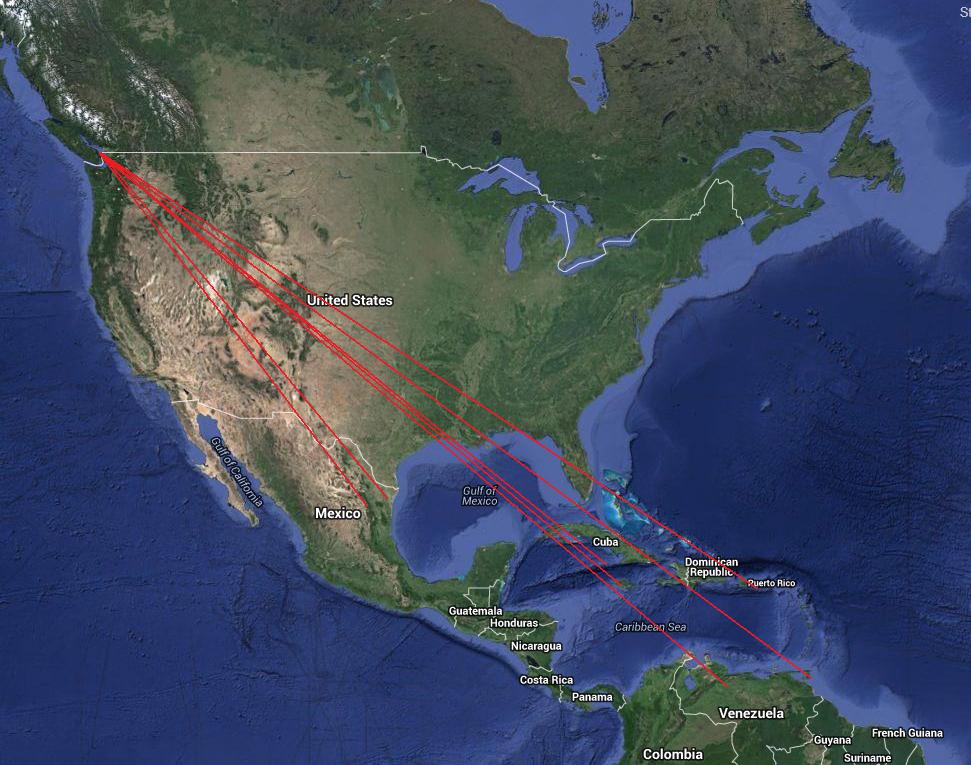
A loud NØLL in Kansas was the first station heard this morning at around 0600 local time but I suspect the band had been open even earlier, judging by the strength of the signals. It didn't take long for the band to stretch out further and not too much later, signals from the Caribbean were making it into southern British Columbia, as well as many parts of North America.
At times the band seemed as crowded as 20m CW during the Sweepstakes as so many of the CW stations congregate in the 20KHz slot just below 50.100MHz. Before breakfast, the following stations were in the log:
ZF1EJ Cayman Islands
9Y4D Trinidad
YV1KK Venezuela
6Y5WJ Jamaica
KP4EIT Puerto Rico
XE2MVY Mexico
XE2X Mexico
WP3C Puerto Rico
NP4BM Puerto Rico
 |
| courtesy: https://www.google.ca/maps |
At times, several in band 'growly' carriers with polar flutter were heard as well as weak signals from some of the 49MHz videos still operating in central Europe.
It will be interesting to see if we have a repeat of this prop tomorrow (Monday) but I rather suspect much of this was the result of two well-placed solar flares earlier in the morning and will not be repeated ... I hope I'm wrong!
A Summer Project

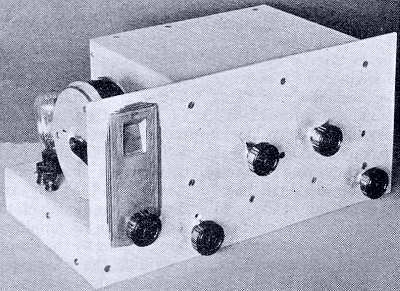
Work has begun on a new "summer project" (as well as re-shingling the woodshed and garden shed roofs) ... a 3-tube audiodyne receiver.
This one appeared in the January 1933 addition of QST (Rationalizing the Audiodyne by George Grammer) and then in subsequent Handbooks for a few years. It's the type of building I like to do, with lots of pre-planning before breaking out the tools, measuring all components carefully and refurbishing some of the 85+ year old parts.
 |
| courtesy: arrl.org |

So far, I've completed all of the shielding and drilling of critical holes ... all measured three or four times before taking the plunge. The only chassis available (Hammond or Bud) is about 1/2" smaller in width and depth, making everything just a little snugger, but still maintaining proportions.

I have no idea how it will perform but so far it's been a fun project. If it works well, even better yet ... but handily, it's given me a good excuse to avoid more important things, like the two roof projects!













