Author Archive
 Bureau QSL Batch
 May 8th, 2016 |
  Author: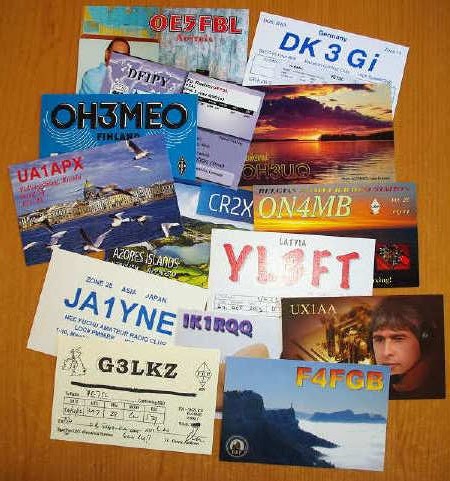
The batch of bureau cards last week included several cards from Europe and were probably the last I'll get for my Cycle 24 10m fun, using the homebrew Tri-Tet-Ten.
As mentioned previously, this rig was the culmination of wondering, for many many years, if I could get a single 6L6 to work well enough on 10m CW, using a 40m crystal ... quadrupling to 10m ... and still have enough useful output to work Europe! As well, the note would have to be 'acceptable' as I realized that any crystal chirping would be multiplied four times, during the quadrupling process.
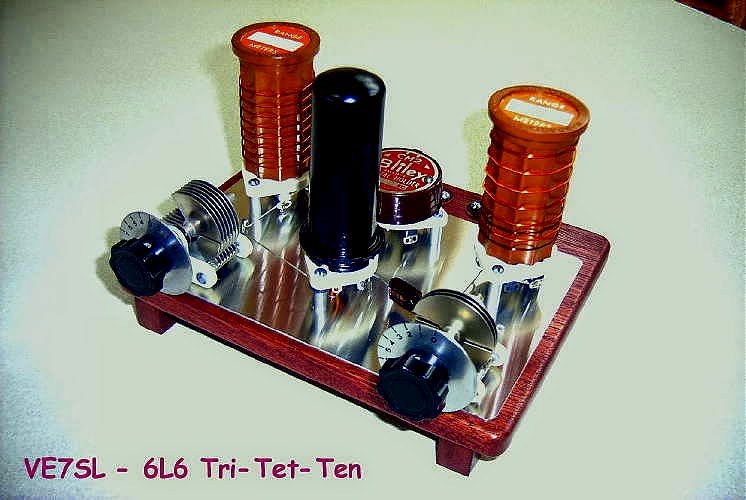
The evolution of my eventual transmitter, is described in more detail here, where you can also hear what the tone sounds like. Suffice to say, the results were much more than I had ever hoped for and during the peak years of this past cycle, many enjoyable hours were spent on 10m CW with my one tube tri-tet crystal oscillator.
I guess I could always move down to 20m CW but, for me, this just doesn't have the same appeal or sense of satisfaction as using it on 10m or what I like to call, "the other magic band". Who knows what Cycle 25 will bring to 10m? I may get another chance yet, if the solar prognosticators are all wrong!
QSL Bounty
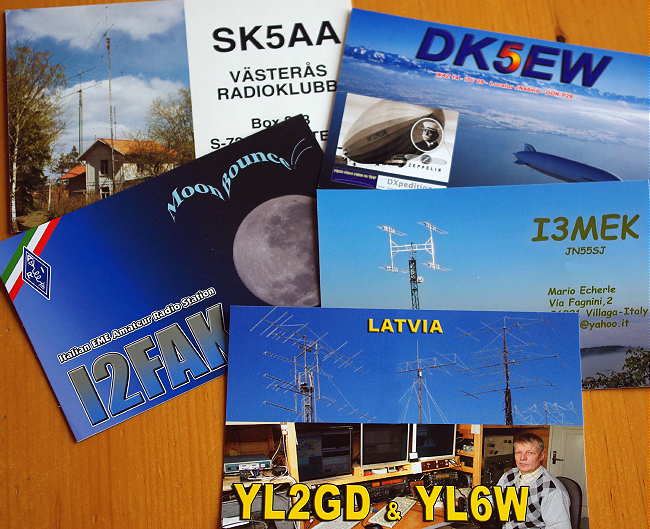
The postwoman was very kind to me last week, leaving five QSL's in two days, as well as a package of cards from the QSL bureau. It rather evoked memories of anxiously watching for the Saturday morning postman (do you remember when they actually delivered mail to your door on Saturday's!) as an 11 year old SWL, hoping that there might be another QSL for my attic radio shack wall.
Four of the cards were for recent 2m EME contacts ...

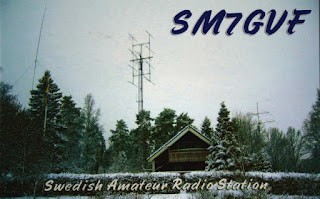
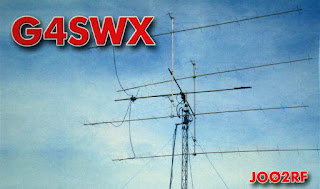
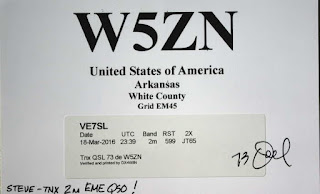
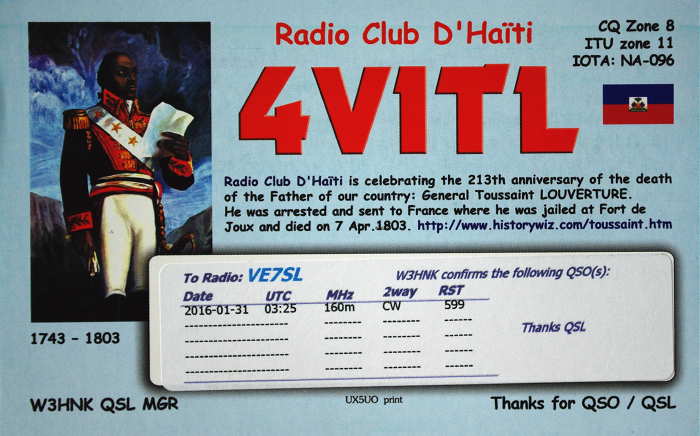
... and one was for 160m, confirming a winter CW QSO with Haiti, bringing my 160m DXCC total to 158 confirmed.

I have always loved QSL's, and looking back, the whole concept of collecting these small treasures was one of the things that initially attracted me to the radio world, when reading a magazine article about shortwave listening and collecting QSL's. I'm not so sure I love the QSL bureau though, but that's a whole other topic ...
Four of the cards were for recent 2m EME contacts ...
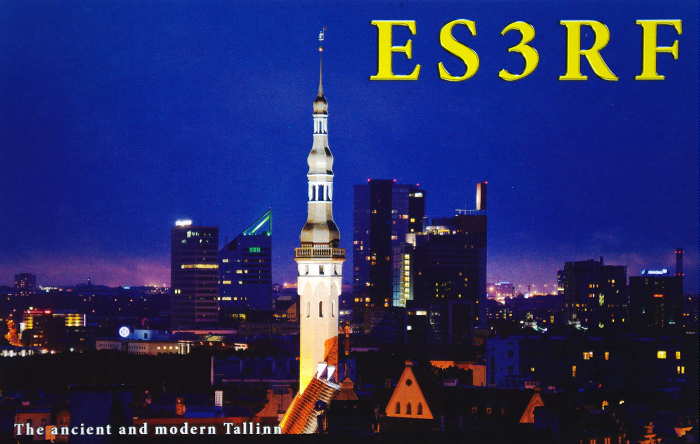
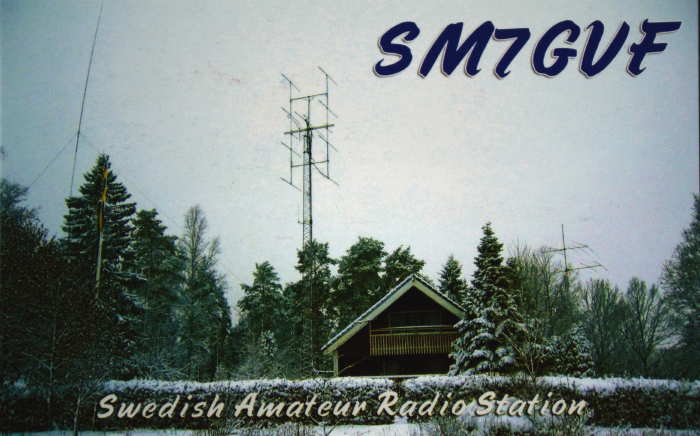
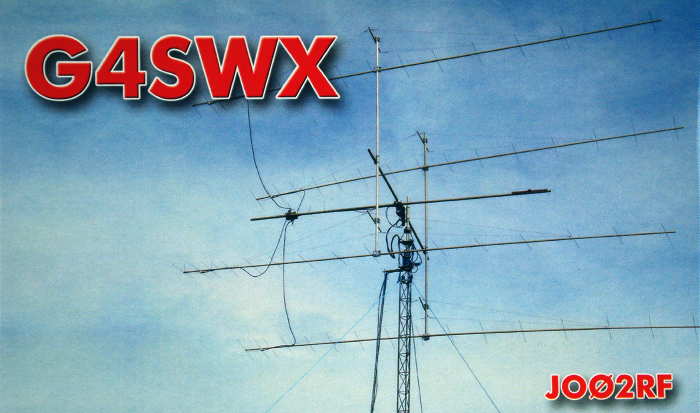
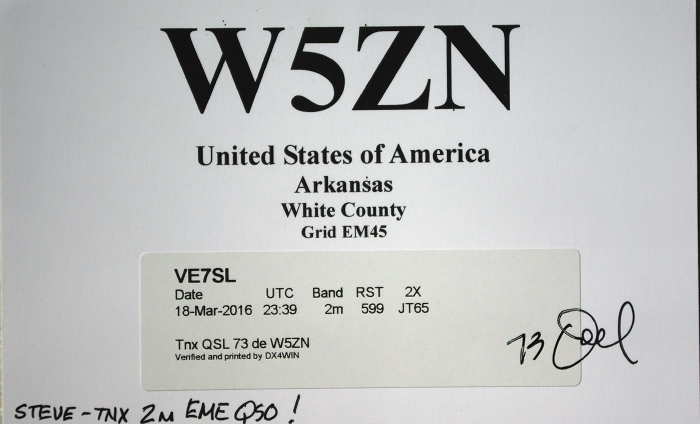
... and one was for 160m, confirming a winter CW QSO with Haiti, bringing my 160m DXCC total to 158 confirmed.
I have always loved QSL's, and looking back, the whole concept of collecting these small treasures was one of the things that initially attracted me to the radio world, when reading a magazine article about shortwave listening and collecting QSL's. I'm not so sure I love the QSL bureau though, but that's a whole other topic ...
The Joys Of ERP
 Amateurs and and U.S. experimental licence holders operating on the LF and MF bands, are limited in the amount of power they are legally able to run. Unlike the HF bands, where maximum power limits are expressed in either DC power input or PEP output, LF and MF operators are required to observe ERP or EIRP limitations. Canadians operating on 2200m are limited to 1W EIRP and to 5W EIRP on 630m.
 Although this doesn't sound like much, mustering this amount of effective power can be quite a task on either band, especially on 2200m. This is due to the very poor efficiencies encountered when using antennas that are so small in size compared with what would be considered 'normal'. For example, a typical 1/4 wave vertical used on 40m is about 33' high and with a good radial system can achieve efficiencies in the 80% range, while the equivalent antenna for 2200m would be 550m or about 1800' high ... a little large for most suburban backyards!
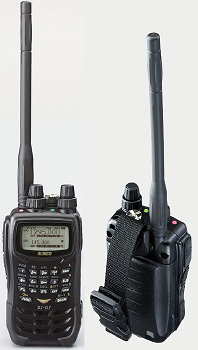
The equivalent of a normal 2m 'rubber-ducky' antenna when built for 2200m would be over 600' tall, while one designed for 630m would be around 170' high! A 2" stub used on your 2m hand-held would be the same as a 56' vertical on 630m. Consequently, most LF / MF backyard antennas will realize efficiencies of less than 1% and likely, quite a bit less.
In order to reach the maximum radiated power levels allowed usually requires several hundreds of watts, especially on 2200m, where near kilowatt levels are needed. These small radiated power levels might seem discouraging but they don't account for radio's great equalizer ... propagation. More than anything else, RF loves to radiate, and at times, what can be achieved on these bands with such low effective radiated powers is stunning
It would seem that Industry Canada did us no favors when they stipulated LF / MF power levels to be measured in EIRP and not the, much easier to calculate, DC power input level ... or perhaps they did. I think that, unlike on HF, imposing EIRP rather than DC input power limits puts everyone on an even playing field. Amateurs with lots of real estate and room for a larger, more efficient LF antenna, will be required to run much less power to reach the allowable EIRP and 'stay legal', compared to someone with a small backyard in the suburbs ... the latter can legally generate the higher level of DC input power required to reach the EIRP limits since their smaller antenna is operating at less efficiency. However, determining EIRP is not as cut and dried as measuring input power.
With some fairly sophisticated (ie. expensive) field strength measuring equipment, not typically found in amateur radio operations, ERP / EIRP can be readily determined. This means that for most amateurs, alternate methods must be used.
Neil, WØYSE in northern Oregon, who runs an experimental 630m station under the call of WG2XSV, has produced an excellent treatise on calculating your station's EIRP level, providing a step-by-step procedure to follow.
In order to determine your ERP / EIRP, you must first determine your antenna's radiation resistance. Two methods of calculating the antenna's radiation resistance for both verticals and top-loaded verticals (inverted L's or T's) are demonstrated, using the physical size of the antenna in relation to the frequency of operation. Once this value is known, the antenna current is measured while transmitting. These two values allow the Total Radiated Power (TRP) to be calculated. The TRP is then multiplied by 3 to yield the EIRP or by 1.82 for ERP. Roughly speaking, 5W EIRP is the equivalent of 3W ERP. Thanks to Neil for this helpful resource.
An alternate method of roughly determining ERP / EIRP values is an interesting new online 'antenna simulator' at the 472kHz.org site. Using known physical sizes along with your ground quality description, the calculator will indicate what total power output is required to produce various levels of ERP and EIRP as well as expected antenna currents, at 472kHz. It's a good starting point if you are either planning a new antenna system or perhaps, repurposing an HF antenna such as an 80m inverted-L or an HF center-fed dipole for use on 630m.
There are also a number of online calculators, such as found here, that will indicate your ERP / EIRP value when you plug in your antenna's 'gain' figure along with your TPO value. Some of the better antenna modelling programs can produce estimates of your antenna 'gain' at 630m and from there it is a simple matter of calculating what power is needed to reach the legal level.
I'm sure there will be a lot more information and discussion about this topic once the LF and MF bands are released in the U.S.A. but in the meantime, calculating your ERP / EIRP levels is not as hard as it might initially seem ... and is likely accurate enough for most agencies overseeing amateur radio activities.
CLE 206 Results
 |
| courtesy: http://www.solarham.net/ |
As I usually do, I retuned my inverted - 'L' close to the CLE frequency range and set up my Perseus SDR to make overnight recordings every hour.

I capture two-minute files on the hour and during the best propagation times (usually from midnight to dawn), every half hour as well. The next day I review the files, tuning through the band to see what has been captured overnight. As you might imagine, this can take some time but it allows me to take advantage of any propagation peaks that I might have missed had I been listening in real time for just an hour or two. It also allows me to get a good night's sleep!
Conditions were noisy, on all three nights, with lightning activity over the western states ... but for the most part had cleared up nicely after midnight. The last night (Sunday) saw the best overall propagation, even with a K index of 2. A very nice, but short-lived opening towards the east, brought an additional 18 more catches that had not been heard on the first two evenings, along with some nice NDB signals from Ontario.
23 07:30 198.0 DIW Dixon, NC, USA
23 07:00 200.0 YJ Victoria, BC, CAN
23 07:00 200.0 UAB Anahim Lake, BC, CAN
23 07:00 200.0 5M Sparwood, BC, CAN
23 07:00 201.0 ZWN Winnipeg, MB, CAN
25 09:30 201.0 YKX Kirkland Lake, ON, CAN
25 09:00 201.0 GL La Grande Riviere, QC, CAN
23 10:00 203.0 ZKI Kitimat, BC, CAN
23 10:00 203.0 YBL Campbell River, BC, CAN
25 11:30 203.0 TCY Tracy, CA, USA
25 09:30 203.0 AB Aberdeen, SD, USA
23 10:00 204.0 ZQR Regina, SK, CAN
23 10:00 205.0 COR Corcoran, CA, USA
25 09:00 206.0 XBE Bearskin Lake, ON, CAN
24 12:00 206.0 SOW Show Low, AZ, USA
25 09:00 206.0 IIB Independence, IA, USA
23 10:00 206.0 EF Castlegar, BC, CAN
24 05:00 207.0 YNE Norway House, MB, CAN
23 04:00 207.0 PY Fort Chipewyan, AB, CAN
25 07:30 208.0 YSK Sanikiluaq, NU, CAN
25 10:00 209.0 ITR Burlington, CO, USA
23 07:00 209.0 IB Atikokan, ON, CAN
23 12:00 209.0 CYT Yakataga, ALS
23 06:00 211.0 HDG Gooding, ID, USA
23 06:00 212.0 YGX Gillam, MB, CAN
25 09:00 212.0 MPZ Mount Pleasant, IA, USA
23 12:00 212.0 CGL Juneau, ALS
23 06:00 214.0 LU Abbotsford, BC, CAN
23 10:00 215.0 ZAB Edmonton (Intl Apt), AB, CAN
25 09:00 215.0 AT Watertown, SD, USA
25 08:30 216.0 YFA Fort Albany, ON, CAN
23 07:30 216.0 GRF Fort Lewis, WA, USA
23 07:30 216.0 CLB Wilmington, NC, USA
23 12:00 217.0 EC Enoch, UT, USA
24 07:30 218.0 RL Red Lake, ON, CAN
23 12:00 218.0 PR Prince Rupert, BC, CAN
23 07:00 219.0 ZRS Regina, SK, CAN
23 07:00 221.0 QU Grande Prairie, AB, CAN
23 07:00 221.0 9A Hanna, AB, CAN
23 07:00 222.0 WY Wrigley, NT, CAN
25 09:00 223.0 YYW Armstrong, ON, CAN
23 07:00 223.0 YKA Kamloops, BC, CAN
23 12:00 223.0 AFE Kake Apt, ALS
25 09:00 224.0 MO Moosonee, ON, CAN
23 07:30 224.0 DN Dauphin, MB, CAN
23 07:00 225.0 X5 Vegreville, AB, CAN
23 12:00 225.0 LWG Corvallis, OR, USA
25 09:00 227.0 YAC Cat Lake, ON, CAN
25 11:00 227.0 MHM Minchumina, ALS
23 07:30 227.0 CG Castlegar, BC, CAN
23 07:30 227.0 9X Brooks, AB, CAN
23 12:00 229.0 AKW Klawock, ALS
23 09:30 230.0 YD Smithers, BC, CAN
23 09:30 230.0 VG Vermilion, AB, CAN
23 09:30 230.0 BI Bismarck, ND, USA
25 09:00 233.0 QN Nakina, ON, CAN
23 07:30 233.0 OKS Oshkosh, NE, USA
23 09:00 233.0 BR Brandon, MB, CAN
23 12:00 233.0 ALJ Hinchinbrook Island, ALS
24 07:00 236.0 ZHT Winnipeg IAP, MB, CAN
23 07:00 236.0 YZA Ashcroft, BC, CAN
25 09:30 236.0 JB Whitehorse, YT, CAN
24 07:30 236.0 FOR Forsyth, MT, USA
23 10:00 238.0 MPA Nampa, ID, USA
23 05:00 239.0 OJ High Level, AB, CAN
25 10:30 239.0 BBB Benson, MN, USA
 |
| courtesy: https://www.google.ca/maps/ |
Hopefully you can jump in for next month's CLE activity. The CLE 206 listening results for all North American listeners and those outside of Europe can be found here.
Music To My Ears
 In my 'other' life, before retiring, I taught high school for 35 years. I soon became tired of doing my nightly lesson preps and marking of papers on the kitchen table so I built a large oak roll-top style desk, but without the 'roll' part.
It had lots of drawers, both big and small, slots and cubby-holes, and made the nightly homework very much more enjoyable.
The left end of the desk was occupied by my Sony ICF -2010 and above it, on the desk's top shelf, was a small amplified and tuneable ferrite loop antenna. The Sony was tuned to the 500kHz international MF 'distress' frequency, which was mainly used as a CW calling frequency for ships wishing to work the coastal traffic handling stations. Once contact was established, stations would move to the 'QSS' working frequency used by the coastal, so that the distress frequency was not tied-up.
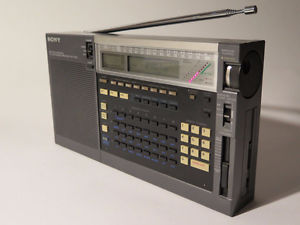
As I sat at the desk doing my nightly prep, the silence would be broken every few minutes with the sound of a CW caller, either a coastal or a ship. It was music to my ears.
On a normal night, the numerous coastals could be heard with their periodic traffic lists interspersed with ships up and down the coast calling with traffic or weather reports. However, on a really good winter night, the frequency was almost constantly abuzz with CW. Ships, as well as the coastals, could be heard from the Gulf of Alaska down to the Gulf of Mexico ... as far west as the Hawaiin Islands and on really rare nights, along the eastern U.S. seaboard. On those nights, 500kHz would sound like 20m CW, even on my little Sony and desktop loop.

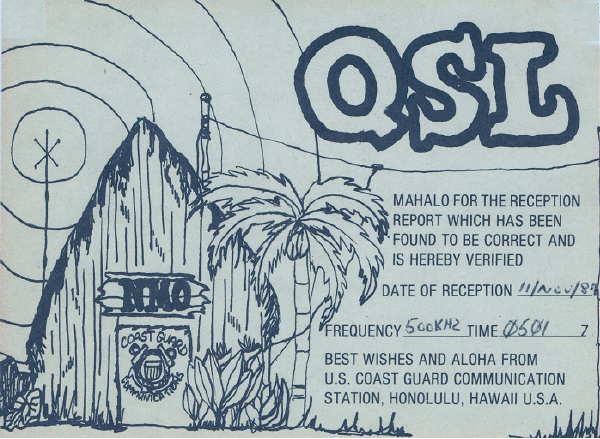

Thanks to the forethought of those that had the good sense to record some of those amazing sounds, you can step back in time and listen to what '500' sounded like back in its prime ... recorded somewhere in western Europe.
The most recent 630m crossband activity brought back these pleasant memories of what the band could sound like at times, with several very strong VE7's and a few weaker U.S. experimental stations to the south, all busily calling CQ at the same time on various frequencies. I consider it a huge privilege to be able to operate on this much revered part of the radio spectrum ... one steeped in such great CW tradition.
I think it won't be too long before 630m will sound much like its old glory days again ... and wouldn't that be a wonderful thing.
April’s Single-Yagi EME
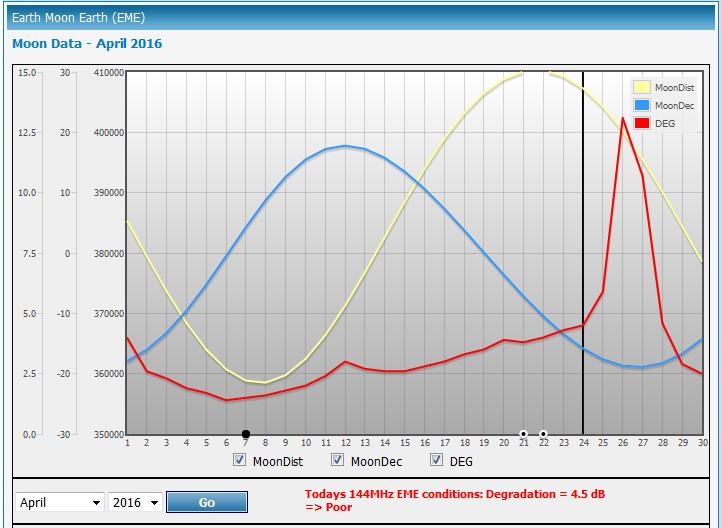
A website that helps determine when these good days occur, is the Making More Miles On VHF eme page. A graphical display of several important elements will easily determine which days might be best to operate ...
 |
| courtesy: http://www.mmmonvhf.de/eme.php |
This month saw six EME contacts, some with stations worked previously, in 2007, and not 'new uniques', while three were new, bringing my uniques total to 73, with this small, horizon-gain assisted system.
G4SXW John 4 x 16el array #71 ... answered my CQ
KB8RQ Gary 24 X 13el array!! worked with moon at 1 deg high
UX5UL Oleg 4 x 16el array #72
UT6UG Val 4 x 32el array #73 Val and Oleg both live in Kyiv, Ukraine
RK3FG Anatoly 4 X 15el array
K9MRI Joe 8 X 28el array - Indiana
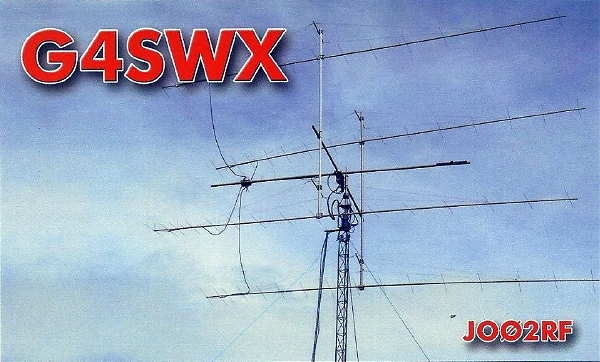 |
| G4SWX 4 x 16 el EME Array |
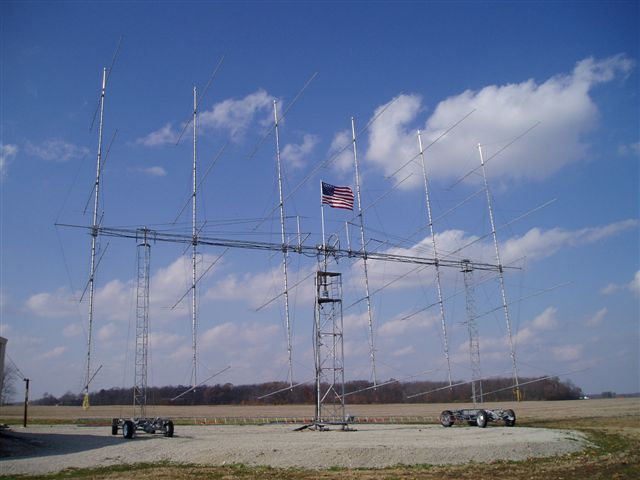 |
| KB8RQ 24 x 13 el EME Array |
As summer approaches, it will be interesting to see how favorable the above mentioned variables will come into play as many of the best northerly declination days will also closely follow the sun and its increased background skynoise ... not so much a problem for me but for those bigger stations trying to hear a very weak signal in a noisier sky.
A Second West Coast Lightwave Adventure
 |
| 51km Path courtesy: https://www.google.ca/maps |
Toby, VE7CNF, successfully inaugurated his lightwave station earlier this week, on Monday night, completing a nice two-way CW contact between West Vancouver (CN89) and Mayne Island (CN88). The distance spanned was approximately 51km (32 miles), crossing atop the western edges of Vancouver and then across the Strait of Georgia, the body of water separating mainland BC from Vancouver Island.
The details of Toby's homebrew lightwave equipment are described on his web site here and are similar to the station at this end ... also described in earlier blogs. This was the same path covered in my two previous lightwave QSO's with Markus, VE7CA, described here.
Monday evening's weather was clear and calm but at this time of the year, true darkness is a long time coming. With a full-moon just a few nights away, the sky never did get very dark it seemed. I set up my end of the path late in the afternoon, just in front of the house.
VE7CNF/7 end showing the busy-looking site in operation.


Accompanying Toby to the mountain lookout location were VA7MM, his YL VA7MAY and Markus, VE7CA who initially scouted out and found this nice site for our original lightwave contacts. Thanks to Markus who snapped a picture of the diehard lightwave crew!
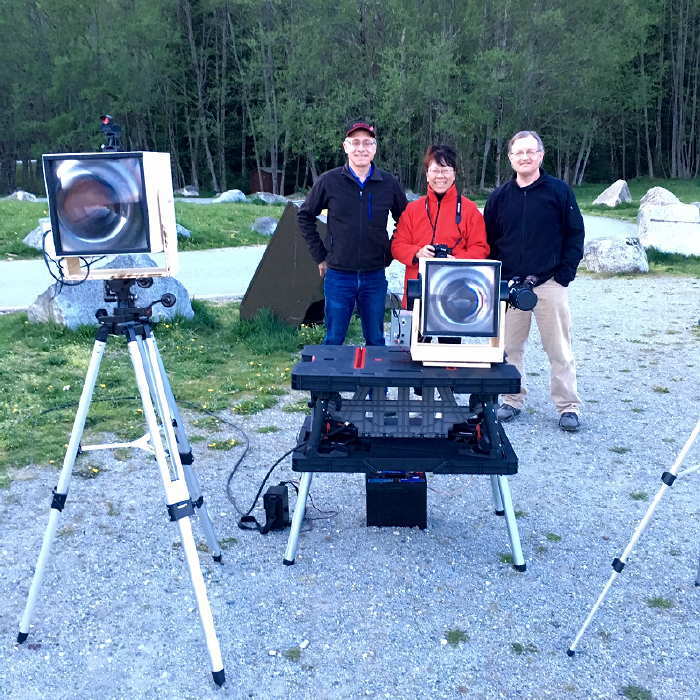 |
| VA7MM, VA7MAY and VE7CNF |
Although Toby's signal was very strong, the lighting hum was strong enough to cause some receiver front-end desensing and slightly modulate Toby's CW signal with a touch of AC ripple. I did not notice this hum when working VE7CA at the same location a couple of years ago. It's possible that there was no snow on the ski-hill at the time and the lights were not turned on.
Moving the receiver just a few degrees to the west made a huge difference, as the hummy background noise level returned to the quiet hush of a dark sky.
Toby's recording of my signal is much cleaner as there are no bright lights when looking towards Mayne Island. It is really interesting to hear the rapid fading, almost a flutter, on my CW signal, as the light passes through various levels of ever-changing haze above the water.
Midway through our one hour QSO, Toby reported that my signal had dropped measurably as had his signal on my end. Although I could see no obvious clouds in the path, I did notice a red glow out in the Strait that had not been there earlier. When I turned off my transmitter, the glow disappeared, indicating that there was indeed some low level haze that had crept up on us, and enough to cause some signal absorption on the path. Thankfully signal levels returned to normal, and actually were a bit stronger, about fifteen minutes later, when the haze thinned and the skies had grown a little darker.
Towards the end of our QSO, I had the chance to test out my #2 receiver. It was built so that I could do some NLOS cloudbounce testing here on the island, without having to separate my main system's transmitter/receiver pairing. At the time, there were no lenses available from the overseas manufacturer, so my quest for a suitable lens led me to a local 'bargain style' hardware importer (Princess Auto), who had a good supply of $5 lenses. The lens seemed to function well in my local tests but it had never been put side-by-side with the higher quality lens in my main transceiver. As it turned out, the $5 lens worked very well, easily detecting the 51km signal although it didn't sound quite as loud since the receiver I built for it was intended to interface with my laptop and lacked the additional audio amp I had built for the main system.
A final interesting observation was made, when on a whim, I placed a large cardboard shield over the bottom quarter of the transceiver's receiver lens. The signal strength didn't appear to change at all. I gradually blocked more and more of the lens but astonishingly, was still able to copy Toby's CW with all but a 1" strip of the lens completely covered! This would tend to indicate that we would be able to communicate with a very much smaller Fresnel or optical glass lens, such as a 4" or even a 2" inch magnifier. As I commented to Toby on CW, the possibilities for experimentation are endless.
All-in-all it was a very successful evening and the mountain-top gang seemed to enjoy the outing as much as I did, and ... the QSL is in the mail.
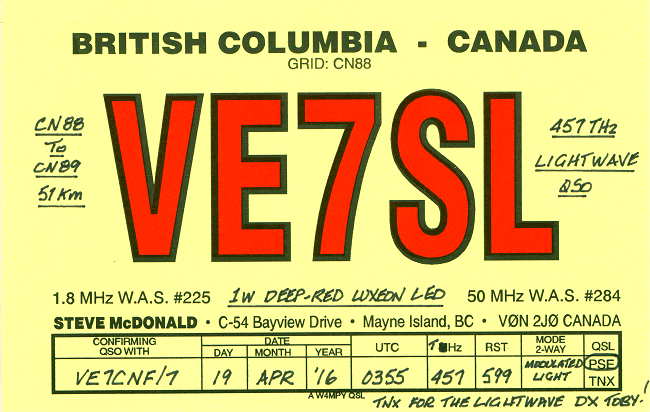
Hopefully there are other VE7's in or around Vancouver that might be interested in throwing a signal over this way some night ... I'll leave the light on for ya!













