Author Archive
 Got Noise?
 June 21st, 2016 |
  Author:
 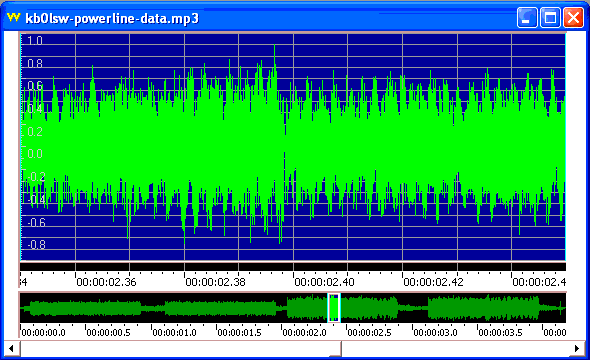 |
| courtesy: ARRL's Utility Noise (RFI) Signatures |
Excuse me if I seem somewhat cynical, but where have they been for the past twenty years as RF pollution, of now unbelievable proportions, has become the norm for most amateurs living in populated regions? In view of the present ubiquitous level of noise pollution, asking this question now is really akin to closing the barn door long after the horses have escaped ... and sadly, they are going to be very difficult, if not impossible, to round-up.
As radio amateurs, we are probably high on the list of those most negatively impacted by unwanted RF crud and were probably the first to bring this issue to the forefront. Many amateurs have watched, and continue to watch helplessly, as their noise floors climb higher and higher. For some, it happened overnight. In major cities and suburbs, it has become increasingly difficult to listen to normal AM radio because of RF noise pollution, so it's not just hams who are affected.
In many cases, the noise is powerline related and although this is part of the inquiry, in most cases this is probably not the main problem. Powerline noise is well acknowledged and here in Canada, RF pollution stemming from powerline radiation is illegal. Hydro authorities are required to clean-up noisy lines by government mandate (Industry Canada) and seem to react positively to complaints by amateurs. I believe a similar mandate is in play south of the border but because of the vast numbers of hydro operators operating in so many jurisdictions, getting action often seems fraught with difficulty.
The inquiry seems focused on the more nefarious types of radiation sources ... those that are not powerline-related, such as RFI caused by switching power supplies, light dimmers, electric motors, high efficiency lighting, computers, portable electronic devices, wireless routers ... generally any type of device radiating unwanted RF emissions.
Presently, complaints about this type of RF noise to governing bodies or to national associations, mostly seem to go without effective response ... solutions to the problem seem to be left to the amateur to "fix" the offending device or to just "accept it", rather than to put responsibilities on the manufacturers creating the problems. I know personally of amateurs who have just given up the hobby or have moved to the countryside because of impossibly-high illegal noise levels. It seemed as if calls for tighter government controls on electronic device emission-levels, especially on inexpensive and poorly-designed imports, largely from the far east, fell upon deaf ears. Some European jurisdictions found a ridiculous solution to the growing complaints by slackening even further, the allowable 'accepted' levels of spurious emissions. Previously illegal noise-making devices became legal overnight!
In the meantime, noisy electronic devices continue to flood the market at exponential levels ... only now, does the FCC pose this mind-boggling question! Equally stunning is their assertion that "... in search for concrete evidence of increased noise floors, we have found limited quantitative data to support this presumption." Perhaps if they had been maintaining vigilance instead of ignoring complaints when the problems were first reported, they would already have a huge body of the 'quantitative data' they are now seeking.
The Technical Advisory Council Noise Floor Inquiry (ET Docket No. 16-191) is well worth reading for any radio amateurs interested in finding solutions to growing noise problems. The three-page document includes a short list of questions to which responses are sought ... your input is vital, especially if hard data can accompany your comments.
Is it too late to turn the tide? There is no doubt that at this late date, it will be a huge uphill climb. The public notification document can be found here and the deadline for submissions, which can be made here, is August 11, 2016.
CW Forever …?
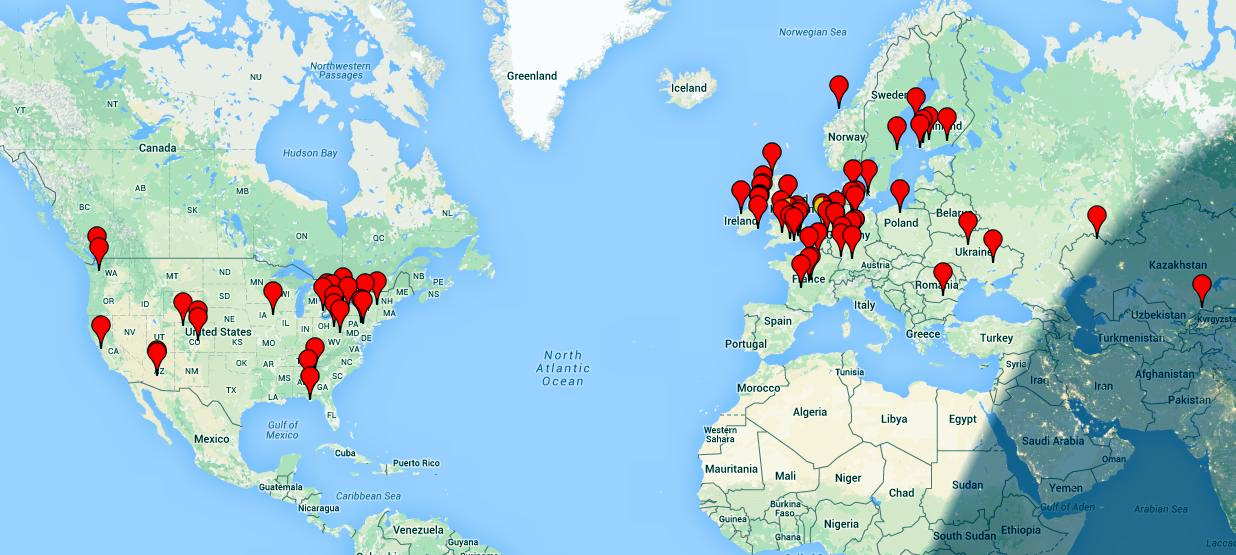 |
| 24 Hour 'JT' 6m Activity |
The transverter develops just over 70 watts output when run on 13V and so far, has been able to take all of the nightly punishment I've been able to throw at it with flying colors. Here is a WSPRnet screen shot taken from a typical night of my WSPR beaconing on 630m:
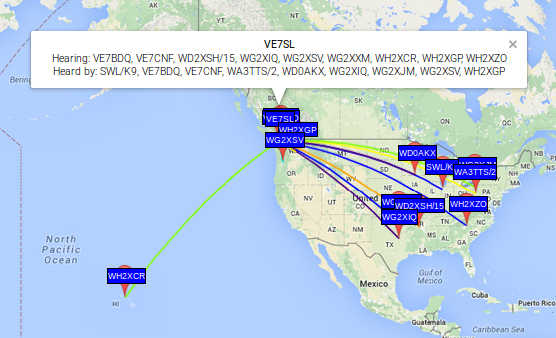 |
| courtesy: KB5NJD's 630m Info |
I was also able to have my first JT-9 mode QSO this week, with Toby, VE7CNF. This mode is the weak-signal WSPR QSO mode, tailored for LF/MF work and allows for calls, signal reports and confirmations (R's) to be exchanged ... the minimum requirements needed to claim a contact. Although additional information can be exchanged, its 13-letter message buffer does not exactly promote ragchew style conversations and some creativity is required to exchange more than the basics.
With many of our newer 'digital-savy' amateurs not necessarily being proficient in CW, I suspect that JT-9 may well evolve to become the go-to weak signal communication mode on 630m, much as it has in Europe. In fact, popularity of this mode in Europe has already spawned a few JT-9 contest weekends on 630m, with high activity levels being reported. I'm really looking forward to a 630m JT-9 QSO party in North America, once the band becomes a reality in the U.S.A.
JT-9 is capable of decoding signals reliably down to -24db SNR and boasts a 50% reliability of decoding at -26db SNR. Audible CW drops out at around -16 to -18db SNR, so communicating with JT-9 is the equivalent of going from 100 watts to around 800 watts ... a significant improvement and very helpful on 630m! Like WSPR, JT-9 will work with non-linear transverters and amplifiers such as the commonly-used and simple to build switching MOSFET Class D/E styles.
There also appears to be a fast-growing use of JT-65A on the 6m band this summer, with numerous 'CW forever' operators finding the mode's ability to dig up to 10db deeper into the noise paying off with surprising results. Some western North American operators have noticed that European JT-65A signal levels indicate that they should be in the CW-copiable range yet no CW activity is heard, for which there seems to be no ready explanation. Perhaps more will be learned this summer as the use of this mode continues to expand.
As one of the 'CW forever' proponents willing to try something different, I also have been listening for and working stations on 6m over the past few days on JT-65A. With the IC-756ProIII throttled back to 25 watts, I've found it fairly easy to make contacts when the band is open but have yet to hear or work anything unusual.
I'd love to hear your own comments on the use of JT-9 or JT-65A, particularly on 630m or on 6m ... maybe you can pass along some tips for those of us that are new to the mode on this band.
I may have to reconsider this 'CW forever' thing!
6m Awakens
 Well Friday morning's planned 2m EME window got pushed to the side when 6m started to show some interesting propagation possibilities. Several Europeans had been working slowly westward, past their usual east coast stopping point. When EA8DBM (Alex) in the Canary Islands reported via the ON4KST 6m chat page that he was hearing a station in Montana, my ears really perked up. At around 10:30 local time, KE7V (Johnny), about 40 miles due south of me in Washington state, was heard working Alex but I could hear nothing from him at all.
 As is often the case between here and KE7V, signals from Europe often move quickly northward and sure enough, about two minutes later, EA8DBM's CW signal appeared at good strength, calling CQ.
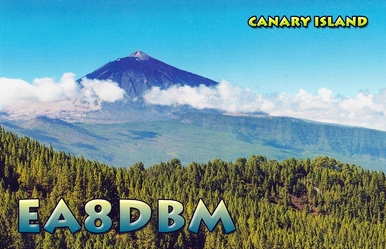
I quickly worked Alex, whose signal stayed around for almost an hour, and then began looking for any others that might be riding along on the same path. Sure enough, his neighbour, EA8TL was heard CQ'ing, but much weaker. After a few calls he came back with my report to which I responded several times, but it was evident that he was having difficulty as he kept repeating my report. Unfortunately, and unlike Alex, he soon faded away without me ever hearing the needed 'RR' for my signal report confirmation.
About an hour later, a rapidly fading and quickly building signal was heard on CW calling CQ at about 25wpm ... it was CN8KD in Rabat, Morocco!
 |
| courtesy: https://www.google.ca/maps/ |
I called Mohamed several times as his signal built, but his rapid-fire CQ's continued much to my frustration. As his signal peaked to a solid 569, he sent a '?' and then replied with 'VE6?', probably as shocked as I was. After repeating my call several times, he returned once again but this time with 'VE7NL?'. The next several transmissions from him were the same and as the delicate links between our two stations shifted once again, he was gone as quickly as he'd arrived ... close, but no cigar. This was the first 6m signal that I've ever heard from continental Africa since coming on the band in 1970. I wonder if I will ever hear him again.
With a dead 6m band on Saturday morning, I was able to get back on EME (JT65B mode) for my final day of favorable moonrise windows and had a nice surprise when VE1KG in Nova Scotia answered my first CQ, for initial #81 with my small station ...
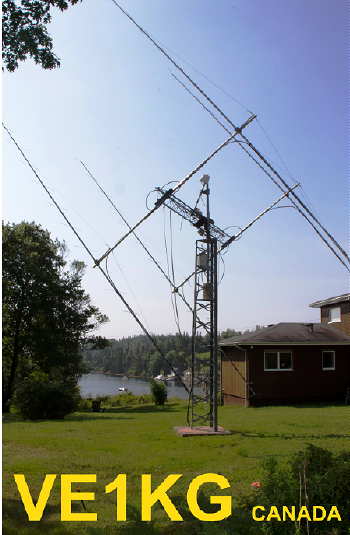
... all-in-all, a pretty fun week on the VHF's!
June’s EME Moonrise Window

With the QSL's from spring's EME activity gradually showing up in the mail, June's EME moonrise action should keep the postman busy next month as well.
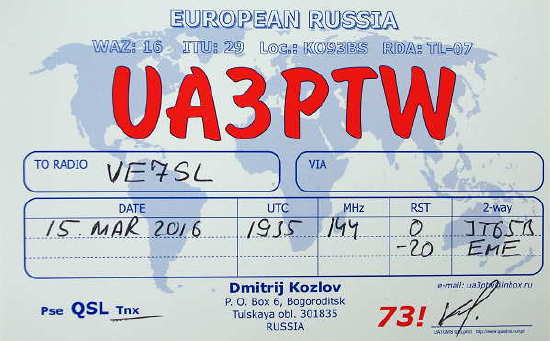 |
| Dmitrij - UA3PTW - Initial #60 |
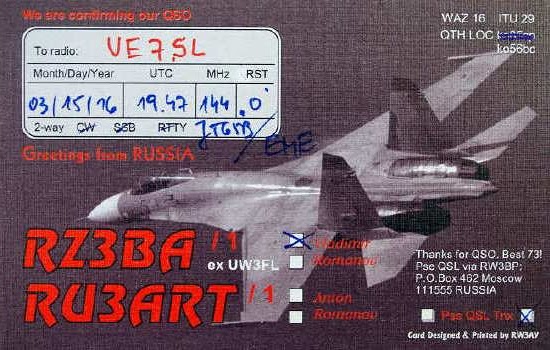 |
| Vlad - RZ3BA/1 - Initial #61 |
 |
| Oleg, UX5UL - Initial #72 |
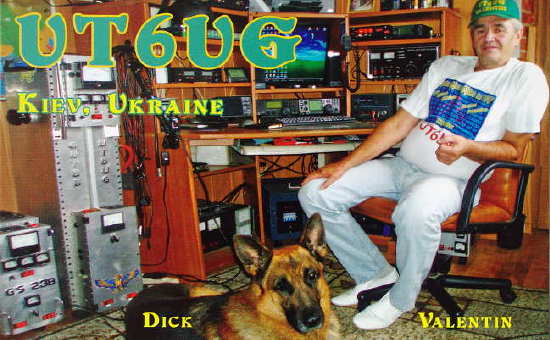 |
| Val - UT6UG - Initial #73 ...both Oleg & Val are in the same city |
 |
| Jorg - DK3WG - Initial #74 |
 |
| Bernie - ZS4TX - Initial #75 |
I have about five days of favorable moonrises directly over the ocean in front of my antenna (9el m2 Yagi), and a couple of hours each day before the moon gets too high for my antenna as it lacks any elevation control. After five days the moonrises usually move too far to the south and I am pointing into too many RF-absorbing Douglas Firs on my neighbor's property.
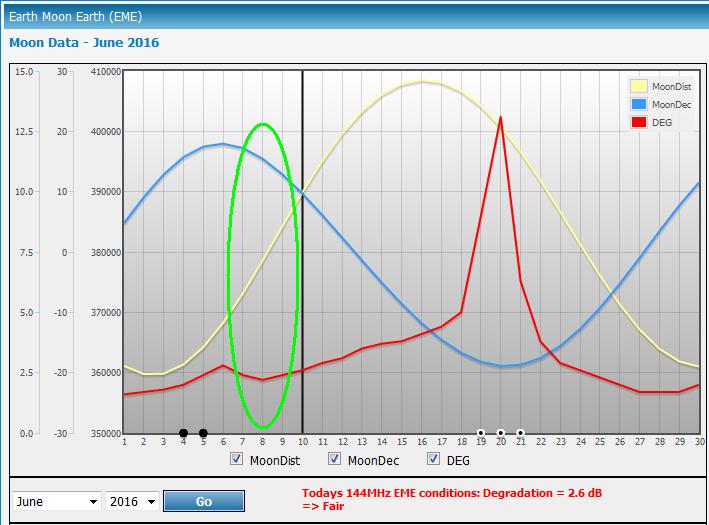
I started on Tuesday morning, which according the EME data graph shown below, should have been the best of the week since the moon was as close as it would get and the skynoise was low but unexpectedly, no signals at all were heard!
 |
| courtesy: http://www.mmmonvhf.de/eme.php |
On Wednesday, things should not have been as favorable since the moon was another 5000 miles further away, but the magic of radio did not disappoint ... my first CQ, with the moon barely 1 degree high, brought something that has never occurred here before ... three replies!
I soon completed three new initials with my QRP (140 watts) station ... RW1AY (# 76 ), DK3BU (#77 ) and DK5SO (#78 ). I have no idea why Tuesday was so poor or why Wednesday was so good, but I'll take it.
Today's conditions were also good again, with my first CQ being answered by N2CV in Florida, for #79.
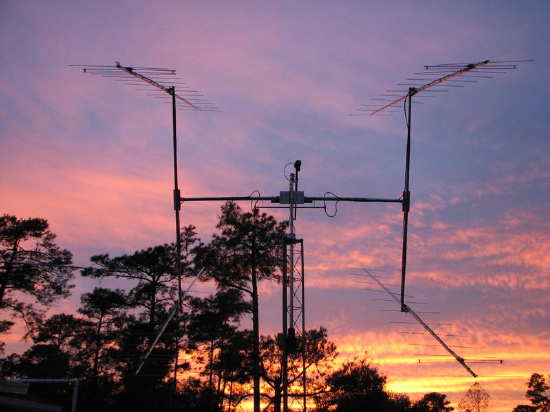 |
| Barry - NC2V - Initial #79 4 x 20 el array |
About an hour later, the strong CQ of YU7AA was heard who responded to my first call. After that his signal faded for some time and eventually returned to speaker quality level and the contact was completed for #80 ... I keep wondering if or when I'll run out of stations large enough to work.
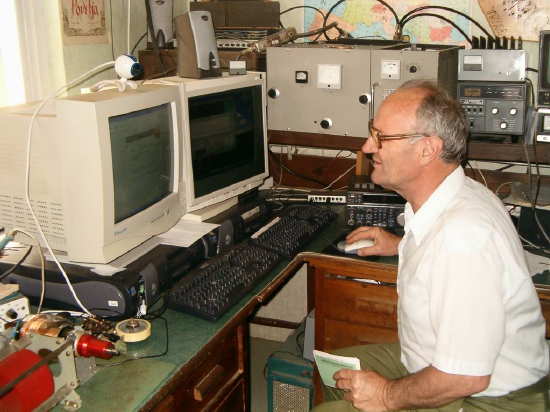 |
| Jozef - YU7AA - Initial #80 |
Who knows what tomorrow will bring, but as the moon climbs further away and rises further to the south, working anyone will be a nice surprise. I've usually avoided summer EME work, as often the best moonrises are very close to the sunrise, making it difficult for bigger stations to hear me when pointing near the sun. After June's good luck, it seems that summers might require more attention ... the next few months might be more interesting than I had thought.
Deceptive Sun
 |
| courtesy: http://sdo.gsfc.nasa.gov/data/ |
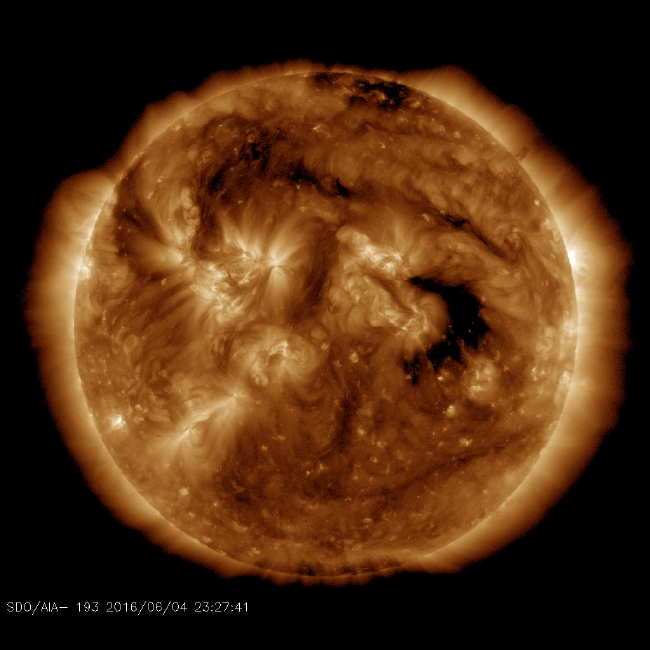
A quick glance at Sunday's sun reveals a spotless environment, something we will likely be seeing more often in the years to come as the Solar Minimum arrives around 2020. The last minimum in 2009 saw a total of 260 days of spotless suns and long periods of very little geomagnetic activity.
Incredibly, during the minimum in the 28 year period between 1672 and 1699 there were 50 sunspots total. That's not a week or a month but two 11 year cycles worth. The normal expectation would be 40,000 - 50,000 spots within a 28-year period.
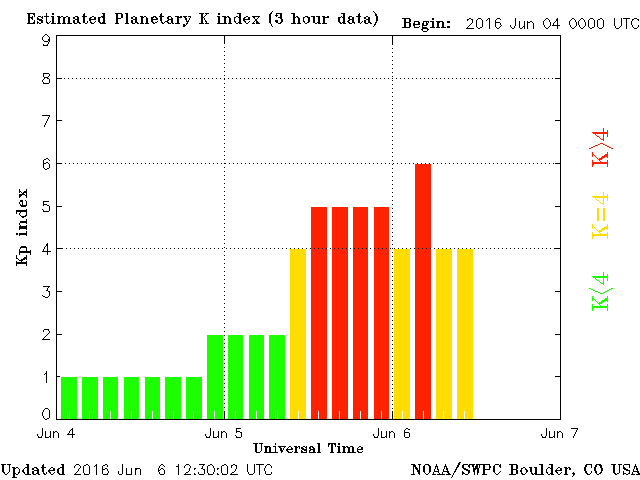
But the present, apparently quiet-looking sun, is not all as it appears as a look at today's satellite data and magnetometer readings indicate we are in the midst of a pretty good disturbance, driving the planetary K-index to level 5.
 |
| courtesy: http://www.swpc.noaa.gov/ |
 |
| courtesy: http://sdo.gsfc.nasa.gov/data/ |
With the vast array of solar instrumentation available to us online, much of the mystery involving propagation has been removed, making the tracking and even the predicting of geomagnetic activity, very much easier nowadays.
 |
| Kiruna Magnetometer: http://www.irf.se/maggraphs/ |
From my location on the west coast of North America, my main 6m interest over the past several summer seasons has been focused on the short-lived and exciting sporadic-e openings over the pole to Europe ... but today's sun is not helping. Most of these fleeting openings seem to require undisturbed fields in the polar regions ... geomagnetic quiet. Once CH738 rotates out of view, hopefully the polar activity will subside and maybe, just maybe, the magical 6m polar path to Europe will tease us once again.
 |
| The July 8th, 2014 magic - West Coast to Europe on 6m |
Magic Band And The DX Window
Late May and early June always sees 6m come to life ... sometimes slowly and sometimes with a 'bang'. Last year's good early start soon flickered-out into what was the poorest sporadic-e season that many could recall. This year's 'start' has almost been a no-show, with just a very few short openings to the south eastern states (Colorado, Utah) and one 'blink and you've missed it' opening to the Great Lakes.
Hopefully the 6m propagation gods are just having some fun with us and things will really spring to life shortly. Once we do get into some periods of good propagation, there are always new arrivals to the band, as most transceivers these days include the 6m band. Every season I hear of newcomers getting their knuckles wrapped for, probably unknowingly and in all innocence, operating inside the 'DX Window'.
If you're new to the band or perhaps not sure how the window should work, here's a short section taken from my Magicband web page, that explains the concept:
Don't Be A 'DX-Window' Lid!
One of the quickest ways to get the 6m community saying nasty things about you behind your back is to mess-up in the DX Window. The DX Window (50.100 - 50.125 kHz) has long been established for one type of contact only, that being a legitimate DX QSO.
The DX Window can only be of value if everyone follows these basic 'rules':
If you are in the U.S.A. or Canada, DO NOT WORK ANY OTHER U.S.A. or CANADIAN STATIONS INSIDE THE WINDOW. The window is NOT for North America - North America contacts.
Do not answer the "CQ" of U.S.A. or VE stations if you are in North America. This creates unnecessary QRM and chances are, they will not respond to your answer anyway. Calling or answering other North Americans in the DX-Window only reinforces bad operating habits, encouraging newcomers to do the same. If you want to work U.S.A. or CANADA, do it outside the DX Window!
Work or call only stations outside of North America inside the DX Window.
The only legitimate exception to these rules, that will not get you in the naughty-corner, is working a KL7, VE8, XE or some other such fairly rare North Americans.
I hate to say it, but some of the worst offenders to the successful function of the DX Window are my fellow VE's, many of whom don't know or don't understand the simple concept of how it works. Now that you know, pass it on!
Now, you may or may not agree with the concept of a DX window, so please don't shoot the messenger. What I do know however, is that if everyone does their best to adhere to the window's concept, it works well. Problems arise when those that should know better, and probably do, decide that for some reason, the concept doesn't apply to them or that it won't hurt, 'just this once'. Others, particularly newcomers, see it and think it's all OK and soon the window is full of domestic QSO's, effectively killing its usefulness.
As conditions slowly improve, hopefully we can work on six this summer. I usually hang out on CW, just below 50.100. As one long-time 6m diehard would often say to me, the newcomer over 40 years ago ... 'We'll see you, all of a sudden!"
VE3AB Netty Electronics
 While ordering components for my 630m transverter project, an internet search for some needed FT-37-77 cores brought me to the website run by Earl, VE3AB in NE Ontario.
Purchasing just a small number of parts can usually be expensive, considering the high cost of mailing these days but in this case, the toroids and a few other parts turned into a real bargain. Earl is a retired Defence Department Manager and Technical Specialist and has one of the most colorful and informative sites that I've ever run across. The extensive, somewhat 'eclectic' site, might at first appear to be a bit disorganized but it really all works nicely once you delve a little deeper ... and there are many layers on Earl's site. It really is quite different and one thing that comes through is his passion for doing things the right way!
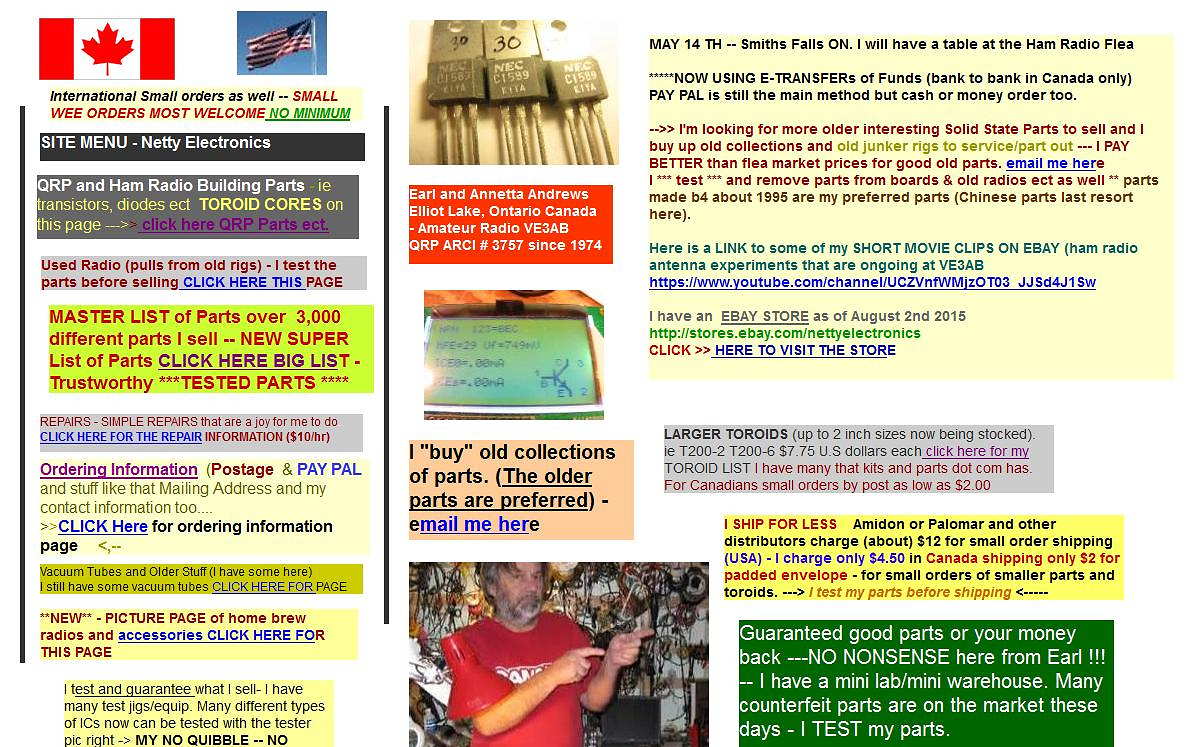
It seems that Earl's two main passions are fishing and supplying quality components at good prices. His dirt-cheap shipping to both Canada and the U.S. is something not often seen any longer, as shipping costs often make small purchases totally uneconomical. Forgive me if this sounds like a blatant plug for Earl's business ... it is not. It's just that I found his site extremely interesting and very different from most ... the fact that he is offering something that many hams might find helpful, is my main motivation.
The introductory 'ham radio' page contains, among other things, a collection of Earl's articles describing repairs on many solid state transceivers while his 'Netty Electronics' page describes his small home-based component selling and acquisition activities. His 'ham electronics magazine' page contains articles on working with circuit boards (re-capping, repairing, de-soldering), antenna articles as well as numerous articles on components, all authored by VE3AB. Earl's website and free services are all financed by personally using monies obtained through sales of parts and part radios as he sees it is a service to the amateur radio hobby, which he obviously loves deeply.
Earl specializes in solid state devices of all description, from vintage to modern. He offers a vast selection of parts for older radios and has information on repairing dozens of older solid state rigs. All parts are tested or guaranteed to be working within specs.

His pages contain extensive information describing his tests of popular Chinese-made transistors, such as this one describing a batch of dual-gate MOSFET BF981 transistors. His 'test' pages are definitely worthy of your attention and, for many, might be a bit of an eye-opener.

If you are looking for a manual for an older rig, Earl has an extensive offering of free manuals on his site. If it's not there, he can probably get it for you.
He is continually buying up collections of older components, as well as new parts ... if you have stuff to unload you might wish to check with him as so many of these valuable parts end up in the trash as shacks go silent. His extensive list of components can be found here. ... you may just find that special part you've been looking for.
One of Earl's goals for the website is to put up a search-engine for his parts but in the meantime, I found my browser's "Find" function worked well in sorting through the large list.
There is enough interesting information on his pages to keep you reading for hours and I find the random nature of much of it rather attractive. Earl says that changes to the site are coming but I hope they're not too drastic ... I kind of like it just the way it is!













