Author Archive
 630m – The Path To VK
 July 19th, 2016 |
  Author:
  |
| Roger, VK4YB |
I've been exchanging e-mails lately with Roger, VK4YB, in Queensland, Australia.
Roger is located about 30 miles from the ocean and has been the only VK signal that I have been able to hear on 630m WSPR mode. He seems to have the strongest signal out of Australia on 630m with his 90 watts and 120' tree supported wire vertical. John, VE7BDQ, has been heard twice down under with his modest station running at the allowable 5W EIRP limit, being reported in the fall of 2015 and again this spring. As well, John has heard Roger, the only signal from VK that either of us has copied.
I would like to be able to run some schedules with Roger in the fall, when transpacific paths should peak again. With that in mind, construction has begun on a new 630m transverter that will allow me to drive my present FET amplifier at full EIRP. Our schedules will utilize the JT9 weak signal mode, similar to JT65 but designed for the noisier LF and MF bands. It uses about 10% of the bandwidth that a JT65 signal requires, about 15Hz, and gains about 2db more sensitivity. A two-way QSO, under the best conditions, would take four minutes if all went well. A typical exchange of the required information, if initiated at my end, would look something like this:
VK4YB VE7SL
VE7SL VK4YB -20
R -18
RR 73
73 73 (not really needed but indicates RR received)
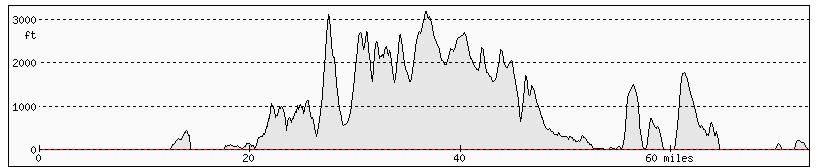
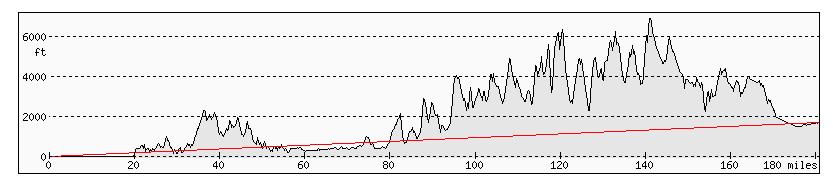
The path from my end is difficult as I am on the east side of Mayne Island and in Roger's direction, about one mile from a 600' hill directly in line with VK. Any RF heading Roger's way will need to leave here at a fairly high angle, which is likely the case anyway considering the low and short (in terms of wavelength) inverted-L antenna.
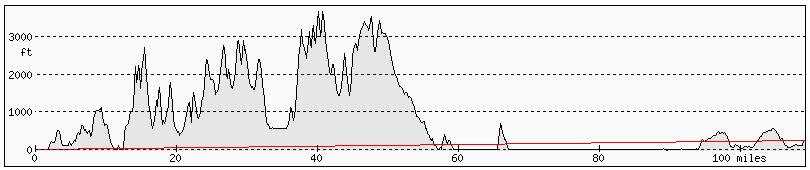
The path profile from here to the open Pacific Ocean is shown below, with my end being on the right edge, just behind those two hills. The rest of the obstructions are on Saltspring Island and then Vancouver Island, before hitting open water.
 |
| VE7SL To VK4YB courtesy: Hey What's That Path Profiler |
 |
| W7IUV To VK4YB courtesy: Hey What's That Path Profiler |
 |
| To VK4YB courtesy: Hey What's That Path Profiler |
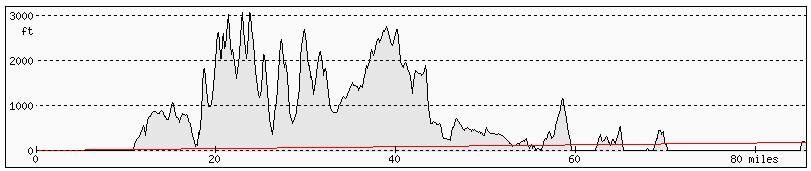
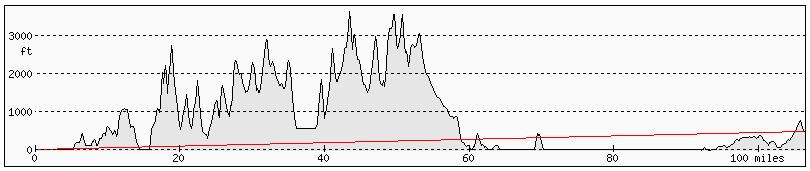
The path from John, VE7BDQ, already heard in VK, is also easier than from here. Not far from the water, John has a pretty clear shot across Georgia Strait, giving his signal lots of time to gain altitude and clear those pesky Vancouver Island peaks.
 |
| VE7BDQ To VK4YB courtesy: Hey What's That Path Profiler |
 |
| VE7CNF To VK4YB courtesy: Hey What's That Path Profiler |
 |
| VA7MM To VK4YB courtesy: Hey What's That Path Profiler |
 |
| VE7CA To VK4YB courtesy: Hey What's That Path Profiler |
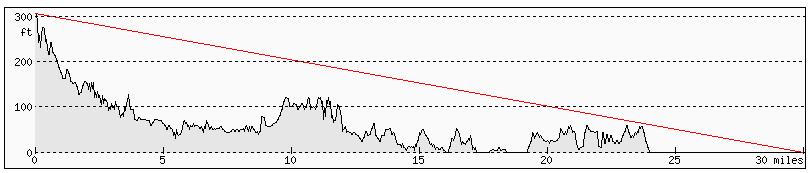 |
| VK4YB Path To Pacific courtesy: Hey What's That Path Profiler |
As the solar activity slowly abates (but not this week!), propagation on 630m will slowly get better and better ... hopefully along with increased levels of Canadians transmitting on the band, and lots of stations in the USA. It is hoped that our enthusiastic neighbours to the south aren't too far away from getting the band fairly soon. Better get those soldering irons warmed-up so you are all ready to go!
Growing 6m JT65 Activity
 |
| image courtesy: http://g8yph.blogspot.ca/ |
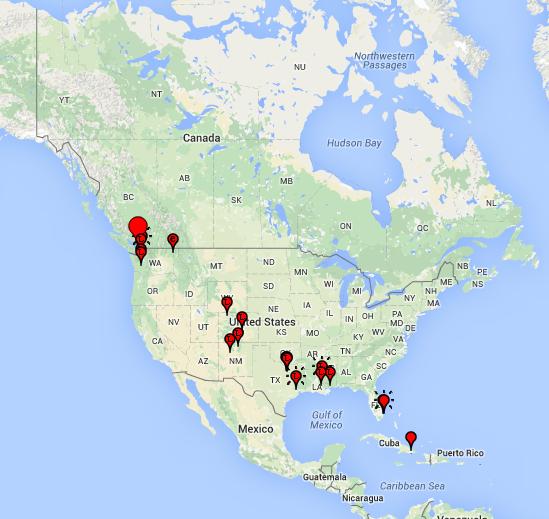
On several occasions this week, I have heard or worked dozens of others on JT mode while the bottom end of the band appears void of signals. Thursday morning was a good example, with several contacts down into the southeastern 'EM' grids on JT mode while seeing no reports of similar contacts being made on CW or SSB from my region.
This summer, there appears to be much more interest in 6m JT65 than ever before, as I see many familiar CW operators up the band on digital. There is no doubt that JT65's ability to dig deep into the atmospheric band noise and decode signals too weak to be heard on CW, provides an advantage when conditions are marginal. Perhaps this alone explains why I see such a difference between the two segments of the band. This is when JT65 really shines as it is primarily a weak-signal mode.
When the band really opens up however, things are different ... things can get messy pretty fast when the JT65 band fills-up with S9+ signals! Under these conditions, moving well away from the crowd is often better than trying to fight overlapping signals, often made worse by S9++ signals in your own grid, transmitting on the opposite sequence. In this respect, the JT65 segment is like a wider version of the 50.125MHz calling frequency ... the one spot in the conventional mode section of the band where anything goes ... the wild west of 6m.
 |
| Dead Band Spots - courtesy: https://www.pskreporter.info/pskmap.html |
During one particularly noteworthy period of no action in the lower part of the band, JT65 signals were either copied or exchanged with CO8, V31, TG9, KP4 and XE. Many of these signals were heard for several hours, making the difference even more striking.
Perhaps having all of the JT signals crammed into a 2kHz sliver just makes it seem busier but the mode is certainly gaining steam. Now actually working guys on JT65 is akin to watching paint dry, as its weak-signal sensitivity comes at the expense of time ... the same information that could be sent on CW in 10 seconds, requires a full minute. A complete QSO takes a minimum of four minutes and the 13-character message buffer does not exactly encourage much conversation, other than calls, signal reports, grid squares and 'RRs'. All the same, calling CQ and waiting for the telltale signs of a reply to appear on the scrolling waterfall is somewhat mesmerizing, not unlike an addictive video game of sorts ... just one more CQ!
Will I abandon the CW end of the band? Never ... but having another mode to play with on the magic band is proving to be much more interesting than listening to the usual din of white noise, waiting for the band to 'really' open.
You can read more about JT65 and download the free software, WSJT-X, here.
Nightly 75kHz WSPR Activity From Arizona – WH2XND
 |
| 2.5mH 136kHz loading coil at WH2XND |
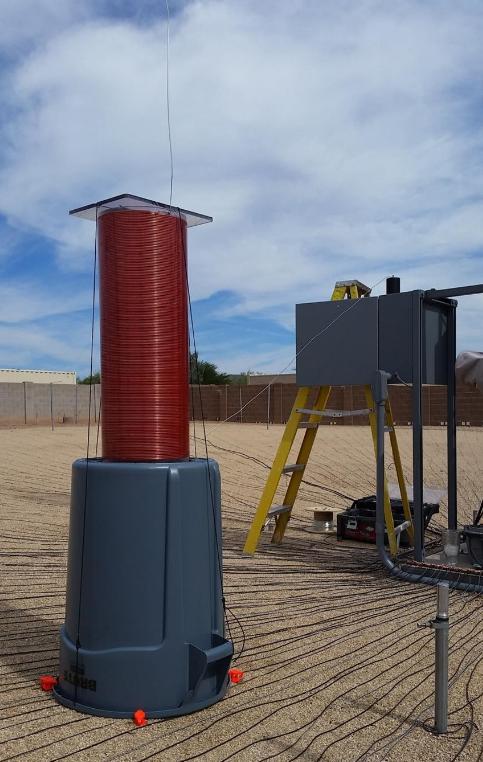
For the past few weeks, Ron, NI7J in Phoenix, has been activating his experimental station, WH2XND, in the LF band ... on 75.550kHz (WSPR), where he is licenced to operate.
Last night I decided to put my nightly 630m WSPR beacon on hold and have a listen for Ron's signal using my 10' x 20' loop.
Ron's main experimental operating has been on 630m and 2200m WSPR mode but his recent activity on 75kHz has sparked a lot of interest among dedicated summertime listeners. WH2XND is licenced for 10W ERP on 75kHz, not a number that's easy to muster considering the poor antenna efficiency produced by typical amateur installations ... however, judging from Ron's coils, his installation looks far from 'typical'!
Ron's signal is being well heard, even up in Alaska, in spite of the noisy summer conditions and it will be interesting to see how well it propagates once we move into the fall and quieter winter nights.
The big loop seemed to do well with Ron's signal last night, resulting in 55 decodes starting at around 2300 local time and continuing to sunrise.
Timestamp Call SNR Grid
2016-07-12 12:28 WH2XND -28 DM33xt
2016-07-12 12:20 WH2XND -27 DM33xt
2016-07-12 12:16 WH2XND -25 DM33xt
2016-07-12 12:12 WH2XND -28 DM33xt
2016-07-12 12:08 WH2XND -27 DM33xt
2016-07-12 12:04 WH2XND -28 DM33xt
2016-07-12 12:00 WH2XND -29 DM33xt
2016-07-12 11:40 WH2XND -25 DM33xt
2016-07-12 11:36 WH2XND -20 DM33xt
2016-07-12 11:32 WH2XND -18 DM33xt
2016-07-12 11:28 WH2XND -18 DM33xt
2016-07-12 11:24 WH2XND -19 DM33xt
2016-07-12 11:20 WH2XND -19 DM33xt
2016-07-12 11:16 WH2XND -20 DM33xt
2016-07-12 11:12 WH2XND -20 DM33xt
2016-07-12 11:08 WH2XND -19 DM33xt
2016-07-12 11:04 WH2XND -19 DM33xt
2016-07-12 11:00 WH2XND -20 DM33xt
2016-07-12 10:56 WH2XND -20 DM33xt
2016-07-12 10:52 WH2XND -21 DM33xt
2016-07-12 10:48 WH2XND -22 DM33xt
2016-07-12 10:44 WH2XND -23 DM33xt
2016-07-12 10:40 WH2XND -24 DM33xt
2016-07-12 10:36 WH2XND -25 DM33xt
2016-07-12 10:32 WH2XND -26 DM33xt
2016-07-12 10:28 WH2XND -24 DM33xt
2016-07-12 10:24 WH2XND -24 DM33xt
2016-07-12 10:20 WH2XND -25 DM33xt
2016-07-12 10:16 WH2XND -24 DM33xt
2016-07-12 10:12 WH2XND -23 DM33xt
2016-07-12 10:08 WH2XND -26 DM33xt
2016-07-12 10:04 WH2XND -25 DM33xt
2016-07-12 10:00 WH2XND -26 DM33xt
2016-07-12 09:56 WH2XND -26 DM33xt
2016-07-12 09:52 WH2XND -27 DM33xt
2016-07-12 09:40 WH2XND -26 DM33xt
2016-07-12 09:36 WH2XND -25 DM33xt
2016-07-12 09:32 WH2XND -24 DM33xt
2016-07-12 09:28 WH2XND -26 DM33xt
2016-07-12 09:24 WH2XND -26 DM33xt
2016-07-12 09:20 WH2XND -28 DM33xt
2016-07-12 09:16 WH2XND -27 DM33xt
2016-07-12 09:08 WH2XND -27 DM33xt
2016-07-12 09:00 WH2XND -27 DM33xt
2016-07-12 08:56 WH2XND -28 DM33xt
2016-07-12 08:52 WH2XND -29 DM33xt
2016-07-12 08:44 WH2XND -29 DM33xt
2016-07-12 08:40 WH2XND -27 DM33xt
2016-07-12 08:36 WH2XND -28 DM33xt
2016-07-12 06:44 WH2XND -32 DM33xt
2016-07-12 06:32 WH2XND -31 DM33xt
2016-07-12 06:28 WH2XND -31 DM33xt
2016-07-12 06:24 WH2XND -30 DM33xt
2016-07-12 06:20 WH2XND -30 DM33xt
2016-07-12 06:12 WH2XND -29 DM33xt
His signal peaked here (shown in blue above) about an hour before sunrise, with almost a dozen decodes in the -18 to -20 region ... not far from audible CW levels which will probably be seen in winter. It was interesting to note as well, that in several transmitting sequences, Ron's signal was stronger in Alaska than it was here and in Washington state ... just the opposite of what one might expect.
In the past, I have had good results on 75kHz with Dex (W4DEX), when listening for his QRSS CW signal, using my normal inverted -L with a 2.5mH RFC inserted in series with the antenna's normal loading coil.
 |
| 'XRS/5' on 75kHz from W4DEX in NC |
Is Your Miniwhip Too High?
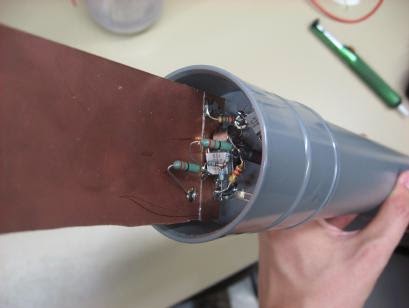 |
| The Mini-Whip at University of Twente's (Netherlands) Remote Receiver |
A recent posting to Yahoo's ndblist Group described an interesting experiment by Dirk Claessens regarding the signal-to-noise ratio (SNR) versus height of his PAØRDT active whip. Dirk's tests were posted on Yahoo's Navtex DXing Group where some further interesting discussion seemed to confirm his findings.
Here is what Dirk discovered, backed-up with his graph data, clearly pointing to the 'ideal height' at his location ... and probably yours as well.
Hi all,
You may recall that to get rid of a source of QRM, my whip is now hanging from a rope-and-pulley system, about 5 .5 mtr from the house, at a height of 7 meter agl.
As the height of the whip can easily be changed, this is an ideal situation to test the behaviour of the whip wrt noise levels, optimal height etc..
I had done this test before some 4 years ago, but not very precise. Time to do it again, and documenting it.
What I also wanted to check, is if there were any noise sources of the own house possibly reaching the whip.
(how far does the "noise bubble" go in function of the height?)
The Perseus was tuned to 549 KHz Deutschlandfunk Nordkirchen, the station closest to 518.
2 markers were set, one to the signal, and a reference marker in a quiet spot nearby on 543 KHz, to get a reading for the noise floor.
The whip was then lowered in "1 meter each minute" steps, readings were taken and written to the marker file.
First the absolute values were plotted.
Note that: blue = noise floor, red = signal, and that the left and right axis scales have identical spans of 19dB, but are shifted, in order to get a compact graph.
We see that for a delta height of 6 meters:
-the noise floor goes up ~8dB, or 8/6 = 1.3 dB/m, almost linearly.
-the signal goes up ~14 dB, or 14/6 = 2.3 dB/m, clearly curved and showing a maximum at ~5..7 m.
The continuous lines are polynomic (2nd degree) regression lines.
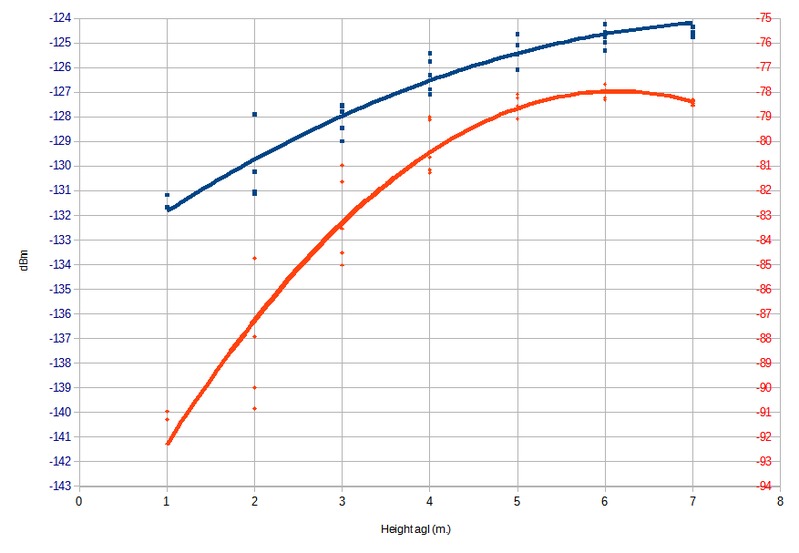
The noise on the measurement values seems to increase with decreasing height. Was this caused by my body standing under the whip, and near to the whip for the lowest measurements??
What really matters of course, is the signal over noise value, this is plotted below:
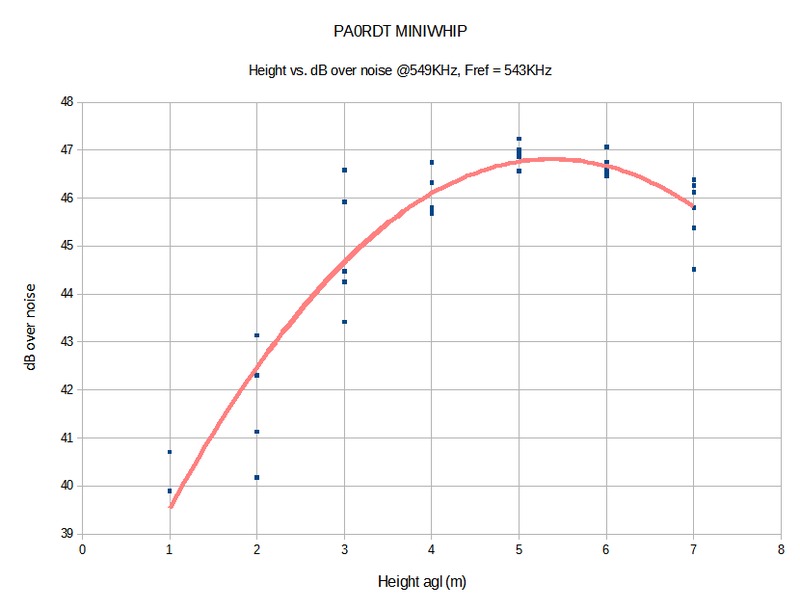
-Within a narrow 1 dB band, the curve shows a clear optimum in the region of 4..7 m agl, a familiar value often given as optimal by Roelof.
-The measurement was performed during the day and thus with ground wave propagation. As the whip is truly omnidirectional, I cannot see a reason why the behaviour would be different at low angle DX signals.
- At 5.5 meter from the house, the whip seems to be outside of the "noise bubble"
and later, following discussion:
I have just checked the noise floor again at 518 (with no signal present)
Perseus set to 125 kS/s, Span/RBW 25/30.5
Shield grounded: -125 dBm
Not grounded: -110 dBm
That's a whopping 15 dB difference!
I have also buried the coax ~20cm deep from the grounding point to where it enters the house.
The ideal height was also that recommended by Roelof, PAØRDT, originally and points out that one of antenna-building's most sacred commandments ... "the higher the better", is not always true!
I have often recommended this simple antenna for those looking for a very effective yet low-footprint receiving antenna for use on the LF and MF bands.
Much more information about Roelof's popular miniwhip may be found in previous blog discussions here.
CLE 208 Results

This past weekend saw another of the monthly CLE listening challenges.
'CLE's' are 'Co-ordinated Listening Events', and NDB DXers around the world focus their listening time on one small slice of the NDB spectrum.
If you are interested in building a 630m system, doing some listening on the high end of the NDB band is a great way to evaluate your station's receiving performance.
The frequency range covered for CLE 208 was 400-419.9 KHz where a fair number of North American NDBs' can be found. Beacons at this end of the band also tend to propagate better than those at the lower end near 200KHz.
This weekend, typical summertime conditions prevailed, with extremely high levels of thunderstorm / lightning QRN ... propagation itself was not too bad for the middle of summer.
As usual, I set up my Perseus SDR for hourly two-minute captures of the allocated spectrum and spent a few hours going over the files during the day. I have yet to purchase and download the latest version of Perseus software but I understand that there are several improvements over the system I am using ... which is excellent for my present needs.
Here is my weekend CLE log:
02 10:00 400.0 QQ Comox, BC, CAN
02 06:30 400.0 FN Fort Collins, CO, USA
02 10:00 400.0 CKN Crookston, MN, USA
02 10:00 400.0 1L Fort MacKay, AB, CAN
02 08:30 401.0 YPO Peawanuck, ON, CAN
02 08:30 402.0 M3 Kindersley, SK, CAN
02 08:30 402.0 L4 Nipawin, SK, CAN
02 11:00 403.0 AZC Colorado City, AZ, USA
02 08:00 404.0 MOG Montegue, CA, USA
02 09:30 404.0 GCR Cordova, ALS
04 09:00 404.0 FNB Falls City, NE, USA
02 08:00 405.0 9G Sundre, AB, CAN
02 08:00 405.0 2K Camrose, AB, CAN
02 08:30 406.0 YLJ Meadow Lake, SK, CAN
02 10:30 407.0 ZHU St Hubert (Montreal), QC, CAN
03 10:30 407.0 CHD Chandler, AZ, USA
02 10:30 408.0 JDM Colby, KS, USA
02 08:30 408.0 Z7 Claresholm, AB, CAN
02 08:30 408.0 MW Moses Lake, WA, USA
02 08:30 410.0 GDV Glendive, MT, USA
02 10:30 411.0 ILI Iliamna Apt, ALS
02 09:00 413.0 YHD Dryden, ON, CAN
02 04:00 414.0 YZK Harper Ranch, BC, CAN
02 10:00 414.0 LYI Libby, MT, USA
02 10:30 414.0 IME Sitka, ALS
02 09:00 415.0 LO West Yellowstone, MT, USA
03 09:30 415.0 CBC Cayman Brac, CYM
04 08:30 419.0 RYS Detroit, MI, USA
Final details can be found at the NDB List Website and worldwide results, for every participant, will be posted there a few days after the event. If you are a member of the NDB list Group, results will also be e-mailed and posted there.
The very active Yahoo NDB list Group a great place to learn more about the 'Art of NDB DXing' or to meet other listeners in your region. There is a lot of good information available there and new members are always very welcome.
6m Es – Is It Changing?

With the summer Sporadic-E season now approaching its midpoint, it looks as though this year may be another poor one. Having been operating on 6m every summer since the early 70's, I'm beginning to believe that we may be seeing some changes in what was once the normal summer pattern.
This summer, I can count on one hand, the number of good solid openings ... openings lasting for several hours. Over the past forty plus years, summers on 'six' for me, here in southwestern BC, were usually very predictable. The last week of May would usually see the start of regular band openings that would quickly escalate to almost daily openings through June and July. It was not uncommon to see the band open all day, into the very late hours and then still be open the next morning. Intense Es from California predominated the 70's and 80's ... much different than the past several summers here. The stronger openings now, when they occur, seem to be more to the southeast, favoring Colorado and other nearby central states. At times, this will turn into double-hop to the southeastern states, usually favoring the 'EM' grids.
Really long-haul openings have also taken on a different flavor. For more than two decades, openings to Japan on Sporadic-E almost always occurred late at night, near midnight ... late afternoon for the JAs'. The openings rarely favored anything other than the west coast. Openings to Europe from the west coast were, for the most part unheard of, and any claims of summer-time EU contacts were often dismissed as 'wishful thinking' and not taken too seriously.
A huge shift in long haul Es over the past decade has pretty much re-written the rules of what we have always taken to be 'normal'. Summertime openings to Europe, from the west coast, have now become a regular expectance and, although still rare and usually short-lived, somewhat dependable. Our midnight openings to Japan have largely disappeared ... replaced by hour-long, mid-afternoon or dinner-hour JA runs, and more often than not, right over our west coast heads to any U.S. call district fortunate enough to be in the propagation's hot-spot. All of this is so very different than the 70's and 80's!
So why are things different now? Is it subtle influences from our ever-changing sun?

We are now heading into our sixth straight day of a spotless sun, but in reality, solar activity has been slowly winding down for the last several years. Long term studies tend to show that the solar cycle has little effect on summertime Es, but maybe not.
Is it climatic change ... global-warming? The e-layer is supposedly high above any weather influence yet there is evidence pointing to Es being associated with lightning storms and high altitude plasma-driven sprite activity. Maybe global-warming includes ionospheric changes as well and perhaps weather plays more of a role than previously thought.
 |
| Courtesy: http://www.astrosurf.com/luxorion/qsl-perturbation.htm |
Is it changes in equipment, with an ever-increasing number of 6m stations sporting huge antenna systems and higher ERPs' than ever before?
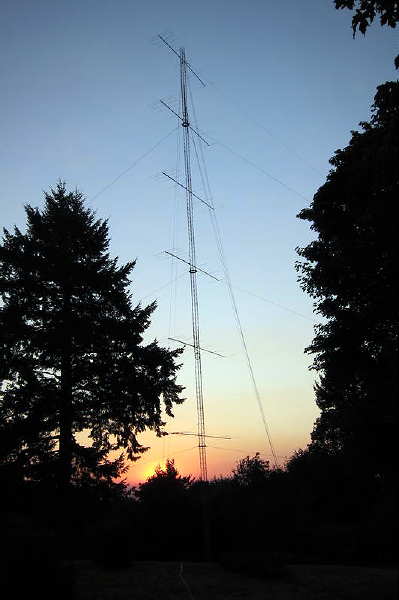 |
| Six 7-el Stacked Yagis At W7EW |
Maybe it's the influence of the Internet on operating practices? There is no doubt that having the ability to watch and follow realtime propagation paths, by the very minute, has made a huge difference in operating strategies ... along with big payoffs when it comes to catching those fleeting openings that would likely otherwise have gone unnoticed. On more than one occasion, I have worked Europeans on a seemingly 'dead band', with no propagation indicators at all ... just an announcement on the Internet that said station was calling 'CQ' at the time. Perhaps nowadays, there are just more savvy operators with good stations and a much better understanding of the DX possibilities ... slowly wringing out the best of what 6m has to offer. Maybe it's a combination of several factors.
Let me qualify my observations by saying that these have been my experiences and perhaps unique to the PNW and southwest VE7 only. Longtime Es data-collector, WA5IYX (Pat) in Texas, graphically shows the yearly Es variance in his region. The pattern appears somewhat sinusoidal in nature over the past few decades, but except for the occasional 'stinker', the variances from one summer to the next are not huge.
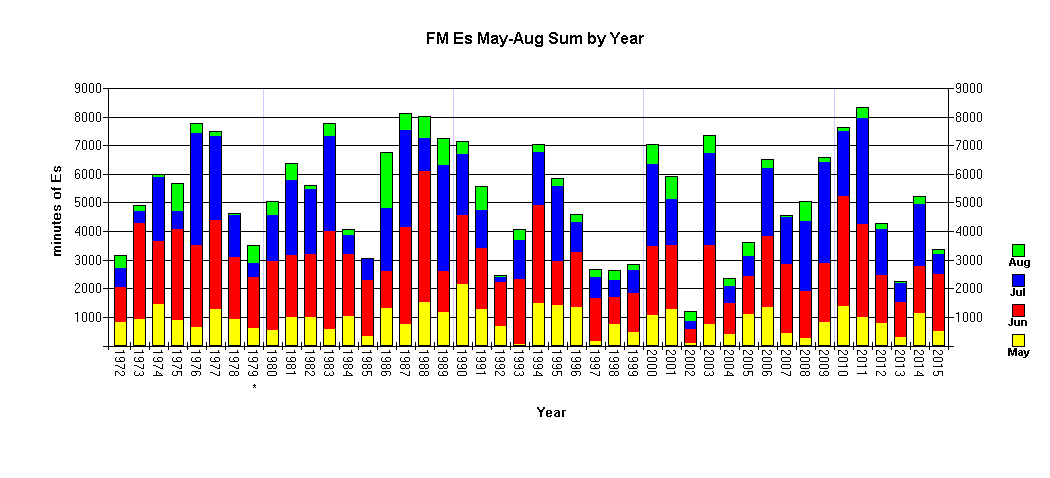 |
| Annual Es At WA5IYX courtesy: http://www.qsl.net/wa5iyx/ |
Are my observations similar to what you may have observed over the past many years? Are the changes real or only imagined? As with most global events being driven by mother nature and continually dynamic, I see no reason why 6m propagation should remain constant from decade to decade ... but I'd sure like to see a little more of it.
Now, usually when I voice complaints about our bad 6m propagation, it seems that things often flip from terrible to amazing soon after. The best Es of the summer often peaks in or close to the first week of July, now fast approaching. Let's hope that this is one 'constant' that hasn't changed as well!
**********************************
Wouldn't you know it. I put above blog together on Tuesday evening, intending to publish it on Wednesday. Early Wednesday morning, before 0900 local time, several Europeans were worked on CW ... perhaps the propagation gods were looking over my shoulder?
As is so often the case with these relatively new types of openings between EU and the west coast, there were no particular propagation clues from this end, other than a brief reception of the KØGUV/b in Minnesota. I was only alerted by the EU propagation reaching as far west as Colorado (KØGU) and a posting on the ON4KST 6m propagation logger that K7RWT in Oregon was hearing the VA5MG/b, sometimes a precursor to PNW propagation over the pole. The propagation map at the time shows no real indicators out this way ... once again, the value of realtime prop-watching via the Internet seems to have played a big role in finding these types of openings.
 |
| courtesy: http://www.on4kst.org/ |
Field Day – ’29 Style!
 |
| courtesy: WA3TTS & NO3M |
In Eric's own words:
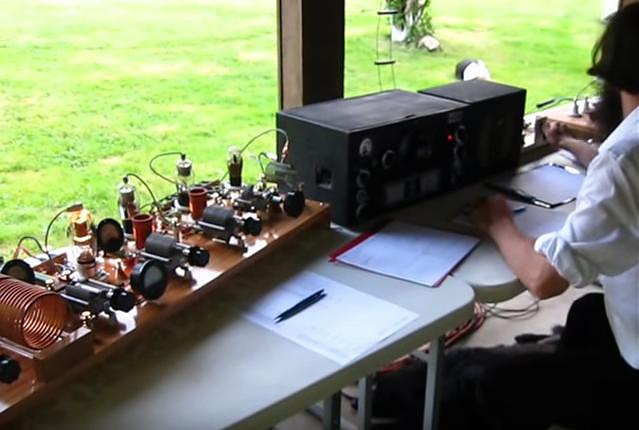
I had a 1920/1930s style Field Day setup this weekend and a bunch of guys over. 80M doublet with homebrew open wire line (approx 550 ohm), the transmitter was a 27-24-24-865 job more or less straight out of July 1931 QST, but with a Hartley instead of crystal oscillator. 27 tuned to 80M, first 24 to 40M, second 24 also 40M, and the 865 on 40M. About 10W. Never did get a chance to try her out on 20M by using the second 24 as a doubler.
I also built the complementary amplifier using a 203A from the August 1931 QST article. I had not even tested the amplifier, only having been finished at 1AM Saturday morning!! It is somewhat different in that the grid circuit is composed of the driving rig's antenna coupling coil/cap, re-wired to be in parallel, not series, of course. It was coined as being a good amp for any existing power oscillator or MOPA, We did a quick job of neutralizing while the gang was here and fired it up..... no modern measurement devices in sight, so we were only going on RF current. 0.9 amps into 50 ohm (pre-tuned the homebrew link coupled, balanced tuner with an analyzer beforehand)... so about 40 watts. I was hoping for 100W.... anyways, after most guys left, a couple of us starting messing around with it more, mainly tightening the output coupling of the MOPA and amp tanks. NICE! 1.45 amps, ie. 105W on 40M.
Anyways, I'll have a full writeup and photos on my website in a few days. We used an HRO5 for a receiver; everyone commented on how good it sounded and well it handled. Of course, this is from a bunch of guys that grew up with this stuff and/or has owned one at one time or another. Everyone had a great time and lots of good discussion and visiting, including 153 QSOs with that pile of junk!
73 Eric NO3M
Most will agree that Eric's station is far from a "pile of junk" as his superb homebrewing skills are clearly evident! Setting up this old style gear can be challenging at any time, but doing it for an outside weekend operation must have been a ton of work. Well done Eric!
For more information about building and operating '29-style transmitters, see the links on my blog sidebar.













