Author Archive
 VE3 – VE7 630m QSO
 October 11th, 2016 |
  Author: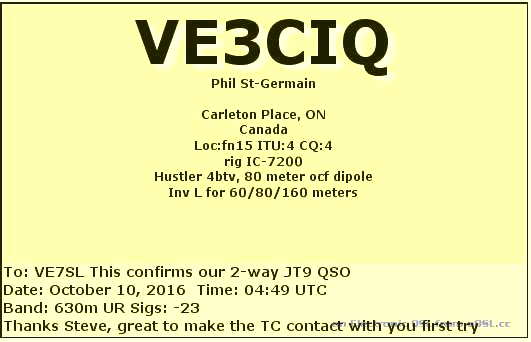
The 630m band continues to provide interesting challenges for Canadian amateurs ... be they antenna, equipment or propagation related.
Sunday night produced another flurry of excitement on the new band, further demonstrating its potential for small stations operating from the suburbs.
On Sunday evening, VE3CIQ in Carleton Place, Ontario (southwest of Ottawa), and I, completed a two-way JT9 contact, following a short exchange of the required information (and more) just after midnight, Ontario time.
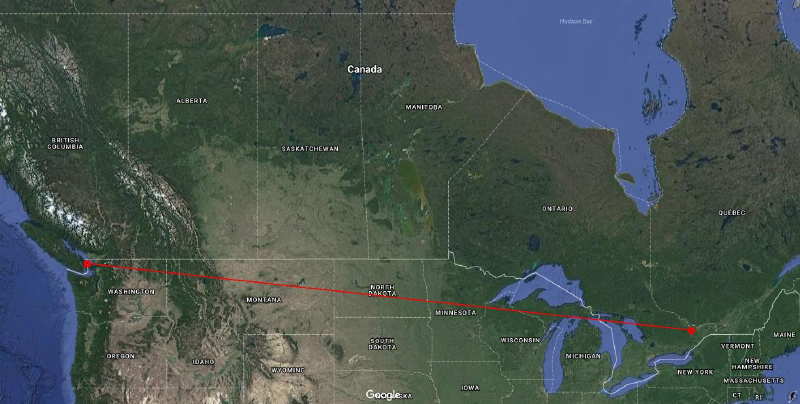 |
| courtesy: https://www.google.ca/maps/ |
Noting the increased east-west favorability over the past few nights, Phil and I decided to give it a shot and were delighted to cover the 2200 mile / 3500km path while Murphy was sleeping and not messing with propagation.
Rather than randomly beacon on JT9, we both set 'calling each other' messages. Although this continued for some time, the QSO only took 12 minutes to complete once I started to decode Phil's signal out west. He had been decoding me and sending signal reports for a long time before his signal eventually peaked up here for the evening. I suspect that we could have continued the contact for the remainder of the night as his signal was getting stronger and stronger as we worked.
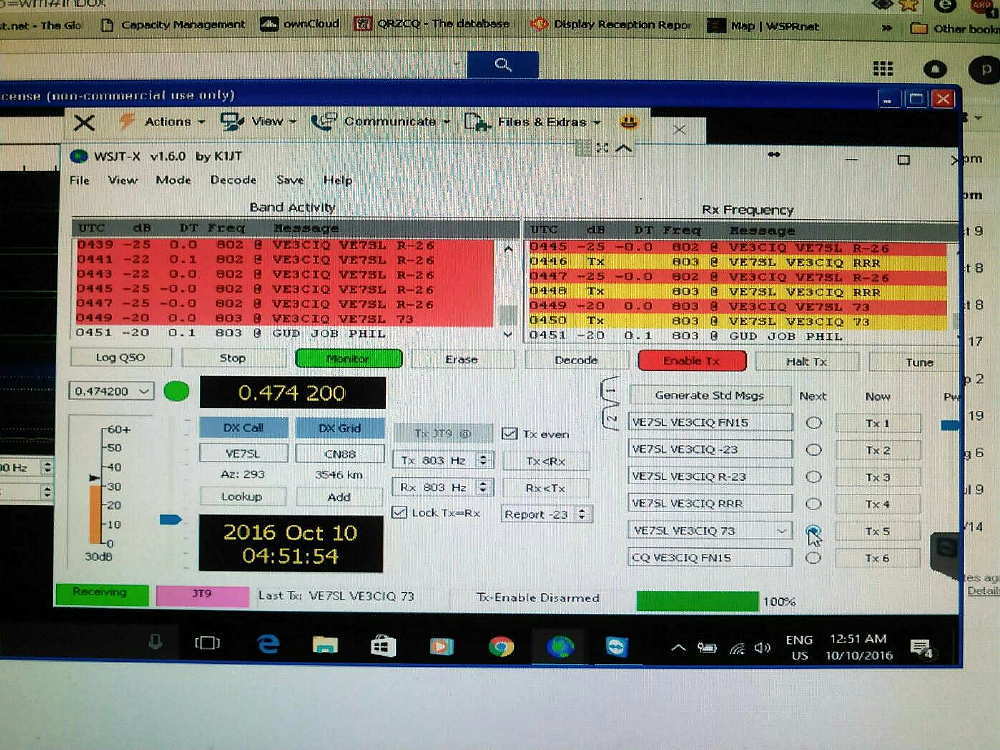 |
| Screen shot of QSO from VE3CIQ's end |
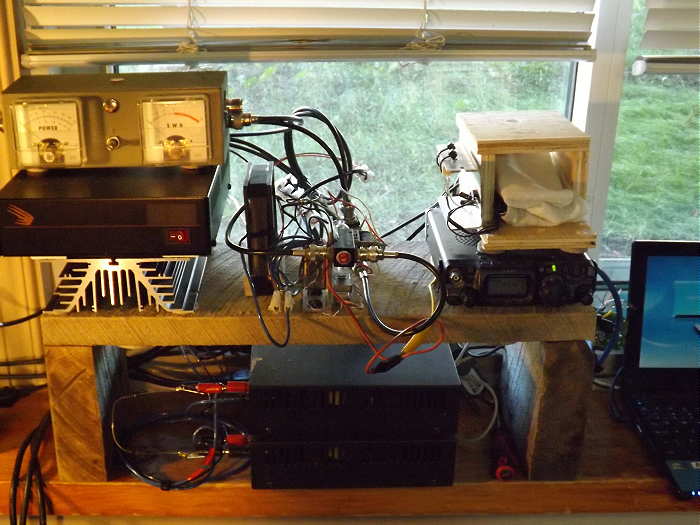 |
| VE3CIQ - 630m Station |
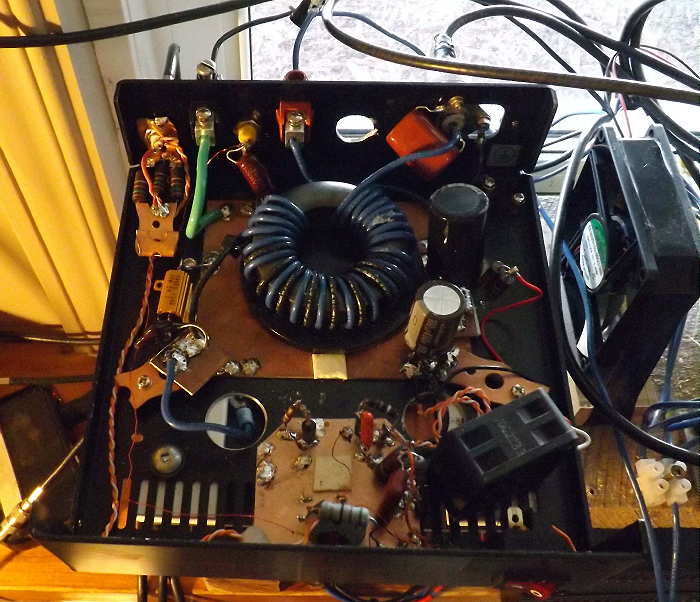 |
| VE3CIQ - Homebrew 630m Class-E Transmitter |
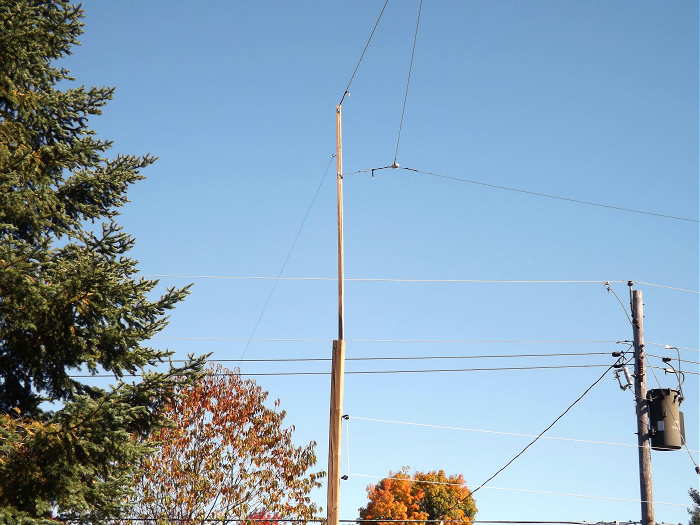 |
| VE3CIQ - 630m Linear-loaded Antenna |

Phil's station stands as yet another fine example of those living in the suburbs without a lot of room for antennas yet still able to successfully operate and explore our new 630m band. With a little ham-radio creativity, it's surprising how well a small station can perform, especially when the propagation co-operates.
Following our contact, I moved back to the WSPR section of the band and continued beaconing overnight.
Apparently Phil and I picked a good evening to run a sked as the overnight WSPR map shows it to have been the best night of the new DX season so far, with forty-four individual stations reporting my signal via the WSPRnet website.
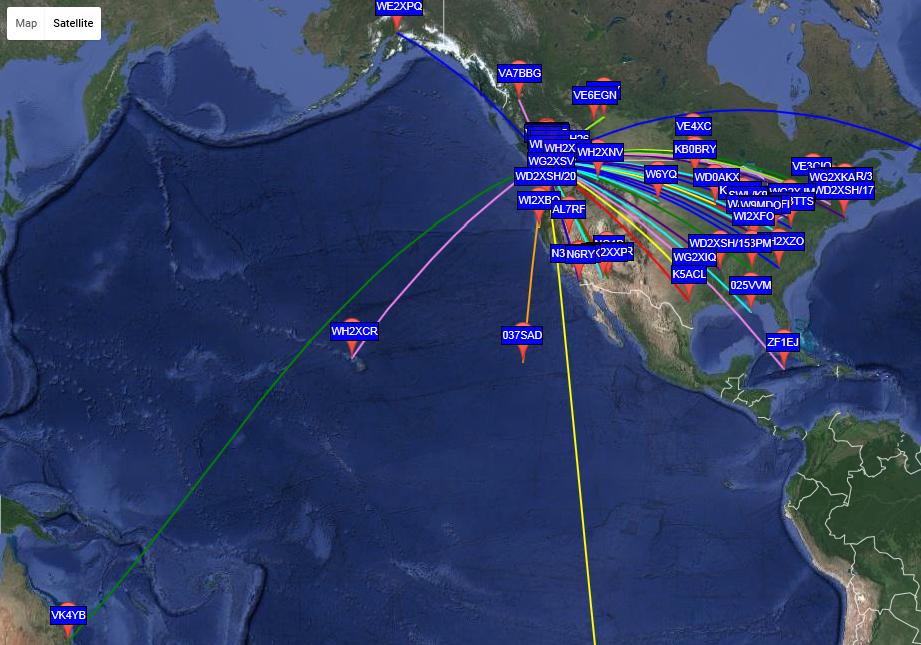 |
| courtesy: http://wsprnet.org/drupal/ |
The GØMRF Class-D 630m Transmitter
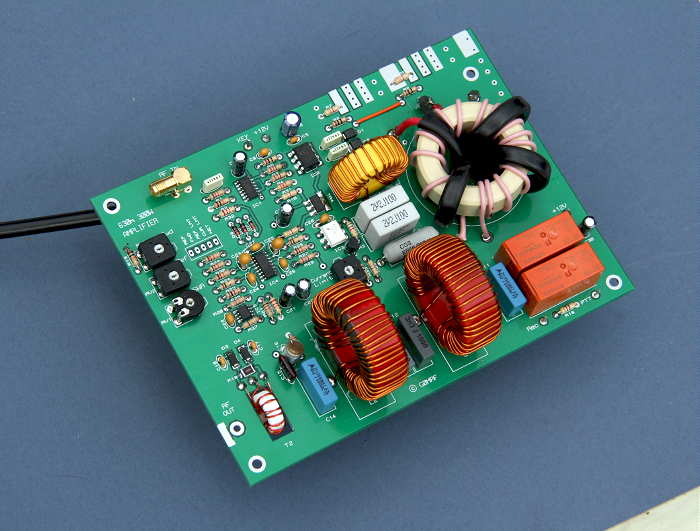 |
| courtesy: www.g0mrf.com/ |
Dave, GØRMF, long time LF proponent and ardent home-brewer has recently posted construction details of his new 630m transmitter.
It is a readily reproducible design that may be of interest to those looking for a transmitter capable of developing full ERP power output.
From Dave's description:
This amplifier is based on the ‘300W Class D Transmitter for 136kHz’ published by the RSGB in Radio Communication and reproduced in the LF Experimenters Handbook by Peter Dodd G3LDO.
This circuit, updated and modified for 630m, uses 2 MOSFETs in push pull driven by square-waves from a CMOS D-type flip flop. The power can be varied from around 25 to 300W by increasing the supply voltage over a 12 to 32V range. Circuits are included to protect against excessive supply current and high reflected RF power.
The amplifier is suitable for any non-linear mode. Examples include CW, QRSS, WSPR, JT-9, JT-65 and FSK.
The circuit has been built on a dedicated double-sided PCB measuring 164 x 120mm. For ease of construction 90% of the components are leaded but it has been necessary to use a few surface mount devices as the normal DIP versions of some ICs are increasingly difficult to find.
In many respects, this circuit is similar to my own homebrew transmitter which can be used on both 630 and 2200m. Although Dave has built his circuit on double-sided PCB, the project would be equally at home on one-sided board or even constructed 'Manhattan' style, the method I chose. This latter style lends itself to easy component swapping to optimize circuit performance.
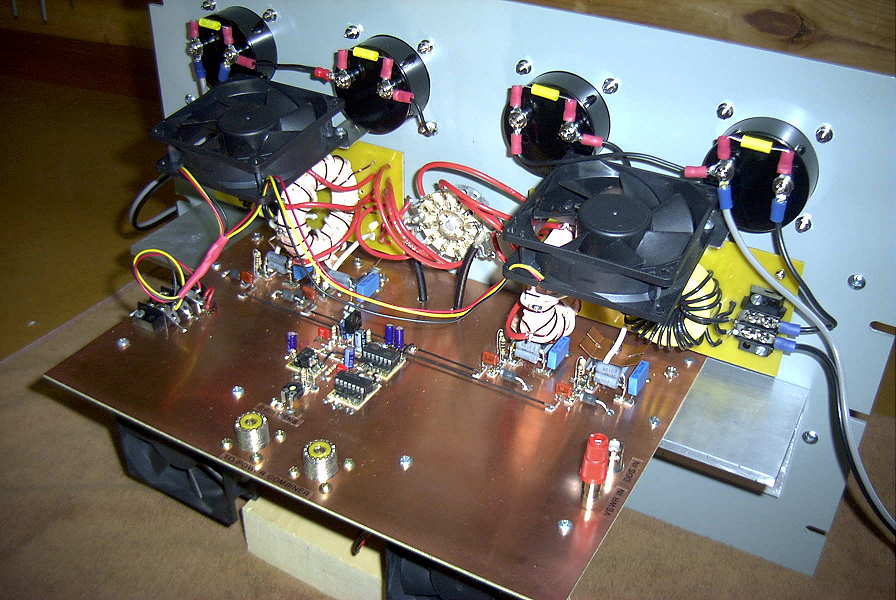 |
| VE7SL 2200m / 630m Manhattan-style Transmitter |
In addition, Dave's website contains several interesting circuits that might be of interest to those getting started on 630m.
VK-VE 630m Repeat
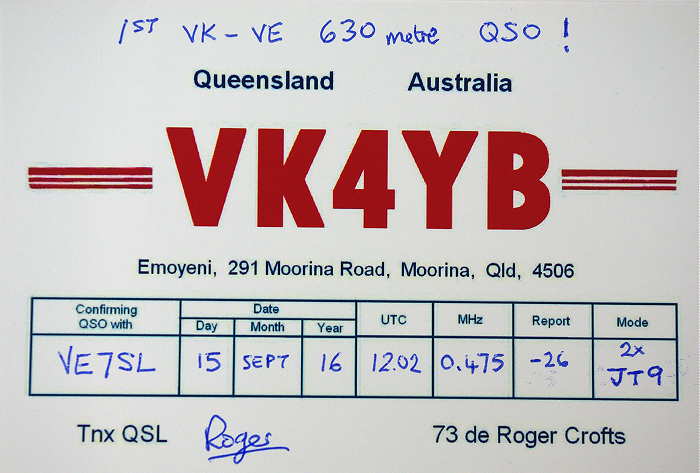
On Saturday morning, VK4YB and I had our second QSO on 630m using JT9, the WSPR QSO mode. Signals were slightly better than our initial contact but still far from previously seen conditions on the 11,000 + km Trans-Pacific path. However what happened following our contact was equally exciting.
I thanked Roger for the contact, via the ON4KST LF / MF chat page and indicated I was going back to bed as it was still pre-sunrise here on the west coast. He indicated that my signal strength had increased noticeably on my last two transmissions and asked if we might try CW for a few minutes.
We had previously devised our CW protocol to follow a similar one to that used in CW moonbounce work. We would transmit and receive in one minute sequences, with me transmitting on the even minutes and Roger on the odd. Instead of using the RST code for signal reporting, an 'O' is used to indicate reception strong enough to have been able to copy both calls. Both stations are required to copy the 'O', which cannot be sent until both calls have been fully copied. An acknowledgement ('R') must also be sent and copied by both stations to indicate receipt of the signal report. Once the 'R' has been copied, the final transmission(s) are a '73'. Once both stations have copied the 'R', the '73' is technically not required but when copied, further confirms the completion of a valid contact.
For both of us (late at night for him and pre-dawn for me), it was a bit of a mad scramble to make a quick changeover to CW. From my end, there are a number of changes that must be made correctly to avoid over-driving the transverter and damaging the frequency doubler as well as changing to manual PTT to avoid hot-switching of the antenna relays. I also need to bring up the PC's visible clock-face with its sweep second-hand ... but we both made the transition in about two minutes.
We ran for about 45 minutes during which time I heard Roger's CW on two back-to-back sequences (1331Z and 1333Z), copying both calls on each sequence. From 1331Z on, I added Roger's signal report to my calls to him ... 'VK4YB VE7SL OOO'.
We stopped at my sunrise but Roger had only copied fragments of my transmission and never enough to copy both calls. It appeared that we could both have used a few more db on the path as previous estimates have indicated that we might see at least another 5 or 6db yet, on a really good morning. As well, it seemed that the TP pipeline on Saturday morning had centered itself to my south, around northern California and VE7 was on the far northern edge of the propagation path.
Well it seemed that Sunday morning had moved the path further to the north and our 'extra 5-6db' was on hand. All of the local VE7's had numerous decodes of Roger's WSPR signals, including my own 20 decodes in the pre-dawn hours, but ... as 'Murphy' would have it, Roger was suffering receiver-blocking thunderstorm / lightning noise, keeping his K3's s-meter hard against the pin and absolutely no chance of a CW sked. It may have been a much more exciting morning had the spring weather near Roger been more cooperative.
This morning, the weather was still restricting good reception down-under but is forecast to dissipate shortly. But Murphy has not finished with us yet, as the TP path had also noticeably deteriorated today as well. It looks as though the challenge will now be getting everything to come into perfect alignment before the summer weather in VK shuts our CW attempts down for the season.
CLE 211 Results
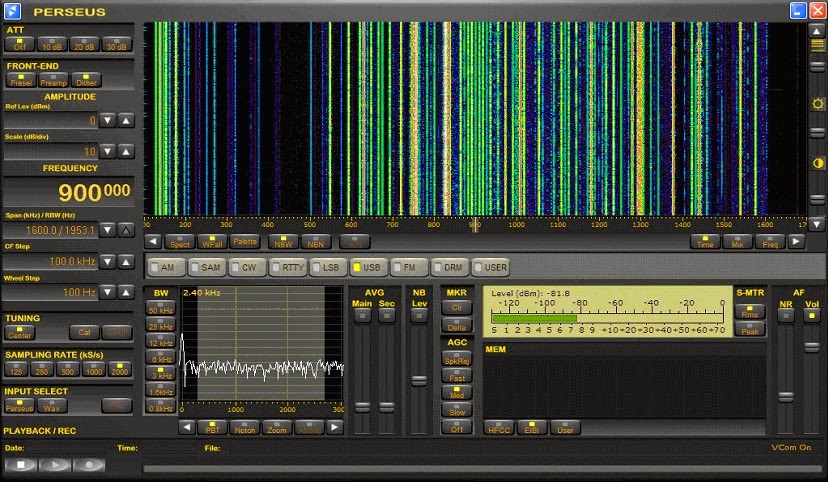
This past weekend's CLE saw noticeably improved conditions compared with the previous event.
With the fall DX season fast-approaching, the combination of diminishing thunderstorm activity and improved propagation provided some interesting catches. Friday night was the best with Saturday having a brief period of favorable prop, while no new stations were heard on Sunday night, the poorest.
It was particularly nice to hear strong signals from the eastern provinces on Friday, highlighted with an excellent signal from 'JT' (390 kHz) in Stephenville, Newfoundland. This long haul east-west propagation can only be found with quite geomagnetic conditions as was the case on Friday.

After examining the geomagnetic 'K' data for Saturday (25th), it's interesting to note that the four catches for that night all coincided exactly with the brief green bar (K= 0-3) centered on the hours around 0900 UTC (circled).
The following NDBs were heard using my Perseus SDR and 'inverted-L' resonated to ~ 300kHz:
24 06:30 385.0 WL Williams Lake, BC, CAN
24 13:00 385.0 OCC Yakutat, ALS
24 10:00 385.0 MR Pacific Grove, CA, USA
24 13:00 385.0 EHM Cape Newenham, ALS
24 08:30 386.0 SYF St. Francis, KS, USA
24 06:30 386.0 HAU Helena, MT, USA
24 06:00 386.0 4N Oxford House, MB, CAN
24 06:30 388.0 MM Fort Mc Murray, AB, CAN
24 09:30 388.0 JW Pigeon, AB, CAN
24 06:30 388.0 GLY Clinton, MO, USA
24 06:30 389.0 YWB Kelowna, BC, CAN
24 08:00 389.0 TW Twin Falls, ID, USA
25 08:30 389.0 EN Kenosha, WI, USA
24 06:00 389.0 CSB Cambridge, NE,USA
24 06:30 390.0 JT Stephenville, NL, CAN
24 06:00 390.0 HBT Sand Point, ALS
24 06:00 390.0 AES Northway, ALS
24 06:30 391.0 TK Telkwa, BC, CAN
24 13:00 391.0 EEF Sisters Island, ALS
24 06:00 391.0 DDP Dorado, PTR
24 06:30 391.0 4W Kelsey, MB, CAN
24 08:30 392.0 ZFN Tulita, NT, CAN
24 06:00 392.0 PNA Wenz, WY, USA
24 06:30 392.0 ML Charlevoix, QC, CAN
25 08:30 392.0 FMZ Fairmont, NE, USA
25 08:30 392.0 BAJ Sterling, CO, USA
24 06:00 392.0 AGZ Wagner, SD, USA
25 09:30 393.0 TOG Togiak, ALS
24 08:30 393.0 2M Opapimiskan Lake,ON, CAN
24 13:00 394.0 RWO Kodiak, ALS
24 08:30 394.0 DQ Dawson Creek, BC, CAN
24 08:30 395.0 YL Lynn Lake, MB, CAN
24 06:00 395.0 ULS Ulysses, KS, USA
24 08:30 395.0 L7 Estevan, SK, CAN
24 08:30 396.0 YPH Inukjuak, QC, CAN
24 13:00 396.0 CMJ Ketchikan, ALS
24 08:30 397.0 ZSS Saskatoon, SK, CAN
24 08:00 397.0 SB San Bernardino, CA, USA
24 08:00 397.0 CIR Cairo, IL, USA
24 08:30 398.0 YOD Cold Lake, AB, CAN
24 08:30 398.0 3D Cumberland House, SK, CAN
24 08:30 399.0 ZHD Dryden, ON, CAN
24 13:00 399.0 SRI St George, ALS
The results from all participants can be found at the NDB List website, or if you are a member of the ndblist Group, results have also been e-mailed and posted there.
The very active Yahoo ndblist Group is a great place to learn more about the 'art' of NDB DXing or to meet other listeners in your region. There is a lot of helpful information available there and new members are always very welcome. As well, you can follow and chat with other NDB chasers regarding antennas, techniques, unidentified signals and nightly propagation.
630m And Recent Geomagnetic Activity
High levels of geomagnetic activity have usually, but not always, been the kiss-off-death for LF/MF propagation.
These past few months have seen fairly regular field disturbances, often pushing the K index to a level '5' or higher. However, while usually attenuating the east-west and northerly polar paths, the Trans-Pacific path often seems to benefit from these events ... particularly last night.
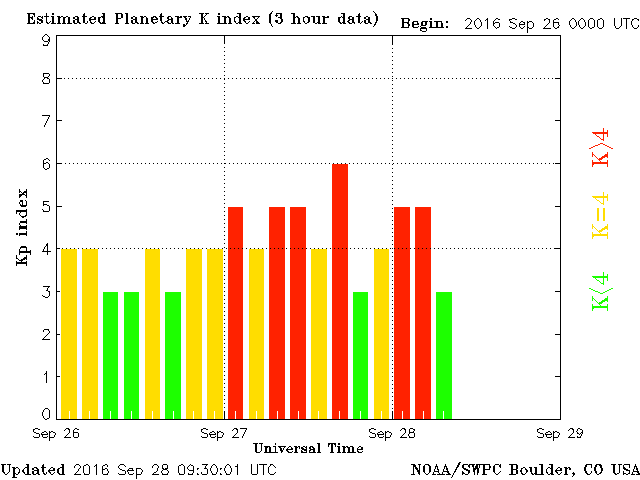
Perhaps it is related to the equinox's normal preference for this path or maybe the goop the sun is sending us at this point in the cycle is different or not as energetic as it is at mid-cycle. Nevertheless it's really encouraging to see that not all disturbances are detrimental to LF propagation.
For a daily summary of all overnight activity and much more, see KB5NJD's '630m Daily Reports'.
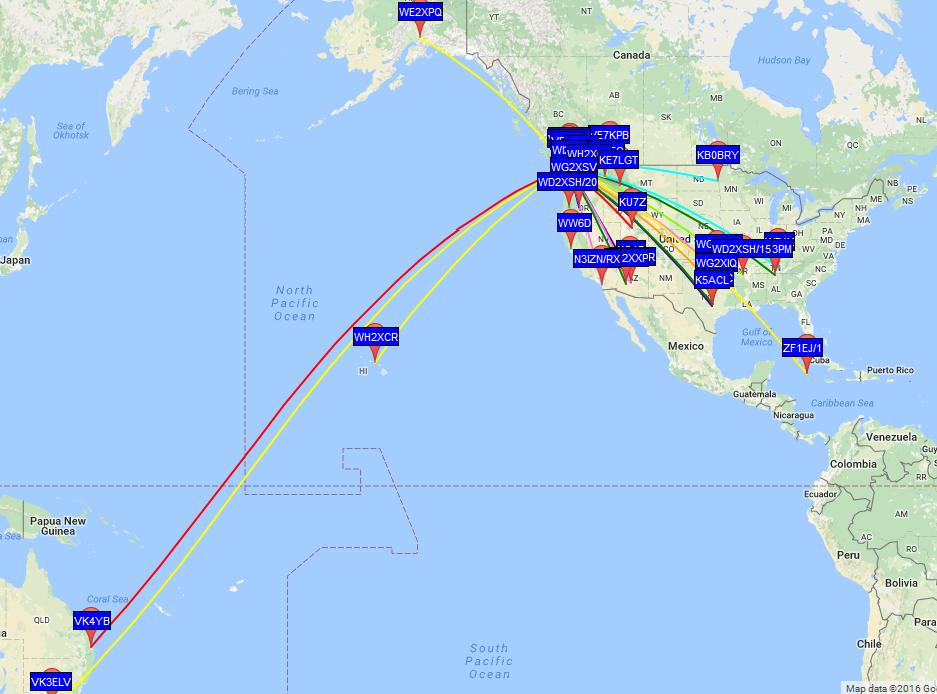
The WSPRnet map reproduced below shows the extent of reception during my own overnight WSPR 630m beaconing session. Missing are many of the normal spots from the eastern provinces and east coast states, indicating the attenuation on this path. Everything else seems enhanced.
 |
| courtesy: WSPRnet |
The path to down under, in-spite of my obstruction in that direction, perked-up as well, with VK4YB decoded here 19 times as well as VK3ELV's 150W and inverted-L near Wangaratta, Victoria.
13:56 VK4YB 0.4756 -28 QG62ku 11820
13:50 VK4YB 0.4756 -28 QG62ku 11820
13:44 VK4YB 0.4756 -24 QG62ku 11820
13:40 VK4YB 0.4756 -24 QG62ku 11820
13:30 VK4YB 0.4756 -27 QG62ku 11820
13:24 VK4YB 0.4756 -20 QG62ku 11820
13:18 VK4YB 0.4756 -24 QG62ku 11820
13:12 VK4YB 0.4756 -22 QG62ku 11820
12:42 VK4YB 0.4756 -26 QG62ku 11820
12:14 VK4YB 0.4756 -20 QG62ku 11820
12:02 VK4YB 0.4756 -23 QG62ku 11820
11:58 VK4YB 0.4756 -25 QG62ku 11820
11:52 VK4YB 0.4756 -25 QG62ku 11820
11:40 VK4YB 0.4756 -29 QG62ku 11820
11:32 VK4YB 0.4756 -26 QG62ku 11820
11:24 VK4YB 0.4756 -25 QG62ku 11820
11:12 VK4YB 0.4756 -22 QG62ku 11820
10:56 VK4YB 0.4756 -26 QG62ku 11820
10:54 VK4YB 0.4756 -25 QG62ku 11820
Merv, WH2XCR in Hawaii, was spotted here 56 times, with numerous transmissions at 'easy CW' levels. He even spotted me twice, with his 80m dipole, presently laying on the ground!
It was also encouraging to see 21 spots from Eden, ZF1EJ in the Cayman Islands, with several at CW levels.
The following stations all uploaded spots of my overnight WSPR signals, as nightly activity continues to grow with the DX season now at the doorstep. Given equal ERP, most of these stations would be workable on either CW or on JT9.
WH2XGP DN07dg 319 122
WG2XSV CN85sr 353 169
WI2XJQ CN87ts 138 150
NO1D DM34tn 1825 147
N3IZN/RX DM13ji 1796 161
WW6D CM88pl 1155 177
VE7CNF CN89ng 55 33
VA7MM CN89og 59 38
WE2XPQ BP51ip 2151 321
W5EMC EM10cl 2963 124
K5ACL EM10bd 2987 125
WG2XXM EM15lj 2610 115
ZF1EJ/1 EK99ig 4977 116
KE7LGT DN26xm 739 107
W3PM EM64or 3365 104
ZF1EJ EK99ig 4977 116
VE7KPB DN29cm 550 79
KU7Z DN41af 1227 129
WH2XCR BL11je 4295 236
KB0BRY EN17nc 1966 86
WD2XSH/20 CN83 598 178
WG2XIQ EM12 2841 120
WE4X EM65ut 3326 102
VE7BDQ CN89la 26 44
KB7W CN93jx 565 163
W6LEO DN17oq 498 103
WH2XAR DM33vp 1924 147
As interest in 630m continues to expand, many U.S. amateurs are already building their stations so they will be ready to go when the word finally comes. I suspect that 630m may soon sound like a small slice of 40m on a busy night ... will you be ready?
The Amazing BOG
 |
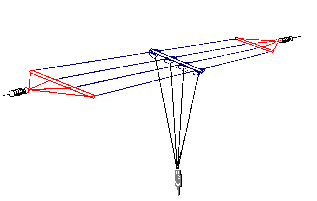
| courtesy: http://www.wd0m.com/antennas1.html |
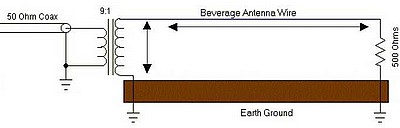
A recent inquiry about 'BOG' antennas on the topband reflector reminded me of my own experiences with this simple yet very effective antenna. A 'BOG' or 'Beverage On Ground' seems to come in many varieties and is usually, out of necessity, shorter than a 'real' beverage.
In many instances, BOGs are as simple as running a wire out on the ground as long and as straight as practical. Not always, but usually, the BOG is fed by a small homemade balun to isolate and match the impedance to a 50 ohm feedline. Most real Beverages are terminated at the far end with a resistor to ground, while for BOG builders, some use it and some don't.
My own experience with a BOG, or as close as I could come to one, was an extension of my 160m half-sloper. The topband half-sloper was quite normal, being about 132' long and fed at the top of its supporting metal tower with 50 ohm coax ... the hot-side of the coax going to the wire and the shield going to the metal tower.
One afternoon I wondered how the antenna would work lower in frequency, in the NDB band below the broadcast band, if I were to extend the sloping 132' element further. I added another length of wire to the lower end and proceeded to run the wire along the ground on the bankside above the beach. I was able to run out another 500' approximately, in a straight line to the east, before running out of beach. I left the far end unterminated and waited for darkness to to have a listen.
The first thing I noticed when tuning the NDB band was how quiet it sounded. There seemed to be almost no noise, man-made or nature-made. Disconnecting the antenna showed a small drop in what little noise there was, indicating that sensitivity levels were still being determined by skynoise ... a good thing.
What amazed me however, was that signals just popped-up everywhere and although not as strong as on my normal NDB antenna (a loop at the time), they were much better copy since there was virtually no noise. The BOG produced a significant improvement in my SNR on all signals. It had been several months since I had logged any new beacons on the NDB band but over the next three weeks I was able to put 65 new catches in the log ... all previously unheard! Switching between the loop and the BOG almost always produced no copy at all on the new signals, compared to an easily copied one on the BOG.
My experience was very similar to that shown in these videos by VO1HP ... with solid signals well out of the low noise background and no sign of atmospheric noise to mask them.
It is clearly evident that the BOG delivers a much better SNR than the comparison loop and is the reason so many topbanders use a separate antenna for receiving. The next video compares the BOG with a 160m 'Inverted-L', a very popular antenna on topband.
BOGs need not be really long and good results can be had with just 200' of wire. Many BOG users employ a simple preamp to boost the low level of signal but often the switchable 'preamp' built into a receiver or transceiver will be enough to overcome the low gain of shorter wires.
I've often thought that if I had a lot of acreage, the ideal receiving system for MF and LF work would be a centrally located radio shack with long Beverage wires fed-out in various directions ... like the spokes of a wheel. Having the ability to directionally switch antennas would produce 'beam-like' capabilities on LF.
There is a ton of web information available on the BOG and the Beverage should you want to give this simple antenna a try and have a narrow strip of space where one might be laid out without causing a problem.
A very comprehensive source of BOG and Beverage information can be found on WØBTU's Beverage Receiving Antennas page here.
A nice compilation of Beverage / BOG exchanges from the Topband Reflector may be found on N1EU's Beverage Antenna Tips page here.
In addition, N1EU has a useful page of discussion about transformers used in these antennas.
PA5MW offers a colorful description of his own BOG experience here.
Bruce, K1FZ has a nice BOG 'hint's' page here and also passed this advise to the original BOG inquiry:
A BOG can do a good job unterminated. If too long they self terminate. Depends upon the soil as to length.
The biggest mistake is making the BOG antenna too long. Try not to go
over 200 feet for 160 meters. Longer will work in some locations
soil like desert, sand, other non/ partial conducting types.
Its been a few years since my last experience with a BOG but I may run one out again for the DX season, now that most of my neighbours have left the island for the winter.
Hunting For NDBs In CLE211
 |
| 'OO'- - 391 kHz Oshawa, ON |
This coming weekend will see another CLE challenge, this time in the 15 kHz slice from 385.0 - 399.9 kHz.
A 'CLE' is a 'Co-ordinated Listening Event', as NDB DXers around the world focus their listening time on one small slice of the NDB spectrum.
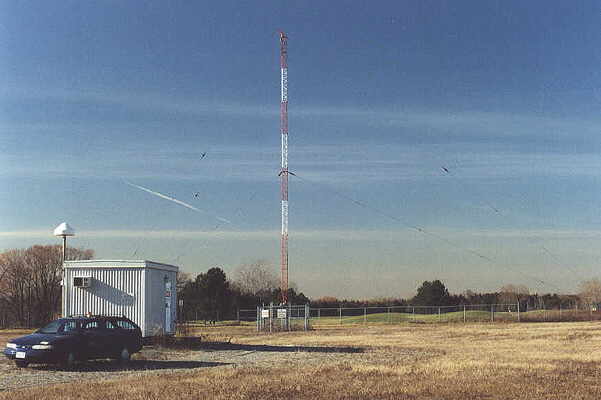
A nice challenge in this one is to hear the Oshawa, Ontario NDB, 'OO' on 391 kHz. This one runs at just 7 1/2 watts output and gets out amazingly well having been logged here last year. It has even been heard in Europe!
From CLE organizer Brian Keyte, G3SIA, comes the usual 'heads-up':
Hi all,
Our 211th Listening Event is only a few days away.
The Northern Hemisphere summertime storms have subsided, the equinox
will have passed when the CLE starts and we can all hope for some good
reception conditions.
Whether you are a keen propagation watcher or just a take-what-comes
listener (like me), please join in.
Days: Friday 23 September - Monday 26 September
Times: Start and end at midday LOCAL TIME
Range: 385.0 - 399.9 kHz
Please log all the NDBs you can identify that are listed in the range
(it includes 385 kHz but not 400 kHz) plus any UNIDs that you find there.
We last used this frequency range for CLE194 in May 2014.
Please send your CLE log to the List in a plain text email if possible
(not in an attachment) with 'CLE211' at the start of its title.
Show on each log line:
# The date (e.g. 2016-09-24, etc., or just 24) and UTC.
(the date changes at 00:00 UTC)
# kHz (the nominal published frequency, if known)
# The Call Ident.
Show those main items FIRST - other optional details such as Location
and Distance go LATER in the same line.
As always, tell us your own location and brief details of the equipment
that you were using during the weekend.
Good listening - enjoy the CLE
----------------------------------------------------------
From: Brian Keyte G3SIA ndbcle'at'gmail.com
Location: Surrey, SE England (CLE co-ordinator)
----------------------------------------------------------
(If you wish you could use any one remote receiver for your loggings,
stating the location and owner - with their permission if required.
A remote listener may NOT also use another receiver, local or remote,
to make further loggings for the same CLE).
73
Brian
These listening events serve several purposes. They:
- determine, worldwide, which beacons are actually in service and on-the-air so the online database can be kept up-to-date
- determine, worldwide, which beacons are out-of-service or have gone silent since the last CLE covering this range
- will indicate the state of propagation conditions at the various participant locations
- will give you an indication of how well your LF/MF receiving system is working
- give participants a fun yet challenging activity to keep their listening skills honed
Final details can be found at the NDB List website, and worldwide results, for every participant, will be posted there a few days after the event. If you are a member of the ndblist Group, results will also be e-mailed and posted there.
The very active Yahoo ndblist Group is a great place to learn more about the 'Art of NDB DXing' or to meet other listeners in your region. There is a lot of good information available there and new members are always very welcome. As well, you can follow the results of other CLE participants from night to night as propagation is always an active topic of discussion.
If you are contemplating getting started on 630m, listening for NDBs is an excellent way to test out your receive capabilities as there are several NDBs located near this part of the spectrum.
You need not be an ndblist member to participate in the CLEs and all reports, no matter how small, are of much value to the organizers. 'First-time' logs are always VERY welcome!
Reports may be sent to the ndblist or e-mailed to either myself or CLE co-ordinator, Brian Keyte (G3SIA), whose address appears above.
Please ... give the CLE a try ... then let us know what NDB's can be heard from your location! Your report can then be added to the worldwide database to help keep it up-to-date.
Good hunting!













