Author Archive
 RFI – More Vigilance Coming?
 July 11th, 2017 |
  Author:
A posting yesterday in the Yahoo MW DXer's Group pointed to a new article at RadioWorld.com, re the new urgency within the broadcast field to address the growing noise floor.
The article "Noise Inquiry Spurs Recommendations" discusses the fallout from last year's FCC Technical Advisory Council's (TAC) Inquiry ET-16-191, seeking public comments on the rapid increase in "man-made RF noise issues".
As radio amateurs have known for decades already, there is a huge problem when it comes to spectrum noise levels. They were even complaining about this way back in 1932's Short Wave Craft ... "The reasons for this extraordinary amount of noise which we have to contend with at the present time are manifold." If only they knew how quiet it really was!
Now that noise is beginning to have severe affects on profit margins when it comes to AM, FM, TV and Wi-Fi connected devices, it seems that there may now be a larger appetite for some resolution.
"Other industries using RF wireless technologies report growing noise trouble as well. A recent IEEE Spectrum article was subtitled “Electronic Noise Is Drowning Out the Internet of Things.” Designers of IoT devices are not getting the range they expect due to unexpectedly high background noise, it reported."
Comments to the enquiry pointed out the usual offenders, all well-known to hams, such as noisy powerlines, switching power supplies, noisy motors etc and emphasized the fact that none of these offenders should cause interference if properly designed.
The TAC Working Group recommended some steps that it thought the FCC should take with the key one being an FCC Notice of Proposed Rulemaking to "resolve unanswered questions and take corrective action".
According to a recent meeting between The Association of Federal Communications Consulting Engineers and FCC officials, it was pointed out that:
- there had been no official RF noise studies done in over 40 years.
- some manufacturers are deliberately cheating to skirt emission requirements.
- those in charge of enforcement (FCC) need to be more diligent.
Other somewhat "telling" recommendations were also put forward and can be viewed in the Radioworld article here.
If you're one of the hundreds (thousands?) struggling with a new mystery noise source, perhaps you can identify the noise signature from one of these two sites:
http://www.arrl.org/sounds-of-rfi
http://www.rfiservices.com/sound.htm
It is reported that the new FCC Chairman seemed receptive to the concerns presented but so far there has been no official action. Hopefully he will soon tackle this with the same gusto shown for chasing down illegal broadcasters. With recent FCC cutbacks and proposed budget slashing from Washington, one wonders if this problem will be given the attention that it needs before it is truly too late to reverse.
RFI – More Vigilance Coming?
A posting yesterday in the Yahoo MW DXer's Group pointed to a new article at RadioWorld.com, re the new urgency within the broadcast field to address the growing noise floor.
The article "Noise Inquiry Spurs Recommendations" discusses the fallout from last year's FCC Technical Advisory Council's (TAC) Inquiry ET-16-191, seeking public comments on the rapid increase in "man-made RF noise issues".
As radio amateurs have known for decades already, there is a huge problem when it comes to spectrum noise levels. They were even complaining about this way back in 1932's Short Wave Craft ... "The reasons for this extraordinary amount of noise which we have to contend with at the present time are manifold." If only they knew how quiet it really was!
Now that noise is beginning to have severe affects on profit margins when it comes to AM, FM, TV and Wi-Fi connected devices, it seems that there may now be a larger appetite for some resolution.
"Other industries using RF wireless technologies report growing noise trouble as well. A recent IEEE Spectrum article was subtitled “Electronic Noise Is Drowning Out the Internet of Things.” Designers of IoT devices are not getting the range they expect due to unexpectedly high background noise, it reported."
Comments to the enquiry pointed out the usual offenders, all well-known to hams, such as noisy powerlines, switching power supplies, noisy motors etc and emphasized the fact that none of these offenders should cause interference if properly designed.
The TAC Working Group recommended some steps that it thought the FCC should take with the key one being an FCC Notice of Proposed Rulemaking to "resolve unanswered questions and take corrective action".
According to a recent meeting between The Association of Federal Communications Consulting Engineers and FCC officials, it was pointed out that:
- there had been no official RF noise studies done in over 40 years.
- some manufacturers are deliberately cheating to skirt emission requirements.
- those in charge of enforcement (FCC) need to be more diligent.
Other somewhat "telling" recommendations were also put forward and can be viewed in the Radioworld article here.
If you're one of the hundreds (thousands?) struggling with a new mystery noise source, perhaps you can identify the noise signature from one of these two sites:
http://www.arrl.org/sounds-of-rfi
http://www.rfiservices.com/sound.htm
It is reported that the new FCC Chairman seemed receptive to the concerns presented but so far there has been no official action. Hopefully he will soon tackle this with the same gusto shown for chasing down illegal broadcasters. With recent FCC cutbacks and proposed budget slashing from Washington, one wonders if this problem will be given the attention that it needs before it is truly too late to reverse.
June Moonbounce Heats Up

With fixed elevation and not having the ability to track the moon as it rises, I can only operate for about two hours before the moon gets too high. The highest elevation that I am able to work seems to stop near 20 degrees.
With QSLs from earlier sessions still arriving, I noted last week's activity was down somewhat from the previous month ... summertime activities usually take priority over EME for most moonbouncers.
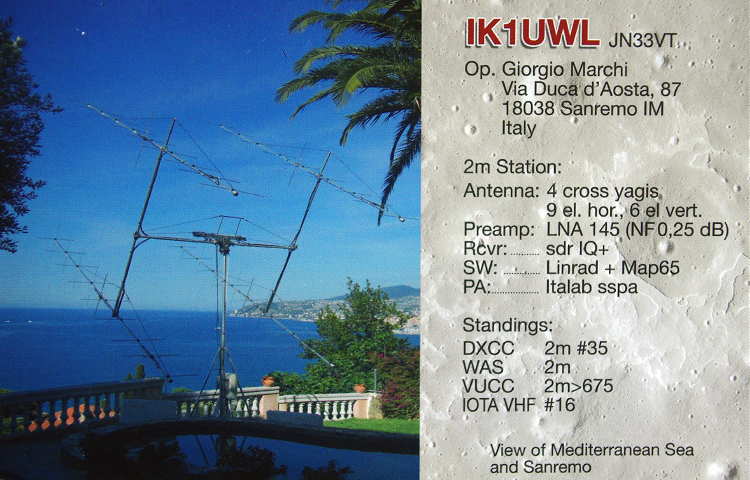
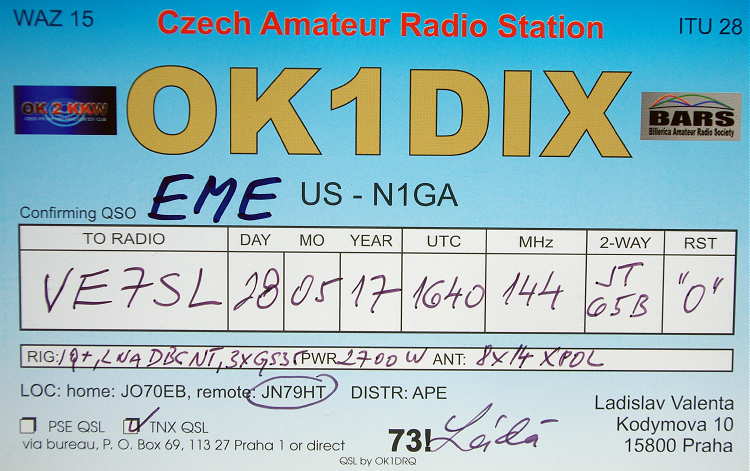
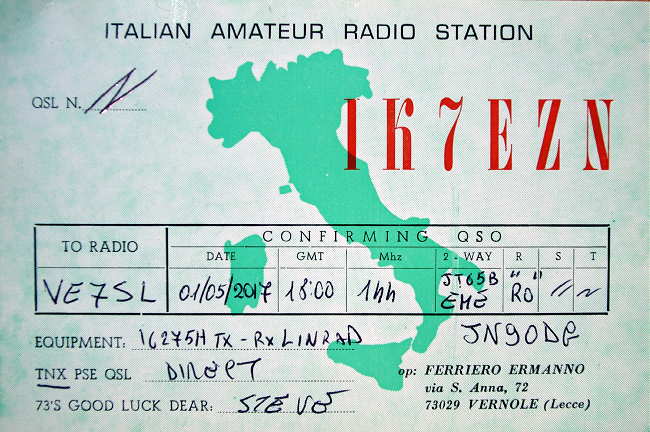
During my two mornings of moon time I worked five stations which included two new DXCC countries, bringing my 2m DXCC total to 30. Stations worked at the end of June were:
ON4AOI #106 (new country)
OH3AWW #107 (new country)
I2RV second QSO
DK9WI #108
IK6CAK #109
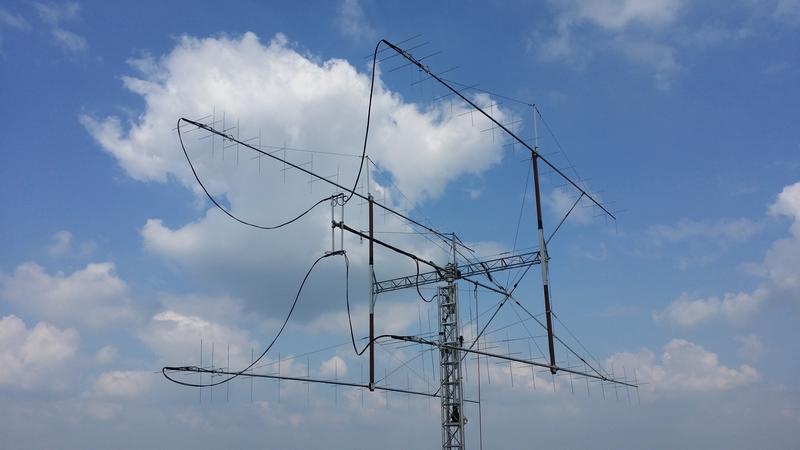 |
| ON4AOI - 4 X 14V / 14H array |
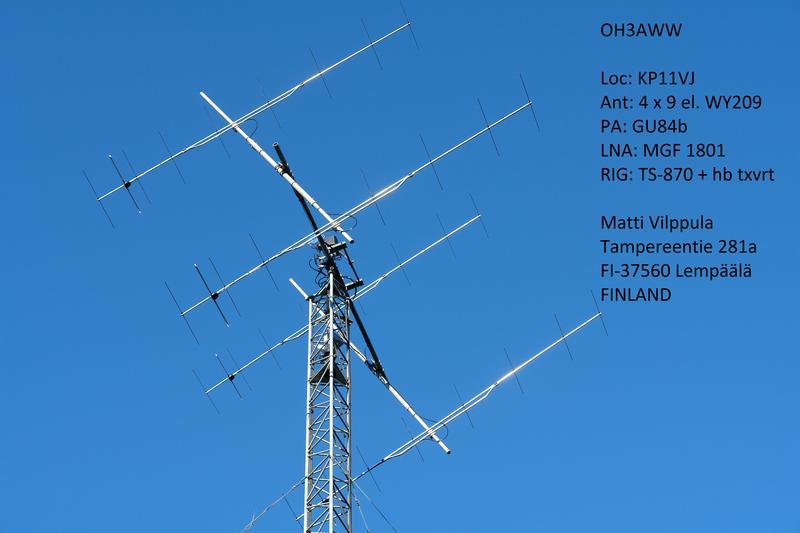 |
| OH3AWW - 4 X 9el array |
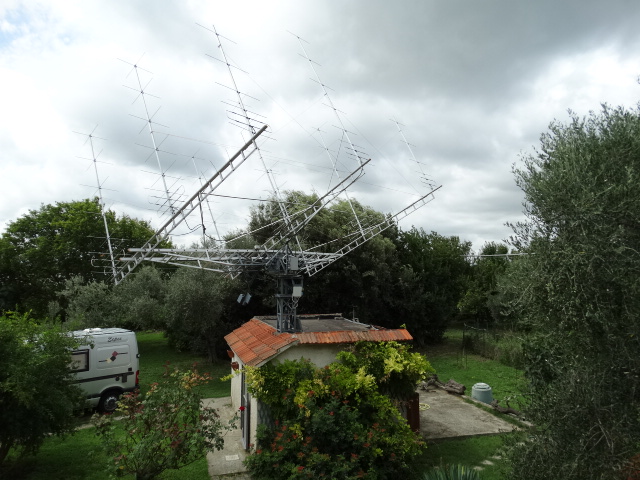 |
| IK6CAK - 9H / 6V 8el LFA array more |
In the middle of a CQ following my QSO with IK6CAK, I heard a faint 'crack' sound from my amplifier, an aging RF Concepts 2-135, followed by the unmistakable whiff of a 'too hot' electronic component ... every ham is familiar with this always unwelcome odor and it usually spells trouble.
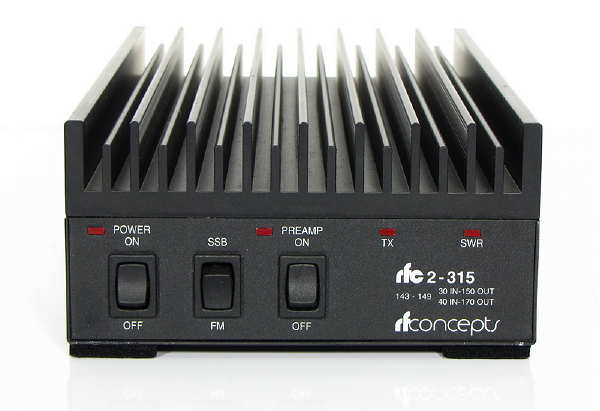
During the next CQ, I saw a trace of smoke coming out of the amp's back corner vent holes, at which point I reluctantly shut things down in the middle of some superb EME conditions.
After tearing into the amplifier, the only thing that looked stressed was a small inductor (L14 below), part of the output filtering / impedance matching circuitry.
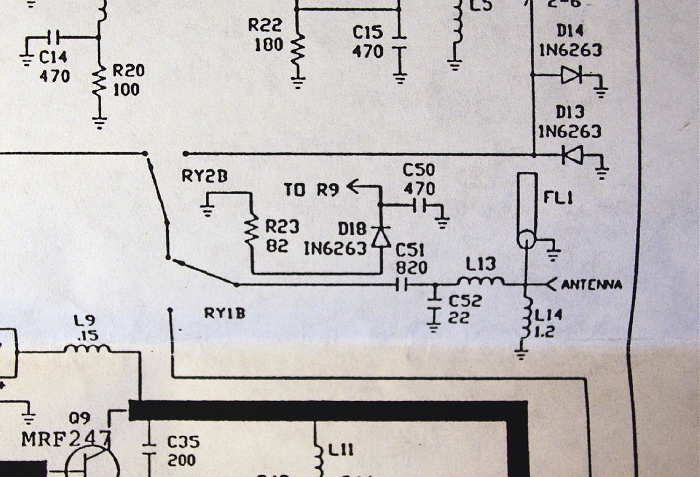
It looked a little darker and somewhat stressed and as I gave it a poke with a screwdriver blade, it immediately disintegrated into what you see below.
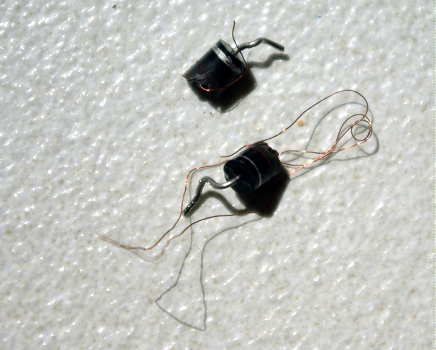
It was a small (1.2uH) encapsulated RFC which appeared to be wire-wound on a core material that I did not recognize and likely suitable for VHF. I surmised that after several years of 100% duty-cycle JT65 operation, the inductor had been over-stressed to the point of failure ... helping to filter all of those nasty high frequency harmonics can't be an easy job!
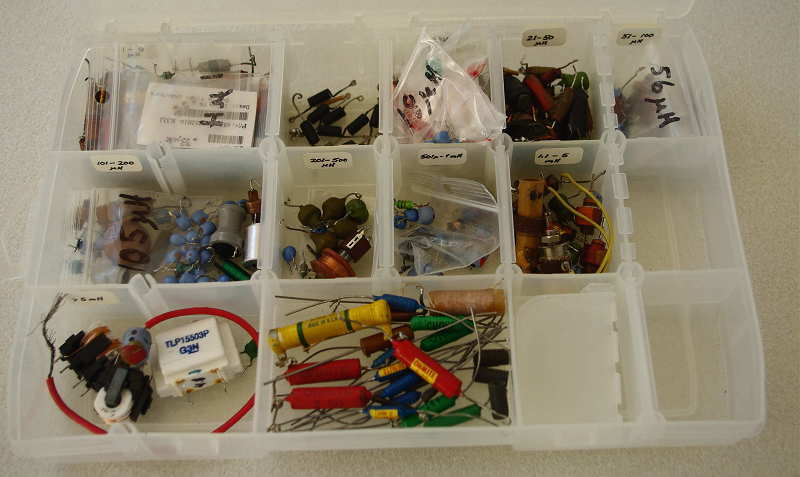
After a search of my RFC collection (see below), salvaged mostly from junked TVs, monitors, VCRs and other electronic cast-offs temporarily 'borrowed' for stripping from our local recycle center here on Mayne Island, I settled on a 1.2uH choke that I hoped would be a suitable replacement. It had just a few turns so I assumed it was wound on some sort of powdered iron or ferrite form. Whether or not it would behave at 144MHz was another question.
After reassembling the amplifier the following morning, I keyed up at full power during the EME window but halfway through my initial CQ I saw smoke and then flames coming from the inside of the case ... yikes! Shutting down immediately killed the fire and after tearing into the amp yet again, I saw that this time, the output coupling capacitor (C51) had completely destroyed itself.
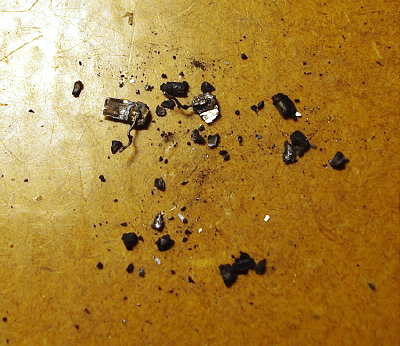
The new inductor (L14) appeared a little heated, but I assumed it was only smoke-damaged from the nearby flameout of the capacitor. I replaced C51, an 820pF silver mica, with a higher rated one of the same value and, once again, gave it the smoke test ... literally.
After a few seconds, a whiff of smoke appeared from the back of the amp, followed by the SWR trip-out kicking in and shutting the amp down.
This time it appeared that the inductor was definitely complicit in the destruction of the capacitor as it was charred and black. I surmised that whatever core material the little inductor was wound upon, definitely was not suitable at 144MHz and had caused the little inductor to either change value or to saturate ... whatever it was doing had created a highly reactive condition in the output circuit, changing the output load impedance and sending the SWR sky-high.
This time I replaced the inductor with a homebrew one, wound on a plain phenolic former, hoping to avoid any ferro-magnetic / frequency compatibility issues. After reassembling the amplifier, it seemed to be happy once again and ran nicely for several 60 second JT65B sequences at full power with no smoke or component heating!
By this time I had run out of favorable EME windows as my moonrises were now too far to the south to keep me away from the neighbour's trees ... I'll just have to be patient and wait until the end of the month for the next definitive test. Let's hope there's no more smoke.
June Moonbounce Heats Up
With fixed elevation and not having the ability to track the moon as it rises, I can only operate for about two hours before the moon gets too high. The highest elevation that I am able to work seems to stop near 20 degrees.
With QSLs from earlier sessions still arriving, I noted last week's activity was down somewhat from the previous month ... summertime activities usually take priority over EME for most moonbouncers.
During my two mornings of moon time I worked five stations which included two new DXCC countries, bringing my 2m DXCC total to 30. Stations worked at the end of June were:
ON4AOI #106 (new country)
OH3AWW #107 (new country)
I2RV second QSO
DK9WI #108
IK6CAK #109
|
| ON4AOI - 4 X 14V / 14H array |
|
| OH3AWW - 4 X 9el array |
|
| IK6CAK - 9H / 6V 8el LFA array more |
In the middle of a CQ following my QSO with IK6CAK, I heard a faint 'crack' sound from my amplifier, an aging RF Concepts 2-135, followed by the unmistakable whiff of a 'too hot' electronic component ... every ham is familiar with this always unwelcome odor and it usually spells trouble.
During the next CQ, I saw a trace of smoke coming out of the amp's back corner vent holes, at which point I reluctantly shut things down in the middle of some superb EME conditions.
After tearing into the amplifier, the only thing that looked stressed was a small inductor (L14 below), part of the output filtering / impedance matching circuitry.
It looked a little darker and somewhat stressed and as I gave it a poke with a screwdriver blade, it immediately disintegrated into what you see below.
It was a small (1.2uH) encapsulated RFC which appeared to be wire-wound on a core material that I did not recognize and likely suitable for VHF. I surmised that after several years of 100% duty-cycle JT65 operation, the inductor had been over-stressed to the point of failure ... helping to filter all of those nasty high frequency harmonics can't be an easy job!
After a search of my RFC collection (see below), salvaged mostly from junked TVs, monitors, VCRs and other electronic cast-offs temporarily 'borrowed' for stripping from our local recycle center here on Mayne Island, I settled on a 1.2uH choke that I hoped would be a suitable replacement. It had just a few turns so I assumed it was wound on some sort of powdered iron or ferrite form. Whether or not it would behave at 144MHz was another question.
After reassembling the amplifier the following morning, I keyed up at full power during the EME window but halfway through my initial CQ I saw smoke and then flames coming from the inside of the case ... yikes! Shutting down immediately killed the fire and after tearing into the amp yet again, I saw that this time, the output coupling capacitor (C51) had completely destroyed itself.
The new inductor (L14) appeared a little heated, but I assumed it was only smoke-damaged from the nearby flameout of the capacitor. I replaced C51, an 820pF silver mica, with a higher rated one of the same value and, once again, gave it the smoke test ... literally.
After a few seconds, a whiff of smoke appeared from the back of the amp, followed by the SWR trip-out kicking in and shutting the amp down.
This time it appeared that the inductor was definitely complicit in the destruction of the capacitor as it was charred and black. I surmised that whatever core material the little inductor was wound upon, definitely was not suitable at 144MHz and had caused the little inductor to either change value or to saturate ... whatever it was doing had created a highly reactive condition in the output circuit, changing the output load impedance and sending the SWR sky-high.
This time I replaced the inductor with a homebrew one, wound on a plain phenolic former, hoping to avoid any ferro-magnetic / frequency compatibility issues. After reassembling the amplifier, it seemed to be happy once again and ran nicely for several 60 second JT65B sequences at full power with no smoke or component heating!
By this time I had run out of favorable EME windows as my moonrises were now too far to the south to keep me away from the neighbour's trees ... I'll just have to be patient and wait until the end of the month for the next definitive test. Let's hope there's no more smoke.
MFJ / Timewave Noise Canceller Shootout


A previous blog described a series of tests that Mark, VA7MM, performed demonstrating the effectiveness of his newly acquired MFJ- 1026 Noise Canceller.
He, along with Guy, VA7GI, recently had the opportunity to compare the performance of the MFJ against Guy's Timewave ANC-4.
I'll let Mark describe the results:
I'll let Mark describe the results:
NoiseCancellerShootout 2017 Report:
Guy Immega, VA7GI, and Mark Mattila, VA7MM, undertook side by side comparative tests of Timewave ANC-4 and MFJ-1026 noise cancellation gear (photos attached) by listening to interference at VA7MM in the HF spectrum between 7 MHz and 14 MHz. The program Spectran was used with the receiver on AM to adjust each unit for best performance and observe the relative performance of each. A system of coaxial relays was used to switch instantaneously between the units (photos attached).


Findings:
For practical purposes Timewave’s ANC-4 and MFJ’s 1026 are equal performers for eliminating interference in the HF spectrum.
Our findings corroborate the earlier findings of VE7CA that are posted on his website.
Switching the units in and out of noise was previously assessed on 40m CW, broadcast and raw noise. Examples of these tests are in a previous blogspot.
Commentary:
- main antenna in the tests was a multiband dipole at 30m above the ground.
- noise sense antenna was a Cushcraft R7 vertical antenna located 20m away from the main antenna.
- receiver was an Icom IC-746Pro.
- main antenna in the tests was a multiband dipole at 30m above the ground.
- noise sense antenna was a Cushcraft R7 vertical antenna located 20m away from the main antenna.
- receiver was an Icom IC-746Pro.
- both units tested have the same nulling capability.
- the preamp on the MFJ was found to be useful in certain instances for boosting the noise signal.
- in one test instance the Timewave unit produced intermod with AM broadcast leaking into the receiver when the noise gain was set near maximum.
- in instances where noise was coming from more than one direction, the filters could eliminate one noise source, or the other, but not both.
General Observations:
- the Timewave and MFJ filters have a learning curve to figure out how to quickly and precisely null out noise. A couple of evenings of tinkering was required to figure out how to use the unit with different noise sense antennas and different types of noise.
- the Timewave and MFJ filters have a learning curve to figure out how to quickly and precisely null out noise. A couple of evenings of tinkering was required to figure out how to use the unit with different noise sense antennas and different types of noise.
- the noise sense antenna is critical and must pick up a strong noise signal for the units to work effectively. In most instances for local interference at VA7MM the noise sense antenna is near the ground and vertically polarized and the main antenna is high above the ground and horizontally polarized.
- both noise amplitude and phase need to be alternately adjusted to attain a good null on the units.
- using Spectran or SDR with the receiver on AM helps in adjusting the units.
Next Steps:
- discussions are on combining the noise canceller with a small vertical plane receive loop on 160 or 80m. The idea is that the combination of the two could enable noise in two directions to be nulled. The receive loop would be pre-amplified.
- having two noise cancellers in series was also discussed as a means of nulling noise from two directions. An issue with this approach is that more processing electronics are put ahead of the front end of the receiver and this introduces its own noise and may create intermodulation.
- having two noise cancellers in series was also discussed as a means of nulling noise from two directions. An issue with this approach is that more processing electronics are put ahead of the front end of the receiver and this introduces its own noise and may create intermodulation.
- I like that the MFJ unit has gain controls for both the noise antenna and the main antenna. Other differences include MFJ providing both relay and RF sense T/R switching whereas the Timewave only has RF sense capability. The noise antenna connector on the MFJ is an SO-239which I find more practical than the RCA phono socket on the Timewave. As far as mechanical construction is concerned, the Timewave is more robustly built.
We’re open to any questions on these findings.
We’re open to any questions on these findings.
73,
Mark Mattila, VA7MM
Guy Immega, VA7GI
MFJ / Timewave Noise Canceller Shootout
A previous blog described a series of tests that Mark, VA7MM, performed demonstrating the effectiveness of his newly acquired MFJ- 1026 Noise Canceller.
He, along with Guy, VA7GI, recently had the opportunity to compare the performance of the MFJ against Guy's Timewave ANC-4.
I'll let Mark describe the results:
I'll let Mark describe the results:
NoiseCancellerShootout 2017 Report:
Guy Immega, VA7GI, and Mark Mattila, VA7MM, undertook side by side comparative tests of Timewave ANC-4 and MFJ-1026 noise cancellation gear (photos attached) by listening to interference at VA7MM in the HF spectrum between 7 MHz and 14 MHz. The program Spectran was used with the receiver on AM to adjust each unit for best performance and observe the relative performance of each. A system of coaxial relays was used to switch instantaneously between the units (photos attached).
Findings:
For practical purposes Timewave’s ANC-4 and MFJ’s 1026 are equal performers for eliminating interference in the HF spectrum.
Our findings corroborate the earlier findings of VE7CA that are posted on his website.
Switching the units in and out of noise was previously assessed on 40m CW, broadcast and raw noise. Examples of these tests are in a previous blogspot.
Commentary:
- main antenna in the tests was a multiband dipole at 30m above the ground.
- noise sense antenna was a Cushcraft R7 vertical antenna located 20m away from the main antenna.
- receiver was an Icom IC-746Pro.
- main antenna in the tests was a multiband dipole at 30m above the ground.
- noise sense antenna was a Cushcraft R7 vertical antenna located 20m away from the main antenna.
- receiver was an Icom IC-746Pro.
- both units tested have the same nulling capability.
- the preamp on the MFJ was found to be useful in certain instances for boosting the noise signal.
- in one test instance the Timewave unit produced intermod with AM broadcast leaking into the receiver when the noise gain was set near maximum.
- in instances where noise was coming from more than one direction, the filters could eliminate one noise source, or the other, but not both.
General Observations:
- the Timewave and MFJ filters have a learning curve to figure out how to quickly and precisely null out noise. A couple of evenings of tinkering was required to figure out how to use the unit with different noise sense antennas and different types of noise.
- the Timewave and MFJ filters have a learning curve to figure out how to quickly and precisely null out noise. A couple of evenings of tinkering was required to figure out how to use the unit with different noise sense antennas and different types of noise.
- the noise sense antenna is critical and must pick up a strong noise signal for the units to work effectively. In most instances for local interference at VA7MM the noise sense antenna is near the ground and vertically polarized and the main antenna is high above the ground and horizontally polarized.
- both noise amplitude and phase need to be alternately adjusted to attain a good null on the units.
- using Spectran or SDR with the receiver on AM helps in adjusting the units.
Next Steps:
- discussions are on combining the noise canceller with a small vertical plane receive loop on 160 or 80m. The idea is that the combination of the two could enable noise in two directions to be nulled. The receive loop would be pre-amplified.
- having two noise cancellers in series was also discussed as a means of nulling noise from two directions. An issue with this approach is that more processing electronics are put ahead of the front end of the receiver and this introduces its own noise and may create intermodulation.
- having two noise cancellers in series was also discussed as a means of nulling noise from two directions. An issue with this approach is that more processing electronics are put ahead of the front end of the receiver and this introduces its own noise and may create intermodulation.
- I like that the MFJ unit has gain controls for both the noise antenna and the main antenna. Other differences include MFJ providing both relay and RF sense T/R switching whereas the Timewave only has RF sense capability. The noise antenna connector on the MFJ is an SO-239which I find more practical than the RCA phono socket on the Timewave. As far as mechanical construction is concerned, the Timewave is more robustly built.
We’re open to any questions on these findings.
We’re open to any questions on these findings.
73,
Mark Mattila, VA7MM
Guy Immega, VA7GI
CLE 220 Results
Last weekend's midday CLE seems to have drawn a lot of interest for a summer event.
Perhaps it was because listeners could participate without having to burn the midnight oil as is usually the case when listening 'live' and not recording with an SDR.
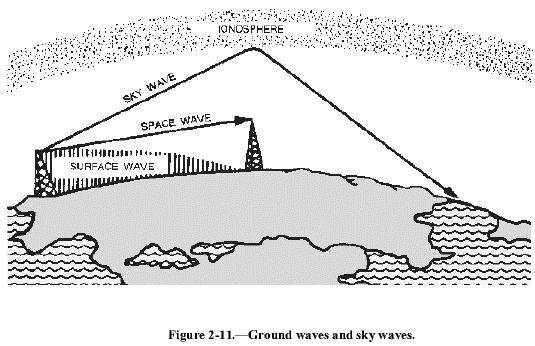
Listening time was restricted to between 1100 and 1500 hours local time, to see what could be heard via daytime groundwave.
In spite of having a low noise seaside listening location, I was surprised to only hear beacons in B.C. and Washington state, with not as much as a whisper from Oregon, Alberta, Idaho, Montana or lower Alaska. The furthest beacon I heard was ZZP-248 in the Queen Charlottes, at 486 miles. I would have wagered that most regions would see similar results, with groundwave distances being fairly constant throughout North America, but this was not the case.
Participants in the central states seemed to enjoy much greater groundwave coverage than here on the west coast. It seems that the rugged Coastal ranges and the Rockies do have a pronounced effect on daylight propagation when skywave is not involved. Beacon ERP cannot be ignored as well as location and ground system efficiency ... some definitely get out much better than others even though output powers may be the same.
Anthony Casorso, ADØVC, listening near Denver, Colorado with an Elad SDR and a 17' Low Noise Vertical (LNV), managed several +500 mile catches but all N-S or to the east.
Bill Riches, WA2DVU, in Cape May, NJ, found SJ-212 in Saint John, New Brunswick, 635 miles to the north with his Perseus and Wellbrook loop.
Dave Tomasko, K9QU, in Galena, Illinois, caught OKS-233 in Oshkosh, NE at 625 miles and FOR-236 in Forsyth, Montana, at a whopping 845 miles with his R-75 and Wellbrook ALA100 loop.
These were heard here at 11 a.m. local time using my Perseus SDR and inverted-L tuned to 300kHz:
24 18:00 200.0 YJ Victoria - Sidney Island, BC, CAN
24 18:00 203.0 YBL Campbell River, BC, CAN
24 18:00 214.0 LU 'Cultus' Abbotsford, BC, CAN
24 18:00 216.0 GRF GRAYE - Fort Lewis, WA, USA
24 18:00 223.0 YKA Kamloops, BC, CAN
24 18:00 227.0 CG Castlegar, BC, CAN
24 18:00 236.0 YZA Ashcroft, BC, CAN
24 18:00 240.0 BVS Skagit/Bay View - Burlington, WA, USA
24 18:00 242.0 ZT Port Hardy, BC, CAN
24 18:00 248.0 ZZP Dead Tree - Queen Charlotte Is, BC, CAN
24 18:00 251.0 YCD Nanaimo, BC, CAN
24 18:00 257.0 LW Kelowna - Wood Lake, BC, CAN
24 18:00 266.0 VR Vancouver - Lulu Island, BC, CAN
24 18:00 269.0 YK 'Brilliant' Castlegar, BC, CAN
24 18:00 272.0 XS Prince George, BC, CAN
24 18:00 284.0 FHR Friday Harbor Apt, WA, USA
24 18:00 290.0 YYF Penticton, BC, CAN
24 18:00 293.0 MB Mill Bay - Sidney, BC, CAN
24 18:00 312.0 UNT Naramata, BC, CAN
24 18:00 325.0 YJQ Bella Bella (Campbell Island), BC, CAN
24 18:00 326.0 DC Princeton Municipal Apt, BC, CAN
24 18:00 328.0 LAC 'Lacomas' Fort Lewis, WA, USA
24 18:00 332.0 WC White Rock (Abbotsford), BC, CAN
24 18:00 338.0 K Ediz Hook - Port Angeles, WA, USA
24 18:00 344.0 XX Abbotsford, BC, CAN
24 18:00 348.0 MNC 'Mason Co' Shelton, WA, USA
24 18:00 350.0 NY Enderby, BC, CAN
24 18:00 353.0 RNT Renton Municipal Apt, WA, USA
24 18:00 356.0 ON 'Okanagan' Penticton, BC, CAN
24 18:00 359.0 YQZ Quesnel, BC, CAN
24 18:00 359.0 YAZ Tofino - Vancouver Island, BC, CAN
24 18:00 362.0 BF 'Nolla' Seattle, WA, USA
24 18:00 368.0 ZP Sandspit - Moresby Island, BC, CAN
24 18:00 371.0 YK 'Donny' Yakima, WA, USA
24 18:00 374.0 EX Rutland (Kelowna), BC, CAN
24 18:00 378.0 AP Active Pass (Mayne Island), BC, CAN
24 18:00 382.0 YPW Powell River, BC, CAN
24 18:00 382.0 AW WATON - Marysville, WA, USA
24 18:00 385.0 WL Williams Lake, BC, CAN
24 18:00 389.0 YWB Kelowna, BC, CAN
24 18:00 400.0 QQ Comox, BC, CAN
24 18:00 408.0 MW PELLY - Moses Lake, WA, USA
24 18:00 414.0 YZK Harper Ranch, BC, CAN
24 18:00 515.0 CL ELWHA - Cresent Beach, WA, USA













