Author Archive
 Hunting For NDBs In CLE 233
 June 20th, 2018 |
  Author:
 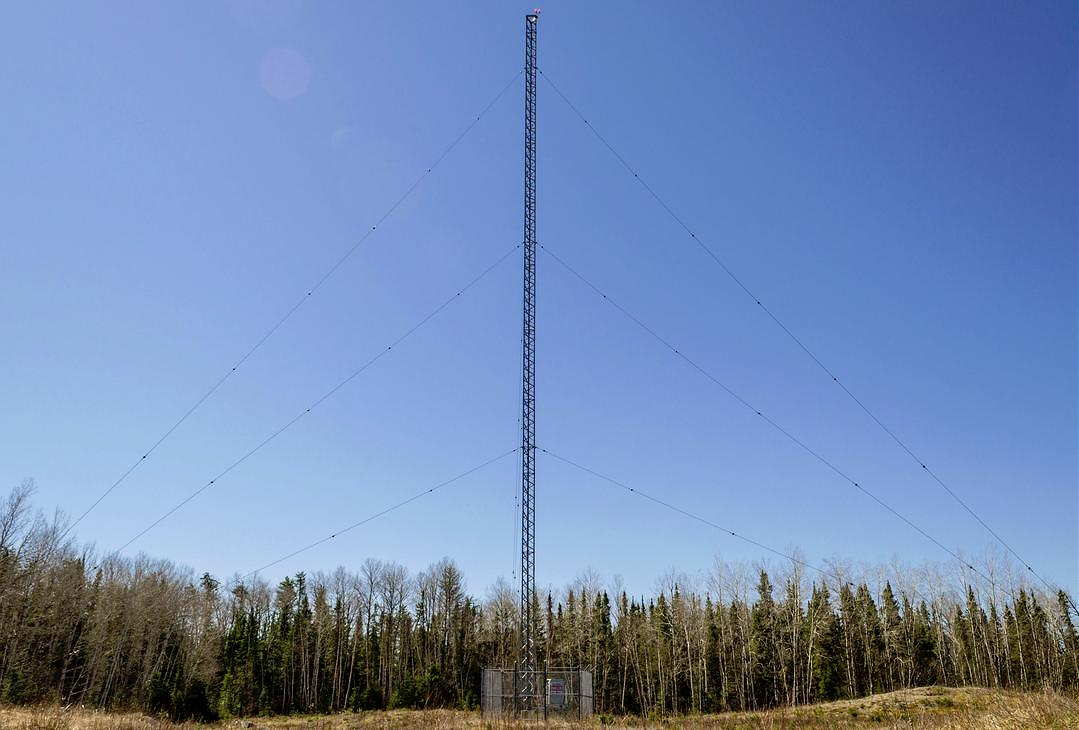 |
| YLD - 335kHz courtesy: http://www.ve3gop.com/ |
This coming weekend will see another monthly CLE challenge. This time the hunting grounds will be 335.0 - 349.9 kHz.
For those unfamiliar with this monthly activity, a 'CLE' is a 'Co-ordinated Listening Event', as NDB DXers around the world focus their listening time on one small slice of the NDB spectrum.
A nice challenge in this one is to hear YLD - 335, located in Chapleau, Ontario.
'YLD' runs just 100W into a 100' vertical but is well-heard throughout North America and many parts of Europe under the right conditions. Listen for its upper-sideband CW identifier (with your receiver in the CW mode) on 335.415 kHz.
Summer lightning storms may provide additional listening challenges but today's lightning map of North America looks surprisingly quiet ... maybe we will get lucky. It can't however, be any worse than last month's CLE, where widespread lightning was reported by almost every participant.!
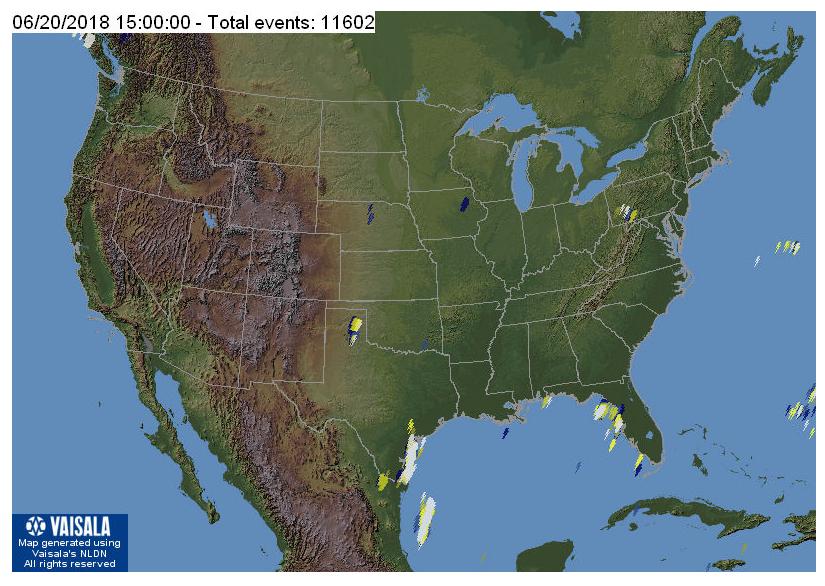 |
| courtesy: http://thunderstorm.vaisala.com/explorer.html |
If you are interested in building a system for the new (U.S.) 630m band, the CLE will give you the chance to test out your MF receiving capabilities and compare against what others in your area might be hearing.
When tuning for NDBs, put your receiver in the CW mode and listen for the NDB's CW identifier, repeated every few seconds. Listen for U.S. NDB identifiers approximately 1 kHz higher or lower than the published transmitted frequency since these beacons are modulated with a 1020 Hz tone approximately.
For example, 'AA' near Fargo, ND, transmits on 365 kHz and its upper sideband CW identifier is tuned at 366.025 kHz while its lower sideband CW ident can be tuned at 363.946 kHz. Its USB tone is actually 1025 Hz while its LSB tone is 1054 Hz.
Often, one sideband will be much stronger than the other so if you don't hear the first one, try listening on the other sideband.
Canadian NDBs normally have an USB tone only, usually very close to 400 Hz. They also have a long dash (keydown) following the CW identifier.
All NDBs heard in North America will be listed in the RNA database (updated daily) while those heard in Europe may be found in the REU database. Beacons heard outside of these regions will be found in the RWW database.
From CLE organizer Brian Keyte, G3SIA, comes the details:
Hello all
Here are the full details for this weekend's co-ordinated listening event.
It is open to everyone including CLE new-comers:
Days: Friday 22 June - Monday 25 June
Times: Start and end at midday, your LOCAL time
Range: 335.0 - 349.9 kHz
Wherever you are, please join us and log the NDBs that you can positively
identify that are listed in this busy frequency range (it includes 335.0 kHz
but not 350 kHz) plus any UNIDs that you come across there.
Send your CLE log to the List, preferably as a plain text email
(not in an attachment) with "CLE233 - FINAL Logs" at the start of its
subject line.
Please show on EVERY LINE of your log:
# The date ( e.g. 2018-06-22 or just the day no. 22 ) and UTC
(the day changes at 00:00 UTC).
# kHz (the beacon's nominal published frequency, if you know it)
# The Call Ident.
Show those main items FIRST on each line, before other optional details
such as Location, Distance, Offsets, Cycle time, etc.
If you send any incomplete logs to the List during the event, please also
send your 'FINAL', complete one.
Please always make your log interesting to everyone by showing your
own location and brief details of the receiver and aerial(s), etc., that
you were using.
We will send the usual 'Any More Logs?' email at about 17:00 UTC on
Tuesday so that you can check that your log has been found OK.
Do make sure that your log has arrived on the List at the very latest
by 08:00 UTC on Wednesday 27th June.
We hope to complete making the combined results on that day.
You can check on all CLE-related information from the CLE Page
http://www.ndblist.info/cle.htm
It includes a link to seeklists for the Event from the Rxx Database.
Good listening
Brian
----------------------------------------------------------
From: Brian Keyte G3SIA ndbcle'at'gmail.com
Location: Surrey, SE England (CLE coordinator)
----------------------------------------------------------
(REMINDER: You could use any one remote receiver for your loggings,
stating the location and owner - with their permission if required.
A remote listener may NOT also use another receiver, whether local
or remote, to obtain further loggings for the same CLE).
-------------------------------------------------------------------
These listening events serve several purposes. They:
The Yahoo ndblist Group has been moved to Groups.io and The NDB List Group will now be found there! The very active group is a great place to learn more about the 'Art of NDB DXing' or to meet other listeners in your region. There is a lot of good information available there and new members are always very welcome. As well, you can follow the results of other CLE participants from night to night as propagation is always an active topic of discussion.
You need not be an NDB List member to participate in the CLEs and all reports, no matter how small, are of much value to the organizers.
Remember - 'First-time' logs are always VERY welcome!
Reports may be sent to the NDB List Group or e-mailed to CLE co-ordinator, Brian Keyte (G3SIA), whose address appears above. If you are a member of the group, all final results will also be e-mailed and posted there.
Please ... give the CLE a try ... then let us know what NDB's can be heard from your location! Your report can then be added to the worldwide database to help keep it up-to-date.
Have fun and good hunting!
- determine, worldwide, which beacons are actually in service and on-the-air so the online database can be kept up-to-date
- determine, worldwide, which beacons are out-of-service or have gone silent since the last CLE covering this range
- will indicate the state of propagation conditions at the various participant locations
- will give you an indication of how well your LF/MF receiving system is working
- give participants a fun yet challenging activity to keep their listening skills honed
The Yahoo ndblist Group has been moved to Groups.io and The NDB List Group will now be found there! The very active group is a great place to learn more about the 'Art of NDB DXing' or to meet other listeners in your region. There is a lot of good information available there and new members are always very welcome. As well, you can follow the results of other CLE participants from night to night as propagation is always an active topic of discussion.
You need not be an NDB List member to participate in the CLEs and all reports, no matter how small, are of much value to the organizers.
Remember - 'First-time' logs are always VERY welcome!
Reports may be sent to the NDB List Group or e-mailed to CLE co-ordinator, Brian Keyte (G3SIA), whose address appears above. If you are a member of the group, all final results will also be e-mailed and posted there.
Please ... give the CLE a try ... then let us know what NDB's can be heard from your location! Your report can then be added to the worldwide database to help keep it up-to-date.
Have fun and good hunting!
An Online Alternative For Comparing Antenna Performance
Over the past few years, the Reverse Beacon Network (RBN) has been utilized by thousands of amateurs to gauge the performance of their antenna systems, to check propagation or to compare their station's antenna performance against another nearby amateur's system.
For those not familiar with the RBN, it is the opposite of a network of 'on-air beacons' and consists of a network of 'on-air receivers', usually SDRs, that automatically skim a wide range of frequencies within the CW bands and report back what they hear, along with a definitive signal strength report ... all posted immediately back to a central website where you can read the data from the various stations that have heard your signal. Calling 'CQ' or sending a few 'TEST de' signals, followed by your call sign, will trigger the desired network response.
 I have recently been testing a new 40m antenna, an inverted-V dipole at 80', against my long-used half-sloper, but have been using a different online receiver network to make my real-time comparisons ... the KiwiSDR receivers, mentioned in previous blogs. I'll have more to report about the new antenna and its performance in an upcoming blog, once everything is finished and the antenna is fully optimized.
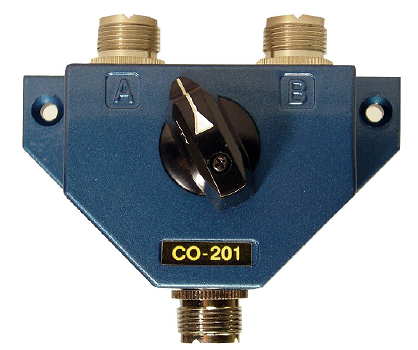
When it comes to real-time 'A-B' antenna comparisons, I found the KiwiSDR network much more interesting and informative than using the RBN. If hard data is what you want, then the RBN will provide it, but not in the same real-time, 'A-B' style that the Kiwis can offer. Once set up so that the two antennas may be fast switched, 'A-B' style, you can actually hear the difference immediately, with your own ears, as if sitting at the online receiver hundreds or even thousands of miles away. By sending a continuous series of dashes while switching between antennas, the comparison can be strikingly obvious, as the propagation variances experienced in an RBN comparison are no longer a factor. One might argue that using longer RBN comparisons, averaging the signal strength over a period of minutes, may yield a truer picture of antenna performance ... but this method lets you hear the second-by-second differences as they happen.
My antenna testing is not yet complete, as much of the initial time was spent trying to determine which online receivers were suitably quiet enough to utilize. Many of them were rejected for being far too noisy to be useful while many others were found to be ideally quiet. I am slowly working my way through the list!
So far, I have been able to listen to my transmitted signal and compare the two 40m antennas on numerous receivers from coast to coast, both near and far, as well as into the Caribbean and South America. I have found the best power to use is between 1 and 5 watts, as making the signal intentionally weak at the receiver end makes subtle differences of just a few db easier to detect.
The gathering comparisons are fascinating as often the signal strengths between my two antennas are very different. Often the sloper and the inverted-V are neck and neck, while in different directions or at different distances, one or the other is a clear winner. On many far-off receivers, I was easily able to detect my signal with all power controls set to '0' with no indication of any output showing on my meters, a rather surprising observation and another reminder of how RF just loves to radiate ... even at very low levels!
If you want to try this yourself and can quickly switch antennas 'A-B' style, here are the direct links to a few of the receivers that I have found to work very well so far ... with low noise levels and no man-made crud, while listening on 40m.
KA7U SDR - Idaho
K1RA/KW4VA - Virginia
W0AY - Montana
K2SDR - New Jersey
G8JNJ - England
K2ZN - New York
WA2ZKD - New York
KD4HSO - Kansas
VE6JY - Alberta
W3SWL - Pennsylvania
N6GN - Colorado
N8DTT/6 - California
VE6JW - Alberta
Kingwood - Texas
TWR - Bonaire
EA8DGL - Canary Islands
Wellbrook ALA1530LNP - Southern Finland
NO2CW - Florida
Pardinho - Brazil
I will continue to update this list as more receivers are tested ... now back to some outdoor antenna tweeking!
Trouble Free HF Antenna For The Apartment Dwelling Ham
 Unfortunately we all know of or hear about hams that have given up all hope of getting on the air, once moving into an apartment or condo, where antennas are normally prohibited. One enterprising local amateur has combined early established antenna fundamentals along with sound engineering, to arrive at an elegant and highly successful solution. If you are also a 'location challenged' amateur, it may just be the thing that will help you, and others, take back your hobby and get on the air!
John, VE7AOV, has been operating from his apartment, in the heart of the very large and noisy greater Vancouver, for several years now ... not simply 'operating', but thriving, from his cozy fourth-floor apartment radio station. The wallpaper shown below would not usually be expected to grace the shack walls where antennas are not permitted!
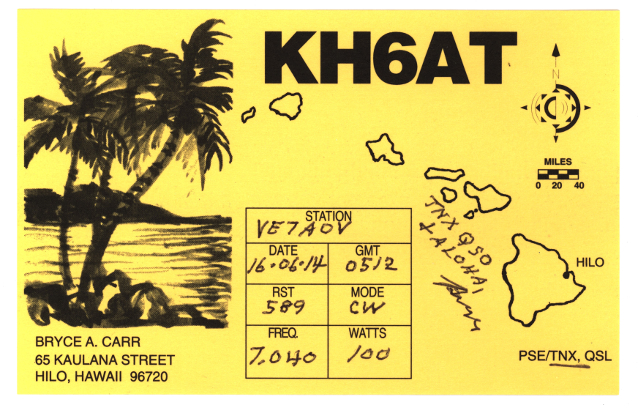

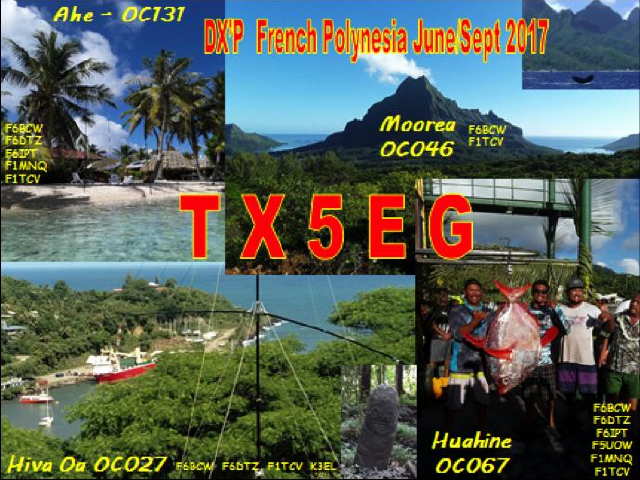
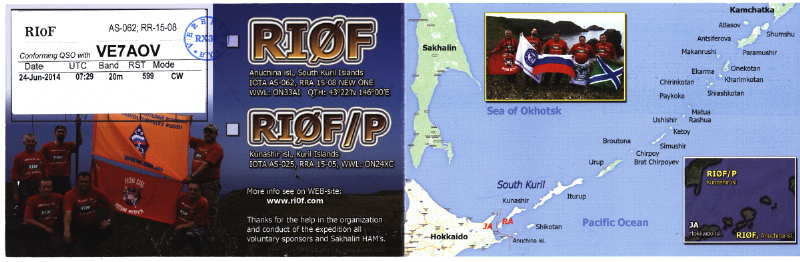
It's soon apparent that John has also overcome the usual problem of noise ingression, from every appliance and random RFI generator in the complex. This is no lucky fluke but all by design, and delivered via an all but invisible classic antenna system made of #26 wire and a few Starbuck's stir-sticks!
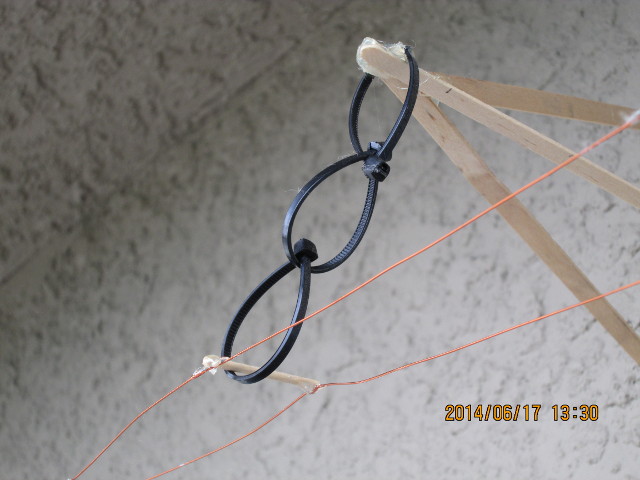 |
| 600 ohm #26 balanced line |
I'll let John tell you a bit more before sending you to his fascinating website, Intuitive Electronics, where you can learn more about his system and the engineering behind his successful, low-noise installation.
When it comes to a high frequency ham station, the antenna alternative chosen by most apartment dwellers is no antenna at all. The design here is a wisp of an antenna that bothers no one and which can work Japan, Australia, France, European and Asian Russia, the Caribbean, Central America, Polynesia and South America from the Pacific coast of Canada. It is a simple solution for apartment dwellers, it is a cheap solution and it causes no t.v.i. or other r.f. problems. It is far preferable to the alternative selected by so many fellow apartment dwellers: no antenna at all.
An implication that it seems to be impossible to rid from the minds of fellows using a Marconi antenna is that they are not just pumping 100 watts of r.f. into their antenna but that they are also pumping that same 100 watts of r.f. into their ground, that is to say the building’s wiring, the safety ground wiring. R.f. in the safety ground is well coupled into the power and neutral conductors of a residence and, in North American code, is even hard connected to the neutral line at the service entrance. The house wiring becomes part of the antenna system.
The ground wiring and everything connected to it is every bit as much a part of the antenna as is the live element. Both radiate just the same amount of r.f. power, fellows. The ground wiring along with every electrical power consumer in the building is worked against the live element. Thinking of what is connected to ground in your house is thinking about one side of your antenna. It’s not just appliances that get the “benefit” of r.f. The land line telephone system, the cable television system, the garage door opener, the security lights and…you name it. They are all “feeling” that 100W of r.f. With regard to r.f., there is no distinction whatsoever to be made between “hot” and “ground”.
You know the reason why vertical antennas have gained a reputation for being noisy on receive now, too. Most verticals are Marconi antennas. Both the safety ground and the neutral serve all the houses in the neighbourhood. The receiver is wired into the electrical appliances of the entire neighbourhood.
This radio station, located four stories above grade and in a wooden building full of apartments would be a worst case for r.f. in “ground”. This station has no r.f. in the station. It has no r.f. in “ground”.
The station has no interference issues. The Building Manager, the Building Superintendent and the administrator for this building’s cablevision have been aware of the station from the beginning. There has not been a single complaint of t.v.i. or any other complaint about the station. That’s a clean record extending back to 2006. There are no red faced, spluttering tenants hammering on the door of this station! At this station, all the r.f. produced by the transmitter makes its appearance out on the antenna. The radio station’s r.f. is not referenced to station ground. Station ground “knows nothing” about the r.f. being generated.
In the present case, that is to say a station to be operated in an apartment building, it is required to have an antenna that is “invisible”. Now it’s not possible to achieve that literally but at least the antenna should be so inconsiderable that there will be no complaints from neighbours about having to look at it. The antenna here is made of #26 A.W.G. wire. That’s wire that is 0.40mm, 0.016 of an inch, in diameter. Four stories up, it’s difficult to see the antenna and that’s even when knowing where to look for it. Part of the antenna’s run is through trees and in among the tree branches it pretty much is invisible. It does not annoy neighbours by casting a shadow; there is no shadow.
In spite if the naysayers, John's small gauge antenna has survived years of winter storms, regular occurrences here on Canada's western edge ... simply because it presents such a low cross-section compared to most conventional antenna wires.
To read more about enjoying your hobby again from your new 'restricted' location and more than likely, learn something new about old fundamentals, give John's website a very close inspection ... there is much wisdom and many gems to be found, even if you don't live in an apartment!
Evaluating Online SDRs For MW Capabilities
 |
| courtesy: https://sdr.hu/ |
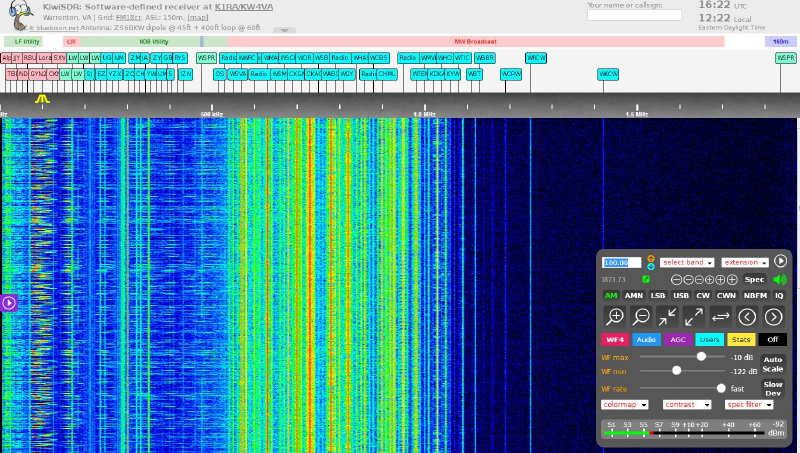
In a previous blog I described the amazing KiwiSDR network of online receivers. A quick check of the network as I write today's blog shows that there are presently 207 active online receivers distributed throughout the world!
Over the past year, there has been a growing interest in using many of the online receivers during the monthly CLE NDB listening events, all focused on the medium frequency (MF) part off the spectrum just below the AM broadcast band. Some use the SDRs to search for unlogged beacons while others use them because their home locations have become too noisy to hear anything using their own radios, a growing problem for listeners everywhere.
One ardent NDB DXer, Dan Petersen, W7OIL, (located in Vancouver, WA) has become a regular Kiwi network user as well as a regular contributor to the very valuable RNA / REU / RWW list of worldwide beacon activity. Over the past year, Dan has been keeping careful notes on not only what he has been hearing but also on how well many of the online radios perform on the MF NDB band.
As it turns out, many receivers perform very well on the HF bands but are dreadfully inadequate when it comes to the medium wave frequencies. Many are plagued with high noise levels, switching power supply signals, intermod or inadequate antenna systems, making them unusable for weak signal DX work below the broadcast band.
Other receivers however, are superb performers, as evidenced by their quiet low noise locations and well engineered antennas, providing the ideal opportunity to conduct some serious medium wave weak signal detection.
Dan has now produced the start of an ongoing guide, mainly focusing on the various Kiwi Network receivers that he has tested, rating them with regard to sensitivity and local noise, when used in the 200 - 500 kHz range only.
His SDR EVALUATION LIST (in .pdf form) can be downloaded from here, and will be updated periodically, as other online receivers are evaluated.
If you are plagued with local noise on the MF band yet would like to do some weak signal DXing, especially during the monthly NDB CLE activities, the online SDRs may be of interest to you. With Dan's helpful groundwork already giving you a leg up, hopefully you can give them a try sometime soon!
*********************************
Speaking of monthly CLEs ... the recently completed weekend event (CLE232), was a rough one, with worldwide lightning noise as well as an active geomagnetic field hampering reception for all participants. In North America, all three nights were terribly noisy and propagation was poor.
As is so often the case, Friday night was the 'best' of the three nights but only 18 stations were heard here. My log is shown below.
It was nice to hear POA in Pahoa, Hawaii, still going strong as it is located close to the present volcanic eruptions.
All signals were heard on a Perseus SDR feeding an inverted-L antenna, resonated to 300kHz.
26 09:00 325.0 YJQ Bella Bella (Campbell Island), BC, CAN
26 09:00 326.0 YQK Kenora, ON, CAN
26 10:00 326.0 DC Princeton Municipal Apt, BC, CAN
26 06:00 328.0 YTL Big Trout Lake, ON, CAN
26 09:00 328.0 LAC 'Lacomas' Fort Lewis, WA, USA
26 09:00 328.0 5J Coronation, AB, CAN
26 06:00 329.0 YHN Hornepayne, ON, CAN
26 09:00 329.0 YEK Arviat, NU, CAN
26 09:00 329.0 X2 Athabasca, AB, CAN
26 10:00 329.0 PMV Plattsmouth, NE, USA
26 09:00 329.0 PJ Robinson (Whitehorse), YT, CAN
26 09:00 330.0 0O UNID, XUU
26 09:00 332.0 XT Terrace, BC, CAN
26 09:00 332.0 WC White Rock (Abbotsford), BC, CAN
26 10:00 332.0 VVV Ortonville Municipal Apt, MN, USA
27 09:00 332.0 VT Buffalo Narrows, SK, CAN
26 12:00 332.0 POA Pahoa - Hawaii Island, HWA
26 06:00 334.0 YER Fort Severn, ON, CAN
Hunting For NDBs In CLE 232
 |
| YEK - 329kHz courtesy: www.ve3gop.com/ |
This coming weekend will see another monthly CLE challenge. This time the hunting grounds will be 320.0 - 334.9 kHz.
For those unfamiliar with this monthly activity, a 'CLE' is a 'Co-ordinated Listening Event', as NDB DXers around the world focus their listening time on one small slice of the NDB spectrum.
A nice challenge in this one is to hear the Arviat NDB, located in Nunavut on the western shores of Hudson Bay.
'YEK', on 329 kHz runs 500W into a 100' vertical and it's well-heard throughout North America and many parts of Europe under the right conditions. Listen for its upper-sideband CW identifier (with your receiver in the CW mode) on 329.421 kHz.
Propagation has been very good on the MF band recently but at this time of the year, good listening is often hampered by a lot of lightning activity. Hopefully that will not be the case this coming weekend but today's map shows what we may be up against!
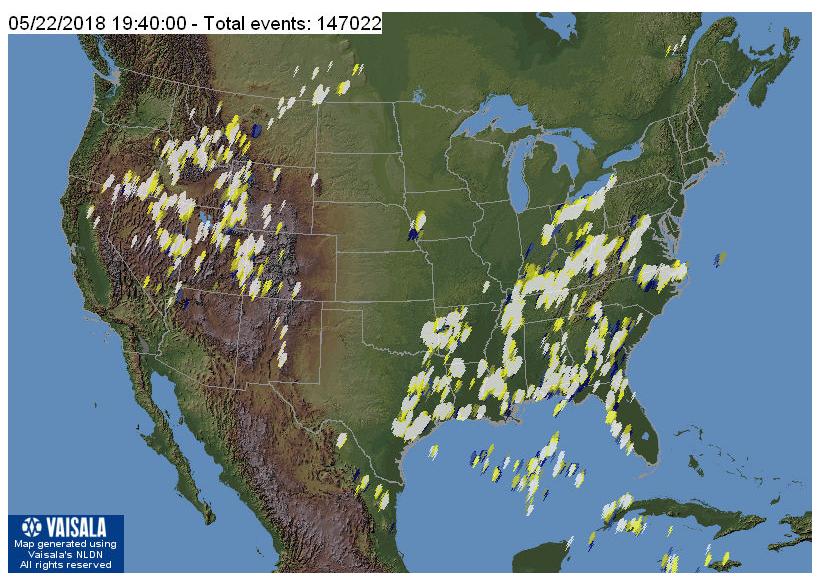 |
| courtesy: http://thunderstorm.vaisala.com/explorer.html |
If you are interested in building a system for the new (U.S.) 630m band, the CLE will give you the chance to test out your MF receiving capabilities and compare against what others in your area might be hearing.
When tuning for NDBs, put your receiver in the CW mode and listen for the NDB's CW identifier, repeated every few seconds. Listen for U.S. NDB identifiers approximately 1 kHz higher or lower than the published transmitted frequency since these beacons are modulated with a 1020 Hz tone approximately.
For example, 'AA' near Fargo, ND, transmits on 365 kHz and its upper sideband CW identifier is tuned at 366.025 kHz while its lower sideband CW ident can be tuned at 363.946 kHz. Its USB tone is actually 1025 Hz while its LSB tone is 1054 Hz.
Often, one sideband will be much stronger than the other so if you don't hear the first one, try listening on the other sideband.
Canadian NDBs normally have an USB tone only, usually very close to 400 Hz. They also have a long dash (keydown) following the CW identifier.
All NDBs heard in North America will be listed in the RNA database (updated daily) while those heard in Europe may be found in the REU database. Beacons heard outside of these regions will be found in the RWW database.
From CLE organizer Brian Keyte, G3SIA, comes the details:
Hello all
Our next Co-ordinated Listening Event is less than a week away.
It is an ideal one for new listeners as well as for regulars:
Days: Friday 25 May - Monday 28 May
Times: Start and End at midday, your LOCAL time
Range: 320.0 - 334.9 kHz
It's straightforward - just log the NDBs that you can identify having their
nominal frequencies in the range, plus any UNIDs that you come across
there. We last concentrated on these frequencies during CLE216 in
February 2017.
We'll be near the DGPS beacons range and some of us, especially in North
America, may hear a few, but please don't report them in this CLE.
73
Brian
-----------------------------------------------------------------
From: Brian Keyte G3SIA ndbcle'at'gmail.com
Location: Surrey, SE England (CLE coordinator)
-----------------------------------------------------------------
If you are interested in some remote listening - maybe due to local difficulties - you could use any one remote receiver for your loggings, stating its location and with the owner’s permission if required. A remote listener may NOT also use another receiver, local or remote, to make further loggings for the same CLE.
-------------------------------------------------------------------
These listening events serve several purposes. They:
*** NEWS FLASH ***
The Yahoo ndblist Group has been moved to Groups.io and The NDB List Group will now be found there! The very active group is a great place to learn more about the 'Art of NDB DXing' or to meet other listeners in your region. There is a lot of good information available there and new members are always very welcome. As well, you can follow the results of other CLE participants from night to night as propagation is always an active topic of discussion.
You need not be an NDB List member to participate in the CLEs and all reports, no matter how small, are of much value to the organizers.
Remember - 'First-time' logs are always VERY welcome!
Reports may be sent to the NDB List Group or e-mailed to CLE co-ordinator, Brian Keyte (G3SIA), whose address appears above. If you are a member of the group, all final results will also be e-mailed and posted there.
Please ... give the CLE a try ... then let us know what NDB's can be heard from your location! Your report can then be added to the worldwide database to help keep it up-to-date.
Have fun and good hunting!
- determine, worldwide, which beacons are actually in service and on-the-air so the online database can be kept up-to-date
- determine, worldwide, which beacons are out-of-service or have gone silent since the last CLE covering this range
- will indicate the state of propagation conditions at the various participant locations
- will give you an indication of how well your LF/MF receiving system is working
- give participants a fun yet challenging activity to keep their listening skills honed
*** NEWS FLASH ***
The Yahoo ndblist Group has been moved to Groups.io and The NDB List Group will now be found there! The very active group is a great place to learn more about the 'Art of NDB DXing' or to meet other listeners in your region. There is a lot of good information available there and new members are always very welcome. As well, you can follow the results of other CLE participants from night to night as propagation is always an active topic of discussion.
You need not be an NDB List member to participate in the CLEs and all reports, no matter how small, are of much value to the organizers.
Remember - 'First-time' logs are always VERY welcome!
Reports may be sent to the NDB List Group or e-mailed to CLE co-ordinator, Brian Keyte (G3SIA), whose address appears above. If you are a member of the group, all final results will also be e-mailed and posted there.
Please ... give the CLE a try ... then let us know what NDB's can be heard from your location! Your report can then be added to the worldwide database to help keep it up-to-date.
Have fun and good hunting!
‘CQ BR’ – It’s “Bug Roundup” Weekend!
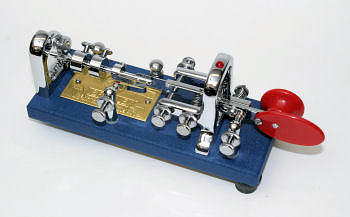
Ever since earning my ticket as a teenager back in '63, almost all of my on-air activity has been focused on CW ... I've always loved it.
Back when I first got on the air there were very few amateurs using keyers. Most used bugs and the remainder used hand keys. It was very easy to tune across the band and identify any of the locals just by the sound of their fist ... like snowflakes, no two were the same. The same went for most stations that were very active. DX or otherwise, one could usually tell who it was, long before the call signs were sent.
So much has changed now with the almost exclusive use of electronic keyers and everyone pretty much sounds the same, which is rather unfortunate I think.
Once my interest in building vintage-style vacuum-tube transmitters evolved, my interest in bugs was reactivated and over the years I have purchased a few more.
I'll do everything I can to promote and encourage the use of CW and especially hand-generated CW. That's why I was excited, once again, to read a recent e-mail from W6SFM, posted to several lists that I read, announcing the Bug Roundup!
The Samuel F. Morse Amateur Radio Club, a Sacramento, California based CW enthusiast club wanted a special time to bring bug operators together on the air.
In the same spirit as ARRL's Straight Key Night, participants are encouraged to make simple, conversational, “chewing-the-fat” QSOs using their bug type key.
This is an opportunity to exercise, share and exhibit your personalized fist. This is NOT a contest. However, there is a very easy and quick registration form found at https://w6sfm.com/bug-roundup/.
Once you've optionally registered for the event simply Call "CQ BR" so folks know you are a Bug Roundup Participant. So lets grab that bug, clean those contacts, and let’er fly! We want to hear that “Banana Boat / Lake Erie Swing" or that commercial KPH/WCC quality fist.
Reserve the date! The event begins on Friday May 18th (00:00 UTC) and concludes Sunday May 20th (00:00 UTC)
That's 5:00 PM Friday evening until 5 PM Pacific Time Sunday (LOCAL)
For more information, to register your station, and to help assist in spotting, potentially increasing QSOs, an On-line chat window link can be found near the bottom of Bug Roundup home page located at https://w6sfm.com/bug-roundup/
We hope to hear you all on the air! 73,
| courtesy: arrl.org |
Please see if you can squeeze-in a few hours of nice old bug-generated CW as the present digital craze is taking a big bite out of conventional CW activity it seems. Hopefully this is only temporary!
FCC’s Pirate Purge Continues

For some reason, the FCC continues to pour money into its hell-bent roundup of FM pirate broadcasters! I suspect much of this 'tough stance' is more politically motivated than for the reasons that they state, but the FCC seems to have plenty of will-power and the necessary funding ... it's too bad that they couldn't put the same zeal into getting on top of or making a start on the huge growing noise problem throughout the radio spectrum. I guess rounding up pirates is much easier than tackling the far more important noise issues, now growing so rapidly that many radio amateurs just throw up their hands in surrender and close up shop for good. Even commercial users of the spectrum are being negatively affected by the growing noise floor, as the growing Internet of Things connected devices produce even more radio crud.
It now seems that the FCC may get a further boost in its crackdown if a new bipartisan proposed federal law becomes reality. A May 9, 2018, article in Radio World reports the tabling of the new bill in the US Congress called the PIRATE Act or "Preventing Illegal Radio Abuse Through Enforcement Act". It would also be nice to see the PAIN Act (Preventing All Illegal Noise) in the RF spectrum but I see no Washington appetite for this much-needed FCC oversight.
The continued obsession for rounding up FM pirate broadcasters is fascinating in its own right. "It is time to take these pirates off the air by hiking the penalties and working with the Federal Communication Commission on enforcement", stated Rep. Leonard Lance (R-NJ).
"As reported in Radio World, the PIRATE Act proposes to hike the fine for violations to as much as $100,000 per day, with a maximum fine of $2 million. The rules currently allow the FCC to impose a maximum daily penalty of about $19,200 per day. At a Congressional hearing on the bill in March, New York State Broadcasters Association President David Donovan told lawmakers that illegal operators are undermining the nation’s Emergency Alert System, causing invasive and insidious interference, pose potential public health problems due to overexposure to radio frequency radiation, and interfere with airport communications."
It is apparent from reading investigative reports, that each acted-upon complaint requires a substantial investment of time and money as in the April 24 Notice of Apparent Liability for a case in Paterson, New Jersey ... it seems that NJ and NY are 'pirate hotbeds'. By the end of the investigation, a team of fully-equipped FCC field agents had visited the pirate's site(s) on eight different occasions, a considerable investment in time, energy and money. In the end, a $25,000 penalty has been proposed for the offender.
I am not a fan of illegal pirate radio broadcasting in any form but the reasons stated by the FCC for the ongoing pirate purges seem somewhat shaky. In all of the investigative reports that I've read, I have yet to find any that were reported to cause "interference with airport communications" and I question the assertion that the low power levels used by most pirates are going to "pose potential public health problems due to overexposure to radio frequency radiation". One more likely reason may be the strong lobby pressure from broadcasters who see the possible loss of advertising revenue. I'm sure that many Washington electees receive healthy campaign donations from state broadcasters as well.
Although many pirate radio ops seemingly solicit advertising revenue, overall it can't be much of a threat to mainstream broadcasters. Is it just the NAB Washington lobby that is fuelling the FCC pirate craze or is it muscle-flexing from the new administration, wanting to look tough on "crime" and radio-pirates are just easy low-hanging fruit? I suspect that it may be more of the latter.
The FCC's 'Pirate Action' postings make for interesting reading as does the fascinating Westword article on pirate radio activity in Ward, Colorado, and the recent attempted FCC take-down of stations in operation since 1997!
There's no question that a lot of FCC resources are being used to eliminate unlicenced QRM. What will it take to see the same attack on unlicenced QRN as well?













