Author Archive
 DXing With The Heathkit CR-1 Crystal Radio
 September 10th, 2019 |
  Author: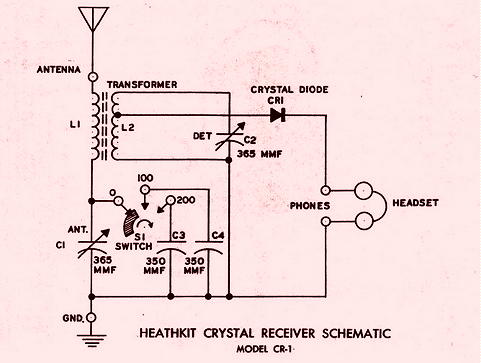
If you’re a regular blog reader, you will likely recall my description of “The Enigmatic Heathkit CR-1 Crystal Radio” a few weeks ago.
Back then I mentioned that I was ‘eager to get my mitts on one’ and that I had arranged to borrow a CR-1 from another VE7 who was fortunate enough to own one.
A few weeks after posting the blog, I received an e-mail from Larry, WB5OFD, in Texas.
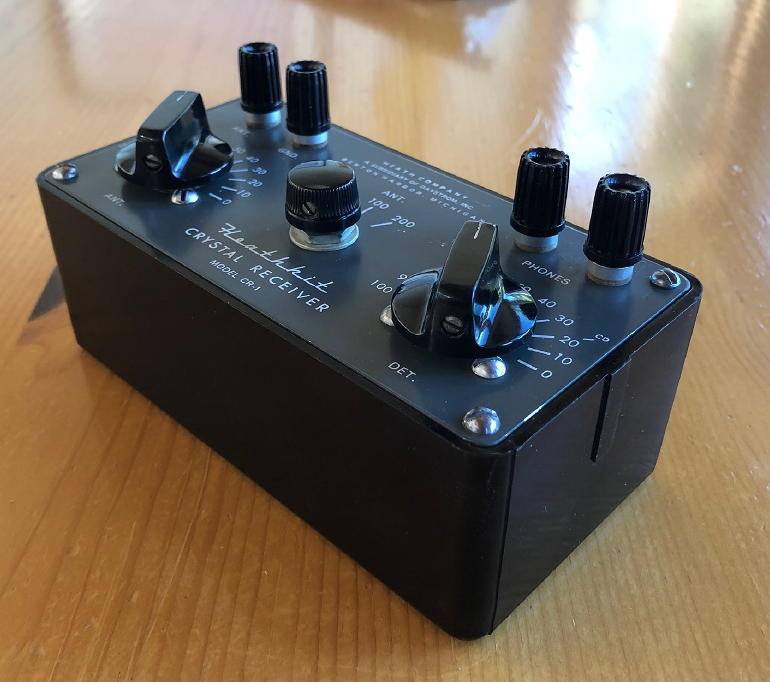
"Reading thru your blogs the other night ... discovered your article on Crystal Radio reception reports. I am in the process of disposing of a lot of radio gear I have collected over the past sixty years and in that pile is a Heathkit CR-1. Yours for free if you would like to have it."
Needless to say I was overjoyed, both at the opportunity to actually own a CR-1 myself and at Larry's exceptional generosity!
Larry went on to explain that he had been in the Air Force and his little CR-1 had been all around the world with him, from Alaska to Turkey ... but from its fine appearance, you would never know it.
 |
| Larry's gift! |
He was happy to pass it on knowing that it was going to a good home. I am most appreciative of this kind gesture from a fellow radio amateur, knowing that these things are not too easy to find ... and are somewhat pricey!
As can be seen in the schematic diagram above, the CR-1 is a simple double-tuned crystal receiver, utilizing a series-tuned tank circuit for antenna-tuning, coupled into the detector tank circuit. The detector diode, a 50’s-era 1N34, is tapped down on the tank for headphone impedance-matching and to reduce circuit loading. Reducing the load on the tank circuit improves selectivity but diminishes sensitivity. Crystal radio design is always a trade-off between these two critical characteristics.
Although I had heard good things about the CR-1, I must admit that I was somewhat skeptical ... just how good could an unmodified CR-1’s simple double-tuned design really be? I was about to find out.
My listening location, on the eastern shoreline of Mayne Island, puts me directly across several miles of saltwater from sixteen exceptionally loud 'blowtorch' signals whose antennas are located near the water on the other side of Georgia Strait. Six of these stations run 50kW ... 24/7. All of these signals are wide and strong, being well-over S9. It is a difficult location for crystal radio DXing as separating weak DX signals from the blowtorches can be challenging.
My previous experience with crystal radio DX is well-documented on my website here. Back then, I quickly adopted the standard protocols to help hear DX. This included the use if a separate ‘spotter’ radio to first find signals that might possibly be strong enough to be heard on the crystal detector. I also used an RF signal generator that let me temporarily put a weak tone-modulated carrier on the frequency of a station that I was trying to hear. Using the tone, the antenna tuning as well as the detector circuit can be optimized for maximum signal. I also used a 100 microamp meter in series with the headphones to make peaking these circuits accurately. The same protocol was used for my CR-1 DXing as well.
Since there are so many very strong signals here, I have added two inline L-C traps on the antenna lead.

My first trap was made from a ferrite bar loopstick inductor salvaged from an old transistor radio.

The second trap is made with a ferrite toroid and Litz wire and produces deeper nulls than the ferrite bar. The bar will soon be replaced by a second toroid trap.

The traps allow me to significantly null any strong signals that could be covering up a nearby weaker signal. For nulling, I set the signal generator on the frequency of the pest signal and then tune the trap for a null while watching the meter. Once everything has been tuned, I’ll often just sit and wait for the desired signal to fade up to a detectable level on the crystal radio and then confirm its audio match to what can be heard on the spotter radio. Very often, a signal initially too weak to be detected, will quickly pop up in signal strength to an easy-copy level for several minutes, before dropping below the threshold of diode detection level once again.
I am presently using a pair of RCA WWII sound-powered ('Big Cans') phones, impedance matched to the CR-1’s output with a multi-tap audio transformer. I have also used a nice set of extremely sensitive Western Electric 509Ws, manufactured in the late 20s. These are also impedance-matched to the CR-1's output. On weak signal tone tests, I can see only a very tiny improvement with the RCAs versus the old 509Ws as both are very sensitive.

There is a large variation in propagation quality on the broadcast band, especially this far north on the southern edge of the auroral zone. The difference from one night to the next can often be quite dramatic. On most nights the band favors the north-south path while on geomagnetically quieter nights it’s the east-west path that dominates. The band needs to be in good shape for any worthwhile hope of DX on a crystal radio.
On one of the recent better nights, of which there have been very few of lately, one of the stations in Alberta was so strong that it needed trapping! This was something I saw quite often with my previous DX set but I didn't expect to see it with the CR-1.
For crystal radio DX, propagation is the best helper. Small incremental improvements (in terms of db losses) can be made in any part of crystal radio's systems but on nights of good propagation, tens of db improvement will magically appear, thanks to Mother Nature!
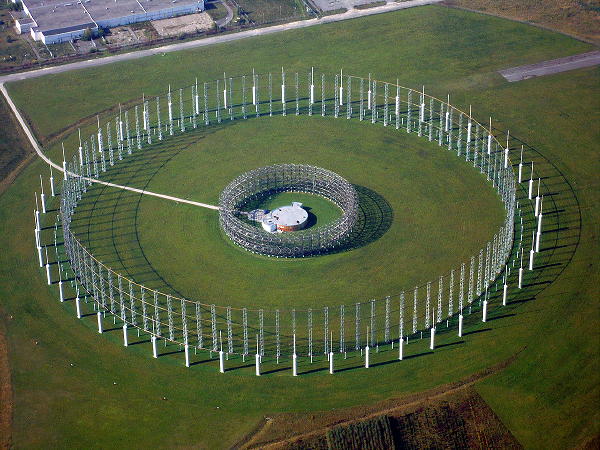
When in Turkey, Larry had the opportunity to connect the CR-1 to the large FLR-9 circular antenna array used during the cold war for HF direction-finding of targeted signals. Covering 1.5MHz to 30MHz, the FLR-9 consisted of ninety-six 120' towers, suspending 1056 vertical elements ... all over a 1500' diameter ground screen! His notes show that he logged the BBC, Italy and West Germany on the CR-1 while using the array!
 |
| The FLR-9 array in Augsburg, Germany |
Over the past few weeks, I have been spending a few nights patrolling the band between 9:30 and 10:30PM, to see what might be heard with the CR-1. So far, I've logged 50 different stations ... far more than I had expected to hear.
The log below shows all of the stations heard. The stations in red are all local line-of-sight transmitters and are extremely strong ... all are well over S9 on my Sony spotter radio. The stations shown in blue are all ‘DX’, with the furthest so far being KOA in Denver, at 1100 miles.


The log illustrates just how much the blowtorch signals prevent weak-signal detection, even with traps! The stations logged on 1510 and 1530 were only possible when the 1550 blowtorch lost their audio for about five minutes one evening! Selectivity becomes increasingly more difficult towards the top end of the band and, unfortunately, there is a larger concentration of strong locals (who seem to delight in over modulation and splatter), making reception up there extremely challenging.
There are still some lower-band signals that I have yet to log and they have been gradually growing stronger as the nights get longer. As well, the region above 1600kHz may still provide a few opportunities over the next few weeks, if the loud local on 1600 can be sufficiently trapped ... the next few weeks will tell if there’s anything left in the CR-1’s tank!
My 10’ x 20’ Active Loop
 |
| courtesy: americanradiohistory.com |
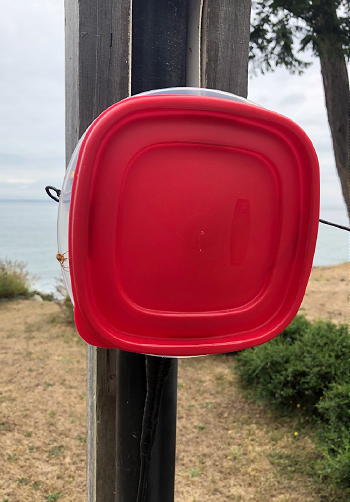
After recently installing a new coax run out to the loop and after five years of summer sunlight, the plastic food-storage container used to house the loop’s preamp (Wellbrook ALA100LN ... LF-30MHz) finally bit the dust ... literally.
Last week I replaced the housing with a slightly larger plastic box but I’ll still be faced with the UV bombardment and eventual deterioration of the clear plastic and lid unless I do something different.
I’ve a couple of thoughts but am hoping for some other suggestions from blog readers.
I have thought about spray painting the container, which may (or may not) prevent UV damage, but wonder if paint will stick to the smooth plastic surface? Maybe if scuffed-up a bit it would stick ... if so, the coating could be annually renewed.
Another idea is to cover it with duct tape ... not pretty, but possibly doing the job. Any other thoughts out there?
Part 2 and Part 3 of this blog were originally published when the loop was first built (2014) and describe the antenna details as well as showing the loop in action ... listening on the NDB and broadcast band as well as showing its nulling capability. It’s been a great performer and I can highly recommend the ALA100LN for a large aperture receiving loop. I’m looking forward to what will hopefully be a good winter of exciting loop DXing.
Part 2 - New LF / MF Loop
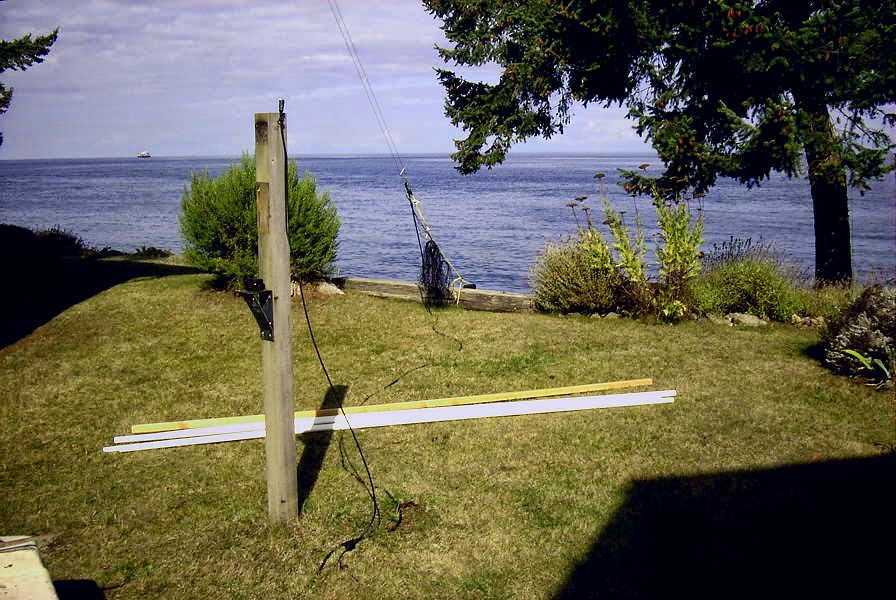
Some may recall my blog back in July (Wellbrook Loop Plans) describing a new loop that I had been thinking about as a possible replacement for my 10' shielded loop. I had been doodling various construction ideas using PVC tubing in an effort to keep it as light as possible, without introducing any metal near the loop. On Monday of this week, I dismantled the 10' loop in preparation for my new experimental rectangular loop.
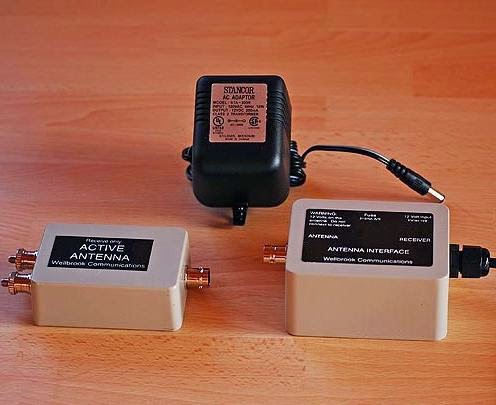 I've had the Wellbrook loop preamp here for a few months, so it was now or never, while the weather was still 'antenna-friendly'. Now I do understand that this goes against one of ham radio's long-standing traditions that dictates all antenna work must wait until the weather can't get any worse. Antennas built in the winter rain always work much better than ones put up in the summer. Hopefully it's not Wouff-Hong or Rettysnitch punishable but the fall DX season is almost upon us and I'm not waiting for the rain!
The new 'loop' is not really loop-shaped but is rectangular (10' x 20') and more like a Flag antenna shape. I considered a Flag but really don't need any back-end nulling capability since I'm mainly interested in listening to the east and to the north.
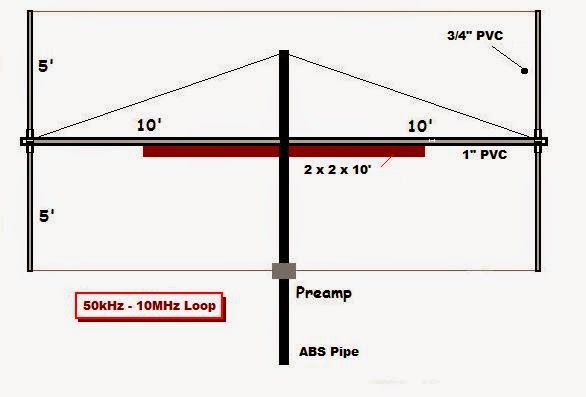
The main boom section is composed of two sections of 1" PVC thick-wall (Schedule 40) pipe joined at the center and reinforced with a 10' section of 2" x 2" Douglas Fir. In addition, the boom has a truss of 1/4" Dacron to take out any end-loading sag. The vertical end sections are 3/4" Schedule 40 PVC pipe, fastened with a T at the boom end. The center mast is made of 2" Schedule 40 ABS pipe with a long section of 1 1/2" ABS nested inside that telescopes upward to anchor the truss ropes and give some additional rigidity to the mast.
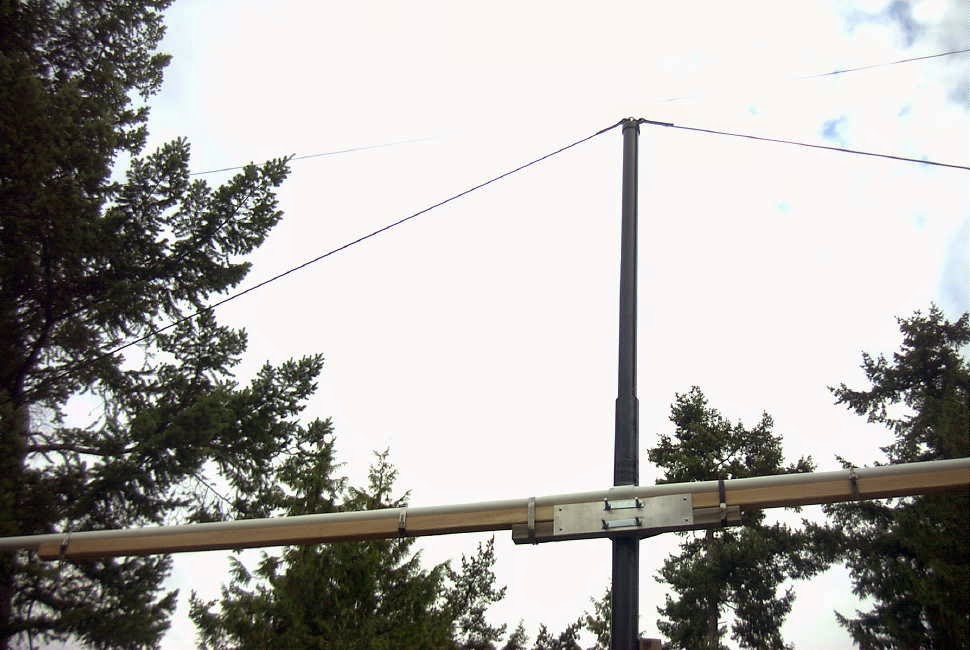 |
| Main boom and mast construction |
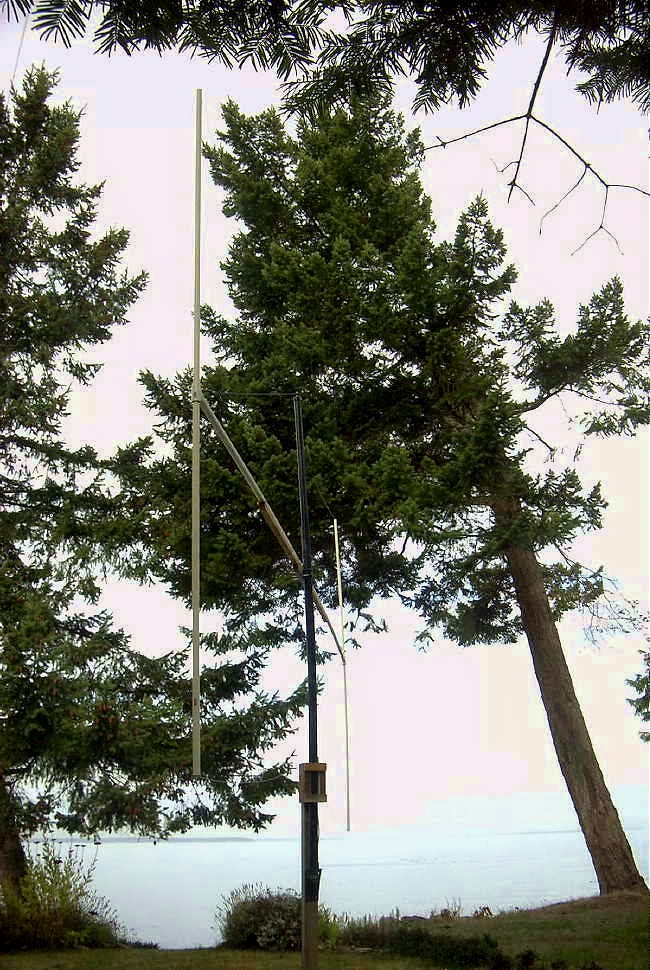 |
| Looping E/W |
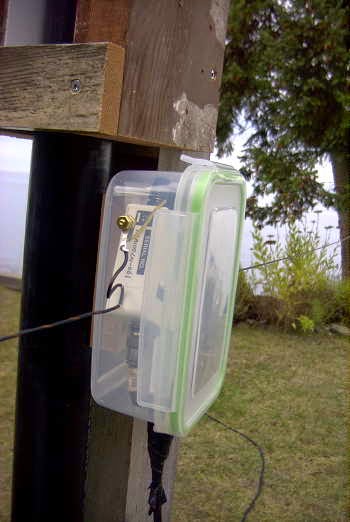
Although the preamp is completely sealed and weatherproofed, I still decided to mount it inside a container. The container also provided a convenient anchor to terminate the loop end wires (PVC-coated #18 stranded) without putting any tension on the soldered terminals.
Although I have not had much time to listen, and conditions are still in 'recovery' mode from earlier disturbances, initial indications are that everything is performing as well, if not better, than expected. It certainly outperforms my 10' active shielded loop by a large margin. I have yet to do any serious S/N comparisons between it and my primary LF receive antenna, a large inverted L, which must be tuned to resonance for the desired listening range. I believe that the very quiet loop / Wellbrook combination will provide an overall S/N improvement.
I have always believed that smaller loops provide deeper and sharper front-to-side nulls so I was pleasantly surprised to measure (using Perseus) null depths from 25-30db, on various groundwave signals ... more than expected. Skywave signals also deliver sharp deep nulls in the order of 22 - 25db ... again surprising, but I'll take them!
A brief listen while pointing S-E last evening turned up good signals from 1 kW'ers KYHN (1650kHz) in Fort Smith, Arkansas and KKGM (1630kHz) in Fort Worth, Texas. An early morning listen revealed good audio from JOIK (567kHz) Sapporo, Japan and JOAK (595kHz) in Shobu. Down in the ndb band, little 25-watter 'IP' on 210kHz was an all-time new catch from Mobile, Arizona.
There is still much to learn from this new antenna system but the biggest challenge will be keeping it up all winter. I did lose one of my 10' loops after several years, due to wind, when the main (un-reinforced) PVC mast eventually failed from flexing fatigue. I will tie the ends of the new antenna down when the winds get strong to reduce as much mast flexing as possible. I could however, run the risk of violating another long-standing radio adage ..."if your antenna stays up all winter, it's not big enough". I just can't win.
Part 3 - Loop Listen
As Murphy would have it, and in spite of the low amount of solar activity, LF/MF propagation has been very poor since getting my new 10' x 20' loop in place. The few front-to-side nulling checks that I have done, have produced results varying from around 20db to 30db, depending upon the signal. I suspect the depth of null is also affected by the signal's arrival angle but there is still more to learn. The pattern seems to be very close to that of a typical circular loop...the classic figure-8 pattern illustrated below as shown on the Wellbrook data that came with my ALA100LN preamp.
 |
| Courtesy: http://www.wellbrook.uk.com |
More typically, the null is around 21-22 db as shown on this test while listening to the ground wave carrier of the 'YZA' NDB (236kHz) located in Ashcroft, B.C., about 150 miles to the NE. As expected, the null is fairly sharp and the front / rear lobe, fairly broad.
One short check at dusk produced nice signals from CJBC, the French-language station in Toronto. The past few nights it has been very strong but with a strong echo effect. I wonder if there is more than one CBC outlet here (860kHz), such as a low-power repeater, causing the echo.
At the same time, while still fairly light outside, WCCO in Minneapolis had a nice signal just before sunset.
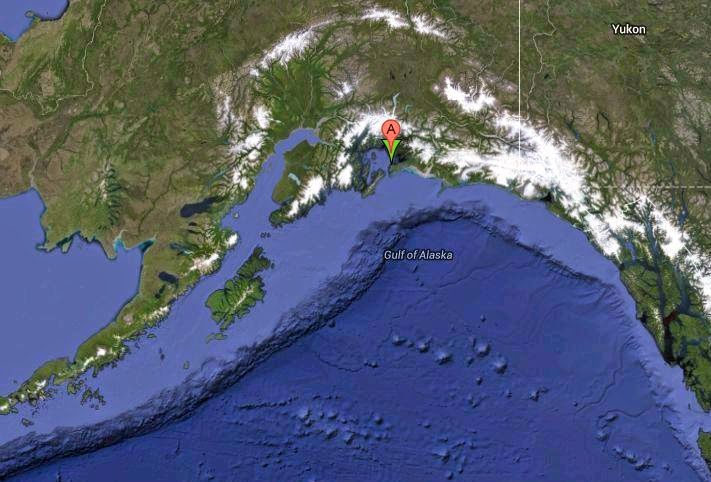
No matter how poor conditions become, it seems that the Hinchinbrook (Alaska) NDB, 'ALJ' (233kHz), is always strong ... looping north.
 |
| Courtesy: https://www.google.ca/maps |
(Since originally posting the above, I have been using the Tiny Take free screen capturing software, to produce better quality catures of my Perseus recordings. It's also probable that my new iPhone would produce a high quality video of my computer screen compared to the older iPad used for these ones, but it's something yet to be tried.)
Hopefully conditions will only get better as the season progresses and I am able to give the loop a good workout ... before it gets too windy!
Hunting For NDBs In CLE247
 |
| courtesy: http://www.ve3gop.com |
This time the hunting grounds will be:
320.0 - 334.9 kHz.
For those unfamiliar with this monthly activity, a 'CLE' is a 'Co-ordinated Listening Event', as NDB DXers around the world focus their listening time on one small slice of the NDB spectrum.
If you've been meaning to participate in CLE, then maybe this weekend is a fine time to try! Lately, we've had a lot of first time submissions so you won't be alone!
As well, if you're trying to learn CW, copying NDBs is perfect practice, as the identifier speed is generally slow and the letters are repeated again every few seconds!
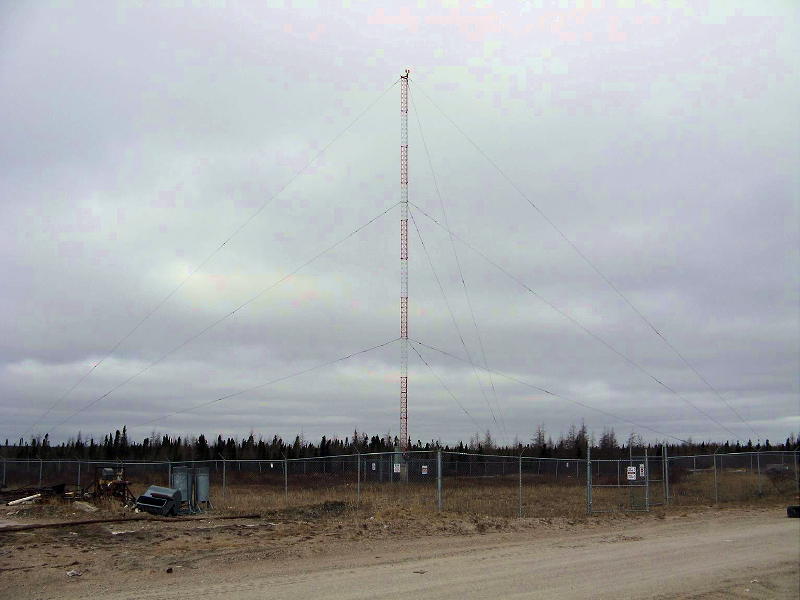
A nice challenge in this one is to hear YER - 334 kHz. 'YER' is located at Fort Severn, in northern Ontario, beside Hudson Bay.
'YER' runs 250W into a 100' vertical and is well-heard throughout North America, Europe and west to Hawaii! Listen for its upper-sideband CW identifier (with your receiver in the CW mode) on 334.404 kHz.
At this time of the season, summer lightning storms should be starting to wane and propagation can often be as good as mid-winter if the lightning cooperates.
When tuning for NDBs, put your receiver in the CW mode and listen for the NDB's CW identifier, repeated every few seconds. Listen for U.S. NDB identifiers approximately 1 kHz higher or lower than the published transmitted frequency since these beacons are modulated with a 1020 Hz tone approximately.
For example, 'AA' near Fargo, ND, transmits on 365 kHz and its upper sideband CW identifier is tuned at 366.025 kHz while its lower sideband CW ident can be tuned at 363.946 kHz. Its USB tone is actually 1025 Hz while its LSB tone is 1054 Hz.
Often, one sideband will be much stronger than the other so if you don't hear the first one, try listening on the other sideband.
Canadian NDBs normally have an USB tone only, usually very close to 400 Hz. They also have a long dash (keydown) following the CW identifier.
All NDBs heard in North America will be listed in the RNA database (updated daily) while those heard in Europe may be found in the REU database. Beacons heard outside of these regions will be found in the RWW database.
From CLE organizer Brian Keyte, G3SIA, comes the details:
Hello all,
Here are all the details for this weekend's co-ordinated listening event.
First time CLE logs too? Yes, please!
Short logs are always as welcome as long ones.
Days: Friday 23 August - Monday 26 August
Times: Start and End at midday, your LOCAL time
Range: 320.0 - 334.9 kHz
Please log the NDBs you can positively identify that are listed in the
frequency range (no DGPS please), plus any UNIDs heard there too.
Send your CLE log to the List, if possible as a plain text email and not
in an attachment. Put CLE247 and FINAL at the start of the email title.
Please show on EVERY LINE of your log:
# The date and UTC (the day changes at 00:00 UTC).
# kHz - the beacon's nominal published frequency, if you know it.
# The Call Ident.
Show those main items FIRST on each line, before any optional details such
as the NDB's Location, Distance, Offsets, Cycle time, etc.
As always, make your log meaningful to everyone by including the listening
location and details of the receiver, aerial(s), etc.
It would be OK to use one remote receiver, with the owner's permission if
necessary, provided that ALL your loggings for the CLE are made using it.
Joachim or I will send the usual 'Any More Logs?' email at about 19:00 UTC
on Tuesday so that you can check that your log has been found OK.
Do make sure that your log has arrived on the List at the very latest by
08:00 UTC on Wed. 28th August.
We hope to complete the combined results within a day or two.
Remember that you can find all CLE-related information from our CLE page
( http://www.ndblist.info/cle.htm ), including a link to the seek lists and
maps provided for this Event from the Rxx Database.
Good listening
Brian
---------------------------------------------------------------------
From: Brian Keyte G3SIA ndbcle'at'gmail.com
Location: Surrey, SE England (CLE coordinator)
---------------------------------------------------------------------
These listening events serve several purposes. They:
The NDB List Group is a great place to learn more about the 'Art of NDB DXing' or to meet other listeners in your region. There is a lot of good information available there and new members are always very welcome. As well, you can follow the results of other CLE participants from night to night as propagation is always an active topic of discussion.
You need not be an NDB List member to participate in the CLEs and all reports, no matter how small, are of much value to the organizers.
Remember - 'First-time' logs are always VERY welcome!
Reports may be sent to the NDB List Group or e-mailed to CLE co-ordinator, Brian Keyte (G3SIA), whose address appears above. If you are a member of the group, all final results will also be e-mailed and posted there.
Please ... give the CLE a try ... then let us know what NDB's can be heard from your location! Your report can then be added to the worldwide database to help keep it up-to-date.
Have fun and good hunting!
- determine, worldwide, which beacons are actually in service and on-the-air so the online database can be kept up-to-date
- determine, worldwide, which beacons are out-of-service or have gone silent since the last CLE covering this range
- will indicate the state of propagation conditions at the various participant locations
- will give you an indication of how well your LF/MF receiving system is working
- give participants a fun yet challenging activity to keep their listening skills honed
The NDB List Group is a great place to learn more about the 'Art of NDB DXing' or to meet other listeners in your region. There is a lot of good information available there and new members are always very welcome. As well, you can follow the results of other CLE participants from night to night as propagation is always an active topic of discussion.
You need not be an NDB List member to participate in the CLEs and all reports, no matter how small, are of much value to the organizers.
Remember - 'First-time' logs are always VERY welcome!
Reports may be sent to the NDB List Group or e-mailed to CLE co-ordinator, Brian Keyte (G3SIA), whose address appears above. If you are a member of the group, all final results will also be e-mailed and posted there.
Please ... give the CLE a try ... then let us know what NDB's can be heard from your location! Your report can then be added to the worldwide database to help keep it up-to-date.
Have fun and good hunting!
Weak Signal Volume Levels
The following blogspot was originally published in July, 2016. Hopefully some will find this of interest as the topic is still very relevant.
***************
A recent posting on Yahoo's Perseus SDR Group inquired about the use of external or PC-based DSP manipulation of signals partially masked by noise to improve readability. The most interesting part of this short discussion was the result of one response indicating:
"BTW one of the best and most simple noise reductions is to lower the volume."
to which the original inquirer responded:
"BTW, lower the volume to reduce noise ... ?? That was a joke, right ??"
Other comments soon followed, including my own, initially:
"Actually, for whatever reason, this works...at least when copying very very weak CW signals. I think it is more of an ear-brain thing where the noise
gets more focus than the signal when listening at moderate levels but
cranking everything down to a very low level has always improved copy for
me....not sure why this works as well as it does."
From Roelof Bakker, PAØRDT:
"The ear brain system works much better at low volume as it is easily
overloaded by strong signals. Similar like too much direct light in
your eyes will degrade contrast. I guess this is getting worse with
age, but I am not sure about that.
I have been watching many videos on YouTube which demonstrate ham
radio gear and most if not all use far to high volume settings,
which degrades readability. I believe it is a normal habit to raise
the volume for weak signals, but this is often contra productive.
When listening for weak signals at low volume settings, a quiet room
is mandatory. I have taken considerable effort in building a quiet
PC, that is aurally quiet.
What does wonders for copying weak signals with the PERSEUS is to
switch off the AGC."
"No it's not a joke and it's not the RF Gain. It's one of the capabilities of the human ear.
Of course qrm can be limited and reduced but noise is difficult. What you often see is that with all those noise reduction things is that the volume drops. Make an audio recording of a part with and without a (white) noise limiter switched on. Open it into an audio editor and you will see that the amplitude of the part where the noise reduction is on is lower. Now amplify that part to the same level as where the limiter is not active and play it back. You will be astonished how little the difference is.
It's probably also a thing that can differ from person to person but I've never seen tools that can make an unreadable signal readable. Most of the time they sound just different, not better."
Likely there is a ton of data showing how our ear / brain link deals with noise or tones buried in noise. With audio levels set to anything above bare minimum, I think it's very easy for your brain to react mainly to the noise and not to the tone. Reducing this level possibly puts the two back on even levels ... even though there really has been no change in signal-to-noise ratio.
When trying to copy very weak, difficult signals, I've always found that turning audio levels down to bare minimums helps me personally. As Roelof mentioned, the entire environment must be dead quiet as well so that there are no outside distractions. Even the sounds of the headphone cord, brushing against clothing or the table top, can make the difference between copy and no copy. Decades of copying very weak ndb CW idents buried in the noise as well as spending several years on 2m CW moonbounce, has taught me that my ear-brain connection works best when audio inputs are very, very low.
 |
| courtesy: http://justagwailo.com/ |
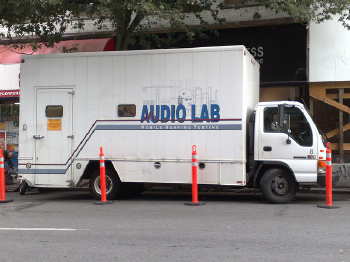
As an interesting aside, my years of copying weak CW tones, has shown itself in other ways as well. Before retirement as a high school tech ed teacher, staff were required to have their hearing checked annually, as part of the medical plan's requirement. Each year the mobile audio lab would roll-up for the tests. I would always make sure to sit perfectly still, with no headphone cord wires brushing against my clothing. The tones varied in frequency and intensity and were often extremely weak, not unlike the weak echoes I was used to copying from the lunar surface. The reaction from the examiner was always the same, every year ... complete astonishment when checking the results and usually a comment that I had the hearing of a teenager! Thankfully my hearing, which I've always been careful to protect, remains exceptionally good, for which I am truly grateful ... so often this is a genetic thing and there is little one can do about controlling hearing-loss as one ages.
I shudder anytime I see a young person with headphones or earbuds firmly in place and with the music volume cranked up to unbelievably high levels. Sadly, many of them will likely pay the price for this later in life as such hammering-away at the delicate auditory mechanism has a cumulative rather than a short-term effect.
So ... the next time you find yourself trying to copy that ultra-weak signal just riding along in the noise, try turning the audio way, way down. Take a deep breath and listen to the tone, not the noise. If you ask me, the best signal filter is still the one between our ears.
Hunting For NDBs In CLE246
 |
| ZSJ - 258 kHz Sandy Lake, ON : source |
This coming weekend will see another monthly CLE challenge. This time the hunting grounds will be split: 240.0 - 259.9 kHz and 420.0 - 439.9 kHz.
For those unfamiliar with this monthly activity, a 'CLE' is a 'Co-ordinated Listening Event', as NDB DXers around the world focus their listening time on one small slice of the NDB spectrum.
If you've been meaning to participate in CLE, then maybe this weekend is a fine time to try! Lately, we've had a lot of first time submissions so you won't be alone!
As well, if you're trying to learn CW, copying NDBs is perfect practice as the identifier speed is generally slow and the letters are repeated again every few seconds!
A nice challenge in this one is to hear ZSJ - 258 kHz. 'ZSJ' is located at Sandy Lake, in northwest Ontario.
'ZSJ' runs 500W into a 150' vertical and is well-heard throughout North America. It has been reported in Hawaii and in Europe. Listen for its upper-sideband CW identifier (with your receiver in the CW mode) on 258.404 kHz.
At this time of the season, summer lightning storms may provide additional listening challenges but maybe we will get lucky. Propagation can often be as good as mid-winter if the lightning cooperates.
When tuning for NDBs, put your receiver in the CW mode and listen for the NDB's CW identifier, repeated every few seconds. Listen for U.S. NDB identifiers approximately 1 kHz higher or lower than the published transmitted frequency since these beacons are modulated with a 1020 Hz tone approximately.
For example, 'AA' near Fargo, ND, transmits on 365 kHz and its upper sideband CW identifier is tuned at 366.025 kHz while its lower sideband CW ident can be tuned at 363.946 kHz. Its USB tone is actually 1025 Hz while its LSB tone is 1054 Hz.
Often, one sideband will be much stronger than the other so if you don't hear the first one, try listening on the other sideband.
Canadian NDBs normally have an USB tone only, usually very close to 400 Hz. They also have a long dash (keydown) following the CW identifier.
All NDBs heard in North America will be listed in the RNA database (updated daily) while those heard in Europe may be found in the REU database. Beacons heard outside of these regions will be found in the RWW database.
From CLE organizer Brian Keyte, G3SIA, comes the details:
Hello all,
These are the final details for our 246th co-ordinated listening event
this weekend. We'll be listening in two contrasting frequency ranges.
First timer logs too? Yes, please!
Days: Friday 26 July to Monday 29 July
Times: Start and end at midday, your LOCAL TIME
Range: 240.0 - 259.9 kHz plus 420.0 - 439.9 kHz
(BOTH ranges are for ALL listeners)
Please log NDBs that you can positively identify in the ranges, plus
any UNIDs that you come across there.
The lower frequency range will be really hard for most listeners in
Europe, the higher range not at all easy for most others.
Send your final CLE log to [email protected] if possible as a plain text
email and not in an attachment.
Show CLE246 and FINAL at the start of its title to help us find your log.
Show on EVERY LINE of your log:
# The Date (e.g. 2019-07-26, etc.) or day (e.g. 26)
# UTC (the day changes at 00:00 UTC).
# kHz - the beacon's nominal published frequency (if you know it).
# The Call Ident.
Please show those main items first on each line, BEFORE any optional
details (Location, Offsets, Cycle time, Distance, etc.)
If you send interim logs, do make sure that you also send a 'FINAL' log
containing all your loggings. As always, do make your log useful and
interesting to everyone by including your own location and brief details
of the receiver, aerial(s) and any recording equipment that you used.
We will send the usual 'Any More Logs?' email at about 19:00 UTC on
Tuesday so that you can check that your Final log has been found OK.
Do make sure that your log has arrived on the List at the very latest
by 08:00 UTC on Wednesday 31 July. Joachim and I hope to complete
making the combined results within a day or two.
To help you with your search you can find lists and maps showing the
target NDBs for your part of the World at http://www.ndblist.info/cle.htm
Select the CLE SEEKLIST link there.
Good listening
Brian
--------------------------------------------------------------------
From: Brian Keyte G3SIA ndbcle'at'gmail.com
Location: Surrey, SE England (CLE coordinator)
--------------------------------------------------------------------
(Reminder: You could use any one remote receiver for your loggings,
stating its location and owner - with their permission if required.
A remote listener may NOT also use another receiver, whether local
or remote, to obtain further loggings for the same CLE).
These listening events serve several purposes. They:
The NDB List Group is a great place to learn more about the 'Art of NDB DXing' or to meet other listeners in your region. There is a lot of good information available there and new members are always very welcome. As well, you can follow the results of other CLE participants from night to night as propagation is always an active topic of discussion.
You need not be an NDB List member to participate in the CLEs and all reports, no matter how small, are of much value to the organizers.
Remember - 'First-time' logs are always VERY welcome!
Reports may be sent to the NDB List Group or e-mailed to CLE co-ordinator, Brian Keyte (G3SIA), whose address appears above. If you are a member of the group, all final results will also be e-mailed and posted there.
Please ... give the CLE a try ... then let us know what NDB's can be heard from your location! Your report can then be added to the worldwide database to help keep it up-to-date.
Have fun and good hunting!
- determine, worldwide, which beacons are actually in service and on-the-air so the online database can be kept up-to-date
- determine, worldwide, which beacons are out-of-service or have gone silent since the last CLE covering this range
- will indicate the state of propagation conditions at the various participant locations
- will give you an indication of how well your LF/MF receiving system is working
- give participants a fun yet challenging activity to keep their listening skills honed
The NDB List Group is a great place to learn more about the 'Art of NDB DXing' or to meet other listeners in your region. There is a lot of good information available there and new members are always very welcome. As well, you can follow the results of other CLE participants from night to night as propagation is always an active topic of discussion.
You need not be an NDB List member to participate in the CLEs and all reports, no matter how small, are of much value to the organizers.
Remember - 'First-time' logs are always VERY welcome!
Reports may be sent to the NDB List Group or e-mailed to CLE co-ordinator, Brian Keyte (G3SIA), whose address appears above. If you are a member of the group, all final results will also be e-mailed and posted there.
Please ... give the CLE a try ... then let us know what NDB's can be heard from your location! Your report can then be added to the worldwide database to help keep it up-to-date.
Have fun and good hunting!
A Long Listen On 1240 KHz
 |
| Ionosphere: source |
One of the Broadcast Band’s (BCB) six ‘graveyard’ frequencies is 1240 KHz.
These frequencies (1230, 1240, 1340, 1400, 1450 and 1490 KHz) are assigned to smaller stations running non-directional antennas and up to 1000 watts of power. In North America, there are typically about 150 stations assigned to each frequency.
The origin of this spooky name is often a source of debate. Some suggest that it comes from the cacophony of strange howls and sounds that can be heard on these frequencies at night, as multiple fading signals fight it out to be heard, while others relate it to the similarity of the jam-packed headstones in a typical graveyard. Whatever the true reason, it's a fascinating part of the BCB to explore.
Most BCB DXers enjoy the challenge of tackling the graveyard frequencies as they're often so busy. New stations will fade in for a brief period only to be replaced by a totally different one a few moments later ... and then a different one soon after. It gets even better if the fade-ups coincide with a local ad or a ‘top-of-hour’ ID, putting a new catch in the log!
Several days ago I reactivated my 10’ x 20’ loop and Wellbrook ALA100N preamp, that I use for NDB and BCB DXing, by adding a new buried coax line from the shack.
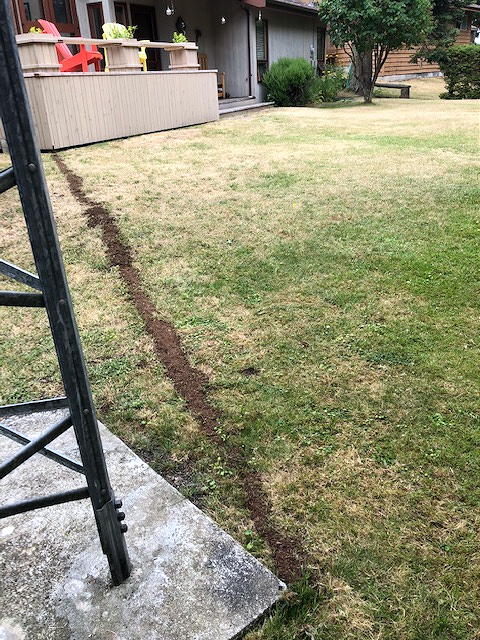
I had previously re-appropriated the loop’s coax for a nearby HF wire antenna and had been without the loop all winter.
After BCB DXer Mike Cherry (VE7SKA) on Salt Spring Island, the next island to the west of me, described some of the European action that he had experienced last winter, I am determined to not miss out during the next winter's BCB DX season!
 |
| 10' x 20' Loop & Wellbrook ALA100N Preamp |
Once getting the loop powered-up in mid-afternoon, I decided to give it a test by making a ‘deep-search’ on 1240 KHz.
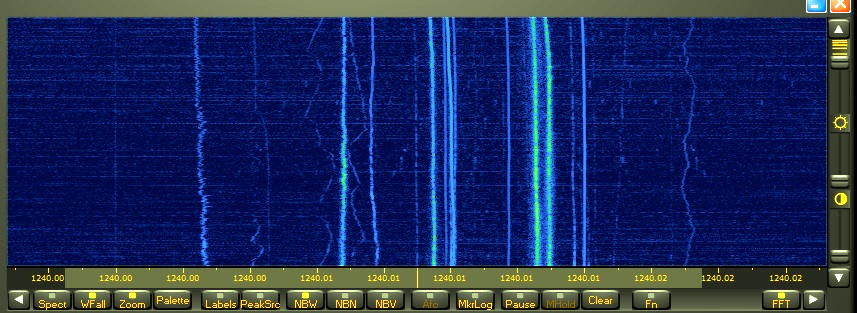
At 1500 hours local time, I wasn’t hearing any audio on 1240 but a weak carrier could be detected audibly. Using my Perseus SDR’s waterfall in its narrowest possible window, produces an extremely narrow passband, effectively increasing the sensitivity by a huge factor. This allows the waterfall to display weak signals that are presently being propagated to my location but far too weak to be heard by ear. I’m estimating that in this narrow bandwidth, it can dig about 30 dB or more into the noise, but there is a price to be paid for this extra gain .... time!
If you're used to watching your receiver’s waterfall scroll along quickly, this mode is just the opposite. It moves in very slow increments, allowing the weaker signals to build up enough to be visible before taking the next deep look. The screen capture shown below is a result of a three-hour listening period, from 1500-1800 hours local time. The entire waterfall is 25 Hz wide, with each tick representing 1Hz.
 |
| 3-Hour Daylight Deep Search |
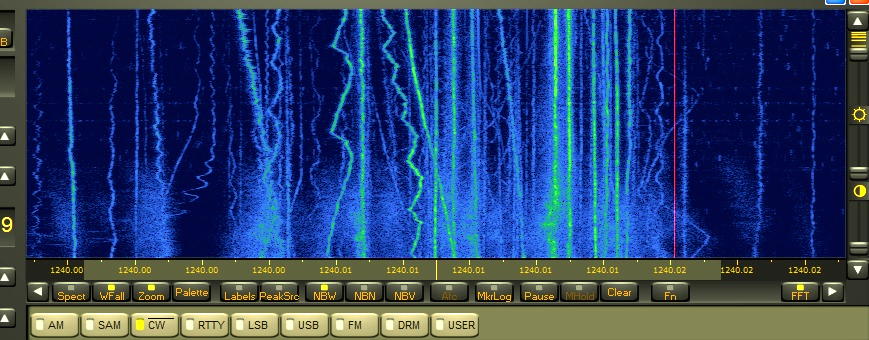
Although no signals were clearly audible during this period, my deep-search revealed the carriers of ~28 different stations being received here in south-west British Columbia ... in the middle of a summer afternoon! It’s interesting to note that few of these signals are 100% stable and several can be seen really struggling to maintain their exact assigned frequency. In this highly narrow bandwidth view, even the worst drift amounts to no more than a Hertz, well within the required tolerance of +/- 20Hz.
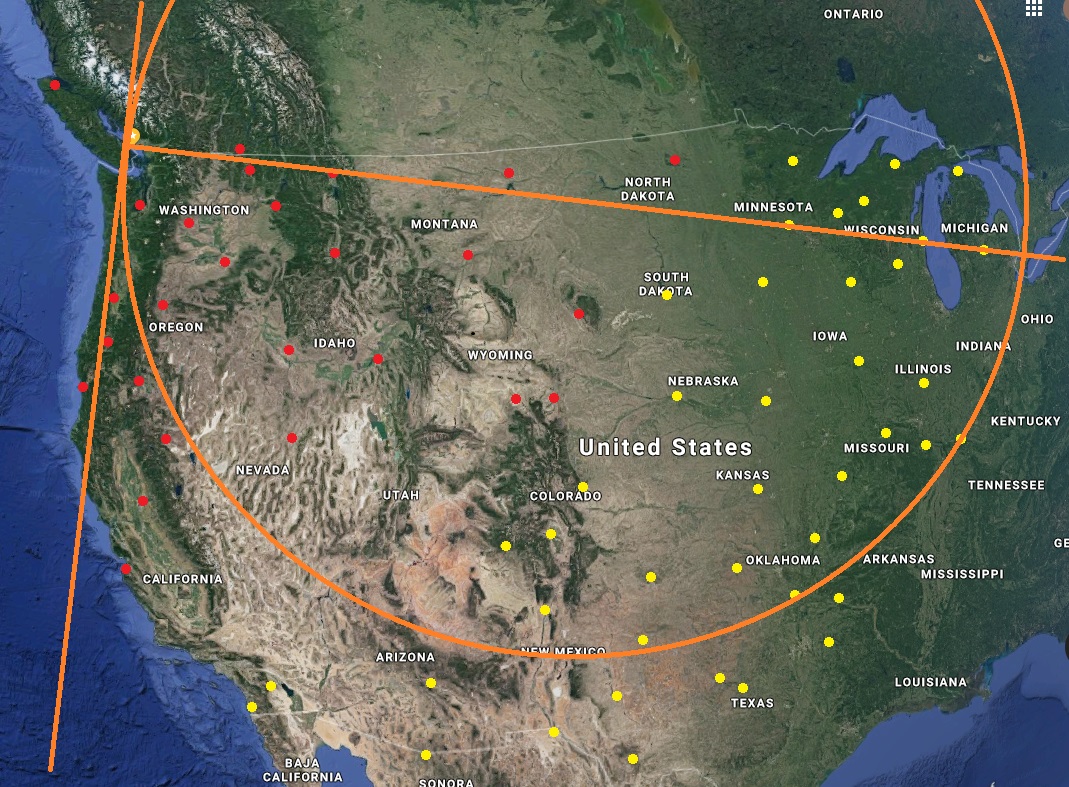
Using the always-reliable MWLIST, the locations of the most likely candidates for these 28 signals are plotted below. These are the 28 nearest stations and with my loop pointing east, a definite east / south-east flavour is evident.

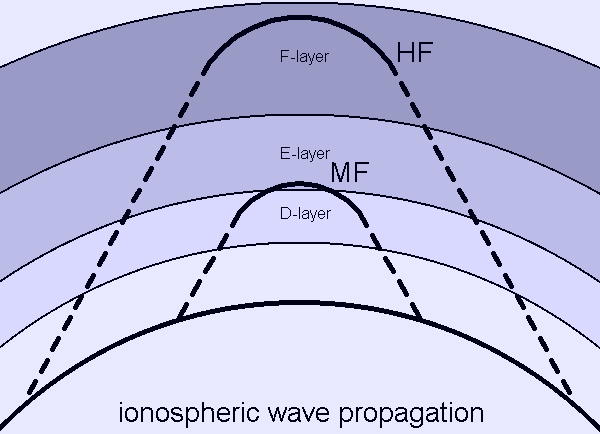
At mid afternoon, one might expect to see only groundwave-propagated signals on the broadcast band. Midday groundwave on the broadcast band can easily travel a few hundred kilometers, gradually growing weaker over the longer paths. Perhaps all of these signals are arriving via this mode as they are at least 20-30dB into the noise. I initially thought that some of the further-out signals were being reflected from a strong daytime D-layer, although most of the energy would be absorbed. Further reading shows detectable groundwave up to 1200km is possible which coincides nicely with the distances observed. Most likely what I'm seeing is a combination of extended groundwave and D-layer refraction on the furthest signals.
The second screen capture shows the same frequency for another three hours, starting about an hour before local sunset. Some of the weaker signals seen earlier now begin to grow in strength as the D-later absorption starts to decay and reveal the higher E-layer. By the end of the third hour, an additional 41 stations have appeared for a total of 69 carriers cantered on 1240 KHz. (note that my Perseus calibration is off by a few Hz)
 |
| 3-Hour Sunset Deep Search |
The next 41 closest stations are now plotted below in yellow, showing the most likely source of these signals. The distances illustrated are in-line with single and double-hop E-layer or possibly lower F-layer refraction.

This view shows the directional pattern of the front of the loop while pointing east, with its very broad circular lobe. In this direction, the narrow null is only seen along the coast.
It will be interesting to do a mid-winter follow-up on 1240 and compare the present summer propagation to the much better winter conditions. I expect that a some point, propagation via the higher F-layer will be present and extend skip distances out to the east coast or to South America.
In the meantime, things are almost ready for some pre-sunrise looks to the west and some overnight top-of-hour recordings ... as soon as I re-calibrate Perseus!
Magic Band Mid-Season Observations
 |
| courtesy: KC8RP FT8 Info |
We are now half-way through this summer’s Sporadic-E season, normally the magic band’s best time of the year. The only exception to this being the winter months of those solar cycles that are robust enough to raise the F2 MUF up as far as 50MHz ... something that occurred for only two or three days during the peak of Solar Cycle 24.
Unfortunately, it really looks as if the old reliable bread and butter modes on 6m, CW and SSB, are fast going the way of the dodo bird, as very few signals on either of these modes have been heard here this summer. As speculated last year at this time, it seems as though the weak signal (WSJT) FT8 mode now reigns supreme on the band, which has come as a great disappointment to myself and many other diehard CW ops.
At the start of this year’s season I reluctantly decided to pay more attention to this mode and see if it could put any new DXCC entities into my 6m log ... if so, it would be time well-spent.
For the past several years, my main 6m interest has focused on European or South / Central American openings, which are usually unpredictable and short-lived. As usual, most of the season’s openings have been domestic, with signals from the central and south-eastern states being the ones most often heard. Usually, signals during these openings are strong and fairly reliable and lend themselves to easy two-way work on either CW or SSB. For the vast majority of summer time openings, FT8 is not needed, as signals are not weak.
For some reason, the popularity of this weak-signal mode on 6m continues to grow in popularity even though signals are so strong! Where this mode really shines is on the short-lived long haul openings to EU or on similar long paths from the PNW, of which there have been very few this season.
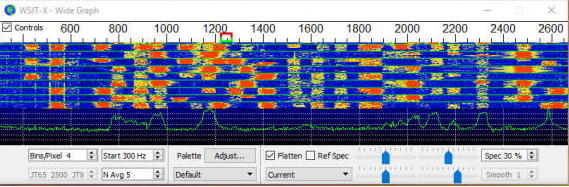
With everyone crowded into a narrow passband of ~ 2kHz, it doesn’t take much to mess things up for your neighbours if you don’t think carefully about how your operating can affect other users of that small sliver of space.
One of the most common examples of poor operating skills that I see is the seemingly endless CQ. This is much easier to do on FT8 than with conventional modes, as the software used can do this automatically for you, every 15 seconds ... while you fiddle with something else in the shack. I’ve seen some nearby stations call CQ continuously for over 60 minutes at a time, with no replies. What this does is make it difficult for other nearby users to actually hear / decode any weak signals on the band that are being covered by the loud CQing station(s) during this entire span of time. Strong local signals can wreak considerable havoc with weak-signal mode software as it's just not designed to happily handle strong signals and do a good job of decoding weak ones at the same time! Please think about this if you are one of those long CQers ... you are not the only one trying to use the band.
Another observation has to do with 'sequencing'. FT8 users must decide if they will transmit on the ‘even’ or on the ‘odd’ 15-second sequence. If you, and all of your neighbours are loud with each other, then it makes sense that everyone is better off operating on the same sequence. This way, all locals are transmitting at the same time which means they are all listening at the same time as well ... nobody causes QRM for one another if everyone uses the same sequence.
This comes off the rails very easily when just one or two strong neighbours choose to transmit during the receive sequence being used by everyone else.
There has been a long-standing precedent for sequencing, established and utilized by meteor-scatter operators for several decades. It calls for stations on the eastern-most end of a path (Europeans for example) to transmit on ‘evens’ ... the ‘0-15’ and ‘30-45’ second segment of each minute. Stations on the western-end of the path (NA) transmit on the ‘odds’ ... ‘15-30’ and ‘45-60’ second portion of each minute. When looking towards JA later in the day, everything reverses for NA stations, as they now become the eastern-end of the path.
Some operators seem to get totally confused by this or don’t check to see what sequence is being used locally before starting to operate ... while some don’t really seem to care.
I’m not complaining about what a given amateur chooses to do but simply describing some of the roadblocks to better use of FT8 and why it is not necessarily very well-suited for 90% of the typical propagation seen on 6m Es.
Many of the newer stations often seem to be using poor or makeshift antenna systems on 6m and are often not able to hear stations responding to their CQs, which may be strong enough locally to disrupt reception for those that are able to hear weaker signals.
I have deliberately made a point of never calling CQ on FT8. From decades of CW DXing I have come to understand that it’s much easier to work DX, on any band, by spending your time listening ... and then calling when the time is right. It’s no different with FT8, yet I see CQs that go on forever. Some will argue that if nobody called CQ, then there would be nobody to hear, which is of course valid ... the reality is, most amateurs cannot resist calling CQ, especially DX stations who enjoy working a pileup. There seems to be no shortage of CQers and those seeking DX should take advantage of that fact.
One loud station was seen yesterday calling another for over 90 minutes-straight. Perhaps he had wandered away from his shack and had forgotten to ‘Halt Tx’ before leaving! FT8 users need to understand how to use their software efficiently.
As for PNW to EU propagation this summer, it has been almost non-existent although I have worked CT1HZE in Portugal and JW7QIA in Svalbard ... by listening ... listening ... and calling briefly, both on FT8. In both cases, signals were brief but strong enough for CW! During the short-lived appearance of the JW7, two NA stations were noted calling ‘CQ JW’ the entire time. Perhaps if they had spent this wasted time more wisely by listening, they would have worked JW.
I’m happy to report that Svalbard was a new DXCC entity for me on 6m, #88, and the first 'new one' in a few years.
It seems that when used sensibly, FT8 is a useful application to have in your DX toolbox ... but for most daily summer Es operation, it’s just not needed. CW or SSB is well up to the task most of the time, even for small stations. Where FT8 shines is on the very brief, often unstable, long haul (EU-NA or JA-NA) paths and then, only if your neighbours don’t do things that will get them into the naughty-corner!
Now, let’s see what the second half of the season has in store for the magic band .... maybe the best is yet to come.