Author Archive
 New version of DSD+ released
 October 9th, 2014 |
  Author:
 With more digital radio appearing on the bands – I noticed the GB7BS (Bristol DMR) repeater coming on stream last weekend, you might want to think about ways of listening to the activity before you decide whether to take the plunge and invest in digital kit.
Over at the RTL-SDR blog, I noticed a post announcing a new version of the DSD+ software which will decode D-STAR, DMR etc. The package runs on Windows and you’ll need an RTL-SDR, Funcube Dongle or some other SDR receiver
New version of DSD+ released
With more digital radio appearing on the bands – I noticed the GB7BS (Bristol DMR) repeater coming on stream last weekend, you might want to think about ways of listening to the activity before you decide whether to take the plunge and invest in digital kit.
Over at the RTL-SDR blog, I noticed a post announcing a new version of the DSD+ software which will decode D-STAR, DMR etc. The package runs on Windows and you’ll need an RTL-SDR, Funcube Dongle or some other SDR receiver
Noble Radio NR4SC update: strong signals
I had a few minutes to play in the RSGB 70MHz activity contest this evening. Although I was still only using the vertical antenna which is not ideal for such activity it proved a useful session.
Neil G4BRK my nearest 70MHz neighbour was on and going well. His signal was well over S9 and it is a compliment to his signal and to the NR4SC’s receiver than he was gone within about 4khz either side, which I was quite happy with. M1PRO, a little further off were also rattling the s-meter and easy to lose a few khz either side.
Most distant signal heard was from Keith G4ODA in IO92/Spalding.
A 70MHz HB9CV antenna arrived today, so I’ll put that together at the weekend and see what can be done.
Noble Radio NR4SC update: strong signals
I had a few minutes to play in the RSGB 70MHz activity contest this evening. Although I was still only using the vertical antenna which is not ideal for such activity it proved a useful session.
Neil G4BRK my nearest 70MHz neighbour was on and going well. His signal was well over S9 and it is a compliment to his signal and to the NR4SC’s receiver than he was gone within about 4khz either side, which I was quite happy with. M1PRO, a little further off were also rattling the s-meter and easy to lose a few khz either side.
Most distant signal heard was from Keith G4ODA in IO92/Spalding.
A 70MHz HB9CV antenna arrived today, so I’ll put that together at the weekend and see what can be done.
Back to basics with the IC740
For the last few weeks, the IC-740 which was sitting quietly under the bench had been niggling at me. I had no HF rig on the operating bench, other than the FT-847 which gets used on VHF mostly. I’d taken the FT1000MP off the bench a while ago and didn’t feel that excited about using it. In fact, I’d thought about selling it – though haven’t really thought that through yet.
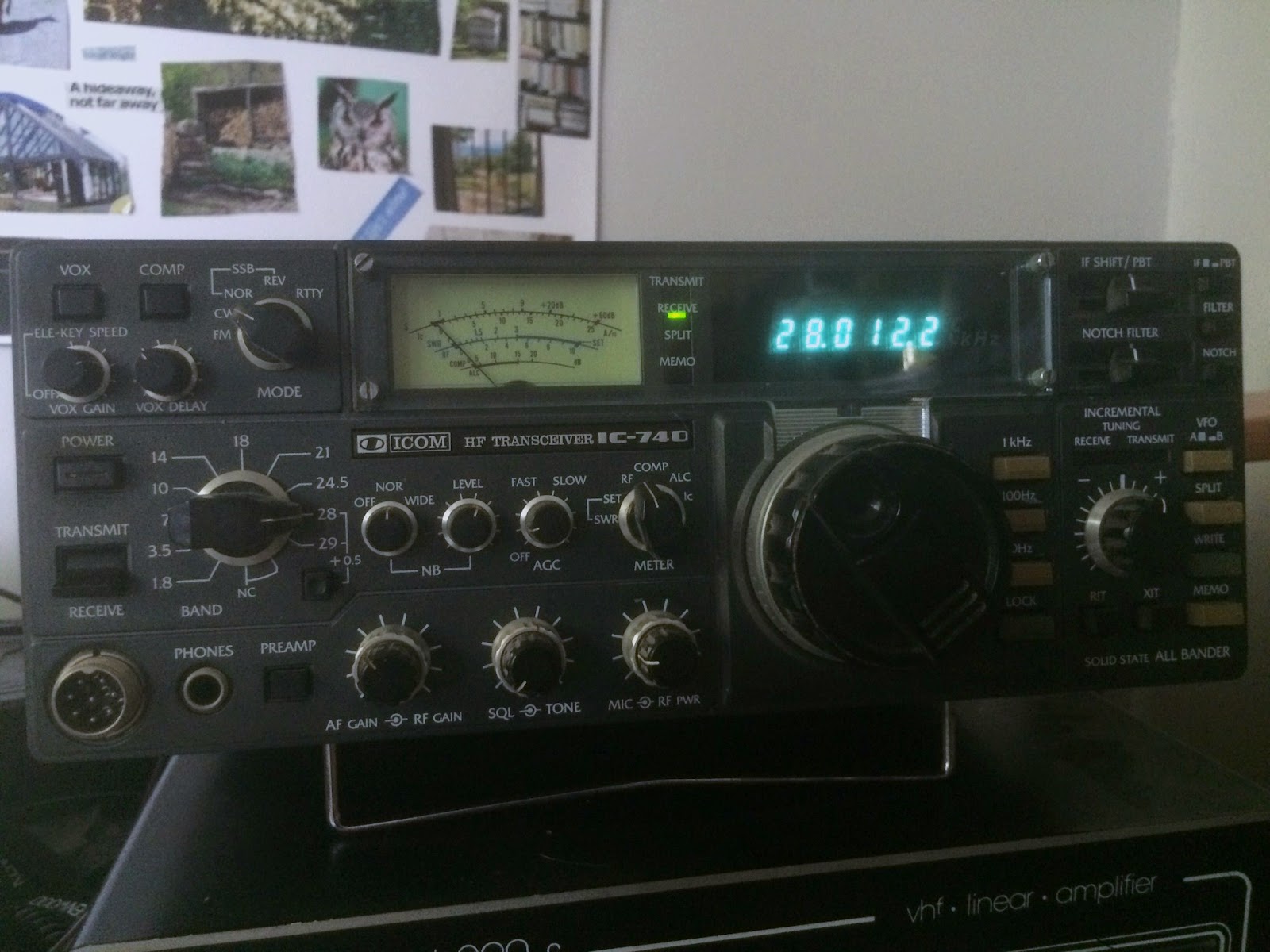
But the IC-740. There was an appeal to getting it out and going again. It was my HF rig when I first got on the air back in 1983. I knew it worked ok as I’d had a handful of contacts on it a few months back. Chasing DX, no, that wasn’t really wanted to do. Perhaps some CW – just run of the mill stuff – there have been times when I’ve found working around the UK on 7MHz CW good fun. Maybe something like that?
Finding a few minutes this afternoon, I hooked it up – plugged an aerial and a paddle in. It puts out the 85W or so that it always did. Tuned around 28MHz and quickly made a few QSOs across Europe, Asia, Africa and North America (not great conditions, but good). I listened to my old pal G3TXF doling out the QSOs as ZD9XF. Although it would be lovely to work Nigel, I don’t really feel the need to play pileups.
So maybe you’ll even hear me and the old IC740 (31 years old) around 7030 playing low power. Who knows! It’s nice to be reunited with my old friend!
Back to basics with the IC740
For the last few weeks, the IC-740 which was sitting quietly under the bench had been niggling at me. I had no HF rig on the operating bench, other than the FT-847 which gets used on VHF mostly. I’d taken the FT1000MP off the bench a while ago and didn’t feel that excited about using it. In fact, I’d thought about selling it – though haven’t really thought that through yet.
But the IC-740. There was an appeal to getting it out and going again. It was my HF rig when I first got on the air back in 1983. I knew it worked ok as I’d had a handful of contacts on it a few months back. Chasing DX, no, that wasn’t really wanted to do. Perhaps some CW – just run of the mill stuff – there have been times when I’ve found working around the UK on 7MHz CW good fun. Maybe something like that?
Finding a few minutes this afternoon, I hooked it up – plugged an aerial and a paddle in. It puts out the 85W or so that it always did. Tuned around 28MHz and quickly made a few QSOs across Europe, Asia, Africa and North America (not great conditions, but good). I listened to my old pal G3TXF doling out the QSOs as ZD9XF. Although it would be lovely to work Nigel, I don’t really feel the need to play pileups.
So maybe you’ll even hear me and the old IC740 (31 years old) around 7030 playing low power. Who knows! It’s nice to be reunited with my old friend!
First impressions of the Noble Radio NR4SC 70MHz CW/SSB rig
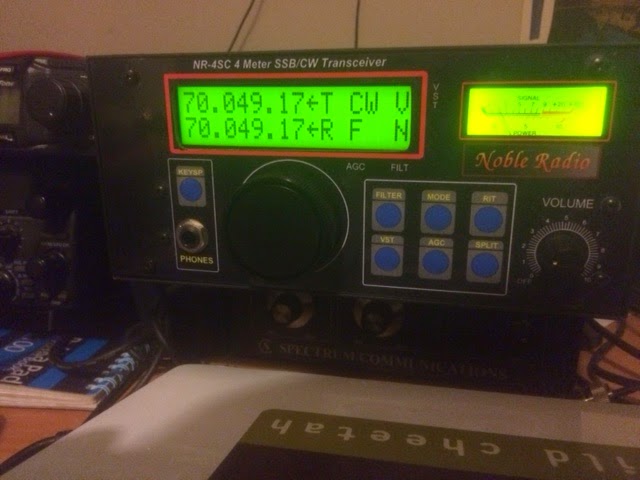
The first impression is of a solidly built radio. It’s quite chunky. When I posted a picture on Twitter, someone used the U word! But, I think the U word we should use is Utilitarian. It’s functional and reminds me of some of the Tentec styling.
Powering it up – I love the clear, big display of the frequency readout. Initially, I found the volume control a bit noisy. I mentioned this to Rob PE9PE and he said that some of the rigs did this, but a few quick rotations of the volume control would cure it. Sure enough it did. I hooked the rig up to my 70MHz vertical, which is what I normally use for working Es and the occasional tropo contact. Not ideal, but enough to make some contacts.
First tests were to listen to the GB3RAL 70MHz beacon. It was the same sort of signal strength that I expect with the Spectrum Transverter and HF rig, but interestingly, I felt the receiver was a lot quieter, which was nice.
The rig has a built in Iambic keyer for CW. I wanted to try that out as it seemed as if CW would probably be my best chance of making some contacts! The keyer socket on the rig is for a 3.5mm jack rather than a 1/4 inch jack – slightly pesty as all my other rigs have the larger size and I couldn’t immediately find an adapter. However, the Palm Paddle which I use with my FT-817 had the right size connector, so I decided to use that and plugged in and changed the mode to CW.
I discovered that the keyer jack is expected to have the dash on the tip, rather than the usual dot! Simple enough to resolve – I turned the paddle upside down and all then falls into place. The keyer is quite nice to use although I made the occasional mistake – which is just a question of getting used to the dot/dash memory.
The rig can also be supplied with a fist microphone and Rob had kindly included one of these with the package. Listening to the transmitted audio and the CW on a monitor receiver was fine and on a quick listen I didn’t hear anything I didn’t like the sound of.
Early this evening, Pete 2E0SQL kindly tried listening for me, although we didn’t manage a QSO – probably owing to our cross-polarised antennas. However, I did hear John M0UKD calling CQ on 70.200 from Hornchurch in Essex and was very pleased to be able to have a quick QSO with him. John was running 25W to a vertical compared to my 10W, so I was pleased to work him.
Tomorrow afternoon brings the Practical Wireless 70MHz contest, so I hope to make a few more contacts then.
In the meantime, the first impressions are positive. A rig which is simple to use, has a nice quiet receiver – and here’s the real plus – a rig with which you can monitor 70MHz without tying up an HF rig – no transverter needed.
I’m looking forward to playing some more, hopefully with some better antennas too and will post my further thoughts.













