Author Archive
 Why has my DVAP started to get disconnected from the reflectors? (Win-DV users)
 December 22nd, 2011 |
  Author:
 Last weekend I thought it was about time that I made some D-STAR contacts again. Out here in the wilderness, I use my DVAP to connect to the network. As I have noted on the blog before, I often use the Win-DV software from http://www.dutch-star.eu
That software allows me to do a bit more than the DVAP-Tool software from AA4RC – just in terms of being able to set up connections on the PC rather than having to do it on the E-92.
Anyway, last weekend I started up the Win-DV software connected it to REF001C and went downstairs with my handheld. I hadn’t heard anything after a while so I did a quick check and found that I had been disconnected. No big deal, I’d probably done something silly!
Connected it and checked again. I’d been disconnected. Probably something to do with 1C so tried another reflector. Same again!
Hmmm. Now my mind was starting to wonder. I closed down Win-DV and started up DVAP-Tool. Guess what? It connected and stayed there!
I didn’t have anytime to investigate at the time, but this evening I checked out the Dutch*star site. It seems that a decision was taken by ‘DPLUS Network managers’ not to allow DVAPs or DV-Dongles to connect to the network unless they sent the hardware serial number. DVAP-Tool was doing that and Win-DV was not, hence anyone using Win-DV would get disconnected.
Why was this done? This blog has never been about radio politics and we’re not going to start now. You can form your own opinion I am sure.
However, the good news is that the latest release of Win-DV allows you to select the ‘HARDWARE’ option to send your DVAP serial number to the network.
I tested it this evening and it’s working fine. You can read more detail on the Dutch*Star site.

More on JT65A
Since getting the JT65-HF program working with my equipment, I’ve been having a great time with the mode. It really is amazing what you can work. It’s a very relaxing mode and you can easily be working someone on JT65 on HF and having a local QSO on VHF, which is quite fun.
Over the last few weeks, I’ve had JT65A contacts on 3.5, 7, 14 and 28MHz. The most satisfying bands have been 3.5 and 28MHz. On a number of occasions, I’ve hooked the receiver up to the computer in the morning and left the JT65 program running all day, to see what I can hear. Because I’ve configured the program to upload what it hears to the reverse beacon network and the PSK Reporter website, it’s easy to keep track of what propagation is like, from my desk or from the train! I shall have to work out some remote control so that I can make some QSOs at lunchtime.
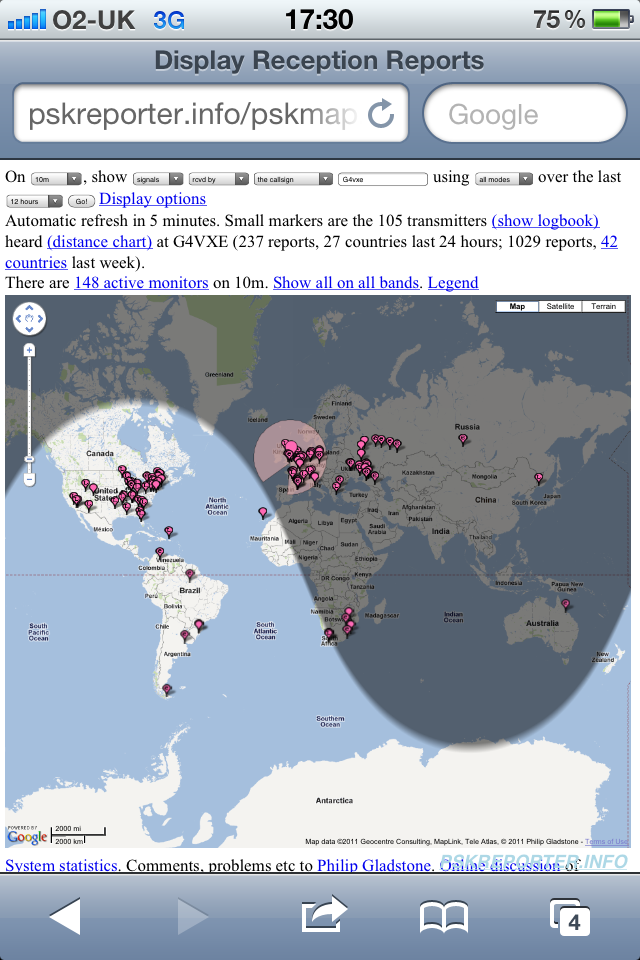
The image above shows a ‘typical to good’ day on 28MHz JT65. Generally the first signals are heard around 0700z and the last ones around 1730z – plus or minus.
In the evenings I have been trying out 3.5MHz JT65 and have been surprised by the results. Some of the notable contacts have been UN9LEI and KP4ED with lots of contacts in between! Hoping to work VK6 at some point, as that would be a nice one in the evening.
Great mode! I’m so glad I tried it. Can’t wait to get the K1JT modes working with my FT847 for VHF/UHF!

Tis the season….for 70MHz FM!
Not much from me during the last few weeks. A busy time at work, with three new websites going live in the space of two weeks – so most brain cycles going towards that during the lunchtimes that I normally use for a bit of blogging!
Over the last couple of weeks, I’ve been turning the 70MHz FM rig on a bit more often. I realise that 70MHz FM is a winter band/mode for me. During the summer, the antenna is usually connected up to the CW/SSB rig in case of a bit of Sporadic E. With the chances of that significantly lower now, I’ve been enjoying some more local contacts.
Good to work Geoff, G3NPI near Buckingham last weekend and to hear how active the band is on FM now. Clearly the combination of PMR kit and imports from the Chinese market has been a popular one. Keen to work a few people using the new Wouxun Dual Band handhelds when it’s warm enough to go out portable again.
This morning I had a nice QSO with Ted G3XUX/P near Winchester. I worked Ted through the MB7FM parrot, but we were also able to exchange signals directly, which is nice over the 40-45 mile or so path between us. Listening to MB7FM whilst I was doing a few jobs showed several other stations active, so if you have 70MHz FM, it’s well worth switching the gear on and making some calls as you can.

JT65A, propagation and data visualisation
When I met Dave WW2R/G4FRE back in the spring he mentioned that after you’ve played with JT65A on HF you really don’t want to do HF any other way. Having had a good weekend playing with the mode, I’m inclined to agree! Of course there are provisos – this is a mode to make bare bones contacts with minimal power or poor propagation. It’s certainly not a mode for chatting!
Having said that, I have loved having the receiver running all day hooked up to the wonderful JT65A-HF program from W6CQZ with the data being uploaded to both the Reverse Beacon Network and the PSK Reporter network
The other thing about this is that when you call CQ or work someone, you can readily see who else heard you, which is absolutely fascinating.
Over the weekend I think my signals have been heard in all continents on 28MHz running anywhere between 10 and about 50 watts (depending on conditions) to the vertical. I have had some fascinating contacts and found some interesting openings.
Mike M0PRL is interested in visualising propagation data to look for openings and he kindly put together a fascinating time lapse sequence of the stations that my JT65A receiver hears over a period of 24 hours (though I confess it’s usually switched off overnight, as you will see). Congratulations Mike, this is a really great visualisation!

My first QSOs on JT65a
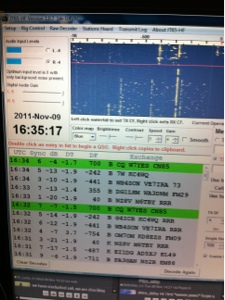
I’ve mentioned before that I wanted to try out JT65A on HF but had hit some problems with the laptop’s sound card and the software. Having got things going on WSPR yesterday; my 1W 20m signal got as far as VE6PDQ/1 in Edmonton. Having had an insight as to what I thought the sound card issue was with the JT65A-HF software was, this afternoon I connected it all up and started the software.
It worked!
First of all I tried it out on 20m and got a decode, having sorted out the levels to the sound card. It seemed that the JT65A software needed a slightly higher input level than WSPR. Having done that I was delighted to work DL1AAH on 20m running about 1W.
I wondered what 10m would be like and sure enough it was busy! I answered a few CQ calls, but a particularly nice QSO was with W7YES – I was running about 10W to the vertical.
By about 1830z the band seemed to have faded but I left the software running whilst we had supper. To my surprise, when I popped up later, the band had opened again and the software had logged some further US stations including WY7LL.
I’m pleased to have this working and suspect I shall have a lot of fun with it.

What’s that signal on 433.075? "Beep Beep – 500 feet!"
I was passing through the shack quickly on Sunday and popped the FT7900 FM rig on to see what was going on in both the 145 and 433MHz bands. To my surprise, the receiver stopped on 433.075 – the output of the local Swindon repeater, GB3TD. However, what I heard was not GB3TD.
At strengths between S2 and about S4, fading up and down, was an FM transmission, consisting of a series of tones followed by an occasional announcement of “500 feet”. I’d never heard this before and wasn’t entirely sure what it might be. To start with, I thought perhaps it was a data from a balloon flight, but as the heights were increasing and decreasing quite rapidly, I suspected that was unlikely.
However, GB3TD sprang into life and Andy, G0BEQ popped up, testing his new Baofeng UV-3R (which sounded great!). I told Andy what I was hearing – and interestingly, about 15 miles away from me, he wasn’t hearing the interference. He was able to tell me what it was though; equipment for model aircraft that reports the altitude of the model plane back to a receiver on the ground.
Oddly, after Andy and I had been speaking for a few minutes, I noticed that the transmission stopped. A coincidence perhaps, or perhaps the signal from the repeater being rather stronger than the few milliwatts from the plane had caused the altimeter to stop working whilst the repeater was active.
Not sure about the legality of these devices – although my suspicion is that they come under the heading of the low power devices and can thus be operated legally. However, if you are a model aircraft enthusiast reading this and you have one of these devices, may I ask you respectfully (genuinely) to try and use a channel that amateurs do not use. If you are in doubt – then your local amateur radio club can probably advise you which frequencies are likely to be in use local to you.
It’s surprising how far a milliwatt or two of FM on 433MHz will travel!

Making VHF go further: Morse can help!
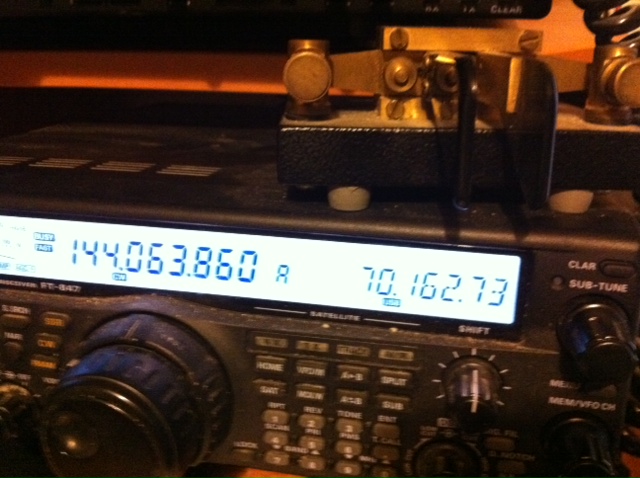
The first weekend in November has always been one of my favourite VHF contests. There aren’t many purely CW contests on VHF these days, but the Marconi Memorial 144MHz is probably the best known. The nice thing is that all over Europe many of the top VHF contest stations and groups take part in the 24 hour event. Quite often at this time of year there is some tropo around and there’s always some meteor reflections too – so there are tantalising hints of contest stations some 1500 or 2000 km away!
These days I don’t treat the Marconi Memorial as a contest but as an exercise in DXing and to see what I can hear and work on 144MHz. This year despite indifferent conditions I was pleased to work TM0W in JN36 at just under 800km – it’s a path that works quite well from here as I see I have worked that station before. DF0MU in JO32 was a nice one too as well as a number of other closer French and Belgian stations. There were hints of more distant Italian and Czech stations, but nothing solid copied.
Although I wasn’t looking to work UK stations this weekend, I did get the impression that there were a few more people from the UK taking part which is good to hear














