Author Archive
 The Baofeng UV-5R has arrived
 April 18th, 2012 |
  Author: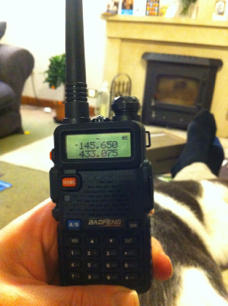
Haven’t had a QSO with it yet, but the UV-5R has arrived. Nicely built and looks promising.
Programming the memories manually is, um, interesting. I can program most things but I’ve ordered a programming cable.
The VHF side seems to work better than the UV-3R. I’ve successfully blipped up GB3WH on 2m and GB3TD, GB3DI, GB3UK on 70cms.
Charger looks ok, though I preferred the USB capability on the UV-3R plus. No sign of an earpiece/mike as supplied with the UV-3R which I found useful. I will try the UV-3R earpiece/mike – I’m guessing that will work fine.
More soon as I have time to play.

More DSTAR in the henhouse – or another WinDV upgrade
I haven’t made that many DSTAR QSOs over the winter, but over the last few weeks, as I have been spending a bit more time outside in the garden on a Sunday morning, I have been getting back into the habit of connecting the DVAP access point up to a reflector and having some gentle QSOs as I potter about the back garden, perhaps cleaning out the henhouse or weeding!
This morning, for example, I made a nice QSO with John EA3WR/M in Barcelona and Marc W6IWW/M (returning home after a late night poker game in LA!) as I was clearing out one of our cold frames.
Some months ago, I mentioned that I had been using the Win-DV software from Dutch Star which is still the first choice software that I use with the DVAP. There have been some updates over recent months and the latest version is now 1.5.2 which contains D-RATS support (which I haven’t tried yet) as well as various other updates. It is also nice to have the flexibility of being able to link and unlink reflectors and repeaters via RF which saves coming into the house to the computer and linking from there.

The Palstar KH-6 50MHz handheld
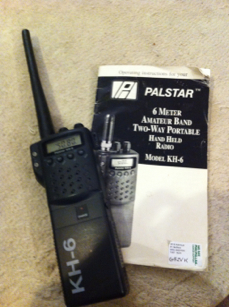
I was browsing around the Ham Radio section of e-Bay the other evening when I came across a Palstar KH-6 going for a modest price. I knew a little about them, having heard that some SOTA participants had used them for activations on 50MHz.
The auction was just ending so I popped in a last minute bid to see what would happen. To my surprise, I won!
The rig arrived yesterday. It seems to work ok and I have done the obligatory across the shack test. Transmitted audio sounded good on the FT847. I put the rig on the external collinear and perhaps not surprisingly the receiver overloaded. However, I could hear the GB3RAL beacon on 50.050.
The challenge, as I have found before is how well such a short aerial will do. However, I’m hoping for some local contacts and perhaps some more distant ones from the top of White Horse Hill or similar summits.

Baofeng UV-5R on its way
When I was browsing through eBay last night, I was interested to note that a new Baofeng rig, the UV-5R was available. It runs higher power than the UV-3R, has a keypad and looks an interesting evolution. Since the rig was only £38, it didn’t take much thought to order one. I shall look forward to it arriving.
In the meantime, Hans, PD0AC has already received one and is writing up his findings which look interesting.

An object lesson in DXing
This evening, as I was driving home, I was reminded of an object lesson in DXing; sometimes it is better to call the weak ones.
As has become customary, I switched on the Anytone AT5555 10m rig and tuned around a little as I headed back from Didcot towards home. The band was going out, but as usual there were some South Americans coming through. LU7DP was loud, working mostly Spanish and Italian stations. A little further down I found CE2WZ also at good strength, working mostly southern Europeans, including my old pal Cedric CT3FT who I couldn’t hear today. I tried calling CE2WZ but he kept CQing. My little signal wasn’t quite enough to get to Chile tonight.
A few kHz further down, I found PU2RJF calling CQ. Betto wasn’t so strong but was coming through ok. He didn’t seem to be getting many callers, so very much tongue-in-cheek I called. To my surprise, he heard me straight away and we had a simple but enjoyable contact.
Fun to remind myself, that although when running low power, it makes sense to call the loud stations, sometimes you should call the weak ones too as they may be running simple stations and will hear you just as well as you hear them.
Obrigado Betto!

A hint of changing conditions and a trip to White Horse Hill
As I was driving home last night, I was looking around on 28MHz SSB as I usually do. In addition to the ‘usual’ South Americans that I’ve been hearing for a few weeks there were a couple of fairly weak French stations. This interested me as I suspected I was hearing them via Es propagation. If that’s true, then with any luck we will start to hear more Es on 28MHz and then hear it rising in frequency towards 50MHz and beyond.
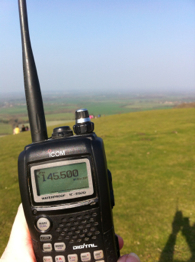
This afternoon, in celebration of the gorgeous weather, Julie and I decided to go up White Horse Hill, which is about 10 miles to the south of where we live. Although it was a little misty up there, we had a great time walking, listening to the skylarks, watching the buzzards and picking out some of the local villages. I took my Icom E-92 handheld and had a tune around on 145 and 433MHz. I was particularly pleased to have a nice 145MHz simplex contact with Mike 2E0YYY/P who was on the Long Mynd in Shropshire. I suppose the distance between us was around 80-90 miles.

Another rig for (almost) £30 – the Baofeng UV-3R plus
A few days ago, I was chatting to a friend on the repeater about the Baofeng UV-3R and what a useful radio it was. He was interested in getting one, but explained he didn’t use eBay. Rather than have him pay £50 in the UK, I said I would order him one.
It arrived today. I had ordered a UV-3R Plus, rather than my Mark 1 model. What are the differences?
The Plus has dual band display. In practice, I don’t think this is a big deal.
The Plus came with a dual band antenna rather than two mono band antennas
The Plus comes with a drop in charger. The charger tray can be powered from the USB style charger that comes with the rig, although I plugged the lead to an iPhone charger.
Although it is entirely adequate, I feel the build quality on the Plus is not quite as good as the Mark 1. What do I expect for £32.90?
Although I have not had any QSOs – it is my friend’s rig, after all, performance of the rig seems as good as the Mark 1. I was able to blip up GB3TD and GB3UK from inside the house.
The Plus came with two earpiece/ microphones – the standard one and an added bonus.
I hope my friend will be pleased with it!














