Author Archive
 First 70 MHz Es opening this year
 May 2nd, 2012 |
  Author:
 I was working from home this afternoon and unfortunately, whilst I was on a call, there was a 70MHz opening to Finland! I managed to catch ES3RF on 50MHz after I finished the call.
I kept an eye on 70MHz though and a bit later, I heard my neighbour G4BRK calling something. Switched the 70MHz aerial onto the FT847 and I could hear some weak SSB on 70.200. It got louder and proved to be Ivan, S51DI! A few stations worked him in front of me, but in typical ES style, the signals built up to S9 and I was able to complete the QSO.
I’ve worked Ivan plenty of times on 70MHz of course, but it’s always great to get the first Es QSO on the band for the year in the log.
Down in the beacon band on 70.059 I heard the HG1BVC beacon for the first time.

Caught my first 50MHz opening of the year
It’s always good when the Es season starts. I associate Es contacts with the sun, being away in the Mediterranean – things I like!
Just after lunch I saw a tweet reporting some 70MHz activity from the Netherlands to Finland. I popped up and checked, finding 50MHz fairly quiet. However, an interesting beacon coming in was OY6BEC – quite short skip. Tried a few CQs on CW but no luck. Up on SSB SP3OCC was coming in, but couldn’t work him. I scraped a QSO with SP5SS before finding some CW activity.
Best DX over the next hour or so was into Estonia, but I had several contacts with SM, OZ, LY, OE, HA, E7 and IS0.
A good start to the season!

I never expected I would shake the hand of an astronaut: Meeting Paolo Nespoli
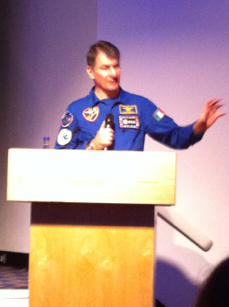
On Friday afternoon, I was scanning my Twitter feeds and saw a tweet from @spacekate. Kate said that on Saturday afternoon, ESA astronaut Paolo Nespoli would be in London, giving a talk at the Royal Aeronautical Society about his flights on the ISS. Kate also said that there were tickets still available and that better still, they were free!
Somewhat unusually, the calendar was co-operative and I was able to book tickets for myself and the boys (Julie was going to a series of talks in Oxford).
When we arrived, we were told that Paolo was running late. Somehow you expect an astronaut to arrive in a fast car. In fact poor Paolo had come by coach, which had been delayed by a cycle race! Whilst Paolo was waiting for his laptop and talk to catch up with him, he was happy to take questions, so I was really excited to be able to ask him about his visual memories of the trip.
The talk was fascinating. Even a 15 year old pronounced it ‘cool’. High praise indeed. But it was. Amazing to learn about some of the effects of zero gravity on the human body from someone who has actually experienced it – and what being launched in a Soyuz feels like (gentler than the shuttle, although the Soyuz ‘rides harder’ further into the flight).
Predictably, Paolo’s photos were stunning, no surprise to those of us who followed his tweets from space and his Flickr stream. A slide which caused much laughter was a shot of Italy from space – being noticeably brighter than its’ neighbours. Especially when Paolo explained that Italy imports a large quantity of its’ electricity.
One of Paolo’s slides featured a shot of one of the two amateur stations on the ISS. He explained that he and Cady Coleman had 77 contacts with schools during their flight – a record that he was proud of. To an audience which included school children and teachers, he encouraged schools who were interested in having a radio contact with the ISS to get in touch with the project.
All too soon, the presentation was over, but as Paolo was dashing out the door, I had the opportunity to thank him for his amateur activity from the Space Station and have a quick chat.
I never expected that I would shake the hand of an astronaut!

Programming the UV-5R – and a word on the antenna
I mentioned last week that manual programming of the memories of the UV-5R was a step too far, at least for me! At the time I ordered a programming cable from Hong Kong. It’s yet to arrive, but today, I had an idea.
I currently have a programming cable for a Midland CT-790 here. Now that looks to be a clone of a Wouxun radio and I knew that the Baofeng UV-5R was supposed to use the same programming cable as a Wouxun. Would it work, I wondered?
I grabbed the Baofeng UV-5R software from the link on http://www.uv-5r.com and installed it. There was an initial problem, because the programming lead installed itself as COM11 and the UV-5R programming software only went up to COM8. I managed to convince the cable to be COM1 (that takes me back to packet days, playing with COM1….) and then fired up the software.
What I thought were error messages were in fact not! They are clearly interesting translations. After a couple of false starts, I managed to get the computer to read the UV-5R and download the memories into the programming software. From there, it was relatively straighforward to modify the memories and upload them back into the radio without incident. The UV-5R software is pretty basic, but it’s functional. Don’t expect handholding, but it beats trying to program the radio manually.
Since I had the Midland CT-790 (Wouxun KG-UV1P) here, I was curious about the antennas. I swapped the Midland’s antenna onto the Baofeng. Where I had struggled to blip up GB3UK on 430MHz with the Baofeng antenna, it worked better with the Midland. Same story on GB3WH on 145MHz. So it may be that the UV-5R antenna is worth replacing – although it’s certainly adequate. The Midland antenna is slightly longer and more flexible. The Midland antenna, if fitted on the UV-5R has a slight gap at the base which might not be ideal for longer term use.
All good fun and interesting – remembering this was a radio that cost less than £40. As K0NR comments in his blog on the UV-5R, a rig for the price of a tank of petrol/gas. Way less, for us…..!!

How many handhelds is too many?
.JPG)
Julian, G4ILO once confessed to being fond of handheld radios. I’m the same! There’s something magic about having a bit of handheld radio kit which can make interesting radio contacts, in some cases around the globe.
When the postman delivered another handheld last week, Julie said, completely in fun, ‘you’ve got quite a few of those now’. And she’s right. Let’s see:
– Icom E92 144/432MHz FM/D-STAR
– Yaesu FT-817 1.8-432MHz All Modes (I sort of don’t *really* class this as a handheld, but technically….)
– Baofeng UV-3R 144/432MHz FM micro transceiver
– Yaesu VX-1 144/432MHz FM micro transceiver (battery not very well!)
– Baofeng UV-5R 144/432MHz FM
– Palstar KH-6 50MHz FM
All except the E-92 and FT-817 have been acquired at quite modest prices over the years, so there’s not an expense thing really.
The trouble is, that strictly speaking, there are a couple more I wouldn’t mind. Something like a Yaesu VX-8GR with APRS/GPS capability built in. That would be fun. And then there’s the Alinco DJ-G7 which does 144/432 and 1296MHz. I’d really like to try 1296MHz! By the way, check out Rob, MW0DNK’s review of the DJ-G7 on his very interesting new blog.
Maybe some consolidation would be good – but they all do different things.Honest!

Lyrids meteor shower
This weekend is the peak of the Lyrids meteor shower. I had a quick listen on both 50 and 144MHz this morning before breakfast. On 50MHz, I heard my radio neighbour Neil, G4BRK calling CQ JT6M on 50.230. Listened for a few moments and was interested to hear SM4KYN with a few bursts. Not bad as I was just using the vertical antenna. On 144MHz, I looked on 144.370 FSK441 and heard a really excellent burst from EB3DYS. I did call EB3DYS for a couple of periods but heard nothing more after that.

D-STAR: New DCS reflectors and DV-RPTR boards
When I was playing around with D-STAR last weekend, I thought the REF001C and REF005A reflectors seemed a bit quiet. I wondered whether people had got fed up and moved on. I didn’t worry too much as I had some nice QSOs.
During the week, I noticed a tweet from the Bromley Repeater Group saying that they had connected up MB6SS, one of their nodes so that they could access the new DCS reflectors. I’d seen a comment about DCS reflectors when I had installed the new version of Win-DV, but hadn’t had a chance to investigate.
A quick Google provided some useful information and I found the following from Kurt DJ0ABR, ‘The main difference (and the advantage) of DCS compared to old reflectors is, that is does not more use the Header-Voice separation. The separate transmission of headers and voice packets makes sense on RF due to the limited bandwidth. But it causes many routing problems in old reflectors. DCS uses a new format and transmits (over the internet) the routing information with every single voice packet. This makes routing much more reliable. Protocol wise there is no header packet, instead each AMBE packet includes a header which adds a lot of resilience and allows you to pick up a QSO mid over. Operation wise: The main differences are that DCS reflectors use channels A to Z and they have names, DCS001 A is world wide, and is permanently linked to the A channels on all other DCS reflectors. A nice touch. The new client code is implemented already in Jonathans gateways, in the Control Center and in a couple of Icom clients. DCS was invented and developed in February by DG1HT, Torsten. I am helping him in debugging and testing. DCS001 runs at a gigabit intenet node in a high school and is currently designed for up to 700 simultaneous QSOs.’
Very interesting. So I did a little research and found that DCS005B was the main UK reflector, though I can see that they are some regional reflectors, for example DCS005W for Wales and the West and DCS005L for the London area. In practice, the new reflectors work well and seem to provide better audio quality than the old-style ‘REF’ reflectors. It’s also nice that you can pick up a QSO half way through an over rather than having to wait for the start of the next transmission.
Activity on the new reflectors can be seen at http://xreflector.net/neu3/ Also, have a look at the DV-RPTR boards which should provide a cheap route for more people to get involved with D-STAR with their existing equipment. This all seems like a positive step in the evolution of D-STAR and pleasing that it is progressing in a more open direction.














