Author Archive
 Not a QRP posting – and a new 144MHz antenna on the way
 September 4th, 2012 |
  Author:
 At the weekend it was the Region 1 144MHz contest and as always I tuned around to see what I could hear. I worked a few Gs as well as ON/PA/F stations all around 300-400km distant.
On Sunday morning, I tuned around quickly and heard a weak French station. It turned out to be F5OAU/P who, I could see from the last time I worked him was in JN27. I turned the beam down that way and called him running my usual 50W. No reply – which was fair enough – he was quite weak.
I decided to fire up the 4CX350A amplifier, now correctly wired up (see earlier post!) and see if I could raise him. I called him on SSB and though he could hear me, he was obviously struggling. Switched to CW and suddenly he could copy me quite easily. Excellent – a distance of just under 700km, We exchanged details and I was just sending him 73s on the key when….
…it all went quiet! Had a relay stuck? No.
Bypassed the amp and connected the antenna straight into the back of the rig – no sign of any stations or GB3VHF. Ah. Tried another rig. Same.
Oh dear.
I’d thought that my trusty 5el yagi on the roof was rated at 500W, but apparently not! I was running about 300W, which would have probably been ok on SSB, but I suspect on CW, was a little too much. I’m guessing there’s a capacitor in the gamma match, or rather, there was a capacitor in the gamma match.
Unfortunately, getting the antenna off the mast isn’t that straightforward, but Justin G4TSH has kindly volunteered to come and help (I am not a fan of ladders, sadly).
The exciting thing, however, is that a new antenna is on the way; a 6el LFA yagi from the team at Innovantennas – I have been talking to Justin G0KSC for a while and it nice to be able to give one of his designs a try out – I’m really looking forward to it. I’m particularly interested that Justin’s designs are claimed to be low noise and I have been plagued by some quite low-level but troublesome noise, a particular pain with weak signals and low level meteor bursts – so we’ll see how it goes.

Scanning and memories for your RTLSDR using K5DEV’s SDR#
If like me, you got one of the £13 SDR receivers from eBay and got it working you might be looking to get some more use out of it. How about if you could save frequencies to memory and scan them? Well, thanks to a post on Dave G4FRE’s blog I learned about K5DEV’s version of the SDR# software which you can see in action in this video from K5DEV’s blog
This looks really excellent and you can download the software from K5DEV’s website

When something doesn’t work, it’s probably not connected properly….
Over the years, operating in different contest, expedition and reasonably complex stations, I can’t count the number of things that haven’t worked quite as they should. And over the years, most of the time, the same problems have been rectified by doing something as complex as plugging it in properly, or switching something on! It’s just so true!
This morning, I had a slight variation on this theme. I came into the shack and I thought it would be nice to try some 144MHz FSK441 Meteor Scatter, as I’ve not done any serious MS for ages. A few months ago, I recommissioned one of the 144MHz amplifiers, capable of 300W or so and I thought I’d give it a blast this morning.
I set up the computer with WSJT and adjusted the drive from the FT847 – warmed the amplifier up and tried a test. Click, click, click from the amplifier with no output. Hmmm. I made a new patch lead between the rig and the amp a few weeks ago – I think it’s ok – but I checked it – fine. Tried the FT817 driving the amp – same issue. I was starting to think that perhaps it was something to do with the 5el yagi, so I went to the back of the amplifier to disconnect the beam and try the vertical antenna.
And then it struck me. When I reconnected the new patch lead – I’d connected the antenna to the input of the amplifier and the patch lead from the rig to the output! With the amp not switched on I hadn’t noticed! Swapped them over and I could see healthy amounts of output again.
Of course, by the time all that had been done – it was time to get on with the day, so no MS QSOs for me this morning.
A silly mistake, but at least they are always the easy ones to fix.

Summer’s over….well maybe
Or at least that’s how it always feels to me with the last bank holiday of the summer done and no more until Christmas!
As I blogged last week, the conditions are changing and there’s been noticeably less Es this weekend. I did work EA7DUD on 50MHz in a brief opening yesterday and I noticed some Es around 27MHz from Italy and Scandinavia.
Having had a bad cold/cough most of last week (I was forced to abandon a QSO last Friday owing to a failing voice), I’ve been on 14MHz JT65A most of the weekend, often remote controlling the PC from the sofa with Pippi the cat on my lap. Some nice QSOs, most notably with LU2XPK in Tierra Del Fuego and also a couple of UA0 stations in furthest Siberia as well as many enjoyable QSOs closer to hand.

Remote control JT65 QSOs with my iPad and iPhone and the LogmeIn client
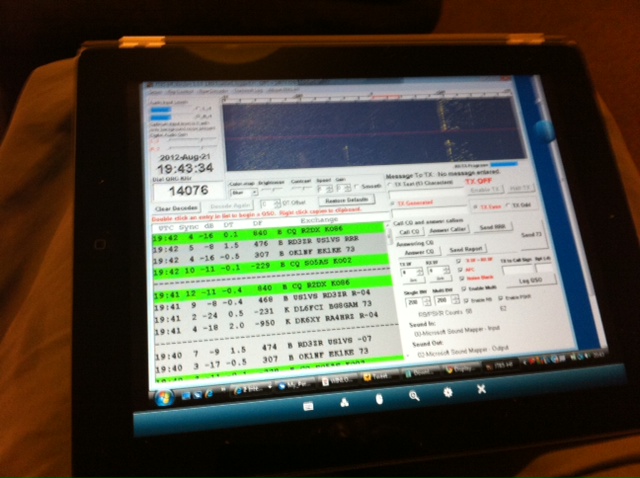
Recovering from a heavy cold and cough yesterday and because there was apparently nothing doing on 50MHz, I thought it was about time I got the HF JT65A gear going again, which I did and made some
enjoyable QSOs on 14MHz.
I’d wondered from time to time about making remote control QSOs. I use the Logmein client to control my PC if I’m out and about and just recently, I’d noticed that their iPad/iPhone client was free for the basic service. Since for datamodes, I didn’t need anything more than screen control – no need to ‘pipe’ audio, this should work just fine.
So last night, I sat on the sofa downstairs, with my iPad and tried to control the PC running JT65-HF. It seemed to work just fine. It felt odd calling someone without being in front of the radio and being able to tweak the power/alc settings and of course to be able to hear signals! However, I made the leap of faith and R2DX was my first ever remote control QSO. I followed on with AB1J and a German station.
I also have the Logmein client on my iPhone, so this lunchtime, I tried the same type of experiments across the Internet from the office. Although broadly successful, there was too much latency, and though I could see signals being decoded and press the appropriate buttons – the timing didn’t always work out correctly. Apologies to Harald DL8ZBA who must have wondered what was happening when I calleed him!
Nevertheless, this looks quite promising, particularly around the house and perhaps further afield when there is a good network connection.

Wouxun KG-UV920R gets out into the wild
After speaking with Ian G4WUH on his new Wouxun mobile 144/433MHz dual bander at the weekend, some more reports are starting to come in.
A very useful resource is VA3ISP’s blog which details some of the findings so far.
A friend in Hungary has also received a rig and I am looking forward to hearing how it works out on the air.
Reading through some posts today, I realised that the reason for the long period of time between my original blog post about this rig and the eventual release date was that some redesign work had to be done. Wouxun have made a good impression with their handhelds, let’s keep our fingers crossed this continues with the mobile.

An interesting weekend’s VHF
Having written last week about the shifting conditions on VHF, it was fun to notice and enjoy both sides of the coin this weekend; summer conditions in the shape of some Es and autumn conditions in the shape of some tropo.
Saturday started off with an interesting QSO with Ian G4WUH on the GB3UK repeater – interesting because Ian was using one of the new Wouxun 144/433MHz dual band mobiles. Very nice it sounded too and Ian spoke highly of the sensitivity of the receiver.
Just as I was about to head back out to the garden I noticed some signals on 50MHz and discovered that there was some Es around up in the direction of Scandinavia. The best distances were SM2SUM (KP03) and YL2LW (KO26) but there were a couple of new squares closer to home in Norway. Signals got very loud at one stage and I thought I should check 70MHz. I was glad I did, as the first thing I heard was ES1AEW/2 on 70.200. Didn’t work him, but had a nice QSO with ES1CW on the key. Not so far away, but just as interesting was a QSO on 50MHz with the Grantham club, operating GB0BL from the Bressay light near Lerwick, Shetland – I was delighted as the GB3LER beacon was coming in and very often there are no stations to be heard.
Sunday morning saw 145MHz FM lively with lots of French stations. In particular, the repeater on 145.725 was strong, way over the top of GB3SN in Hampshire. A bit of research showed that it was the FZ2VHC repeater near Le Havre. I listened to a QSO finish and then cautiously dropped my call in. To my delight, Jean F6CRB replied, in English and was delighted to have a QSO with a UK station – we chatted for a few minutes. Some other repeaters and simplex stations were heard although the good conditions were over, probably by around 1030 local time as the day warmed up.
It was enjoyable to once again, get the 145/433 MHz scanning going again and see what could be worked.














