Author Archive
 A cheap way onto 29MHz AM/FM using an Intek M60
 March 9th, 2013 |
  Author:
 After my posting about Sporadic E a couple of days ago, I had an interesting email from Steve G1KQH who pointed me in the direction of a simple way of getting onto 29MHz FM (and AM) using one of the Intek CB radios, the M60.
You do need to pop the cover off and remove link LK2 – this allows the rig to cover 25.610 to 30.100 in ‘PO’ mode (the rig is configured with different settings for different adminstrations’ CB allocations, but PO allows the widest coverage).
Here’s a video from Simon Parker on the modification required
Here Simon shows cycling through the various modes
I’ve not tried this, but it looks a temptingly cheap way to get on 28/29MHz AM/FM for the Es season if you don’t already have a rig.
Thanks Steve for the tipoff and thanks Simon for the video ‘how to’.
Hints of Sporadic E to come
With a couple of brighter days earlier this week and milder temperatures, perhaps it is starting to feel like Spring. Did I mention how much I hate the dark, cold days of Winter?!
Driving home on Monday night from the gym, I switched on the FT8900 and it came to rest on 29.600FM. There, were two huge signals; two Swedish stations talking to each other in a local QSO. Signals were clearly very solid. I wasn’t surprised to discover that there had been a few 50MHz ES contacts on Monday evening.
This lunchtime, I was listening around on 28MHz from the mobile and was pleased to hear the band open into Russia and I had a nice contact into the Moscow area.
So it feels like the first few Es openings are starting to take place on HF at least.
I am contemplating running 50MHz WSPR this season when I am not able to be in the shack and see how far that goes.
14Mhz WSPR over the weekend
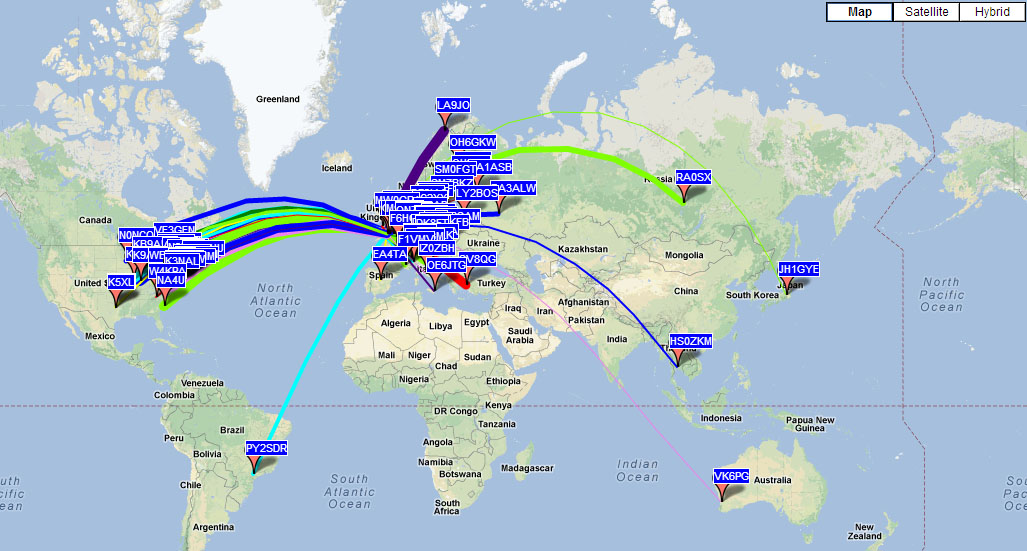
For a change, I ran 14MHz WSPR, running about 1W at the antenna over the weekend. Quite good results – nice to get a report from VK6PG
DVAP tool for the Raspberry Pi
A few weeks ago, I heard that there was to be a version of the DVAP Tool software that would run on the Raspberry Pi. That was after I had discovered the image including the G4KLX software.
However, it is always great to have a choice! I found a post from Robin AA4RC from the DVAPDongle group today containing details of how to install DVAP tool onto the Raspbian Wheezy operating system.
Well worth a go!
> >
> > Follow the steps below to install/run:
> >
> > 1) make sure you are running Raspian Wheezy 2013-02-09 and are connected to
the internet with your Pi.
> >
> > 2) open an LXTerminal window and run: “sudo apt-get install qt4-dev-tools”.
Answer “Y” when prompted.
> >
> > 3) in terminal window run: “curl -O
http://opendstar.org/tools/DVAPTool-1.04-rpi.tgz”
> >
> > 4) in terminal window run “sudo tar xzPf DVAPTool-1.04-rpi.tgz”
> >
> > 5) in terminal window run DVAPTool with “./DVAPTool” from your home
directory.
> >
> > Note that this is a full GUI version. I’m working on a text only daemon.
> >
> > There are no current plans to compile DVAPTool for any distribution other
than Raspian. It may or may not work on others.
> >
> > 73,
> > Robin
> > AA4RC
> >
>
New version of ircDDB Gateway and DVAP Node installed on Raspberry Pi
After the Raspberry Pi and DVAP experiments a couple of weeks ago, I decided to dedicate a Raspberry Pi to running the gateway. I ordered a new Pi ( with different coloured case) and hard wired it to the Internet router. Connected the DVAP by USB and it all seemed to work well.
Speaking to Martin 2E1THX this morning, he mentioned that the latest release of the software included the CCS capability – which allows you to dial up another DSTAR user by entering a code on your DTMF keypad.
Upgrading the software went very smoothly, although when the machine first came up, the software locked up! I rebooted and all was well.
To accept incoming CCS requests, I needed to open up some ports on my router and forward them to the Raspberry Pi. That worked fine! I opened up UDP ports 30061 to 30065.
I’ve enjoyed having the dedicated Raspberry Pi for DSTAR gateway activity and have had some excellent QSOs as a result.
New stations heard on 472khz WSPR
I’m finding it interesting to note how variable conditions can be on 472khz WSPR. Some days are distinctly better than others. It will be fascinating at some stage to try and correlate the various indices with improved reception/conditions.
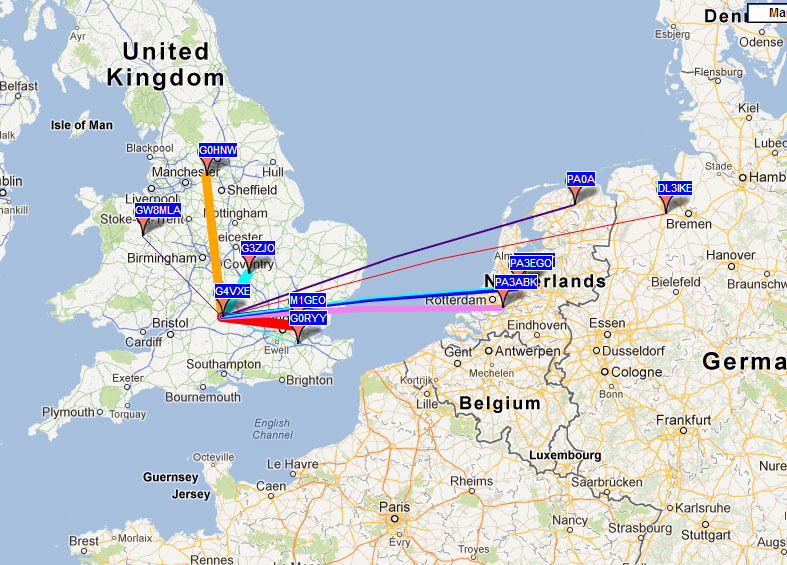
Last evening was a good one and I copied a number of new stations; PA3FNY, G0HNW, DL3IKE and PA3EGO. New to me, that is. Nice too, to hear Paul G0HNW. I’m sure it’s a coincidence, but most of the stations I have heard up to now have been on an East-West axis, so good to hear someone from the north.
Remember all this is on unmodified, untuned kit, so I hope it serves as an encouragement to anyone else who might be interested to try and hear something!
Visiting the Harwell Rally
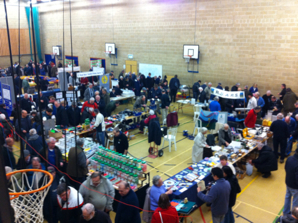
Time was when I used to attend many of the radio rallies. These days, I generally attend one a year – and it’s usually the Harwell Rally – located about 20 minutes drive from home.
Today was the day! And enjoyable it was. No major purchases – just a bit of aerial wire and some back issues of magazines. I did enjoy chatting with Francis, G7CND of GEO – Group for Earth Observation I could easily be tempted to have a go at some of the imaging that the group are doing!
I had a happy hour or two on the Practical Wireless / RadioUser stand, with Rob G3XFD and Tex, G1TEX – chatting to visitors and selling the odd back issue magazine and archive CD.
It was good to see many friends including Graham G4FUJ (who first taught me morse a very long time ago!), Pete 2E0SQL, Rob M0VFC, Paul M3JFM, Mike M0RBD as well of course the Harwell team who put the rally on – great to see Ann G8NVI, Mike G8CUL, Malcolm G8NRP, Bob G0ADH, Mike G0MJW, John G3VPW, Des G3NNG – lots of other smiling faces too.
A great time inspite of some inclement weather!