Author Archive
 FT1000MP and data modes: low level audio
 May 25th, 2013 |
  Author:
 When I first got the G4ZLP interface, I bought leads to connect both the FT847 and the FT1000MP to the computer. I hadn’t really got the FT1000MP connected up, and had used the FT847 for pretty much all my digimodes activity on both HF and VHF.
Given that the receiver on the FT1000MP is a bit nicer, particularly on LF, this seemed a bit of a waste, and particularly now the Es season is upon us, the FT847 is pretty much continuously busy on 50 and 70MHz. That meant no JT9 on HF.
So yesterday, I hooked up the FT1000MP. No problem at all with the interface. However, I did notice that I needed to crank the input volume control on the computer much further up. Not a problem on WSJT-X but actually on JT65-HF there was barely enough audio output for proper decoding.
Reading around the net, it seems that a number of people have found the Audio Out jack to be quite low level on the MP. Obviously, there are options – the speaker socket would offer more audio – but at the expense of losing the ability to listen. Or even a small audio amp to increase the audio level a bit.
Either way, it is working now and it’s nice to be able to play JT9 on HF and keep an eye on 50/70MHz simultaneously.
This is how to do bicycle mobile – thanks to Simon G4SGI
After I posted my picture of bicycle portable yesterday, my pal from Cheltenham, Simon, G4SGI asked if I’d seen his bicycle mobile video. I had seen it but I watched it again last night.
It’s well filmed and I think inspiring! I’m sure some of you will enjoy it too. Quite apart from the well thought out mechanics of Simon’s bicycle mobile station – I am very impressed about how he is able to speak clearly whilst travelling at a good speed!
Well done, Simon and thank you for the inspiration
First bicycle portable trip of the year
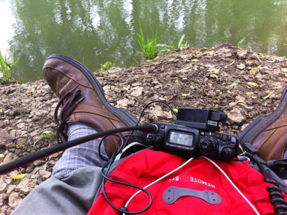
For one reason or another, I’m a bit late starting my bicycle portable trips this year. For one thing, the weather hasn’t been great. I went to get my bike out a couple of days ago and found that it had a (not so slow) puncture. Amazon came to the rescue with a new inner tube!
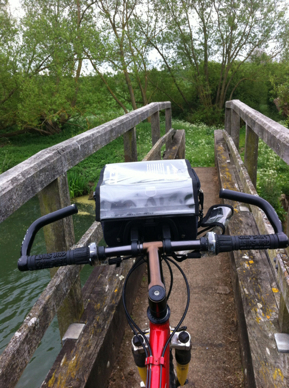
So it was today that I set out with a rucksack on my back containing the FT817 and a 50MHz whip (thanks again Ian, MW0IAN). I had a great ride along the banks of the Thames, around 13 miles in total. I stopped a couple of times to get the rig out and have a listen. Typically, the band was flat – just the GB3RAL and GB3BAA beacons audible – which I guess wasn’t bad going with a whip, down at river level.
And even if there was no propagation, I love being by the river….
Raspberry Pi camera, OS updates and DSTAR
Last week I noticed that the Raspberry Pi camera was available. At the princely sum of £20 including VAT, I ordered one from CPC It arrived very quickly but I didn’t have time to do anything with it until yesterday.
The camera is a PCB on the end of a ribbon cable – all very simple. I found the following instructions on the CPC site for installing the camera. OS and firmware updates are required to the Pi in order to use the camera. I followed the instructions through and didn’t encounter any problems, although somehow I managed to download the wrong script for the rpi-update (in the end, I used the procedure here https://github.com/Hexxeh/rpi-update)
I did have to take the Pi out of its’ case in order to connect the camera – and I have seen some correspondence which suggests that a case which accomodates the camera might not be far away.
Getting the camera going was fine, although this is where the CPC instructions fell down. They mention software on the Pi called raspicam. I tried running it, only to find that the software wasn’t there. Initial reaction was that I’d messed up, but actually no, the software had been renamed and you need to look for raspistill and raspivid
I found the easiest way to attach the camera to something to hold it still was BluTack although trying to make that work on an odd angle, pointing the camera out of the window was a little frustrating!
Picture quality was good. It struck me that you could easily use the Pi and the camera for a shack webcam.
My other Raspberry Pi is dedicated to running my DSTAR gateway. I thought that I would upgrade the OS in the same way today, although I’ve not upgraded the firmware as I didn’t want to use the camera on that machine (doubtless there are other improvements). The upgrade procedure took over 2 hours.
I also took the opportunity to upgrade Jonathan, G4KLX’s DVAPNode and Gateway software to the latest version. First time I brought the system up, the processor went to 100% and stayed there and I wondered what I had done! However, after a rather inelegant shutdown, involving removing the power – and bringing the system back up everything seemed to be working as it should, once again.
Proving it, I had a really nice DSTAR QSO with Horacio LU1BJW in Buenos Aires. I understand that DSTAR is not everyone’s cup of tea, but it does enable some very interesting QSOs to be made.
PSK on 50MHz: Good activity on datamodes
It’s been a good Es day. From the time that I came into the shack this morning, 50MHz has been open pretty much all the time – sometimes a little less and a little more. There have been some nice contacts to be made, nothing very distant or rare, but very enjoyable none-the-less. And some 70MHz Es too – always welcome.
Zipping up and down 50MHz this morning to see what was on, I was surprised to note a fair amount of PSK activity around 50.250. So much so that I stopped off there, and started up the Datamodes window in PZTLog. There was even some PSK63. However, all my QSOs were on PSK31, the best DX being IK8YSS down in JN70, who actually, I could barely hear on the speaker (always a test of a good QSO!).
A call that got my attention coming back to a CQ on PSK was YV5JDT/I1 !
Plenty of more traditional CW and SSB QSOs during the opening, but I shall have to keep an eye on the datamodes section during other openings. I did try a couple of CQs on JT9-1 around 50.293, but had no takers – although I notice my signals were heard by IZ0MIT, IK2WJT and my neighbour, Neil, G4BRK. It would be nice to find JT65A activity too.
First 70MHz Es QSOs (and a friendly scarecrow)
Since last weekend, I’ve been keeping a much closer eye on 50 and 70MHz. Being Sunday, having a bit more time made all the difference.
50MHz was already opening as I got into the shack this morning. I checked 70MHz, not really expecting anything and immediately heard my neighbour, Neil, G4BRK working something I couldn’t hear. I listened a bit longer and there was propagation to the east. SP2JYR came up briefly, but not well enough for me to work. As the Es closed down this morning, a 70MHz CW contest started up, but this didn’t enthuse me!
This afternoon we were out at the village open gardens. By the way, Julie won a prize for her excellent scarecrow, Gardenia De Hessian!

When we came back from an enjoyable afternoon, I checked the bands. 50MHz was going well; EA9UG was a nice one on 50MHz CW. CT8LI was a got away on phone. I checked 70MHz and initially although I could hear some signals, it was all a bit faint.
I spent a few minutes trying to work EA4DS on 50MHz JT6M without success, but couldn’t resist working EA4HW on RTTY for my first ever RTTY QSO on the band.
Finally a bit of luck went my way on 70MHz; I had a nice QSO with Jo CT1HZE and also great to work EA7KB.
Lots of other nice QSOs in the log over the weekend; YU6MM and E77OA yesterday, LY1R today – all on six.
Good fun!
WG2XPN 70MHz beacon active
As in previous years, Brian Justin, WA1ZMS has kindly arranged a US 70MHz beacon for the summer season. This year the callsign is WG2XPN and the frequency is 70.005 beaming towards Europe.













