Author Archive
 It was one of those CQs you don’t expect to be answered… (and trouble in the FT8900 PA)
 June 13th, 2013 |
  Author:
 If you’re a VHF/UHF enthusiast, you’ll know what I mean when I say that there are CQs you make, which you don’t expect to be answered.
And so it was last night, around 2030 local time as I was driving back from the gym to home. I knew that 50MHz had been lively earlier on the evening as I heard a CT station on FM as I drove up from the station. As I drove out of the gym, I could hear a local QSO (local to Italy, that is, with no callsigns) fading up and down on 50.500.
I wondered if the band was still open – so as I drove out along the main road, I tried a CQ call on 51.510 – completely expecting silence to be the only reply. But there was a signal – which completely caught me by surprise with its’ strength – but I didn’t have the volume set right. I thought it was a local and asked for a repeat. It was EA2DVT!
Although Alejandro was obviously having some problems copying me, we were able to have a nice QSO as I drove home. A real surprise and pleasure!
The FT8900 seems to have a bit of an intermittent fault though. A few times recently, I have had reports of interference on the audio. Baz, G8DOR thought it was something to do with the PA. The issue seems to be temperature related and only seems to happen for a short time. The suggestion seems to be that there might be a dry joint somewhere in the PA. It will be interesting to see if it occurs on both sides of the radio (the FT8900 having two distinct radios in it) – at the moment, I’ve been using the right hand side. I’ll switch it over to the left and see if that changes things.
New GB3WGI 144MHz transatlantic beacon goes live with G2FKZ legacy funding
It was good to receive the following press release from John, G4BAO this morning – excellent news!
The GB3WGI Transatlantic 144MHz beacon went live at 1600 GMT on the 4th of June in time for the peak of the 2013 Sporadic E season. The beacon runs 100 Watts EIRP in CW and JT65b modes on 144.487MHz and is located in the West of Northern Ireland (IO64bl). The plan is to apply for an increase in EIRP in due course.
The beacon’s function is to provide an early warning of 144MHz Transatlantic propagation on the Europe to USA path as a complement to the existing 144MHz Transatlantic beacon network in the USA which provides alerts on the USA to Europe path. It also aims to encourage participation in the IRTS Brendan Trophy and to further study the propagation path using weak signal digital modes (WSJT) developed by Nobel Laureate Professor Joe Taylor K1JT. It is hoped that the project will benefit amateurs interested in 144MHz long distance weak signal working as well as those generally interested in digital modes, and could provide the first real evidence of transatlantic propagation from the US to North West Europe. Current 144MHz European transatlantic beacons are much further to the South and/or East in Cornwall, France and the Azores. GB3WGI has a clear sea takeoff to the eastern seaboard of the USA.
The beacon was supported by a number of amateur donations including The City of Belfast Radio Amateur Society, but the major donation of £500 was made by the RSGB Propagation Studies Committee from the legacy left by the late Charlie Newton G2FKZ. The bulk of this went on the beacon, the remainder to fund beacon driver development for future beacons. Charlie Newton, wrote the definitive book on radio auroras, and was acknowledged as one of the leading experts on the topic of VHF propagation. He was for many years a leading light in the Radio Society of Great Britain (RSGB) Propagation Studies Committee.
Acknowledgements also go to Brian WA1ZMS who inspired the concept of GB3WGI, Andy G4JNT who designed and built the driver, Powabeam Antennas and The DX Shop who supplied parts for the antenna system, to James G3RUH who provided a GPSDO reference, to Murray G6JYB for Ofcom liaison, to John GI4BWM and Dave GI4SNA and of course to beacon keeper and site manager Gordon Curry GI6ATZ who really drove the project through to completion.
John Worsnop G4BAO 7th June 2013
David KK4MND shows using the SO-50 satellite using a Baofeng UV-5R
It was good to see, earlier in the week via the Southgate Amateur Radio site, a video from David Mercado KK4MND, using his Baofeng UV-5R to operate through the SO-50 sateliite. David is using an after market MFJ antenna for the rig, rather than the stock antenna. Nevertheless, it’s pretty impressive to see the satellite coming through so well – on a simple handheld. This is the sort of thing that everyone with a dual band handheld should try!
I have a UV-5R of course, and I’ve programmed up the frequencies for SO-50. I only have a stock antenna, so I have ordered something which should give a little more gain – at vast expense (£8 including shipping from Hong Kong!) to see if I can do something similar. I think the best passes for something like this will be when the satellite is almost overhead – let’s say 45 degrees elevation and more. When the antenna arrives, I will let you know how it goes!
Well done David, on such a great and inspiring video.
Some more satellite experiments – and a good 70MHz day
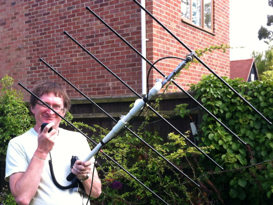
I wanted to try out the SSB satellites today and was pleased to listen to a couple of passes of FO-29. Signals were good and there was a surprising amount of activity. With the FT817 not being full duplex, working out the Doppler is a bit interesting, but Pete 2E0SQL has given me some useful info – so I will have another try soon and see how it goes.
Another QSO on SO-50 today, none other than 2E0SQL, so I was delighted. We’re only about 12 miles apart, so it’s fun to make a contact the long way round.
A good Es day too. 50MHz has been going well off and on through the day but I felt like concentrating on 70MHz. I worked 2 Italian stations this morning and then this evening the band was open to the Czech Republic, Poland -with the best of signals from Denmark where I was pleased to make several contacts including Bo, OZ2M.
An Elk in the garden: satellite contacts with the FT817
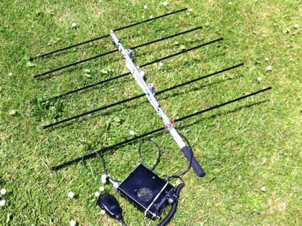
For some time, I have been keen to try some portable operation through some of the amateur radio satellites. I had been particularly inspired by Pete 2E0SQL’s portable operations through the satellites with his FT817 and hoped I could do the same.
Pete uses the Arrow 145/440MHz antenna and as far as I could see, it was not readily available in the UK. I contemplated ordering one from the USA but the thought of the import duty put me off a bit. AMSAT UK carry stocks of the ELK 145/440MHz log periodic which also have a good reputation albeit at a price. I’d recently disposed of a couple of bits of kit on eBay, so I felt I was in credit and ordered an ELK!
I was delighted when it arrived this morning. I wasted no time in making up a cable between the N connector on the ELK and the FT817. Assembling the antenna proved quite straightforward.
My first check with the antenna at ground level in the back garden was to see if I could hear GB3VHF, which I could, so given that’s not a huge signal, I was confident the antenna was working.
I looked at GoSatWatch on my iPhone to get some satellite predictions and as luck would have it, SO-50 was passing over at precisely that instant. I heard signals, so that was promising.
The next pass of SO-50 was a nice high one, so I was all prepared and sat out on the lawn with the FT817 and the antenna. R1AO was the first station heard, and although he had a little difficulty getting my callsign, we just about made it. IZ1DBY heard me and called as well, so that was very promising indeed.
I’m hoping to try some SSB operation through FO-29 as well.
The ELK antenna comes with a neat carrying case that will easily fit in a rucksack. It will form a very useful part of my backpack portable station I think. I’m also looking forward to doing some satellite work when we’re on holiday in Devon from a slightly rarer square than IO91!
WSJT-X v1 available
It was good to see, during the week that Joe Taylor, K1JT took WSJT-X from its Beta state to a ‘release’ version. If you’ve been reading this blog you’ll have seen that JT9, the mode produced by WSJT-X has been very usable for some months, so the last few weeks have seen a few tweaks to the software.
It works well and it has gained in popularity recently over recent weeks – with a very considerable amount of activity now available on the mode. Interestingly, Joe says that future plans for the program call for the integration of some of the more popular modes from the WSJT software. This sounds good – particularly incorporated in the very easy to use interface provided in WSJT-X.
Reasons to be on 50MHz FM
Driving home this evening, I had the second VFO scanning through the 50 or so memories across 29/50/145 and 433MHz, with a few in between!
It doesn’t often stop on 51.51 the 50MHz FM calling frequency, but I heard a loud voice ask someone to move to 51.530. I stopped the scan and tuned there.
The station had an English accent, so I guessed it was a local or an expat. Of course, it turned out to be the latter; EA7/G0WHX. He was a great signal working a G4 I couldn’t hear. There was a little fading, but I listened to the QSO for around 15 minutes.
A great reminder to call on 51.510 a bit more often! You never know who’s listening!













