Author Archive
 A first QSO on the FO-29 satellite and some 50/70MHz Es
 August 4th, 2013 |
  Author:
We’ve just returned from an excellent week’s holiday in South Devon. I took the picture at Goodrington Sands, which has the dual benefit of being a nice beach and having a steam railway behind it.
I took the FT817, whip antennas for 21, 50 and 144MHz as well as the Elk 144/432MHz log periodic. In the event, the only radio operating that really ‘called’ was satellite operation.
I listened on a few SO-50 passes, most of which were quite busy, but without managing to make any contacts.
However, I did take the plunge and try FO-29 for the first time. The lack of full duplex on the FT817 makes this a bit of a challenge, but thanks to some sage advice from Pete 2E0SQL on where to transmit and where to listen, I managed to work DG0ER for my first contact on this satellite. I heard some other interesting stations such as UA9CS as well, so must make an effort to feel a bit more competent on FO-29.
Back home today, after I’d finished writing the Practical Wireless column, I switched on and found 50 and 70MHz buzzing with Es. I was pleased to work IW9HII (JM67) on 70MHz for what must be my best DX on the band this summer at around 2000km as well as I3VWK. On 50MHz, I was pleased to work old pal T77C who was coming through nicely on CW.
WSJTX v1.1 – JT65A and JT9 in the same package
A week or two ago, Julian G4ILO blogged about a new version of WSJTX that he’d been testing with Joe K1JT (incidentally, great to see that Joe will be at the RSGB’s Convention later in the year) that supported both JT65A and JT9 modes. At the time of Julian’s blog posting, the program wasn’t publically available, but when I checked earlier this week, it was there and available.
The rather nice idea is that if you have a receiver with a filter that’s 4khz wide or so, you can place your receiver strategically so that it can receive both JT65A (say around 14.076Mhz) AND JT9 (up around 14.078). You can decide whether you will monitor both modes or just one. And when you double click to reply to someone, the program determines which mode they were on and transmits accordingly.
I downloaded the program yesterday and had it monitoring away happily in rather poor HF conditions.
More great software from K1JT!
A 10GHz receiver using an LNBF and an RTLSDR – 10GHz RX for £20 or less?
Laurent F6FVY tweeted the other day a very interesting link, showing that people had used a LNBF designed for broadcast satellite reception and an RTLSDR dongle for 10GHz reception.
There are two good videos and I particularly liked the one from EA5KGD showing his reception of EB5EA’s 10GHz signals using the LNBF and the RTLSDR as an IF on around 618MHz.
So, I’ve ordered a suitable LNBF from the USA, which came in at just over £14 including shipping. If I can get a 10GHz receiver going for just under £20, I’ll be happy!
The only puzzle I have at the moment, which I am sure is easily solved, is that the LNBF requires its power to be fed up the coax. I am not sure what arrangement to use for this in conjunction with the RTLSDR. If anyone has seen anything suitable written up, I’d be very grateful! It looks like I need to find a way of feeding the 12V up the coax…
This looks like it would be fun to get going. There’s a 10GHz beacon on Cleeve Hill about 40 miles from here. I wonder if I could receive it and potentially look for rainscatter.
Readymade antenna adapters for RTLSDR dongles
I’d made up a cheap and cheerful antenna adapter using a spare connector for the RTLSDR dongle, but I hadn’t been overwhelmed with its performance. I suspect it was a bit lossy!
When I was reading up on something the other day, I discovered that the antenna socket on the RTLSDR dongle is an MCX connector, of which, I confess, I had not heard previously. In the course of my investigations, I discovered that MCX male to SO-239 adapters are available readily (and pretty reasonably priced) on Amazon
The adapter arrived yesterday and I hooked the RTLSDR up to the 50/144/432MHz collinear. I ran up SDR# and it worked well. Happily there was a 50MHz Es opening going on at the time and I heard several LA stations on CW and SSB. On 144 and 432MHz, the performance was definitely better than my rather lossy arrangement. Airband too was working much better than when I’d tried it before and several transmissions were easily identified on the display.
A small but worthwhile investment.
Receiving SO-50 satellite signals on the UV-5R and NA771 antenna
During the week, I noticed that there were some good, overhead SO-50 passes in the evenings. The weather has been so good we have often been out in the garden later on. It’s been very simple, therefore to take the UV-5R and the NA771 antenna out into the garden and have a listen for the SO-50 satellite as it passes over.
Results have been good, with a number of stations received, including ES6DO, DG0BBE, DL9ZAD (who almost heard me!) and OM0AD. I am sure it will be possible to make a QSO when the conditions are right.
The FT817 and Elk gives much better results, but of course, the advantage of the UV-5R/NA-771 combo is that it is available very quickly and does not require any setting up!
Tracking flying things: decoding SSDV pictures from 30km high
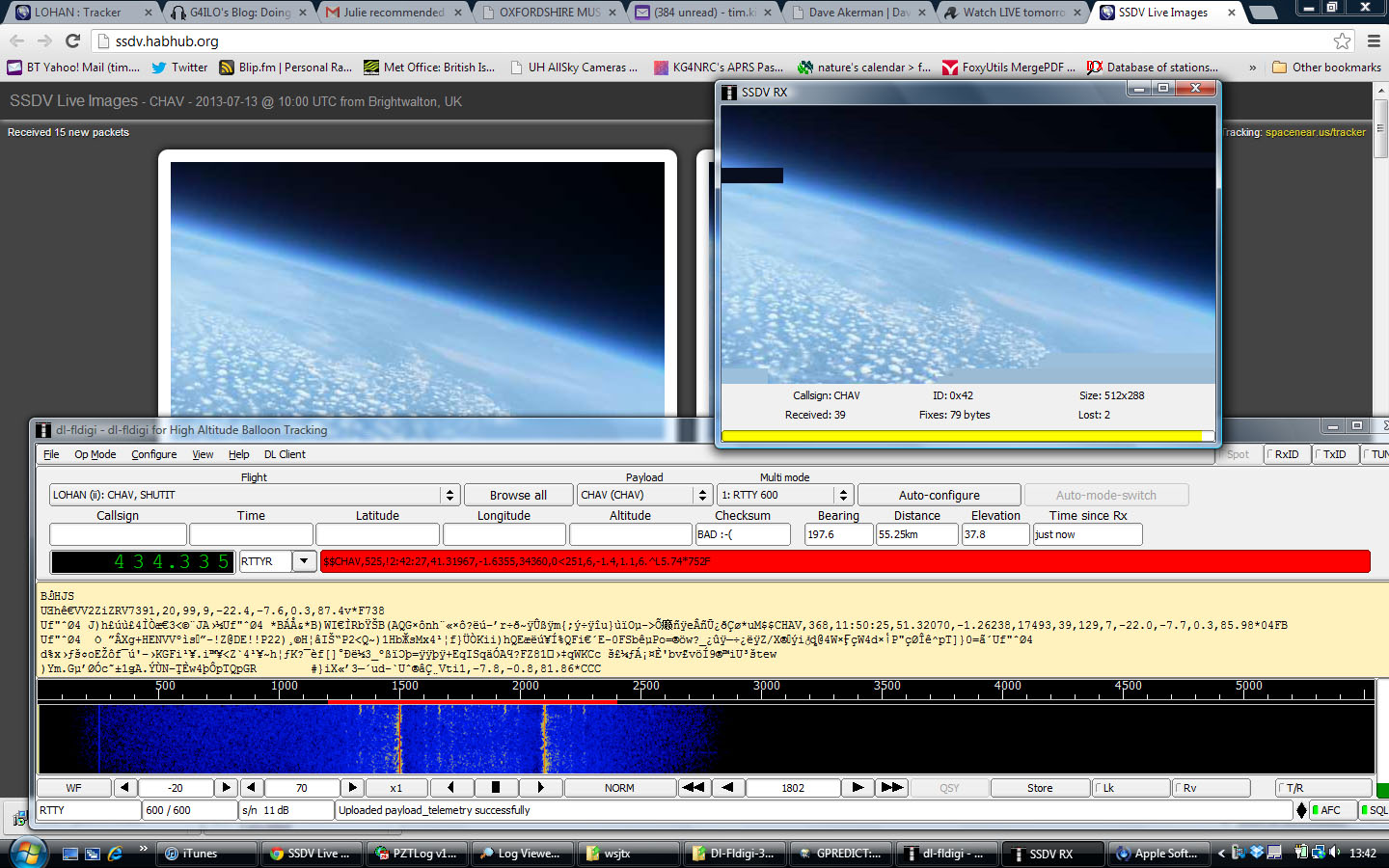
This morning Dave Akerman launched another of his HAB flights from Brightwalton, a few km to the south of me. For the first time since I have been tracking the balloon flights on 434MHz, Dave’s payload was taking pictures and sending them back to ground. Several transmissions from two balloons were available, and as the balloons rose to about 10km, I just tracked their position and altitude.
Then I wondered how I would get on decoding the data and pictures. I tuned the rig to the appropriate frequency and heard an interesting sounding signal. It turned out to be 600baud RTTY. I pressed Auto Configure on DL FLDIGI and was encouraged immediately to see that data started to be decoded.
Rather pleasingly, on the SSDV Habhub site I noticed my call listed against the pictures that my data packets, which DL FLDIGI uploads to the server, had contributed to. SSDV seemed a very robust protocol and quite often, I would get a solid data packet from the image, where perhaps a position report had failed.
I had not tried SSDV before, but it turns out that if you press S whilst in DL FLDIGI, you can see the image that you are downloading, Here you can see one of the better images that I decoded, when the balloon was around 30km high.
WG2XPN 70MHz beacon heard in Europe
Via Dave, WW2R/G4FRE it was good to hear that yesterday, the WG2XPN 70MHz experimental beacon, run by Brian WA1ZMS was heard in Europe on 70.005.
The beacon was heard in GJ, I, DL and IS0 – at a distance of over 7300km. Jo, CT1HZE suggested that this could be as many 4 hops of Transatlantic Es.
Excellent DX!













