Author Archive
 It’s 29MHz repeater season: a QSO through KQ2H!
 October 18th, 2013 |
  Author:
 Last night as I was driving back from the station, there was the sense on SSB that 28MHz was in good shape with some loud signals coming through from North and South America.
I tried a few CQ calls on 29.000MHz AM, but didn’t hear anyone at all. I wondered if there would be anything on the FM segment. Sure enough the KQ2H repeater from the Catskill Mountains in New York was coming through well – at times well over S9, although fading somewhat, making me think that what had probably been a good afternoon’s opening might have been coming to an end!
I listened for a few minutes before hearing KC2OBW call through a connected UHF link and decided to give him a call. Although my signals (10W or so to the whip) were not strong, it was enough to have a simple QSO. Good fun!
Remember the 29MHz repeaters have a 100khz repeater shift, so if you hear the output on 29.620, you need to transmit on 29.520. Fortunately, the ability to program the Anytone rig makes it easy to set up memories with different transmit and receive frequencies.
Maybe see you on KQ2H?
Smartphone SSTV
Yesterday at work, whilst I was waiting for a bit of code to finish running, I was idly looking at some apps on my phone. In particular, I noticed that the icon for my SSTV app had changed.
It’s the SSTV app for iPhone/iPad by Black Cat Systems. I got it a while ago thinking about using it to receive SSTV on the 28MHz rig in the car but hadn’t really got around to doing much with it.
Looking at the app yesterday I noticed that there was now the facility to take a photo with the iPhone and send it via SSTV. That got me thinking. You know how I’m not one for complicated interfaces! Well, I wondered if there would be any mileage in using a handheld and the iPhone together and just using audio coupling.
It struck me it could be fun, if you were out portable on a hilltop, to send an SSTV picture from the phone, through your handheld, just by holding the speaker of your phone in proximity to the microphone of the handheld.
Though I didn’t try it from a hilltop, I did try sending a picture from the iPhone through the Icom E92 (on FM) to the iPad with the Baofeng UV-5R on receive close by. The picture isn’t excellent, but it’s a reasonable approximation of what was sent!
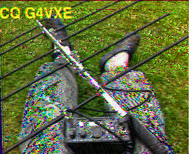
If you’re an Android user, there’s DroidSSTV to do the same as SSTV!
See you on SSTV from a hilltop?
More 28MHz mobile fun
Conditions seem to have been pretty good on 10m over the last day or two. Yesterday, as I was driving back from the convention the band was buzzing! I concentrated on 29MHz AM and was interested to hear N4ZED coming in from Georgia. I called but although Ken could hear a G there he wasn’t able to pull me out. Hardly surprising given my low power. I was surprised he heard anything at all,
This evening AM was quiet as I was heading home, but the SSB portion was lively. I managed a quick fire contact with K8CW which I was happy with, running 10W or so to the whip.
A day at the RSGB Convention 2013
You can never please all the people all of the time! We all know the truth of that statement. I thought the programme for this year’s RSGB convention was a particularly strong one. But talking to a friend at lunchtime, he felt it was a weak one! a couple of people mentioned the lack of any contesting content, other than the trophy presentations!
The best day for me to attend was Sunday, immediately meaning that I couldn’t see GW8JLY’s Meteor Scattter and YO4FNG’s VHF DX presentations, both of which I would have loved to have seen, but they were Saturday only.
I arrived on Sunday morning and found my way to the room where Graham G0NBD was presenting on the 472khz band. Given my experiments I was interested to hear how it was being done ‘properly’. Graham’s presentation was fascinated and I came away with a few ideas. An interesting snippet was that apparently, in addition to the IC706 working on 472khz, so does the old IC735 – up to about 25 W of output!
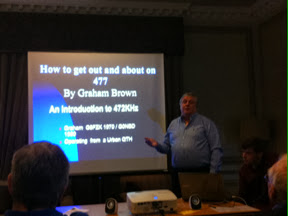
There were also some interesting uses for the RTLSDR dongles and making them work much lower in frequency. I need to have a look at that!
I would have loved to have had more time to hear about propagation on the band, but Graham filled 45 minutes very easily and capably.
Next I headed over to hear half of the OFCOM update, presented by Paul Jarvis and Ash Gohil. I was impressed with what I saw and felt they did a good job, with a generally good natured, but challenging audience! There were some in the audience who seemed specialised in making issues where no issues existed! However, it was an interesting session and gave a flavour for the nature of the upcoming consultation on the amateur licence review.
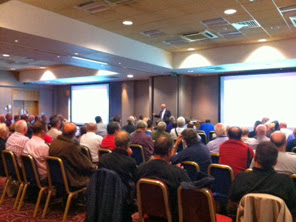
Far from being faceless Government officials, which one might be tempted to imagine. Paul and Ash came across well, seeming very approachable and genuinely willing to listen.
After this, I was looking forward to Pete, 2E0SQL’s ‘Another slice of Pi’ presentation. At yesterday’s presentation, Eben Upton himself, from the Raspberry Pi Foundation was in the audience. No pressure, then! but Pete said they had a great and very fruitful conversation in the bar afterwards, with Eben offering some interesting insights to forthcoming developments.
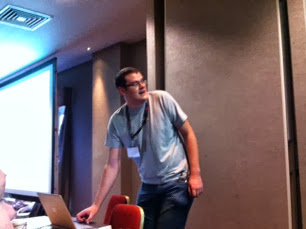
Pete’s presentation was excellent and I came away with some more things to try with my Pi – particularly with some ideas for new software to try.
I didn’t fancy the Roast Pork lunch so much, so drank coffee and chatted with friends, some not seen face to face in 10 years or so. Undercurrents of ‘politics’ are never far away and I noticed a couple of discussions going on which I was glad I didn’t need to be involved in!
After lunch it was time for the presentation which had been the trigger for me to attend the convention, ‘DXing with weak signals’ by Joe K1JT. You may remember I have referred to Joe as one of my ‘Ham Radio Heroes’. I really wanted to hear him speak and if possible to meet him and have the chance to say ‘thank you’.
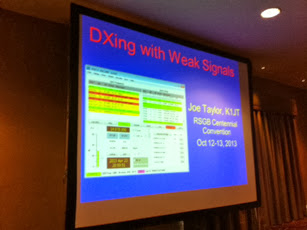
Joe was an excellent and engaging speaker. Although I know his software pretty well, there were some very interesting points discussed and things I learned.
I was particularly enthused about the idea of getting on 144MHz EME. Joe talked about having worked over 800 stations with his station which uses a pair of 10el X-Y yagis. This was inspiring!
It was interesting to get a sense of how the various JT modes stack up with SSB, CW and so on – just how weak can a signal be to get some intelligence out of it.
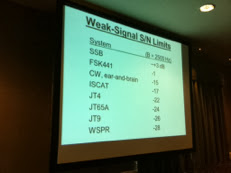
I would have quite happily listened to Joe for hours, but sadly the talk was soon over, but it was a privilege to hear him speak.
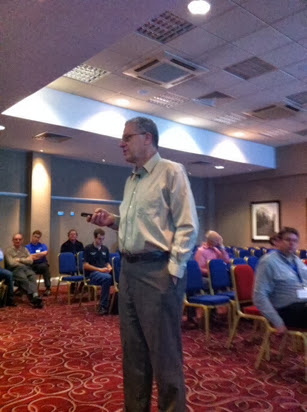
A really enjoyable and inspiring day out!
First 28MHz DX of the season from the mobile
Driving home this evening, 28MHz was in good form with some strong US and South American signals audible.
I was particularly pleased to work Ziggy KZ9DX from near Chicago. Although my signal was not huge, I was happy that 12W to the mobile antenna was doing ok.
Hopefully signals will continue to improve and there will be AM contacts to be made soon!
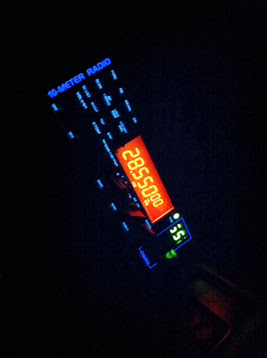
28Mhz activity: Can we learn from the CBers?
I can hear a sharp intake of breath from some of you, but bear with me…!
You have to admire the way the CBers make the most of the spectrum. For the last month or so, as I’ve been getting back to the car in the evening, I’ve been turning the 10m rig on. By and large the amateur band has been quiet, with the occasional Brazilian station coming through.
Tune down a MHz or so and listen to the CB band and there’s distinctly more activity. The 27.555MHz calling frequency (not legal in the UK, of course) generally has something going on, even if conditions are poor.
I suppose amateurs, if they find 28MHz closed, they head off to another band – whereas the CBers, in theory, only have the one band that they can use, so make the best of it. It must be the VHF operator in me, but I find a half-open band far more interesting than a wide-open band – it’s far more fun to try pulling the weak signals through than having them boom in! So, I admire the guys that are trying out propagation day in and day out and making, from what I hear, some interesting contacts.
When the band is poor or half open – the concept of a centre of activity or calling channel makes some sense. A weak signal somewhere between 28.400 and 28.600 is unlikely to be heard – but perhaps if there was a centre of activity – someone somewhere might hear something.
I wondered whether the 10-10 International group might ‘nominate’ a centre of activity, but could not see that they did – nets at specific times, certainly – but nothing more generalised.
I seem to remember somewhere reading that 28.400 was nominated as an unofficial calling frequency. Perhaps over the winter, when the band is not in great shape, we should make a few calls there anyway and see what happens! I’ll bet some interesting contacts would result.
Maybe some possibilities for 29MHz AM too – some more activity around 29.000 and 29.010MHz AM would be very welcome.
On many bands, it’s all about activity. 28Mhz deserves more of our attention, even when it’s not wide open! See you on 28.400 SSB or 29.000 AM, maybe?
ZR6AIC’s interesting blog and satellite webSDR
Over the weekend, I came across Anton, ZR6AIC’s blog which is well worth a read, if you’ve not seen it before. Plenty on RTLSDR, Satellites, Raspberry Pi – I enjoyed skimming through it last night.
Anton, based in southern Johannesburg, South Africa also has a couple of interesting WebSDRs that you can play with. One which particularly caught my attention was his VHF/UHF Satellite SDR, on which you can listen around 437MHz. It might be quite interesting to get some Satellite passes for Anton’s location and take a listen!













