Author Archive
 DSTAR: ON8JL’s Babystar and – the chickens speak with South Korea
 February 2nd, 2014 |
  Author:
 In the course of my reading around about DMR yesterday, I came across some interesting DSTAR developments that I had missed.
ON8JL has an interesting range of standalone gateways, the Dadystar and the Babystar. The Babystar, in particular, looks like an alternative to the DVAP/Raspberry Pi gateway. It retails around EUR280 and comprises of a standalone unit with a 430MHz 10mW transmitter, receiver and Ethernet interface.
You can plug the Babystar into your internet router and use your 70cms DSTAR handheld to access the DSTAR network. It looks like you can program the necessary settings into the Babystar by means of a web interface hosted on the device.
See ON8JL’s webpage about the Babystar device
See MM0DUN’s page on using the Babystar
Meanwhile here, it was a more pleasant February morning, so I was able to get out into the garden for some chores this morning, taking the IC-E92 handheld. I’d just completed cleaning out the henhouse when Joe HL5KY put a call out on REF001C
I gave Joe a call and we had a very pleasant chat, and the chickens made their voices heard in South Korea!
DMR talk – and a great blog (Grapevine Ham Radio)
I keep an eye on e-Bay, of course, and had seen the Kirisun units around. These, it seems, are DPMR, using FDMA and whilst are no doubt very interesting to try out, they won’t get you anywhere down the DMR route.
A DMR handheld that won’t break the bank is the Connect Systems CS700 which is retailing in the US at around USD180. There’s a really nice writeup over at the Grapevine Ham Radio blog. Incidentally, I can’t believe I have missed Jason’s blog up until now. There’s lots of great stuff there. And to make it even more embarrassing, he kindly includes a link to my blog on his site. Sorry, Jason – this will be fixed! Hans, PD0AC also carries an interesting item about the CS-700 on his blog.
It will be interesting to see if or how the talk develops and whether DMR makes any sort of impression in terms of on-air activity over the next few months
Playing with the portable satellite gear on SO-50 and FO-29
Yesterday, the weather was good enough (just) that I felt like taking the gear out into the garden to try and use the satellites. I was particularly interested in FO-29, which is one of the SSB satellites.
Shortly before Christmas, a very kind benefactor gave me a diplexer and I was keen to give that a whirl, connecting up both the FT817, FT790 and using the both on the Elk antenna.
So, out into the garden we go, with the FT817 and Palm Paddle, for 2m transmit, the diplexer, the FT790 for 70cms receive, the Elk antenna and a Lead Acid battery! I got it all setup prior to the pass and started to have a listen around. Signals started coming through on 70cms, which was good. However, there was obviously a poor connection somewhere, as when I try to send a few dits on 2m, there were a lot of crunchy noises on 70cms. It sounded like a connector not done up properly, as I was able to make it go away – mostly.
By this time I’d missed much of the pass, but I did just manage to find myself on the satellite downlink. However, I did discover that it is not possible to hold and aim the antenna, tune the 70cms downlink and send dits all at the same time! Patrick, WD9EWK suggested that I could probably send dits and tune the TX with one hand which is probably the way to go.
For the next pass of FO-29 which was quite a low one (12 degree elevation) I decided that I wouldn’t lug everything back out into the garden (especially as it was starting to gently rain at this stage), so I just took the FT817, the battery and the Elk out.
Ages ago, Pete 2E0SQL had suggested to me that if I transmit on 145.945 up it would come out on around 435.862 at the start of the pass. So I decided to make it a half duplex pass and give that a go. Despite the rather weak signals from the low pass – and the fact that it was mostly behind the lime tree at the end of our garden, I was pleased to be called by F6CTW with whom I was able to make a scratchy QSO. We’ll do it better another time, I’m sure. It was good to make an FO-29 QSO again and I’m excited to try it again, be it full duplex, which will be much better of course, or a cheap and cheerful half duplex. If you hear me gently drifting down the transponder, that will be why.
Later in the afternoon, I thought I would get on SO-50. I particularly wanted to look out for Ken G0PPM who has been working on getting QRV and I wondered if he would be able to be on. I decided to use my trusty Baofeng UV-5R. In some respects the UVB-6 is nicer, but there’s something a bit strange about the squelch that I couldn’t quite set completely off. Must have a look at that.
The satellite seemed to take ages to ‘arrive’, but it did and as it was a nice overhead pass, signals were great. First station heard was Dave M0SAT – not far away, near Watford (we last worked on 70MHz). I signed with Dave and heard G0PPM’s call, so was delighted to be able to work Ken, who had a great sounding signal from his portable location. Ken is often on the road, so it will be fun to work him from various locations around the south and south-west of England and occasionally, South Wales. R1AO then put a call through and worked a couple of stations – I was delighted to be able to catch him for a new country on the satellite. With DG0BBE and an OE6 coming through, but not worked, I was pleased to be able to work Branko 9A3ST just before the pass was over.
A really exciting satellite day and a good bit of encouragement for me to get on a bit more often – when the weather allows!
uLog – a new, simple logging program from M0PZT
For the last year or so, I’ve been using PZTLog written by Charlie, M0PZT, which I have found excellent and a pleasure to use.
Charlie has just released uLog (Micro log). As its’ name suggests, it’s a stripped down logging program for people who don’t want anything complicated.It seems to do just that! I downloaded it (like PZTLog, it is free) and installed it in seconds.
It is compatible with the PZTLog database too – so I found that I could point it at my existing PZTLog database file and log QSOs successfully. I checked, too, that I could go back in and use PZTLog – it’s all fine. Some of the database fields used in PZTLog are not populated in uLog – but remember – the point is simple logging!
I like the simplicity of the logging window – which you can just have running – and tab over to the application from whereever you were, when you need to log a QSO.
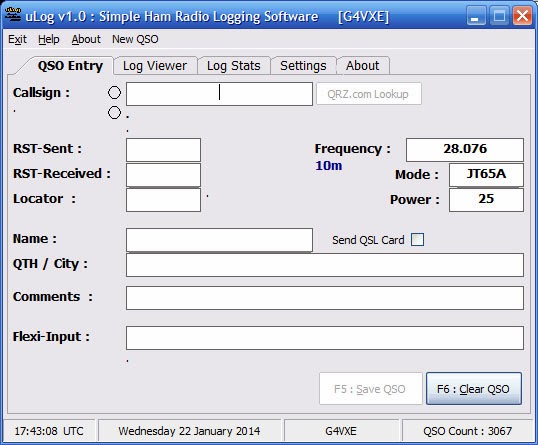
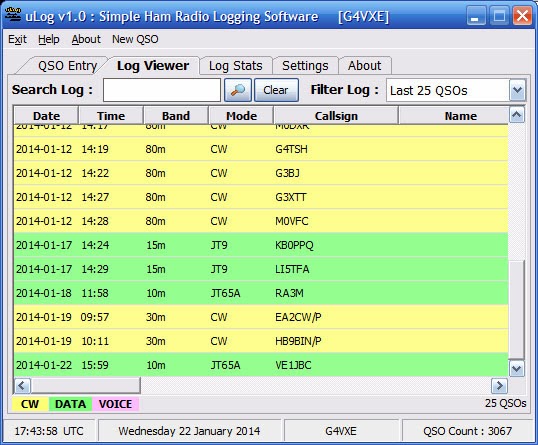
Update In normal, super-responsive Charlie style – he took a look at the issue I mentioned regarding the Flexi-input and the locator/WAB issue and has amended it. Thanks, Charlie!
SOTA Goat – your friendly mountain top companion (for iOS)
Over the weekend, I decided to grab a copy of the iOS application ‘SOTA Goat’ written by WW1X. I’d seen some nice reviews and I thought it would be fun to take a closer look at some of the SOTA activity.
The application allows you to look at SOTA summits, worldwide, on a map – search for it by name and so on.
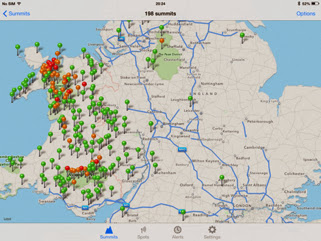
You can also look at SOTA related spots from the DX Cluster as well as upcoming alerts of activity from the SOTAWatch website.
It’s nicely put together and particularly at the weekend, it was fun to look at the activity and have a little listen to see what could be heard.
This *might* be where I rethink getting rid of the FT1000MP! The HF antenna was on the FT847 and I was looking for one of the SOTA portables on 14MHz. On the FT847 there was a great deal of noise – I swapped the antenna over onto the FT1000MP and it was clear as a – clear thing! I do have a CW filter in the FT847 too.
I was hoping to hear Richard G3CWI of SOTABeams fame, last weekend operating as GW3CWI/P, but things weren’t quite right on 7 and 14MHz for us.
I like the SOTAGoat app. It’s not free, but it’s well put together and informative. I sense I will enjoy looking out for the SOTA stations. And on the iPhone, it looks a nice way of alerting people, if you’re out portable on a SOTA summit.
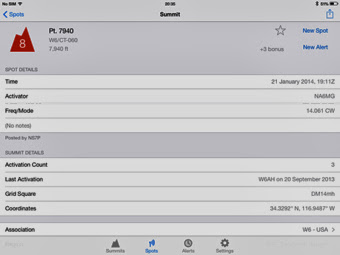
Not many summits like the one above close to me! But the screenshot gives you a good idea of the information available about each summit.
And it’s back! GB3VHF back on air
An update from Chris G0FDZ on the GB3VHF service page shows that the beacon came back on air this morning.
There will be a temporary interruption to service at some point when the electricity supply is moved back to the mains from the generator – but the timing of this is not known.
Thanks Chris for sorting it out.
GB3VHF 144MHz beacon currently off air
Chris, G0FDZ, the beacon keeper of the GB3VHF 144MHz beacon reports it as off air at the moment.
Unfortunately, there has been an equipment failure of the power supplies. No particular problem – Chris has the bits to mend it! However, unfortunately, due to the very wet weather, it’s not possible to get in the door, as it has swollen!
See the service updates page for GB3VHF
From the pictures, particularly the fallen oak tree, it would appear that the weather at the site has been very bad recently.













