Author Archive
 Nostalgia post: 49MHz handhelds and AM CBs
 March 2nd, 2014 |
  Author:
 I was thinking about the ‘Handy from Tandy’ conversion from 49MHz and it occurred to me that the first set that I ever transmitted on was a 49MHz handheld.
It must have been around 1980 when I was a keen shortwave listener and starting to get interested in getting an amateur licence. My parents had taken us on holiday to Fishguard in Pembrokeshire. Just along the A487 from Fishguard towards Cardigan is the village of Dinas. This particular year, a new shop had appeared in Dinas, a CB shop. I was very keen on looking in the shop window!
Of course, at this stage, CB was illegal in the UK and as I was living at home – there was no possibility of illegal operation – not that I would have done anyway 🙂
I can remember a number of 49MHz handhelds for sale in the shop as well as the 27MHz AM sets.
When I returned home to Cheltenham, I researched the 49MHz handhelds. They were very low power and they appeared to be legal to use. I bought a set of two. The range was probably 100-200 yards in a built up area. A couple of doors from me lived Jon, G6BHS, so it made perfect sense for Jon to have the other handheld and for us to use them to chat. Good fun!
27MHz CB was legalised in 1981, on FM, and I very quickly purchased a CB licence and a Cybernet Beta 1000 set (great receiver!) and had some fun and learned some basics about aerials and propagation.
Of course, it was just the push I needed to get my first amateur licence, G6TTU early in 1983.
50mW on 50MHz FM – ‘The Handy from Tandy’
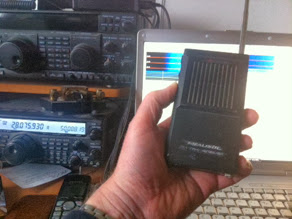
Earlier in the week, I noticed a handheld 50MHz FM transceiver on eBay for £6.99. I read a little and it turned out to be a converted Tandy/Realistic 49MHz handheld. Back in the late 1980s (I think), Practical Wireless ran an article by Peter Julian, G7PRO on how to convert one of these on to 50MHz FM.
There had been a follow up article by Mike Hadley G4JXX and by coincidence, the transceiver on eBay was Mike’s! Unfortunately, Mike didn’t have a copy of his article, although he did kindly send me a scan of the original G7PRO one. I’m sure I can locate a copy of Mike’s article.
The little transceiver arrived today and I wasted no time in putting a 9v battery in it! It works fine and transmits and receives quite happily on 51.510MHz FM. The original article suggests the power output is in the region of 50mW, but I think Mike’s modification is for a little more output.
Actually, my thought was not particularly to use this as a transceiver, although it will be fun to play with the low power and see how far it will go, but in the Es season, to use it as a monitor receiver in the greenhouse/garden and see if I can hear any Es on it.
As for the price, I think it’s provided £6.99 worth of enjoyment already!
A book for DXers and dreamers: Pocket Atlas of Remote Islands by Judith Schalansky
Out for a lunchtime walk yesterday, I decided to pop into the local bookshop for a browse, not particularly intending to buy anything.
However, in the ‘travel’ section, I came across a lovely little book called ‘Pocket Atlas of Remote Islands: Fifty Islands I have not visited and never will’ by Judith Schlansky. As I leafed through the book, beautifully presented, I realised that in a manner of speaking, I had ‘visited’ many of the islands mentioned through the medium of radio.
When we have a contact with a distant island though, it is easy for it to be just a tick on a list and very often we have little sense of what life is like there. This is where this book comes in nicely!
For each island, there’s a map – as well as a couple of pages with some background to the island. In fact, the entry for Annabon relates directly to amateur radio and the aborted DXpedition in the early years of the ‘noughties’.St Kilda’s entry was even sadder, describing the issues of infant mortality that had beset the island.
I only browsed a handful of islands last night, but for anyone who is interested in the big wide world out there, and I’m certain that includes many radio amateurs – you’ll love this book!
TX Factor – new online ‘TV’ amateur show
I’m always a bit apprehensive when I hear there’s going to be a new amateur radio podcast. There have been some very good ones and some very bad ones! Just because someone is a keen radio amateur, doesn’t necessarily make them a good broadcaster on the subject!
The ‘TX Factor’ (corny name, but hey…) boded well. The presenters are all professional broadcasters. Bob, G0FGX is someone that I have come across on air a couple of times recently and he’s an engaging and interesting guy with plenty of broadcast experience. Mike G1IAR and Nick 2E0FGQ both have impressive CVs. Mike looks to have a particularly interesting job, mastering recording sessions for some big names.
I had a chance to catch up with the first TX Factor show yesterday. It’s well produced, engaging and inspires you to want to have a go. I really recommend you take a look.
I love Cornwall and it was interesting to see the Poldhu segment. I was glad to see that Bob addressed the question of whether Marconi’s ‘S’ signal really did get heard in Newfoundland! The SOTA activation was very nicely demonstrated by Tom M1EYP and it was good to see Mike G1IAR visit the Norman Lockyer Observatory in Devon. Great stuff.
Well done and I’m looking forward to seeing more shows. They must take quite a bit of production – well done to the team.
Find the TX Factor’s website here
Great 29MHz conditions
For the second time in a few days, I had a 29MHz QSO through the KQ2H repeater on 29.620 (input on 29.520) on the way home from the station. With the days lengthening, the propagation is lasting a little longer too and KQ2H has been a really great signal even at 1830z.
Last Friday I worked M0CGL through the box and then this evening it was nice to have a QSO with Terry G0VHS in Weymouth.
Gear is the Anytone AT5555 at around 20W into the Sirio whip on the car.
The band has been quiet in the morning, although I’ve tried a few CQs on 29.600 at around 0715z – I’m sure it’s open somewhere. Judging by the Russian taxi controllers on 27MHz – it’s good out in that direction!
Good to hear some people making 29MHz AM QSOs today as well – though the AM segment was quiet by the time I got back to the car.
A spring day stolen from winter – a chance for some satellite QSOs
After the appalling weather of the last few weeks – the storm on Friday/Saturday was probably the worst windstorm I can remember here – today dawned sunny and still. And mild!
I decided to take advantage and see if I could make some garden portable satellite QSOs. The first useful pass was from FO-29. I decided to try it half duplex rather than dragging everything out for the full duplex kit. Perhaps I should have done! I called CQ but no QSOs. I did hear EA6VQ and a DL5 on CW (whose call I’ve forgotten!) quite nicely. Had I had the full duplex kit going, I could have hopefully tuned around and make the contacts. Never mind!
Next pass was SO-50. I’m not usually so optimistic about SO-50 passes at weekends as they can be quite busy and chaotic, but I thought I would listen anyway. CT2GOY was the first station heard, working a Frenchman. The QSO finished and I dropped my call in and worked him for the first time. Next station heard was EA6VQ – obviously having a satellite morning too! He had a couple of QSOs before I was able to work him, which I was delighted about – my first Balearic Islands QSO on satellite.
I missed the the next FO-29 pass somehow – doing a little work in the garden – and what a pleasure it was to be outside again! My last SO-50 pass of the morning and my window for activity was quite a low one up to the North – maxing at around 15 degrees. Those can sometimes be a bit of a challenge with my 5W and handheld gear but anyway, I heard a couple of SP stations that I missed and then worked OH2FQV – always a nice QSO.
We have to pop out this afternoon, so no more opportunity to be outside with the gear – but feels nice to have been out there!
New release of WSJT-X (February 2014)
I wondered why there had been so many hits on an old WSJT-X post over the last week. I guess you were all looking for a new version.
The good news is that it is available on K1JT’s WSJT-X page now.
I’ve downloaded it this evening and had a quick 7MHz JT65A QSO with CT3IB and everything seems well. I can’t see any huge differences so far, so guess it is a maintenance release, fixing any issues that the team have become aware of.
I’m looking forward to when some of the other WSJT modes are included in the new WSJT-X interface, as hinted at on Joe’s site.