Author Archive
 An evening on 472khz WSPR receive
 April 4th, 2014 |
  Author:
 I realise that I have not been very active monitoring 472khz WSPR this winter season. HF conditions seem to have been so good that I have rather ignored LF.
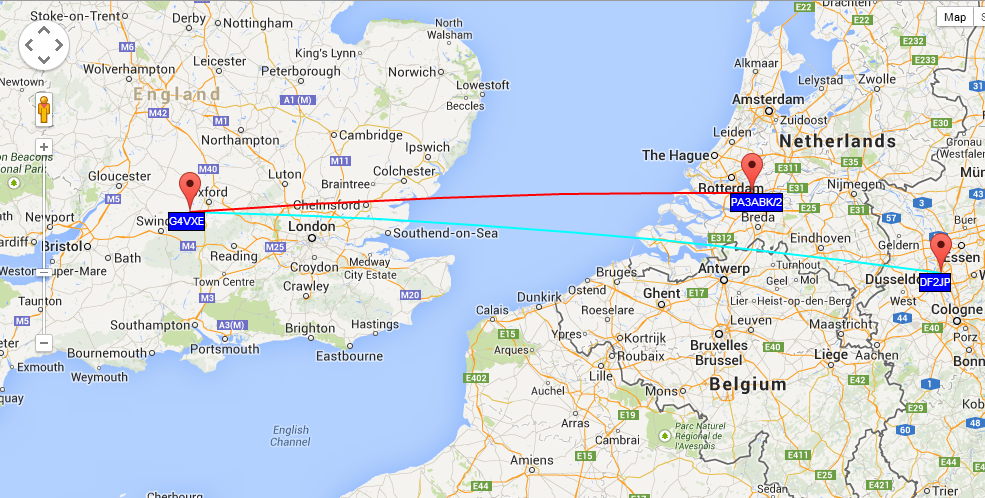
Noticing Roger, G3XBM blogging that 472khz WSPR was quiet, last night, I decided to run the FT847/HF6V on 472khz WSPR receive overnight. Sure enough it was quiet, but it was good to hear PA3ABK/2 and DF2JP, who I think is a new station to me.
More 28MHz mobile fun: PSK and TX6G
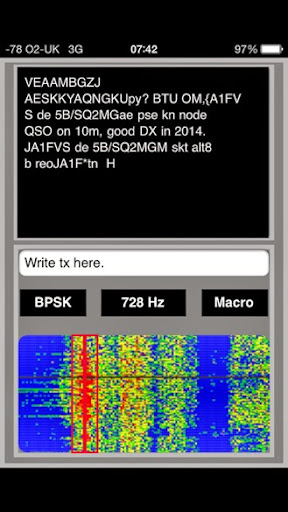
This morning, 28MHz seemed pretty quiet as I drove to the station this morning – very little on SSB. When I got to the station, I tried CW which was just as quiet. As I spun up the band to the beacon area, I noticed some PSK on 28.120.
Some months ago, I downloaded the Multimode application for my iPhone which decodes PSK and RTTY. I just fired up the app, held the phone reasonably close to the rig and saw PSK signals appear on the display. To tune the signal in, you just drag the centre of the bar to the centre of the required signal and with any luck it displays.
This morning, it was fun to see 5B4/SQ2MQM working a JA station. And this evening when I got back to the car, LW5ER was coming through nicely.
Obviously you can’t have all this going whilst you’re actually driving. That would be dangerous! So, I tuned up the band to the SSB segment and the very first signal I heard was TX6G coming through – really great signals. In a perfect world, the next sentence would be that I cracked the enormous pileup running 10W to the whip.
Sadly no! The Anytone can’t deal with split frequency operation, so it was just a case of enjoying listening to the signals coming through from the other side of the world. I did stop in a lay-by and text Justin, G4TSH, who’s there, that they had a great signal to the mobile.
DMR and DSTAR on the same radio?
Imagine that! DMR and DSTAR on the same radio.
Take a look at this post which I found on the VE3XPR site – which is an interview with Jerry Wagner of Connect Systems.
It will be really good to see if this comes to pass.
Good luck Jerry, good luck Connect Systems!
Experiments with the SSB satellites (AO-73, FO-29 and VO-52) with the V2000 vertical
Browsing around the AMSAT-UK site yesterday, I came across this article by the ever inspirational Ray, W2RS about how he had made QSOs on the SSB satellites using nothing more than a dual band mobile whip, a diplexer and SSB transceivers for 144 and 432MHz.
Well! I wondered if I could do something similar, given that I had the V2000 vertical up on the mast. In some respects, it is a ‘long whip’ as Ray discusses, putting quite a lot of radiation towards the horizon, which is what’s normally wanted for tropo, but not for satellites, but there are certainly some vertical lobes.
So, I fed the V2000 into the Diamond diplexer and then connected the appropriate coax from the diplexer to the FT847’s 144MHz port and (separate) 432MHz port.
An initial test to see if there was much desense or crackle was positive.
The first satellite around was AO-73, which was testing its’ transponder in daylight. After a bit of fiddling around, I was able to hear my CW, just as the satellite flew over the horizon! Then VO-52 came over and I was receiving good signals on 145MHz and again was able to hear my CW, sufficiently to call CQ. No-one came back, but it’s a start! I also managed to hear myself on a pass of FO-29 with reasonable elevation.
This is all quite promising and I’m pretty sure that I will be able to make some QSOs in due course, most likely on CW.
However, all of this enthused me sufficiently that I’m aiming to be able to take the FT847 out into the garden (or out portable) with the diplexer and the Elk to try and make some contacts with the yagi.
Good fun – thank you for the inspiration, Ray!
A bit of ISS packet radio
I hadn’t put the receiver on 145.825 and monitored the packet transmissions from the ISS digipeater for a while. Nice to do so over the last couple of days and see plenty of stations plotted on the map.
I haven’t been in shack at the right time to press the transmit button – but it’s just interesting to see what’s been heard
Gear is the FT8900 / V2000 vertical – UZ7HO soundcard modem software/UISS software
Aircraft scatter propagation and the Air Scout software by DL2ALF
This morning as I was putting the Practical Wireless column together and in particular, some microwave reports, I remembered that sometime ago I had heard about the Air Scout software by DL2ALF. This software uses data from FlightRadar24.com and plots it on a map. Not only that, but you can enter in your locator, the target station’s locator and the software will give you an idea of when there are aircraft in the right place to reflect the signals and enable a brief contact.
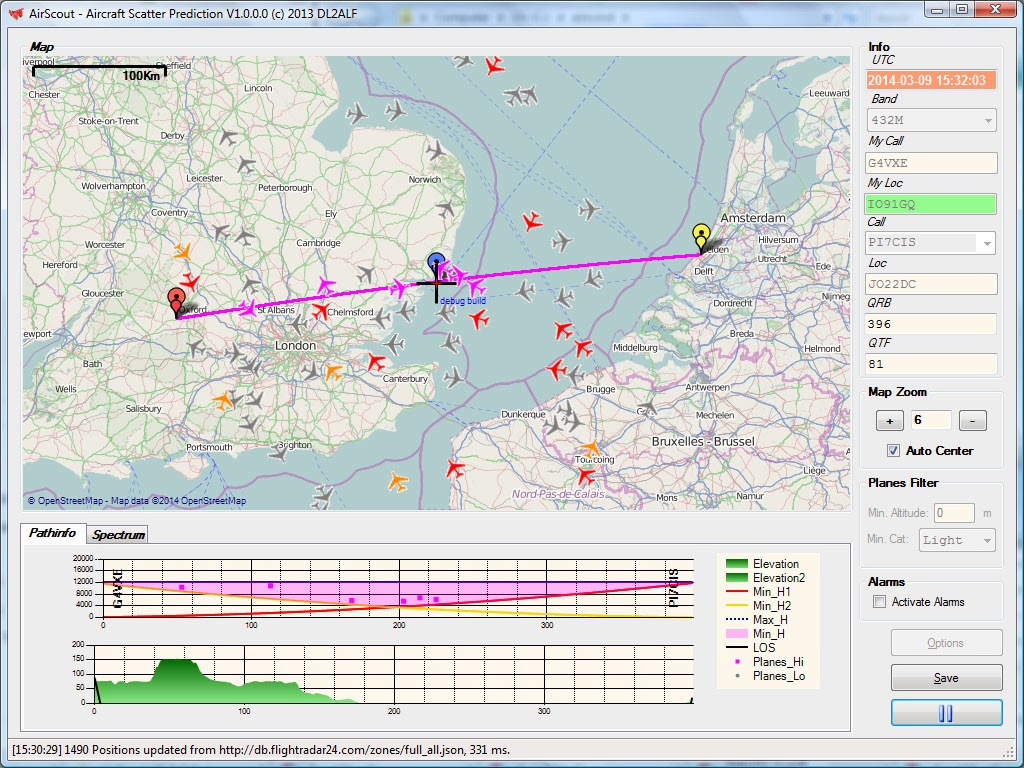
The first path I tried was quite a simple one, from here to the GB3VHF beacon on 144MHz. Although I can hear it all the time, even on the collinear, it is very quickly apparent when there are aircraft on the path, by the Doppler shift. It didn’t take long for me to see that the software was working and aircraft reflections were being heard at ‘the right time’.
A more challenging path was the 432MHz one from here to PI7CIS in JO22. At the moment, with the 10el yagi, I am not hearing the beacon all the time, so I left the FT847 running with the beam pointing towards Holland and after a few minutes, I heard a weak signal from the beacon. Sure enough, referring back to the AirScout software, there was an aircraft along the path.
Very interesting! I must look at this software a little more and see if I can learn a little more about how I might use it to make some aircraft scatter contacts.
You can download a copy of AirScout here
More fun on 29MHz AM
Over the weekend I had my first QSOs on 29MHz AM from the home station, using the FT847. It seemed to work fine, although I had a sense that my long feeder run was a bit of a barrier and I was probably doing better with slightly less power from the mobile!
On the train last night I was chatting on Twitter to Jon, G0IUE. Jon is located in Corsham, some 35 miles or so to the west of me. Jon had been working some nice DX in the late afternoon on 29MHz AM and I suggested that as I would soon be back at the car, we have a go and see if we could make a QSO.
As I was getting of the train, I had a tweet from Jon to say that he was working OX1B on 29.050 AM. I hurried along the platform as quickly as I could and got back to the car, but the frequency was quiet. However, I left the rig on the frequency and started my journey.
As I got out of the built up area, I could start to hear some weak signals and realised it was Jon calling CQ. Although I couldn’t copy him fully at that stage, I could tell he was there. Larry K1IED replied to Jon’s CQ and started a QSO. During one of the breaks in transmission, I dropped my call in and was delighted when Larry heard me.
Heading west all the time, near Abingdon, I was able to hear Jon quite well on ground wave. We were able to have a three way QSO for several minutes. Larry signed with us and Jon and I QSYed to GB3WH on 2m FM.
My destination, the Gym at Carswell, has quite a good take off in Jon’s direction, so on my arrival, I suggested to Jon we try on 29MHz AM. We did and we just able to exchange signals. Jon was easy copy for me, but my slightly lower power from the Anytone was only just making it. We moved onto SSB and it was a very easy QSO. Larry K1IED had been listening and joined in on SSB which was great fun.
A really nice, fun QSO – the stuff that memories of solar cycles are made of!
Jon shot a bit of video of the QSO (on AM) with Larry coming in really well.













