Author Archive
 VP8ORK 2011 ebook available, free!
 May 9th, 2014 |
  Author:
 Although I’m not a huge fan of chasing Dxpeditions these days, I still think it’s fascinating and magical to travel to a remote part of the planet, set up a radio station and be able to make contacts all over the world.
Nodir Tursoon-Zadeh EY8MM has produced several eBooks based on his photographs from various high profile Dxpeditions which are available for free.
If you are an iPad/iPhone user, simply go to the iBooks store and search for VP8ORK 2011 and you should be able to download and view the book, which makes excellent reading. Nodir has taken some wonderful photographs which really capture what it is like.
It looks like Nodir has published an eBook on the FT5ZM trip to Amsterdam Island, which is available in the Blurb store but I can’t see it in the iBooks store just yet. I suspect you can get it onto your iDevice from Blurb, but I haven’t tried that yet!
You know you’ve been doing a lot of satellite operating, when….
I caught a nice little Es opening on 50MHz this evening. Nothing huge, but some HAs coming in on CW with a few other countries audible from time to time.
I realised I had been working a lot of satellite QSOs recently, when I was reaching for the VFO during the QSOs, expecting to have to tweak it for doppler!
Talking of satellite QSOs today, I was pleased to work RA3MAU over in `KO97 on VO-52 this afternoon. A gotaway on FO-29 was UN7CY. Great to hear him on CW – easy copy on the vertical, but I couldn’t find myself to call him! Other nice QSOs today with PA3ARK and EI9EW on VO-52.
Caught my first 50MHz Es opening of the year
Although I’ve been aware of some Es happening on 50MHz for the last few days, inevitably, the openings have been when I have been busy or engaging in good works (cleaning the village church, springs to mind!).
This evening after supper, I popped up to the shack to see what satellite passes might be of interest and I decided to check 50MHz. To my delight there was an S9 CW signal around 50.097. A quick listen and a call and IS0GQX was in the log for the first Es QSO of the season.
I heard him work a few others around this area, but no other stations from the Med were heard, and within 5 minutes, the band was quiet again. Love those early season Es openings!
Catching up! More satellite QSOs, First 50MHz Es of the season and 1000 blog posts
It seems to be a while since I stopped and wrote something here.
The simple satellite operation on VO-52 and FO-29, using the FT847, diplexer and the V2000 vertical continues. On VO-52 in particular, I have been surprised how well it works and have made a fair few QSOs, mostly on CW. Some passes are better than others, depending on the direction of the satellite and the vertical nulls of the antenna. I was interested to get decent signals through VO-52 the other day as it was over Greenland and the footprint of the satellite covered VE1 and W1 – so perhaps I may manage a QSO into North America when the time is right.
FO-29 tends to be a bit harder – just in terms of finding my downlink signal – again it depends where the satellite is, but I’ve managed a few contacts now, which is very pleasing indeed.
Nice to work GS3PYE/P – the Camb-Hams expedition to Lewis (IO68) on SO-50 this evening. I ventured out into the garden with the UV-5R and the Elk.
I’ve missed them both, but there have been at least a couple of Es openings on 50MHz. Earlier in the week, Ron ZB2B emailled to say that he had worked some stations in G, GW and EI in an Es opening and it looks like the band was nicely open yesterday morning (we were out, cleaning the local village church!).
Finally, apparently, this is my 1000th post to this blog. I enjoy writing it – and sometimes, enjoy looking back a few years to see what I was playing with then. It’s interesting to see how things change. Thank you to YOU, though, for reading it!
Printing your own QSL cards using HAMQSLer
Anyone who knows me well may be slightly taken aback to find me writing about QSL cards! Each to their own, but it’s a part of the hobby that really doesn’t appeal to me at all. However, I’ve always said that I think it’s nice to be able to QSL contacts which are special to you in some way.
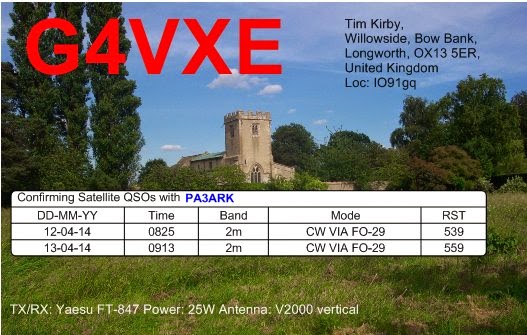
And so it was, I felt, the other day when I worked Berend, PA3ARK on FO-29. Berend often inspires me to try something new and so I thought it might be nice to try and create a QSL to commemorate the QSO.
I looked around and found the HAMQSLer program from VA3HJ. I managed to get past the ‘the final courtesy of a QSO is a QSL’statement at the top of the website! In my opinion, the final courtesy of a QSO is to say 73, but therein lies why I find myself at odds with the ‘every contact must be QSLed’ brigade!
The program is free to download and I found it well-designed and easy to use. I did have to install the Microsoft .Net framework 4.5.1 and install it on my PC before I could install the software.
I was able to import a background image of a photo of our village church to use. I really had wanted to try and use one of the aerial photographs I took of the village when I flew over in G3WGV’s aircraft a couple of years back. However, I found the colours didn’t really lend themselves to overlaying text on top of the photo. Actually, I’m sure a more artistically gifted person would have managed, but I opted for the easy approach – one where I had a nice blue sky, where I could place most of the text.
I found that I was able to setup various static text fields and create a QSOs box, which could be populated from an ADIF file from my logger.
After a bit of resizing and trying various options, I was ready to import my ADIF records. I did tweak the Mode field in the ADIF record, so that I could show that the QSO took place on a satellite. The logger, of course, records that I was (in this case) transmitting on 144MHz, but not that it was a satellite QSO. I wanted this to be clear, so I amended the Mode field in the ADIF field to say CW Via FO-29, which I thought was clearer.
More on FO-29 and VO-52 operation with the V2000 vertical
A little later FO-29 was due over and I wondered if I might be able to hear anything. The pass was quite quiet, but I did hear my Twitter friend, Berend, PA3ARK on CW. I was able to find my signal and place it reasonably close to Berend’s and we had a bit of a sketchy, but valid QSO.
Really pleasing to find that some simple CW satellite operation is viable with just a vertical antenna.
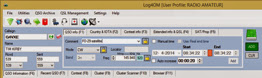
Berend sent a nice photo of the entry of the QSO in his logbook!
Evening update: I caught a late afternoon pass of VO-52 and was hearing myself well enough to have a tune around and was able to answer UT3UX who was calling CQ on CW and work him. I’ve not found too much CW activity so far. I’m sure I can work some SSB, but with the slightly lower signal levels, CW gives a bit more latitude!
More smartphone PSK from the mobile, with PSKer
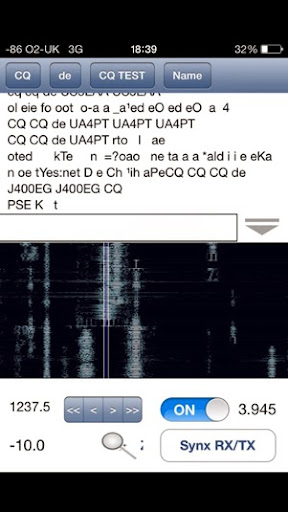
After I mentioned running a PSK program on my iPhone the other day, my friend Simon asked which one it was and whether it was PSKer. That was a program that I hadn’t heard of, so when I had a moment yesterday, I decided to investigate.
PSKer looks a very nice program and I decided to give it a go. When I got back to the car yesterday evening, I ran it up and set the receiver running on 28.120. There was plenty happening.
PSKer seems to decode a little easier than the Multimode program I was using the other day. I haven’t yet tried it on transmit. However, I did discover that it can be set to send tones through the speaker, rather than the earphone socket, which is what you want when you are too lazy to make up a lead!













