Author Archive
 Weekly Propagation Summary – 2016 Feb 22 16:10 UTC
 February 22nd, 2016 |
  Author:
Here is this week’s space weather and geophysical report, issued 2016 Feb 22 0359 UTC.
Highlights of Solar and Geomagnetic Activity 15 – 21 February 2016
Solar activity reached moderate levels early in the period due to an M1/1n flare (R1-minor radio blackout) from Region 2497 at 1056 UTC on 15 Feb, but low levels of activity were observed on 16-19 Feb with very low levels observed on 20-21 Feb as Region 2497 rotated behind the west limb. Region 2497 (N13, L=087, class/area=Eac/250 on 12 Feb) was the largest, most magnetically complex and active sunspot region on the disk this period, however, despite the frequency of solar activity this period no Earth-directed coronal mass ejections (CMEs) were observed.
No proton events were observed at geosynchronous orbit.
The greater than 2 MeV electron flux at geosynchronous orbit reached moderate levels on 15-16 Feb but an enhanced solar wind environment due to a coronal hole high speed stream (CH HSS) caused an increase to high flux levels throughout the remainder of the period (17-21 Feb), with a peak value of 36,500 pfu observed at 1755 UTC on 19 Feb.
Geomagnetic field activity reached G2 (Moderate) geomagnetic storm levels this period. The onset of a south polar-connected negative polarity CH HSS caused and isolated period of active conditions late on 15 Feb, unsettled to G2 (Moderate) geomagnetic storms on 16-17 Feb, and unsettled to G1 (Minor) geomagnetic storms on 18 Feb. As the CH HSS rotated out of geoeffective position, geomagnetic field activity decreased from quiet to unsettled levels on 19-20 Feb to quiet levels on 21 Feb due to the return of a nominal solar wind regime.
Forecast of Solar and Geomagnetic Activity 22 February – 19 March 2016
Solar activity is likely to be at low levels with a slight chance for M-class flares (R1-R2 (Minor-Moderate) Radio Blackouts) on 22-29 Feb and 15-19 Mar. C-class flares are expected on 01-14 Mar with a chance for M-class flares due to the anticipated return of Region 2497 (N12, L=087) which produced four M-class flares last rotation.
No proton events are expected at geosynchronous orbit, barring any significant flare activity.
The greater than 2 MeV electron flux at geosynchronous orbit is expected to reach high levels on 22 Feb and 15-19 Mar due to an enhanced solar wind environment caused by coronal hole high speed streams (CH HSSs). Moderate levels are likely on 23-24 Feb, 04-05, 07-08 and 13-14 Mar with low flux levels expected for the remainder of the period.
Geomagnetic field activity is likely to reach G1 (Minor) geomagnetic storm levels on 14-16 Mar and active field conditions are likely on 01, 03, 06 and 17 Mar, all due to the effects of multiple CH HSSs. The remainder of the period is expected to be at quiet or quiet to unsettled levels under a nominal solar wind regime.
Don’t forget to visit our live space weather and radio propagation web site, at: http://SunSpotWatch.com/
Live Aurora mapping is at http://aurora.sunspotwatch.com/
If you are on Twitter, please follow these two users: + https://Twitter.com/NW7US + https://Twitter.com/hfradiospacewx
Get the space weather and radio propagation self-study course, today. Visit http://nw7us.us/swc for the latest sale and for more information!
Check out the stunning view of our Sun in action, as seen during the last five years with the Solar Dynamics Observatory (SDO): https://www.youtube.com/watch?v=zXN-MdoGM9g
We’re on Facebook: http://NW7US.us/swhfr
Weekly Propagation Summary – 2016 Feb 15 16:10 UTC
Here is this week’s space weather and geophysical report, issued 2016 Feb 15 0238 UTC.
Highlights of Solar and Geomagnetic Activity 08 – 14 February 2016
Solar activity was low from 08-11 Feb. The largest C-class event during that period was a C8/1f observed at 11/2103 UTC from Region 2497 (N13, L=087, class/area Eac/250 on 12 Feb) with associated Type II (est. speed 483 km/s) and Type IV radio sweeps. A CME was visible following this event and is anticipated to arrive at Earth early on 15 Feb. Solar activity was moderate from 12-14 Feb with Region 2497 producing an M1 flare each day. No other Earth-directed CMEs were observed.
No proton events were observed at geosynchronous orbit.
The greater than 2 MeV electron flux at geosynchronous orbit was at normal to moderate levels during the period.
Geomagnetic field activity began the week at minor storm levels due to effects from a co-rotating interaction region (CIR) ahead of a CH HSS. Predominately quiet to unsettled levels were observed for the remainder of the period with isolated active periods on 09, 11 and 12 Feb associated with extended periods of negative Bz.
Forecast of Solar and Geomagnetic Activity 15 February – 12 March 2016
Solar activity is expected to be at very low to low levels with a chance for M-class flares from 15-17 Feb. Activity is expected to decrease to very low levels with only a chance for C-class flares from 18-29 Feb as Region 2497 moves beyond the west limb. Low levels are anticipated once again on 01-12 Mar as well as a chance for M-class flares with the return of Region 2497.
A slight chance for a proton event exists at geosynchronous orbit from 15-17 Feb due to the flare potential and position of Region 2497.
The greater than 2 MeV electron flux at geosynchronous orbit is expected to be at normal to moderate levels for the majority of the period. High levels are likely on 18-20 Feb following effects from a CME and a subsequent CH HSS.
Geomagnetic field activity is expected to reach minor storm levels on 15 Feb due to effects from the 11 Feb CME. Quiet to active conditions are expected on 16 Feb as CME effects subside. Minor storm conditions are likely again on 17 Feb as a recurrent negative polarity CH HSS becomes geoeffective. Quiet to unsettled conditions are expected with isolated active periods possible on 18-20 Feb as CH HSS effects continue. Mostly quiet conditions are expected on 21-29 Feb. Quiet to unsettled conditions are expected from 01-03 Mar due to effects from a positive polarity CH HSS. Mostly quiet conditions are expected for the remainder of the period with unsettled to active periods possible on 06-07 Mar and 11 Mar as two sequential small recurrent coronal holes affect the field.
Don’t forget to visit our live space weather and radio propagation web site, at: http://SunSpotWatch.com/
Live Aurora mapping is at http://aurora.sunspotwatch.com/
If you are on Twitter, please follow these two users: + https://Twitter.com/NW7US + https://Twitter.com/hfradiospacewx
Get the space weather and radio propagation self-study course, today. Visit http://nw7us.us/swc for the latest sale and for more information!
Check out the stunning view of our Sun in action, as seen during the last five years with the Solar Dynamics Observatory (SDO): https://www.youtube.com/watch?v=zXN-MdoGM9g
We’re on Facebook: http://NW7US.us/swhfr
Weekly Propagation Summary – 2016 Feb 08 16:10 UTC
Here is this week’s space weather and geophysical report, issued 2016 Feb 08 0222 UTC.
Highlights of Solar and Geomagnetic Activity 01 – 07 February 2016
Solar activity was at low levels throughout the entire period. Several regions produced low level C-class events, the largest a C5/Sf at 04/1822 UTC from Region 2494 (S11, L=162, class/area Dki/270 on 07 Feb). A filament eruption observed beginning on 05/1939 UTC near S19W28 was associated with a CME that is anticipated to be a glancing blow midday on 09 Feb. Several other small filament eruptions occurred but none were expected to be geoeffective.
No proton events were observed at geosynchronous orbit.
The greater than 2 MeV electron flux at geosynchronous orbit was at normal to moderate levels.
Geomagnetic field activity began the week at quiet to unsettled levels. Active to minor storm conditions were observed early on 03 Feb due to a co-rotating interactive region (CIR) followed by the onset of a positive polarity coronal hole high speed stream (CH HSS). Quiet to unsettled conditions were observed during largely nominal solar wind conditions from 04-07 Feb, with the exception of an isolated active period on 07 Feb due to prolonged negative Bz.
Forecast of Solar and Geomagnetic Activity 08 February – 05 March 2016
Solar activity is expected to be at low levels throughout the forecast period.
No proton events are expected at geosynchronous orbit.
The greater than 2 MeV electron flux at geosynchronous orbit is expected to be at normal to moderate levels with high levels possible from 12-16 Feb and 19-23 Feb following subsequent CH HSS events.
Geomagnetic field activity is expected to be at unsettled to active levels with isolated minor storm periods on 08 Feb due to prolonged negative Bz and negative polarity CH HSS effects. Quiet to active conditions are likely to continue into 09 Feb as effects continue along with a possible glancing blow from the 05 Feb CME. Quiet to unsettled conditions are expected from 10-12 Feb as a recurrent positive polarity HSS moves into a geoeffective position. Mostly quiet conditions are expected from 13-16 Feb. Quiet to unsettled conditions are expected from 17-19 Feb with active periods possible on 18 Feb due to effects from a recurrent negative polarity HSS. Predominately quiet conditions are expected from 20-29 Feb. Quiet to unsettled conditions are expected with isolated active periods possible on 01-03 Mar as another positive polarity CH HSS becomes geoeffective. Quiet conditions are expected to close out the forecast period.
Don’t forget to visit our live space weather and radio propagation web site, at: http://SunSpotWatch.com/
Live Aurora mapping is at http://aurora.sunspotwatch.com/
If you are on Twitter, please follow these two users: + https://Twitter.com/NW7US + https://Twitter.com/hfradiospacewx
Get the space weather and radio propagation self-study course, today. Visit http://nw7us.us/swc for the latest sale and for more information!
Check out the stunning view of our Sun in action, as seen during the last five years with the Solar Dynamics Observatory (SDO): https://www.youtube.com/watch?v=zXN-MdoGM9g
We’re on Facebook: http://NW7US.us/swhfr
Weekly Propagation Summary – 2016 Feb 01 16:10 UTC
Here is this week’s space weather and geophysical report, issued 2016 Feb 01 0641 UTC.
Highlights of Solar and Geomagnetic Activity 25 – 31 January 2016
Solar activity was at very low to low levels during the period. Low levels were observed from 25-29 January with Regions 2488 (N02, L=320, class/area Dai/240 on 25 January) and 2489 (N10, L=253, class/area Eko/300 on 29 January) producing the majority of the C-class flaring. The largest flare of the period was a C9/1f at 28/1202 UTC from Region 2488. Region 2488 was in slow decay over the period. Region 2489 continued to exhibit growth through 28 January and slowly decayed thereafter. Several filament eruptions, and subsequent coronal mass ejections (CMEs), were observed during the period, but none had an Earth-directed component.
No proton events were observed at geosynchronous orbit.
The greater than 2 MeV electron flux at geosynchronous orbit was at high levels from 25-27 January, moderate levels on 28 January, and normal levels from 29-31 January. The maximum flux of the period was 2,117 pfu observed at 26/1500 UTC.
Geomagnetic field activity was at mostly quiet levels throughout the period with isolated unsettled periods on 27-28 and 31 January and an isolated active period observed late on 31 January. Solar wind parameters were in decline as the period began under the waning influence of a negative polarity coronal hole high speed stream (CH HSS). Solar wind speed gradually decreased from approximately 480 km/s early in the period to around 260 km/s by 30 January before increasing slightly to 300 km/s by the end-of-the-period. A solar sector boundary crossing into a positive (away) orientation occurred at approximately 27/0834 UTC, accompanied by a slight increase in total field (Bt) measurements to 9 nT on 27 and 28 January. On 31 January, another increase in Bt to 10 nT was observed along with a prolonged period of southward Bz. The geomagnetic field responded with isolated active levels to end the period.
Forecast of Solar and Geomagnetic Activity 01 February – 27 February 2016
Solar activity is expected to be at very low to low levels with a chance for M-class flares (R1-R2, Minor-Moderate) from 03-25 February with the return of old Regions 2484 (N08, L=094) and 2488 (N02, L=320).
No proton events are expected at geosynchronous orbit.
The greater than 2 MeV electron flux at geosynchronous orbit is expected to be at normal to moderate levels with high levels likely on 04-07, 09-15, and 18-23 February as a result of CH HSS influence.
Geomagnetic field activity is expected to be at unsettled to active levels on 01 February due to continued effects from a prolonged period of southward Bz. Unsettled to active levels are likely from 02-04, 08-09, and 17-20 February due to recurrent CH HSS activity.
Don’t forget to visit our live space weather and radio propagation web site, at: http://SunSpotWatch.com/
Live Aurora mapping is at http://aurora.sunspotwatch.com/
If you are on Twitter, please follow these two users: + https://Twitter.com/NW7US + https://Twitter.com/hfradiospacewx
Get the space weather and radio propagation self-study course, today. Visit http://nw7us.us/swc for the latest sale and for more information!
Check out the stunning view of our Sun in action, as seen during the last five years with the Solar Dynamics Observatory (SDO): https://www.youtube.com/watch?v=zXN-MdoGM9g
We’re on Facebook: http://NW7US.us/swhfr
Weekly Propagation Summary – 2016 Jan 25 16:10 UTC
Here is this week’s space weather and geophysical report, issued 2016 Jan 25 0701 UTC.
Highlights of Solar and Geomagnetic Activity 18 – 24 January 2016
Solar activity was at very low to low levels during the period. Only weak C-class flares (<C3) were observed on 20-21 January and 24 January from Regions 2484 (N08, L=094, class/area Dro/030 on 20 January), 2487 (S13, L=336, class/area Dai/100 on 21 January), and 2488 (N04, L=319, class/area Dai/200 on 24 January). Region 2487 was in a growth phase since its emergence on 18 January, but entered into a decay phase after 22 January and was only responsible for three weak C-class flares. Region 2488 continued to exhibit growth since its emergence on the disk on 18 January and was responsible for two weak C-class flares. No Earth-directed coronal mass ejections (CMEs) were observed during the summary period.
No proton events were observed at geosynchronous orbit.
The greater than 2 MeV electron flux at geosynchronous orbit was at normal levels on 19-20 January, moderate levels on 21 January and high levels on 18 January and again on 22-24 January. The maximum flux of the period was 12,881 pfu observed at 24/1550 UTC.
Geomagnetic field activity ranged from quiet to major storm (G2-Moderate) levels. The period began under quiet conditions for the majority of 18 January. At approximately 18/2056 UTC, a small shock was observed in ACE data indicating the arrival of a CME from a filament eruption on 14 January. Total field (Bt) initially increased from 6 nT to 12 nT with solar wind speed increasing from 300 km/s to near 380 km/s while the Bz component fluctuated between +6 nT and -9 nT. By 19/0935 UTC, the Bz component deflected north and total field increased to 14 nT. A subsequent rotation of the Bz component occurred after 20/0325 UTC to a maximum of -13 nT followed by another increase in the total field to a maximum of 21 nT at 21/0545 UTC. By this time, the Bz component was fluctuating between +/-18 nT. By 21/1006 UTC, Bt decreased to around 8 nT, while the solar wind speed increased to around 530 km/s as the solar wind began to transition into a negative polarity coronal hole high speed stream (CH HSS). The geomagnetic field responded with an unsettled period late on 18 January, quiet to active levels on 19 January, quiet to minor storm levels (G1-Minor) on 20 January, and unsettled to major storm levels (G2-Moderate) on 21 January. Solar wind speeds continued around 500-550 km/s under CH HSS influence until late on 23 January. Solar wind speeds continued to be elevated in the 450-500 km/s range through the end of the period. As a result, the geomagnetic field was at quiet to active periods from 22-24 January.
Forecast of Solar and Geomagnetic Activity 25 January – 20 February 2016
Solar activity is expected to be at very low to low levels with a slight chance for an M-class flare (R1-R2, Minor-Moderate) from 25-31 January as Region 2488 continues to develop.
No proton events are expected at geosynchronous orbit.
The greater than 2 MeV electron flux at geosynchronous orbit is expected to be at mostly high levels due to recurrent CH HSS activity. A return to moderate levels is expected on 25-26 January, 07-08 February, and 14-18 February.
Geomagnetic field activity is expected to be at unsettled to active levels from 25-30 January, 02-03 February, 07-10 February, and 17-20 February due to recurrent CH HSS activity.
Don’t forget to visit our live space weather and radio propagation web site, at: http://SunSpotWatch.com/
Live Aurora mapping is at http://aurora.sunspotwatch.com/
If you are on Twitter, please follow these two users: + https://Twitter.com/NW7US + https://Twitter.com/hfradiospacewx
Get the space weather and radio propagation self-study course, today. Visit http://nw7us.us/swc for the latest sale and for more information!
Check out the stunning view of our Sun in action, as seen during the last five years with the Solar Dynamics Observatory (SDO): https://www.youtube.com/watch?v=zXN-MdoGM9g
We’re on Facebook: http://NW7US.us/swhfr
Weekly Propagation Summary – 2016 Jan 18 16:10 UTC
Here is this week’s space weather and geophysical report, issued 2016 Jan 18 0131 UTC.
Highlights of Solar and Geomagnetic Activity 11 – 17 January 2016
Solar activity ranged from very low to low levels. Very low conditions were observed on 11-14 January and again on 16-17 January. Low levels occurred on 15 January with a few weak C-class flares observed from Region 2480 (N02, L=125, class/area Eso/190 on 10 Jan). A 14 degree long filament, centered near S30W03, erupted between 14/1803-2048 UTC. An associated coronal mass ejection (CME) was visible in SOHO LASCO imagery beginning at 14/2324 UTC. Analysis, and subsequent WSA-Enlil model output, determined a potential glancing blow could impact Earth early on 19 Jan.
No proton events were observed at geosynchronous orbit.
The greater than 2 MeV electron flux at geosynchronous orbit was at high levels throughout the summary period.
Geomagnetic field activity began the period on 11-14 January at quiet to active levels due to effects from a negative polarity coronal hole high speed stream (CH HSS). Quiet conditions persisted on 15-17 January. ACE satellite parameters indicated a maximum wind speed reading of 662 km/s at 12/0711 UTC. By period's end, wind speeds had declined to about 330 km/s. Total field (Bt) reached a maximum reading of 10 nT late on the 10th and generally ranged between 3-7 nT for a majority of the period. The Bz component varied between +/- 7 nT from late on the 11th through early on the 13th. Through the remainder of the period, Bz did not vary much beyond +/- 4 nT. The phi angle was in a predominately negative (towards) orientation through midday on 16 January when a rotation to a more positive (away) sector was observed.
Forecast of Solar and Geomagnetic Activity 18 January – 13 February 2016
Solar activity is expected to be at very low levels with a chance for C-class flares throughout the outlook period.
No proton events are expected at geosynchronous orbit.
The greater than 2 MeV electron flux at geosynchronous orbit is expected to be at high levels on 18, 23-26, 29-31 January, 01-06 and 09-13 February. Normal to moderate levels are expected for the remainder of the outlook period.
Geomagnetic field activity is expected to be at unsettled to active periods on 18-19 January due to possible glancing blow effects from the 14 Jan CME. Unsettled to active levels are expected on 22-23, 28-29 January, 02-03 and 07-09 February due to recurrent CH HSS effects. Predominately quiet levels are expected for the remainder of the outlook period.
Don’t forget to visit our live space weather and radio propagation web site, at: http://SunSpotWatch.com/
Live Aurora mapping is at http://aurora.sunspotwatch.com/
If you are on Twitter, please follow these two users: + https://Twitter.com/NW7US + https://Twitter.com/hfradiospacewx
Get the space weather and radio propagation self-study course, today. Visit http://nw7us.us/swc for the latest sale and for more information!
Check out the stunning view of our Sun in action, as seen during the last five years with the Solar Dynamics Observatory (SDO): https://www.youtube.com/watch?v=zXN-MdoGM9g
We’re on Facebook: http://NW7US.us/swhfr
I Need You in My Log! SKCC K3Y/0 Special Event (January 2016)
I need your help!
Come meet me on the shortwave (HF) ham bands for the Morse code (CW mode) special event, the Straight Key Century Club (SKCC) celebration, with special callsign, K3Y. During the shifts (time slots) listed below, I am the control operator as K3Y/0.
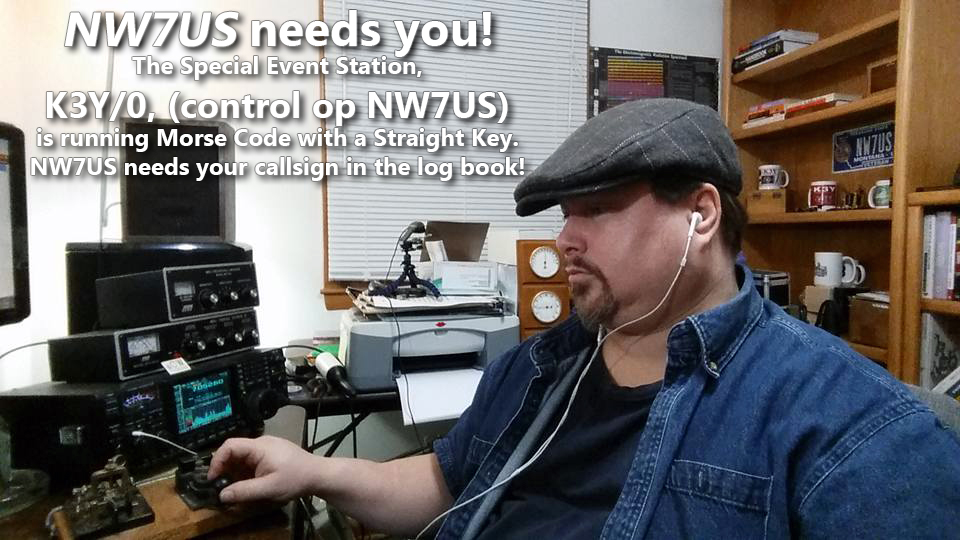 I need you to make a contact with me.
This special event takes place every year during January. We celebrate the legacy of Morse code, and promote Morse code and manual creation of the code by any non-electronic (digital) device and method. Which means that we love mechanical bugs, straight keys, two ends of a wire, or any other manual device, if Morse code is generated. The Straight Key Century Club is a free membership group. The link to their website is below.
I need you to make a contact with me, during my scheduled times, listed below.
NOTE: YOU DO NOT NEED TO BE A MEMBER OF THE (free) SKCC GROUP. To get into my logbook, you meet me on my frequency, and use Morse code to communicate with me. It is painless. If you must, you can use computer-generated Morse code. Or, you can tap it out on any Morse code signalling device, like a bug, a set of paddles, or a straight key; whatever you choose to make Morse code emanate from your HF transmitter.
HOWEVER: For those of you who want to get fully immersed in the spirit of this event, you are invited to use a straight key. And, as a bonus, you may and can join the SKCC group for FREE. Then, you would have your own SKCC number. That’d be cool; we SKCC members use that number in our exchange during our QSO information exchange. But, you don’t need that. Since it is free, why not?
What is needed is simply you, getting on the shortwave band, finding me, hearing me, and responding to me with Morse code. In other words, we need to have a QSO using Morse code. I am not a fast operator, so no problem if you are not very fast. I’ll meet your speed.
In any case, here are some of the times I will be on the air as K3Y/0… please dust off your straight key, bug, paddles, whatever, and make a QSO with me. Thanks!
My current schedule:
UTC Start/End (remember, these are NOT your local times, but are the UTC (GMT) times!)
(revised times, as of edit date)
 00:00 - 02:59 19-Jan-16
 00:00 - 02:59 20-Jan-16
 00:00 - 02:59 21-Jan-16
 00:00 - 02:59 22-Jan-16
 00:00 - 05:59 23-Jan-16
 14:00 - 18:59 23-Jan-16
 20:00 - 21:59 23-Jan-16
 00:00 - 02:59 24-Jan-16
 14:00 - 18:59 24-Jan-16
 21:00 - 21:59 24-Jan-16
 00:00 - 02:59 25-Jan-16
 00:00 - 02:59 26-Jan-16
 00:00 - 02:59 27-Jan-16
 00:00 - 02:59 28-Jan-16
 00:00 - 02:59 29-Jan-16
 00:00 - 05:59 30-Jan-16
 13:00 - 18:59 30-Jan-16
 20:00 - 21:59 30-Jan-16
 00:00 - 03:59 31-Jan-16
 13:00 - 23:59 31-Jan-16
Now, what frequency will I be on?
To find out what frequency I am on:
Visit http://g.nw7us.us/sched4SKCC and look on the right side for my callsign, NW7US. I usually post my frequency of operation right after my call sign.
Typically, evening operation is 30m, then 40m, and then possibly 80m.
If you are trying to alert me to your presence, you may message me on my personal Facebook profile, under my “Tomas David Hood” profile messages, but I may not see that right away.
Here is the detail covering the K3Y operation and the SKCC group: http://skccgroup.com/k3y
73 de NW7US
dit dit
This was last year:
https://www.youtube.com/watch?v=UfRvITFpTb4
..
..













