Author Archive
 The excitement is palpable!
 August 26th, 2013 |
  Author:
 I saw this posted on QRP-L today and decided to share it here, for those of you who might not be subscribers. This was a post by Grayson Evans, KJ7UM/TA2ZGE. It describes his recent encounter with QRP. You can almost feel his excitement and joy from his post!
Sorry, I have to admit that I’m not much of a QRPer. Not because I don’t like it or not interested, it is just that I haven’t had much luck at it. I have a hard enough time trying to make a contact with 100W out of my Kenwood something-or-other. Part of the problem (well, probably all of the problem) is my QTH. Very urban in the middle of Ankara, the capital city of 6 – 8 million. S7 background noise on 20 on a good nite. And my apartment is on the bottom floor of a 6 story concrete building surrounding on all sides by equally tall solid concrete buildings. I have tried all sorts of antennas out the window and in the small garden, but they all seem to work equally poorly. I currently have an end-fed “zepp” sort of thing strung between two street lights. It seems to work the best until a big truck takes it out.
Anyway, I have two MFJ QRP rigs I bought second hand a few years ago. One is 20M CW and SSB, 5W, the other is 40M CW only, 5W. I did make a few contacts with them when I lived in the U.S., so at one time I know they worked.
My family (wife and 11 year old son) have started doing some camping around Turkey (not a popular activity here). So I thought it would be a good idea to try some portable QRP operating in the forests. Never done it before. The first time a tried, I had all sorts of problems, nothing seemed to work. Back to drawing board.
Last weekend I tried again, took more parts, two antennas (a new 20M dipole), two batteries, etc. tuner with SWR, dummy load, and a good supply of 807’s (youngsters probably not familiar with “807s”).
This time everything seemed to work, but I could only get 1 watt out of the MFJ 20M rig (SSB and CW). OK, 1.2 watts. Also the key input didn’t work. I figured a no-go again.
Also it was a contest weekend. No surprise, there is some sort of contest every weekend here. _____ “QSO party” (fill in the blank with any european or eastern european country…they are not QSO’s, and not a party). I am not a contester but I have to admit they are good for testing antennas/rigs.
BUT, I got a big shock (emotional kind)!
First of course, zero background noise. Those little rigs have a nice receiver. I could even hear myself think with headphones on.
Second (and this is the SHOCK), if the calling station was S5+, I could work em. EVERY TIME.
I have no idea what contest I was working (the usual call sign, phony 5/9, and a sequence number), but I worked over 80 stations in a 2000 km radius over a 2-3 hr time. I haven’t had time to look up all the screwy prefixes (“DX” to you is the norm here of course), but I recognized Romania, Central Russia, Slovenia, Poland, Germany, Spain, Portugal, netherlands, Denmark, Belgium, Slovakia, Slodowneya, etc. etc.
AND, when I mentioned I was actually running 1 Watt, I got a few stations to give me a real signal report. and they were never less than S4. I got a few S8 and S9’s. how could this be?
I am impressed. This RF stuff is amazing.
I gotta try this again!
Photo is here:http://s838.photobucket.com/user/WA4GVM/media/Misc/qrpin_zpsb02e80f4.jpg.html
73, Grayson TA2ZGE/KJ7UM
(sorry this rambled)
Follow my hollow-state blog at hollowstatedesign.tumblr.com
Thanks, Grayson, for sharing. You’ll find out that most QRPers are happier for their fellow QRP’ers success, rather than their own! I hope you’ll be doing this again, and often! (Hint! I still need Turkey via QRP!)
72 de Larry W2LJ
QRP – When you care to send the very least!
Profiles in QRP – Volume 2 – Todd Fonstad N9NE
One of the nicest things about participating in the QRP Fox Hunts, is the people that you get to meet, get to know, and get to become friendly with. Some of the nicest folks on this blue marble that we call the Earth, participate in those Hunts.
Early on, I noticed there was always one station in particular that would ALWAYS blow my ears out – whether I was serving as Fox, or even when I was hearing him in the pack as a fellow Hound. I would think to myself, “Just who is this N9NE guy? Where the heck is he and what’s with that killer signal?!?” I also thought that Todd’s signal was the loudest QRP signal I had ever heard!. Whenever Todd came on the air, I always felt like the guy in the radio control room from that episode of the Little Rascals – “The International Silver String Submarine Band”.
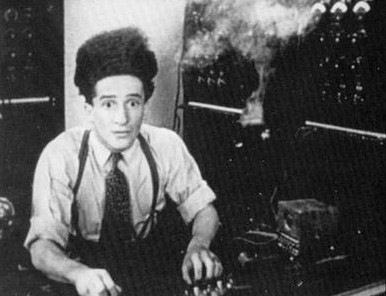
If I didn’t get the cans off my ears, I was certain to have a temporary hearing loss for at least a couple hours! I got to know Todd over the years from the Hunts, from e-mails and one-on-one QSOs on the air. Todd is one of the good people and one of the best QRPers that I know. So without further ado:
1) How did you first become interested in Amateur Radio?
My father bought me a Knight Kit ‘Ocean Hopper’ regenerative receiver for Christmas in 1957. I had to assemble it. Little did he ever imagine what a gift that would turn out to be! I had a neighbor, W9DPN, who was a ham, and he helped me along and let me listen to his conversations.There was a W0 station who used to send MCW practice on 40M, and I used to copy him, along with W1AW. The code came naturally to me. Our little city of 3500 had an active ham radio club of almost 40 members, and in 1958, there were a number of us middle and high-schoolers who got our novice and conditional licenses. No internet then! My grandfather gave me his 1928 vibroplex ‘bug’ (he had been a telegrapher on the ‘Soo Line RR’, and I started using it immediately.) I never had a hand key until years later.
2) How long have you been licensed?
March, 1958 as KN9LWV (55 years).
3) What drew you to QRP?
A friend lent me one of the first Ten-Tec QRP rigs back around 1972 or so, and I took it to the lake cottage. I was amazed at the stations I could contact. BTW, when I first got my conditional in 1959, I contacted Houston, TX with my Heathkit VF-1 VFO! I imagine there were some harmonics involved. When Heathkit came out with its HW-8, I bought and assembled it and used it portable from a number of locations as well as on some Field Days back in the 1970s. This was before there was a QRP division in contests. For me, the challenge of QRP keeps me interested: QRO (except for DX on 160M) is just too easy!
4) Who has been your biggest QRP influence?
(Hard to answer. I’m going to hve to leave a lot of deserving folks out of this 😉 Local friends (some SK now) and folks I’ve run QRP FD with in ‘exotic’ locations: K7RE in 2001 or so in a National Forest campground in NE WY (we took first place), and N0UR on his MN farm 2009 (class 2B2B which we also won). But I’d have to say Doc, K0EVZ who was my first motel-to-fixed station QSO (he was in ND, and I was vacationing in south TX). He was probably the one who interested me initially in the Fox Hunts and has been an online friend and advocate for the hunts for years. Current influences come mainly from my fellow online Fox Hunters with whom I keep in touch via e-mail and Facebook. That is real camaraderie!
5) What is your favorite QRP activity?
No problem with this one: the Fox Hunts! But I also am quite competitive in other QRP contests: 160M, ARRL SS CW and Phone, QRP-ARCI, FYBO, state QSO parties.
6) What’s your favorite piece of QRP gear (past or present)?
My QRP K2 which I built in 2000. This said, I use my K3 now in the main unless I am portable when I use my K2.
7) Describe your current QRP station.
K3 dialed down to 5W or less. I often put the Elecraft Step Attenuator inline to drop my output into the low milliwatt range if signals are strong. There’s that challenge again! I still use the K2 in the field, and have the HW-8 at the ready. Good antennas are the key to doing well with QRP: all of mine are home-brewed or modified except for my Force 12 C-4SXL 40-10M beam up 70′. (four years ago, I dug the five foot hole by hand and concreted the first 20 feet of Rohn 25 tower, also by hand … then had back surgery a year later, LOL!) I also have a 176′ doublet hanging from below the beam that really does wonders on 80M, and a 52′ high ‘vertical tee’ with 80 ground radials for 160M. It helps to have 2 acres out in the country where I have room and little noise.
8) What is your fondest QRP memory.
Three stand out:I was leading a field trip of college students to the Gulf, and we were camped on Galveston Island, TX. I had arranged a sked on 15M with my daughter (N9IJY) who was in middle school at the time. She had the use of my home station in WI, while I had a 15M dipole up 10 feet, and my HW-8 powered by a motorcycle battery. We had a near-perfect CW contact for about 20 minutes! Second, K4BAI was a fox in last summer’s 20M hunt, and the conditions were superlative. Using the Elecraft Step-attenuator, he and I hooked up with 500 microwatts of output! (the beam came in handy to say the least!). And third, I was able to complete a quick contact with Namibia (V5/DL3XX) this past winter with 5W on 160M CW just as the sun was rising on him.
9) What other hobbies/interests do you enjoy when you’re not on the radio?
Genealogy (I scan family photographs and documents), cycling, swimming, running-jogging-walking (I ‘usta’ run marathons and ultra-marathons which my disintegrating body make it impossible to do anymore!), canoeing, camping, computer use, word games, being with my son and daughter and grand kids! Am active in a small church which is my family out here in the sticks of central WI. Enjoy traveling (son lives in OR, and my late wife’s sisters and families live in OK, so I drive the 1,000 miles there quite often). I still attempt to keep up with my professional interests (I taught geography and earth sciences at a regional university) but am falling behind with all the new technology out there!.
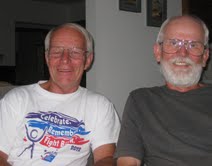
Here’s a photo of two superlative QRPers – That’s Todd N9NE on the left and Dave AB9CA on the right. Both are EXCELLENT Fox Hunters!
Todd was also kind enough to send along a post he has sent to the QRP-L e-mail reflector from back in 2005. The thread (and I remember it well!) was about “Memories of Morse Code Examinations”.
“These stories are great!
I grew up in a small community in central Wisconsin. My father (SK) bought me a Knight Ocean Hopper regenerative receiver kit for Christmas, 1957 when I was 13. I had it together in a few days and was soon getting those beautiful QSL cards from Radio Moscow and Radio Habana Cuba. There was a little ‘door’ in the top of the receiver where one would change band coils. The valves were from England. I can still remember the smell of those hot little tubes. My across-the-street neighbor was a dentist, W9DPN. I had learned the code by rote in Boy Scouts, but Doc showed me his station and how he actually communicated on CW with his Viking Ranger, HQ-129X, and a trap vertical. Within a few weeks, I passed the novice exam and had to wait about 8 weeks (forever) to get my ticket, KN9LWV, on March 19, 1958.
I then had to wait another two months before I could get the money together to buy a used Heath DX-20, sans meter! I recall stringing an 80 meter dipole and a 40 meter folded dipole above our small yard, between neighbors’ trees. My ‘TR switch’ was a DPDT ceramic hand switch, and I ‘tuned’ the transmitter by placing a light bulb between the two center contacts of the switch while holding the key down, and dipping and loading for maximum brilliance. I was probably running QRP into the antennas for the remainder of 12 months then given to Novices.
Using that Knight regenerative was a real education! Every time I would key the rig, the receiver would blank out and, of course, there was no side tone. I lost many contacts either by touching the front panel or by getting my hand too close to it, thereby changing the frequency. Later, my dad found out that a WWII veteran in town had a Hammarlund BC-779A ‘Super Pro’ receiver in his warehouse, and I was given it on permanent loan. Despite its musty smell, it served me well for several years before it died.
1958 was right at or after the greatest peak among modern solar cycles if I recall correctly. I would run home from high school, get on 15 meters (yes … the Super Pro only went up to 20 Megacycles, but I was able to ‘pull’ it up to get above 21 MCS), work several Europeans, eat, and run back to school, all in one hour. What excitement! BTW, my first DX QSL card was from G3BRA. As a 14-year old, I was so embarrassed
By the time I had finished my Novice stint, I had earned the ARRL CW Proficiency Receiving award at 20 wpm. I never had a hand key. My grandfather had been a telegrapher on the “Soo Line’ RR, and I inherited his 1928 Vibroplex bug.
Within that year, I passed my conditional exam, and some years later (in the late 1960s), I took the Chicago and Northwestern passenger train (SK!) from downtown Oshkosh to within a few blocks of the Federal Building in downtown Chicago.The train was scheduled to get there by about noon, but due to some sort of problem, it arrived at 2 pm. I had studied for the Extra, and now had less than 3 hours to pass the CW and technical exams for the General, Advanced, and Extra. I got to the Extra with 20 minutes to spare … passed the code, but had to rush the exam such that when ‘The Man’ corrected it, he stated in a loud voice “You fail!”.
I finally passed the Extra in Dallas in the early 1970s while a graduate student at the University of Oklahoma. My wife and I drove from Norman to the Federal Building there, and I took the code test in a small room. Receiving was no problem, but I hadn’t touched a hand key much, and sending at 20 wpm was a real trial. The written exam was taken in a large room, filled with thirty or forty persons. The answers were coded onto an answer sheet (no written answers or schematics by then!), and I took it to the glass-enclosed office where a young lady corrected it by hand. I was confident I had passed and was astounded to see her check one answer after another as incorrect with her red pencil! She looked at me and said “I’m sorry, but you failed.” I was so upset and said ‘what?’ so loud that most of the heads in the examining room raised to see what the ruckus was! I told her that it was possible that I had failed, but not by that many questions. She re-examined my answer sheet, then sheepishly told me that she had just used the wrong exam master! The correct one exonerated me, and rest is history.
I changed K9LWV to N9NE soon after that because it sounded nice on CW. If you ‘Google’ N9NE, you will find some real surprises!”
Thanks, Todd for taking the time to answer my questions and for providing the extra history. This is the part of Ham Radio that I love the best – the personal histories and the stories – everyone has them!
72 de Larry W2LJ
QRP – When you care to send the very least!
QRP and Frustration
One of the biggest caveats that’s always mentioned to potential QRPers is what I like to call the “frustration factor”. All the QRP “how to” books bring this up. I’ve read them, you’ve read them …… I’m sure you’re familiar with all the bug-a-boos:
“Hams new to HF should never start out using QRP.”
“QRP is difficult, don’t expect much success.”
And my favorite – “Never call CQ using QRP.”
In my personal and most humble opinion, these statements, if they are taken as absolute truisms or rules of thumb, are pretty much hogwash.
But rather than refute these, or dwell on the negatives, I would like to accentuate the positives. If you’re new to the QRP game or are perhaps thinking of dipping your toe into low power waters, you SHOULD do several things to maximize your chances for success.
DO put up the best antenna that you can. A tower and beam are the best, if you have deep pockets and plenty of property and an understanding wife. If you’re like the rest of us mere mortals, that will probably mean dipoles, verticals or whatever. If you can, put them outside and put them up as high as circumstances permit. If you install a ground mounted vertical (not a bad choice) lay down as many radials as you can. If you’re stuck in HOA Hell, attic dipoles have yielded success. Magnetic loops, either home brewed or commercially built, such as the Alex Loop have saved the bacon of many covenant restricted Hams.
But whatever the case may be, just remember a quote that my friend Chris KQ2RP recently reminded us all about in his blog. To quote K2TK, “A poor antenna has infinite gain over no antenna”. In other words, while a better and higher antenna will maximize your QRP experience, ANY antenna is better than none. However, if you’re reduced to loading up your mattress boxspring, then you had better lay in a supply of Advil. Do whatever you can to put up the best aerial you can under your circumstances. This is not the place to skimp.
DO use the full “QRP Gallon”, which is the full 5 Watts for CW or 10 Watts for SSB, if you’re just starting out. While Rockmites and other flea powered radios do a great job, save QRPp for after you’ve gained some experience. QSOs made with less than a Watt ARE a heckuva lot of fun, but if you’re a QRP Newbie, save them for later.
DO make use of the various tools available to you. Reverse Beacon Network is one of these. Not only can you use RBN like a Cluster, to see who is on and who is calling CQ, but you can use it to gauge your own performance. Not getting any answers to your CQs? Check out your own call on RBN to see where and how you’re being heard. You can also use RBN to compare one antenna against another. I did this to check out my vertical vs. my wire on 80 Meters one Autumn evening last year. I picked a lonely, deserted frequency and called CQ with one antenna for about five minutes, and then switched. By going to RBN, I was able to see how (roughly) how one did against the other.
And while we’re talking about calling CQ, go right ahead and call CQ if you want to. Odds are you will be heard by someone, somewhere, depending on propagation. Many times, when a band has seemed dead, I have called CQ and have been answered, and have had great QSOs. I see no reason on God’s green Earth why calling CQ should be limited to those running power.
DO jump into the DX pileups! This will give you experience, which will be your greatest teacher. Getting on the air, making QSOs, and experimenting with antennas, participating in the QRP Fox hunts will teach you more than any Website, book, or Elmer. Getting your hands dirty and learning “when to hold ’em and when to fold ’em” will make you a veteran QRP op in no time. But remember, then it will be YOUR time to share what you have learned with those who come after you.
72 de Larry W2LJ
QRP – When you care to send the very least!
Nice rag chew
Today’s QSO was a very pleasant 20 minute rag chew with Gene N5GW. Gene and I have worked each other countless times, but to be honest with you, the majority of our conversations have sounded something like this:
N5GW DE W2LJ UR 559 NJ 5W
W2LJ DE N5GW TU UR 559 MS 5W
N5GW DE W2LJ TNX 72 DE W2LJ QRZ?
But as I stated before, today we had an actual conversation – no QRP Sprint exchange …. for a change!
And this time, Gene was not in Mississippi, he was in Tennessee, on vacation on the Cumberland Plateau. Gene and his XYL are enjoying the mountains, and having a gold old time. Gene brought along his IC-7000 and strung up a wire antenna in an oak tree outside their cabin. Gene had a good 589 signal into New Jersey, and I got a 559/569 report in return.
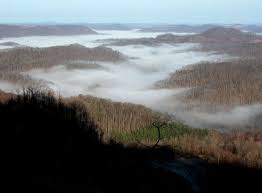
Gene had the good fortune of having a good antenna (even though it’s temporary), and high elevation. That combination gave him a winning signal.
It’s always a delight to actually converse with guys that I’ve only held brief QSOs with. QRP is not just contesting and sprints. It’s also very much getting to know the other guy, just like in the other niches of Amateur Radio. And this is the better part, because this is where the lasting friendships are made.
72 de Larry W2LJ
QRP – When you care to send the very least!
I’m having fun!
I know that band conditions aren’t the best. And I also know that this Sunspot Cycle 24 maximum, as compared to other sunspot cycle maximums has been kinda “meh”. But you know what? I’m having fun despite the band conditions!
You can sit around and pee and moan about “How this sure wasn’t like the cycle we had back in ’57 when you could work the world with a 1/2 Watt and a wet string!”, or you can get on the air and choose to operate. I choose the latter.
Today was another successful lunchtime QRP session. The KX3 and Buddistick successfully netted S564EB, which is a special event station commemorating the European Basketball Championships in Slovenia. A little later, still on 17 Meters, I bagged IS0GQX, Bruno in Sardinia for that country on a new band.
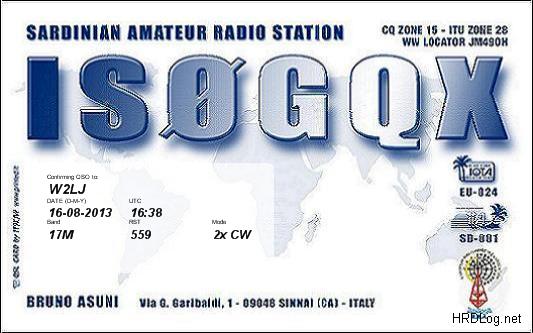
When the sunspot cycle does finally dwindle to weeks and months of little or zero spots, I’m sure that this “not so great” maximum is going to look mighty fine from the rear view mirror. As long as it lasts, I am going to keep at it. 5 Watts to a Buddistick plopped on top of my Jeep – every QSO amazes me!
Now, to another matter. The period for submitting log entries for the Skeeter Hunt is entering the halfway mark. Next Sunday, August 25th at 11:59 PM EDT, is the absolute final deadline for log submissions. So far, I’ve received 55 log summaries. That’s about 1/3 of the people who signed up for Skeeter numbers. In fact, I’ve received two log summaries from Non-Skeeters! So if you participated, please send me a log summary.
For some VERY preliminary results, you can go to – http://www.qsl.net/w2lj/index%20page%205
If you submitted a log and you don’t see your numbers next to your call, then I didn’t get them. Please send them again! Soapbox comments and photos will appear after next Sunday.
So far here are some standings:
Top 5 finishers:
KX9X
N5GW
KX0R
NK9G
N0SS – who is also top multi op finisher so far.
Top multi op, multi transmitter is WQ4RP (so far).
Top mixed (SSB and CW) – W9LR
Top SSB – a tie between KK4NWC and KC5FM.
Hope to see your numbers soon!
72 de Larry W2LJ
QRP – When you care to send the very least!
A very special day
Today is a special day if you’re of Polish descent, Catholic, and a Ham Radio operator. Today is the feast day of St. Maximilian Kolbe. For those of you who are not Catholic, a Saint’s Feast Day commemorates the day that the faithful believe that the Saint left this earthly existence, directly heading to Heaven for his or her eternal reward.
It was on August 14, 1941, that Father Maximilian Kolbe, a Franciscan friar died from an injection of carbolic acid. Fr. Kolbe was a detainee at Auschwitz, during WWII. He was sent there for the crime of providing shelter and safe harbor to over 2,000 Polish Jews in his friary at Niepokalanów.
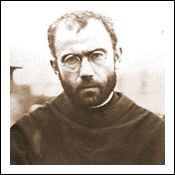
At the end of July 1941, three prisoners disappeared from Auschwitz, during what appeared to be a successful prison break. To retaliate, the deputy camp commander picked out 10 men at random to be starved to death. One of the chosen men, Franciszek Gajowniczek, cried out that he had a wife and children and begged for mercy. Fr. Kolbe heard this and asked, and was granted permission to take Gajowniczek’s place.
In the starvation bunker where the condemned men were being kept, Fr. Kolbe celebrated Mass each day and led the men in hymns and prayers. Two weeks later, after all the men had passed, Fr. Kolbe was the last condemned prisoner left alive. The Nazi’s had other plans for that bunker, so to end it all, Fr. Kolbe was given the lethal injection.
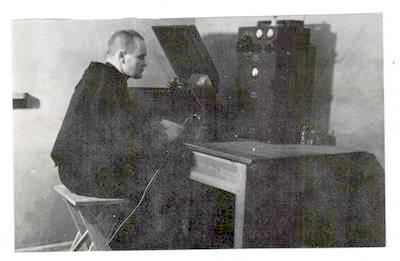
But during his lifetime here on earth, Fr. Max was unique among Saints, as he was an Amateur Radio operator. His call sign was SP3RN, and this might be the only photo in existence of him “at the key”, so to speak.
High noise level
I was fighting a high ambient noise level tonight, while participating in the monthly NAQCC Sprint. Not as terrible as it was a few years ago, when 40 Meters was so bad that I had to abandon the 40 Meter Fox Hunts, but bad enough to be annoying.
With the goofy damp weather we have been having, I think the local QRN was due more to atmospherics, than anything else. I’ll have to see how the band conditions are over the next few days.
In any event, I racked up 22 QSOs during the during the Sprint, almost evenly divided between 40 and 20 Meters. It ended up being 10 QSOs on 20 Meters and 12 on 40 Meters. Not my best effort, by any means, but not abysmal, either.
I was happy to work Jim W1PID at the very end, but was disappointed that I was not able to get a QSO in with my two NJ buddies, Don W2JEK, or Charles W2SH. They were both sitting on frequencies, running mini pileups, and I could just not break through.
Just goes to show you ….. sometimes you get the bear, and sometimes the bear gets you.
72 de Larry W2LJ
QRP – When you care to send the very least!














