Author Archive
 The Android HT – Part 2
 November 10th, 2012 |
  Author:
 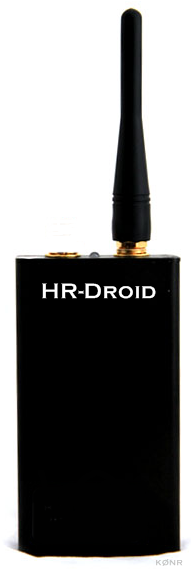 My article on the Android HT generated some interesting comments and ideas. Thanks so much! One of the main themes in the feedback is to have the radio be “faceless”, with the user interface done on a mobile device (i.e., smartphone or tablet). The mobile device would communicate to the transceiver via Bluetooth (or maybe WiFi). This approach has the advantage of separating the radio hardware (which probably doesn’t need to change very often) from the compute/display hardware (which is on a faster-paced technology path). I went ahead and hacked together a concept photo of such a device (click the photo to enlarge it). This device could interface with any mobile device that has a Bluetooth interface, so it would be independent of OS on the mobile device (yes, you could use your iPhone).
Such an approach opens up a variety of use models. Imagine sticking the transceiver in your backpack and using an app on your smartphone to enjoy QSOs when hiking. Alternatively, the radio could hang on your belt. At home, the radio could be left in some convenient location, connected to an external antenna on the roof and operated from the mobile device. (Low power Bluetooth is said to have a range of about 10 Meters.) These are just a few thoughts…I am sure you can think of others.
I would expect the original Android HT concept to be easier to use for casual operation, due to the All-In-One Design with dedicated hardware volume control, channel select and PTT switch. I am assuming those functions would be implemented in software in the faceless implementation, which would likely be less convenient. Most mobile devices have their own GPS system included, so that would mean one less thing that has to be in the radio.
The other idea that surfaced in the feedback is using Software Defined Radio (SDR) technology to implement the transceiver. This would provide a higher degree of flexibility in generating and decoding signals, enabling additional areas of innovation. That is a great idea and will require a whole ‘nuther line of thinking.
73, Bob K0NR
The Android HT
 I’ve been watching all of the innovative work going on in the smartphone and tablet arena and wondering how we could get more of that going in ham radio. To be sure, there are always radio amateurs developing creative technology. Some examples are adaptations of D-STAR, IRLP, improvements on APRS and sound card modulation modes. However, amateur radio is missing a standardized platform for handheld communications. Such a radio platform could open up lots of software innovation in this space.
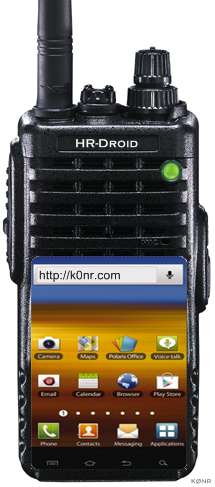
What I have in mind is a dualband (2M/70cm) handheld transceiver that is built on top of the Android operating system. (Sorry Apple Fan Boys, iOS is a non-starter based on Apple’s walled garden philosophy.) This radio would have some of the hardware features we now take for granted in smartphones: GPS, WiFi, USB, maybe even a camera. I’d also include APRS hardware built-in, similar to the Yaesu VX-8GR or the Kenwood TH-D72A. I’ve hacked together a concept photo shown on the left of this post (click to enlarge). We would probably want to maintain some of the most important direct hardware controls such as PTT, volume and channel select. The rest of the user interface would be done via a touchscreen display, where the power of the Android OS comes into play.
While this hardware configuration is exciting, the real power comes from having a software developers kit (SDK) with a stable Application Programming Interface (API). This would unleash the creativity of all those software-oriented hams out there and a plethora of apps would emerge. There are plenty of ham radio apps available on the Apple and Android platforms…it’s just they are missing the radio as part of the package. An obvious area for innovation would initially be in APRS or maybe D-STAR. We could actually have the equivalent of SMS text messaging on ham radio, backed up via the WiFi connection. (Yeah, this kind of exists already but it is really cumbersome to use due to the braindead menu-driven user interfaces of current radios.) Just think how easy programming the radio would be with a touchscreen approach.
This is the type of product development that requires significant investment, but the technology is readily available. I suppose a garage shop operation could get this done but one of the big radio manufacturers could easily pull this off. Maybe one of those upstarts from China might want to take this on. Whoever does it, just send me $5 per unit and I’ll be happy  .
.
That’s my best idea for this morning. What do you think?
73, Bob K0NR
Seventy Three
 Like many technical activities, amateur radio has its own set of jargon and protocols used both on and off the airwaves. As part of our Technician license course, we cover basic jargon but also encourage the use of plain language. A new Technician recently asked about the use of the term “73″ on the local FM repeater, so I am posting this short piece.
Much of amateur radio history and practice is rooted in Morse Code, which traces back to the electrical telegraph. Two shorthand codes you’ll hear on both voice and Morse Code communications are:
73 means Best Regards
88 means Love and Kisses (sometimes Hugs and Kisses)
These codes originated with telegraph operating and are listed in the Western Union 92 Code, a set of numerical shorthand codes. On voice (phone) transmissions, you often hear something like this:
“Great to talk to you, Joe. Thanks and Seventy Three. This is K0NR, clear.”
Since 73 is often used at the end of a radio contact, it almost takes on the meaning of “best regards and goodbye.” “Eighty Eight” is used in a similar manner but is heard much less frequently on the ham bands.
Sometimes you’ll hear 73 expressed as “Seven Three”, which corresponds to how the Morse characters were sent. It is incorrect to say “Seventy-Three’s” since this would literally mean “Best Regards’s”. Of course, most of us have made this error from time to time, very similar to grammatical errors in the English language. (“Somes time we forget to talk good.”)
QRP operators often use 72 instead of 73 because low power operating is all about getting by with less. See W2LJ’s blog.
And I normally use 73 at the end of most ham radio related email messages.
73, Bob K0NR
This Spewed Out of the Internet #23
 Just catching up on a few things spewing forth from the internetz.
From the Great Minds Think Alike Department, Jeff KE9V suggests that the world needs a really good transceiver focused on 50 MHz and higher. I’ve always had this irrational attraction to VHF and higher and would love to have a solid radio in this category.
Don’t miss the Jamboree On The Air (JOTA) this weekend. Also, take a look at this ARRL article on Radio Scouting. Our local Scout troop will be on the air as KB0SA for JOTA.
Based on the blog posting by Jerry KD0BIK, I picked up a Kelty Redwing backpack, for SOTA and other hiking activities. The 20% off coupon for REI was a good incentive to pick up the pack.
I managed to miss the 2012 Pacificon hamfest. Early in the year, I figured out that I needed to be in the San Francisco area right around the Pacificon date, so it looked like a sure thing. Unfortunately, circumstances changed and I missed it again this year. I keep hearing great things about Pacificon so it may be the best hamfest in the USA, based on a quality venue and great programs. I will have to wait until next year to validate this theory.
The LA Times has a great time-lapse photography video of space shuttle Endeavor moving through the streets of LA. Check it out.
HamRadioSchool.com has a neat video of a flagpole vertical antenna getting installed. There’s some really good content on that website. But I might be biased, since I’ve been contributing a few articles under the Shack Talk banner.
My buddy Ken WA6TTY has written a review of the new ARRL RFI Book. Ken is an EMC expert and does an excellent job of reviewing the book.
- 73, Bob K0NR
FCC Proposes Part 97 Changes
 The FCC finally got around to addressing a number of issues via a NOTICE OF PROPOSED RULE MAKING AND ORDER. This proposal is an odd mix of Volunteer Examiner (VE) rules, changing the license renewal grace period and dealing with a problem with emission designators.
This notice proposes changes to Part 97 of the FCC Rules and seeks comment on these proposals:
- Require that VEs give examination credit to an applicant who can demonstrate that he or she formerly held a particular class of license
- Provide that a CSCE provides element credit for the holder’s lifetime
- Reduce the grace period for renewal of an expired license to six months
- Reduce the time before a call sign becomes available for reassignment to six months (to match the grace period)
- Reduce the number of VEs required to administer an examination from three to two
- Allow remote observation of examination sessions by VEs (allow exams to be given via an audio and video system)
- Clean up some issues in the rules concerning Morse code testing (which has been eliminated)
- Allow emission types FXE and FXD to clear up issues concerning MOTOTRBO and DMR (see my previous post on this topic)
Comments on theses items must be filed with the FCC within 60 days.
73, Bob K0NR
Can I Use My Ham Radio on Public Safety Frequencies?
 We have quite a few licensed radio amateurs that are members of public safety agencies, including fire departments, law enforcement agencies and search and rescue. Since they are authorized users of those public safety channels, they often ask this question:
Can I use my VHF/UHF ham radio on the fire, police or SAR channel?
It is widely known that many amateur radios can be modified to transmit outside the ham bands. The answer to this question used to be that amateur radio equipment cannot be used legally on public safety channels because it is not approved for use under Part 90 of the FCC Rules. (Part 90 covers the Private Land Mobile Radio Services.) The only option was to buy a commercial radio with Part 90 approval and a frequency range that covered the desired amateur band. Some commercial radios tune easily to the adjacent ham band but some do not. The commercial gear is usually two to three times as expensive as the amateur gear, and just as important, does not have the features and controls that ham operators expect. Usually, the commercial radios do not have a VFO and are completely channelized, typically changeable only with the required programming software.
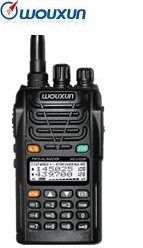
The situation has changed dramatically in the past two years. Several wireless manufacturers in China (Wouxun, Baofeng, etc.) have introduced low cost handheld transceivers into the US amateur market that are approved for Part 90 use. These radios offer keypad frequency entry and all of the usual features of a ham radio. It seems that these radios are a viable option for dual use: public safety and amateur radio.
Here is a short list of the most common radios on the market:
| Model | Features | Price |
| Wouxun KG-UV2D, KG-UV3D | Several different models with slight variation in features, check carefully before ordering 136-174/420-470 MHz 5 kHz is smallest frequency step | $120 |
| Wouxun KG-UV6D | Several different models with slight variation in features, check carefully before ordering 136-174 / 420-520 MHz 2.5 kHz frequency step | $175 |
| Baofeng UV-5R, UV-5RC | The UV-5RC is an updated case style 136-174 / 400-480MHz 2.5 kHz frequency step | $65 |
Some Things to Consider When Buying These Radios
- The manufacturers offer several different radios under the same model number. Also, they are improving the radios every few months with firmware changes and feature updates. This causes confusion in the marketplace, so buy carefully.
- Make sure the vendor selling the radio indicates that the radio is approved for Part 90 use. I have seen some radios show up in the US without an FCC Part 90 label.
- Make sure the radio is specified to tune to the channels that you need.
- The 2.5-kHz tuning step is required for some public safety channels. Your particular set of frequencies may or may not need it. For example, a 5-kHz frequency step can be used to select frequencies such as 155.1600 MHz and 154.2650 MHz. However, a 2.5 kHz step size is needed to select frequencies such as 155.7525 MHz. There are a number of Public Safety Interoperability Channels that require the 2.5-kHz step (e.g., VCALL10 155.7525 MHz, VCALL11 151.1375 MHz, VFIRE24 154.2725). The safest thing to do for public safety use is to get a radio that tunes the 2.5-kHz steps.
- Although these radios have two frequencies in the display, they only have one receiver, which scans back and forth between the two selected frequencies. This can be confusing when the radio locks onto a signal on one of the frequencies and ignores the other.
Recommendation
I own 3 different models of Wouxun radios and two Baofeng UV-5R radios. I think they are all great radios for what they do. For serious public safety use, I would recommend getting the Wouxun KG-UV6D with the 2.5-kHz frequency step. The controls of the Wouxun are superior, including a knob for channel/VFO selection and RPT key for changing repeater shift. The Wouxun software works much better than Baofeng’s (which is really a mess). Also, if you show up at an incident with the Baofeng, your fellow first responders will think it is a toy. If you are absolutely sure you don’t need the 2.5-KHz frequency step, then you might consider one of the other Wouxun models.
I have purchased several radios from importcommunications.com and have been very satisfied with the service. You may want to shop around for the best price.
73, Bob K0NR
VHF SOTA Activation (W0/ SP-081)
It was another great day for Summits On The Air (SOTA) activity. I hiked up to Kaufman Ridge HP (W0/SP-081) with Joyce K0JJW to do the first SOTA activation of that summit. This summit is just south of Kaufman Ridge North (W0/SP-085) mentioned in this post.
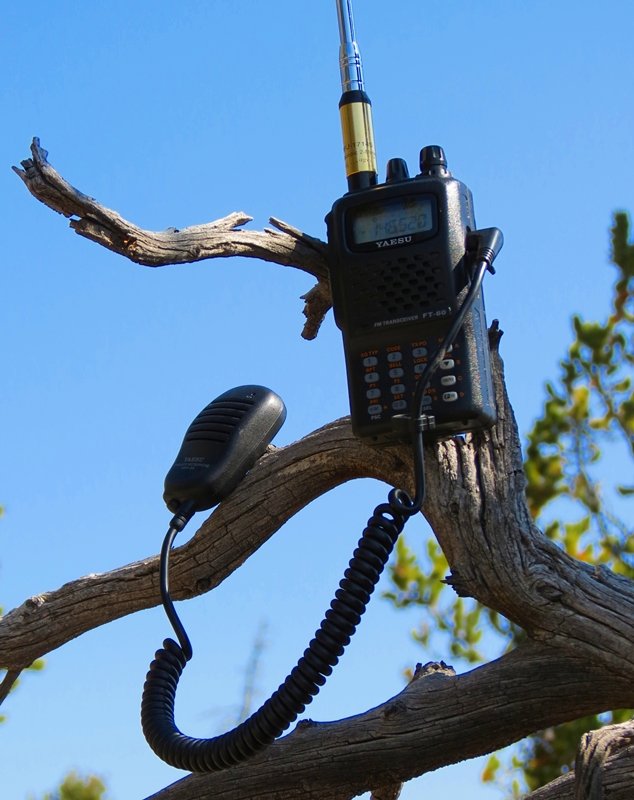
Unlike some of my previous SOTA activations, I actually kind of sort of planned this one. I had my Yaesu FT-60 HT with a decent omni antenna for 2 Meters (the MFJ-1714). I also took along the VX-8GR handheld for use as an APRS station. Note the innovative In The Tree mounting scheme for the FT-60:
On the way up, I heard Steve WG0AT on the summit of Mount Rosa (W0/FR-034) calling on 146.52 MHz. I gave a quick call to Steve to let him know I was hearing him but that I was not at the summit yet. About 20 minutes later, I was on top and worked Steve and his hiking partner Frank K0JQZ, for a summit-to-summit contact.
A call on 146.52 MHz got a reply from John N0EVH who was operating mobile. Then I worked Bill KD0PFF who was driving up a 4WD road to Red Cone Peak. Later, I worked his 4WD partner Stan KD0PFC. Fred WA0SIK, a regular in the various VHF contests, came up on five two to give me another contact. Then I got a call from Dave K0HTX who spends many weekends over on the other side of South Park. Finally, I caught Randy KN0TPC and Jeremy KD0MWT on 147.555 MHz, near Divide at a Boy Scout Camporee.
It was really cool to catch all these folks out having fun in the mountains. It was a glorious fall day and the aspen trees were at their peak fall color.
73, Bob K0NR













