Author Archive
 Another June VHF Contest In the Bag
 June 18th, 2015 |
  Author:
 Last weekend was the ARRL June VHF Contest, my favorite ham radio event of the year. For me, this is “vhf activity weekend” when all of the vhf radio enthusiasts come out to play on the bands above 50 MHz. The sporadic-e propagation that is (almost) always present during the contest means that 6 meters will be hopping.
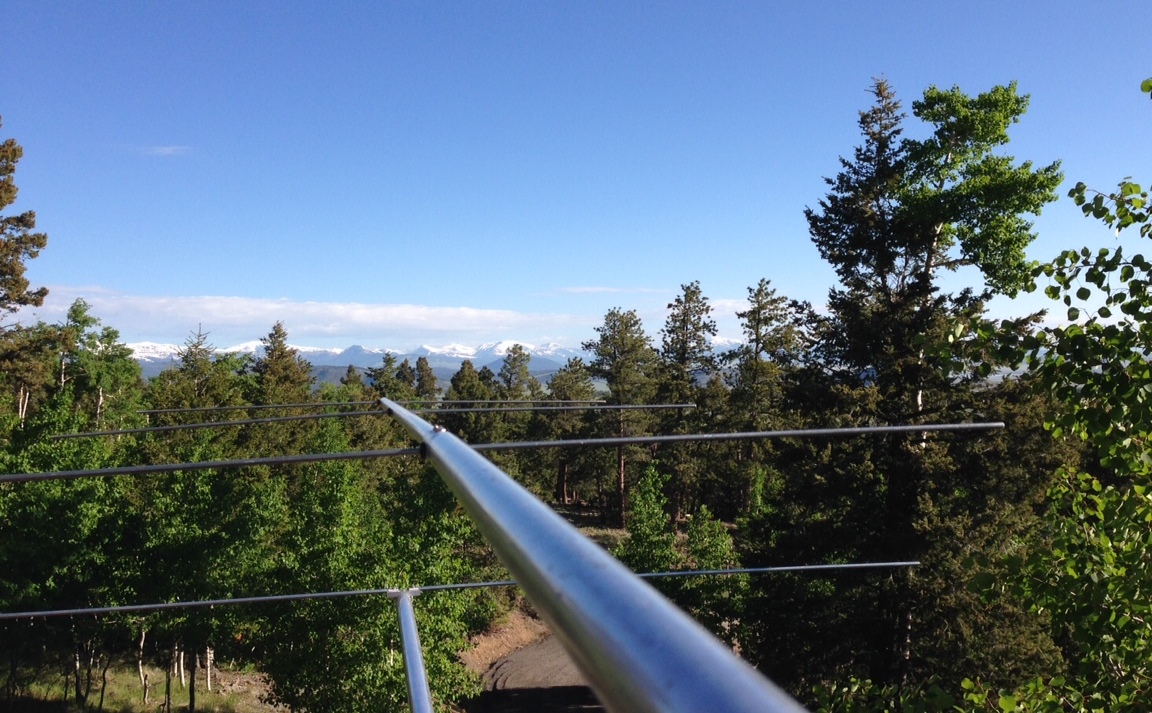 I entered in the 3-Band Single Operator category, using 6m, 2m and 70cm. My 6m rig is a Yaesu FT-950 driving a 6M5XHP Yagi antenna. For 2m and 70cm, I use a Yaesu FT-847 to drive a 2M9SSB Yagi on 2m and a similar Yagi for 70 cm. I set up portable masts at our cabin in DM78av, near Trout Creek Pass, Colorado (9600 feet).
This year, propagation seemed OK but not great. My score turned out to be about the same as last year with similar effort and same equipment, but down from previous years. 6m had sporadic-e openings very late both evenings, about the time I was ready to give up. Fortunately, I stuck with it and made quite a few contacts late into the evening.
The rovers kept things from getting too boring when 6m was not cooperating. Thanks to W3DHJ/R, ABØYM/R and WE7L/R for roving in eastern Colorado. WBØGAZ/R passed through South Park heading towards Denver and give me a few contacts. I also got a few contacts from KØCS/R and KØJJW/R. Thanks for roving!
Best DX was ZF1EJ in EK99, a new country for me on 6m.
73, Bob KØNR
K0NR June VHF Contest Summary:
 Band  QSOs  Mults
-------------------
    6:  190    83
    2:   30    13
  222:
  432:   11     6
-------------------
Total:  231    102  Total Score = 24,684
The post Another June VHF Contest In the Bag appeared first on The KØNR Radio Site.
We Call It “Tech Field Day”
For Field Day this year, the Tri-Lakes Monument Radio Association (WØTLM) is planning a one day event that combines our Tech Day training activities with normal Field Day radio operating. This Tech Field Day will have a strong emphasis on radio education and training, including an opportunity to make contacts on the HF bands under the supervision of an experienced radio ham.
click to expand
Sat June 27th, 2015 (8:00 AM to 5 PM)
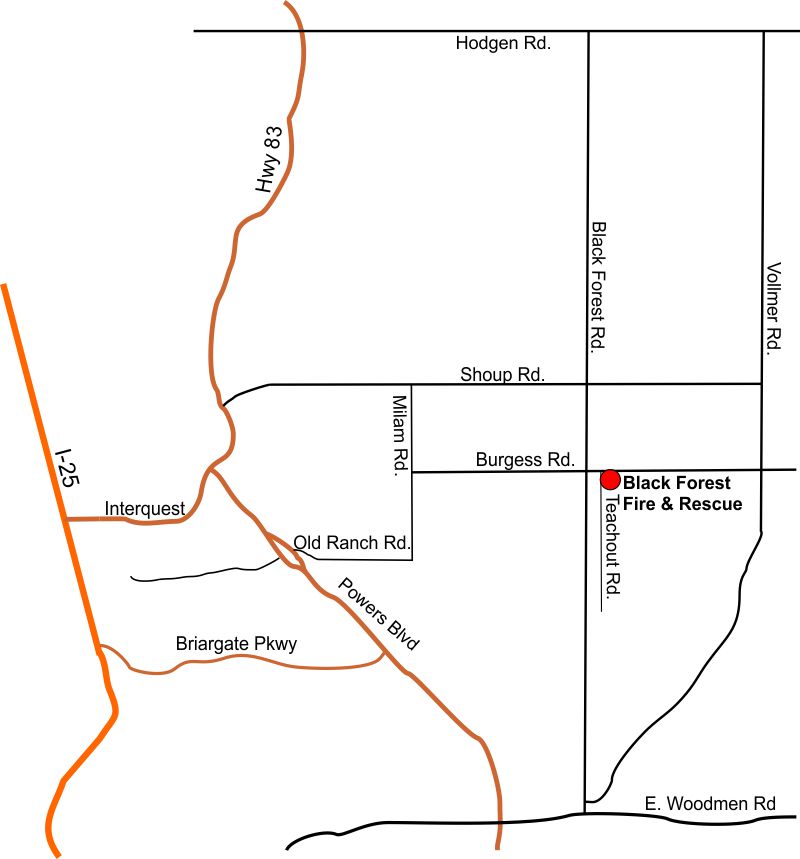
Location: Black Forest Fire Station 1
11445 Teachout Road, Colorado Springs
Come to our one-day education and radio operating event and learn from informative presentations of amateur radio topics. Operate a high frequency (HF) radio station with the helpful guidance of an experienced radio ham. Learn about emergency communications and public service. Most of all, have a bunch of fun messing around with ham radio stuff!
| Time | Activity | Presenter |
| 8:00 | Setup starts | |
| 8:30 | FM Simplex and Repeaters | Bob Witte, KØNR |
| 9:30 | Operating SSB on the HF Bands | Stu Tuner, WØSTU |
| 10:30 | Construction of Dipole Antennas | Larry Kral, NØAMP |
| 11:30 | Summits On The Air (SOTA) | Steve Galchutt, WGØAT |
| 12:00 | Start Field Day Operating | |
| 13:30 | Copper pipe antennas | Al Andzik, WBØTGE |
| 14:30 | Emergency Power for Ham Radio | Mike Hoskins, WØMJH |
| 15:30 | Ask an Elmer Panel | Bob Witte KØNR and crew |
| 17:00 | End of operations – tear down |
For more information, visit the W0TLM web site.
73, Bob K0NR
The post We Call It “Tech Field Day” appeared first on The KØNR Radio Site.
Good Operating Habits on Field Day
In preparation for ARRL Field Day, I will be doing a presentation at our radio club meeting, explaining how FD works. We have lots of newer hams, so I want to cover the basics well. I looked around on YouTube for some video of typical Field Day contacts so our members could hear what it sounds like.
This video shows Andy K5PO doing an outstanding job of operating the WR5P Noise Blankers Field Day station. Give a listen and notice how he keeps the contacts short and to the point, clearly communicating using phonetics.
73, Bob K0NR
The post Good Operating Habits on Field Day appeared first on The KØNR Radio Site.
Can I Use My Ham Radio on Public Safety Frequencies? Updated
This is an update to one of my most popular posts.
 We have quite a few licensed radio amateurs that are members of public safety agencies, including fire departments, law enforcement agencies and search and rescue. Since they are authorized users of those public safety channels, they often ask this question:
Can I use my VHF/UHF ham radio on the fire, police or SAR channel?
It is widely known that many amateur radios can be modified to transmit outside the ham bands. The answer to this question used to be that amateur radio equipment cannot be used legally on public safety channels because it is not approved for use under Part 90 of the FCC Rules. (Part 90 covers the Private Land Mobile Radio Services.) The only option was to buy a commercial radio with Part 90 approval and a frequency range that covered the desired amateur band. Some commercial radios tune easily to the adjacent ham band but some do not. The commercial gear is usually two to three times as expensive as the amateur gear, and just as important, does not have the features and controls that ham operators expect. Usually, the commercial radios do not have a VFO and are completely channelized, typically changeable only with the required programming software.
The situation has changed dramatically in the past few years. Several wireless manufacturers in China (Wouxun, Baofeng, Anytone, etc.) have introduced low cost handheld transceivers into the US amateur market that are approved for Part 90 use. These radios offer keypad frequency entry and all of the usual features of a ham radio. It seems that these radios are a viable option for dual use: public safety and amateur radio, with some caveats.
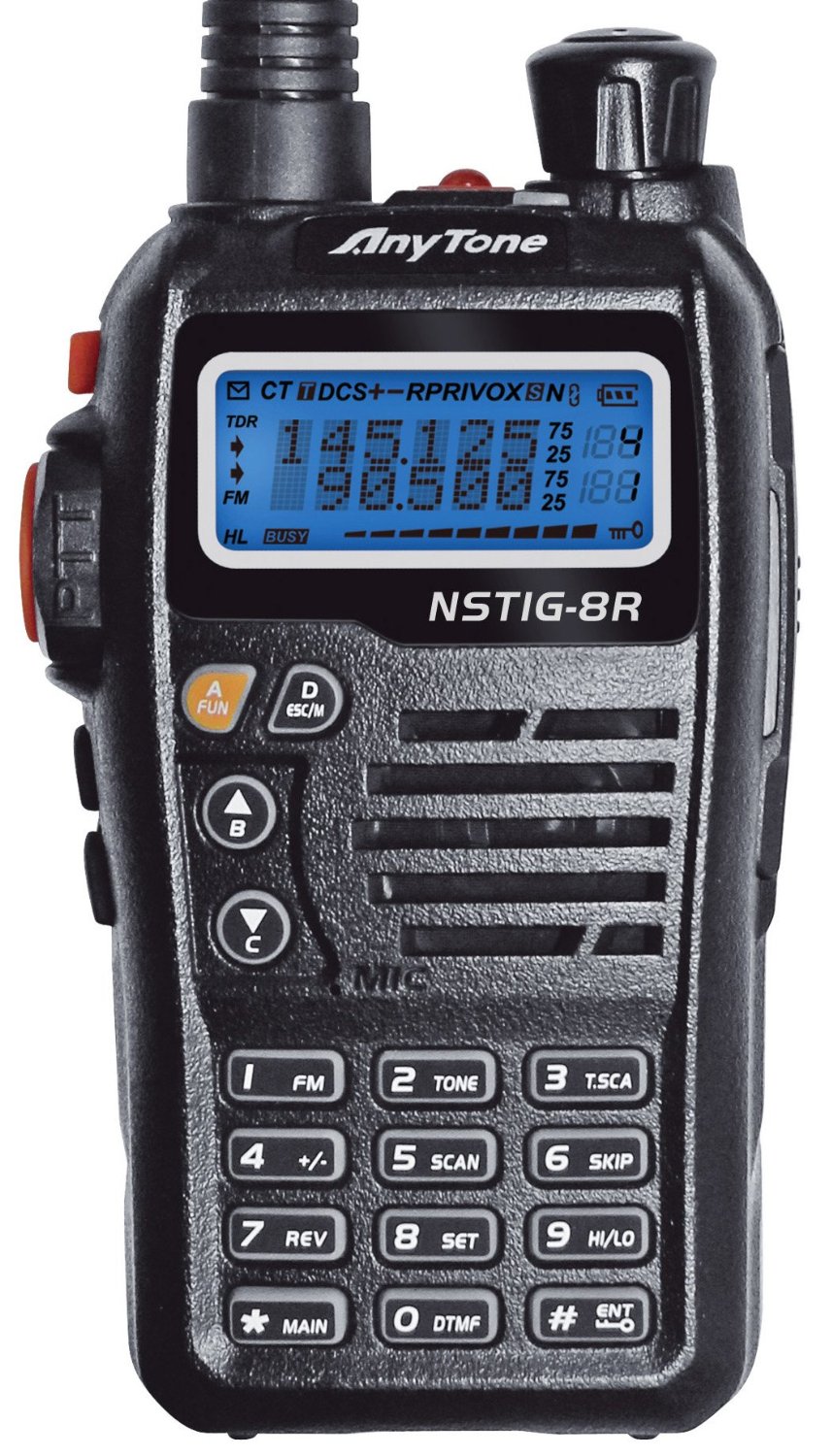
New radios are being introduced frequently, so I won’t try to list them here. However, you might want to do a search on Wouxun, Baofeng and Anytone for the latest models. I will highlight the Anytone NSTIG-8R radio which I have been using. It seems to be a well-designed but still affordable (<$75) handheld radio. See the review by PD0AC.
Some Things to Consider When Buying These Radios
- The manufacturers offer several different radios under the same model number. Also, they are improving the radios every few months with firmware changes and feature updates. This causes confusion in the marketplace, so buy carefully.
- Make sure the vendor selling the radio indicates that the radio is approved for Part 90 use. I have seen some radios show up in the US without an FCC Part 90 label.
- Make sure the radio is specified to tune to the channels that you need.
- The 2.5-kHz tuning step is required for some public safety channels. For example, a 5-kHz frequency step can be used to select frequencies such as 155.1600 MHz and 154.2650 MHz. However, a 2.5 kHz step size is needed to select frequencies such as 155.7525 MHz. There are a number of Public Safety Interoperability Channels that require the 2.5-kHz step (e.g., VCALL10 155.7525 MHz, VCALL11 151.1375 MHz, VFIRE24 154.2725). The best thing to do for public safety use is to get a radio that tunes the 2.5-kHz steps.
- Many of these radios have two frequencies in the display, but only have one receiver, which scans back and forth between the two selected frequencies. This can be confusing when the radio locks onto a signal on one of the frequencies and ignores the other. Read the radio specifications carefully.
Recommendation
There are a number of reasonably good radios out there from various manufacturers. My favorite right now is the Anytone NSTIG-8R but I also like the Wouxun KG-UV6D. The Baofeng UV-5R continues to be popular in the amateur community as the low cost leader. However if you show up at an incident with the Baofeng, your fellow first responders will think it is a toy. Which leads to a really important point: the established commercial radio manufacturers such as Motorola, Vertex, etc. build very rugged radios. They are made for frequent, heavy use by people whose main job is putting out fires, rescuing people in trouble and dealing with criminals. These low cost radios from China are not in the same league. However, they can still serve in a less demanding physical environment while covering the Amateur Radio Service (FCC Part 97) and the Private Land Mobile Radio Services (FCC Part 90).
73, Bob K0NR
The post Can I Use My Ham Radio on Public Safety Frequencies? Updated appeared first on The KØNR Radio Site.
Three Common Mistakes When Using Metric Units
 A while back, I had someone point out a few errors I made concerning the use of metric units. This caused me to review the SI system to make sure I had it correct. (I am sure I’ll continue to screw up a few things but, hey, life is a journey.)
The International System of Units, universally abbreviated SI (from the French Le Système International d’Unités), is the modern metric system of measurement. For a thorough treatment of the topic, take a look at the National Institute of Standards and Technology (NIST) publication: Guide for the Use of the International System of Units (SI). A shorter and easier-to-read document was written by Charles Poynton: Writing SI units and symbols.
But more to the point, here are three common mistakes I often see occurring in ham radio literature:
- Using mHz instead of MHz to indicate megahertz (one million hertz). Upper case M indicates mega, while lower case m indicates milli (one thousandth). In ham radio usage, we rarely speak of frequencies in mHz. Note that I wrote mega with a lower case m even though the abbreviation has a upper case M. The unit of hertz is with a lower case h but when abbreviated as Hz, it should be upper case.
- Using KHz or khz instead of kHz to indicate kilohertz (one thousand hertz). Lower case k should be used for kilo but upper case H is used for hertz. It is common to see upper case K used to indicate 1024 in digital systems.
- Using M instead of m to indicate the unit of meter. The proper way to refer to the wavelength of the 144 MHz ham band is 2m, not 2M. Similarly, the abbreviation for kilometers is km, not kM or KM. The abbreviation for centimeter is cm.
Units that are based on a person’s name use an upper case letter in the abbreviation. For example, ampere, volt, watt and hertz are abbreviated as A, V, W and Hz respectively. When the unit is spelled out, it is left lower case (go figure).
While the world does keep on turning when we make these mistakes, accuracy and understanding is improved by proper usage. Did I miss any other common SI errors?
73, Bob K0NR
The post Three Common Mistakes When Using Metric Units appeared first on The KØNR Radio Site.
Explaining Standing Waves
When we teach the Technician License Class, we provide a simple explanation of Standing Wave Ratio (SWR) that emphasizes the concept of impedance matching. An SWR of 1:1 is a perfect match; anything higher is less than perfect.
SWR is an important amateur radio concept, one that is not that easy to explain so I am always on the lookout for training materials. HamRadioNow just republished this video of excellent standing wave demonstration by Bill Hays, AE4QL. Bill actually goes well beyond just standing waves and shows some antenna and transmission line theory as well.
If you just want to learn about standing waves and basic antenna radiation, view the first 35 minutes. After that, it starts to get a little deep.
Grab a cup of your favorite beverage, settle in and get ready to learn from this video.
73, Bob K0NR
The post Explaining Standing Waves appeared first on The KØNR Radio Site.
World’s Best Microphone Hanger
I am often disappointed by the crummy microphone hanger clips supplied with mobile ham transceivers. Typically, they are cheap metal clips with sharp edges waiting to impale your hand, that look like this:
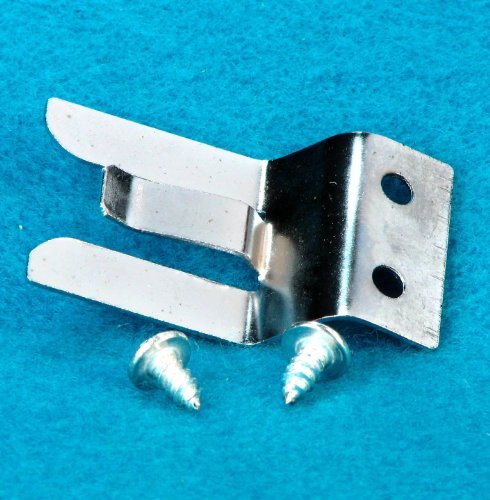 I recently came across these microphone clips that are awesome! Available from Amazon for $7.49.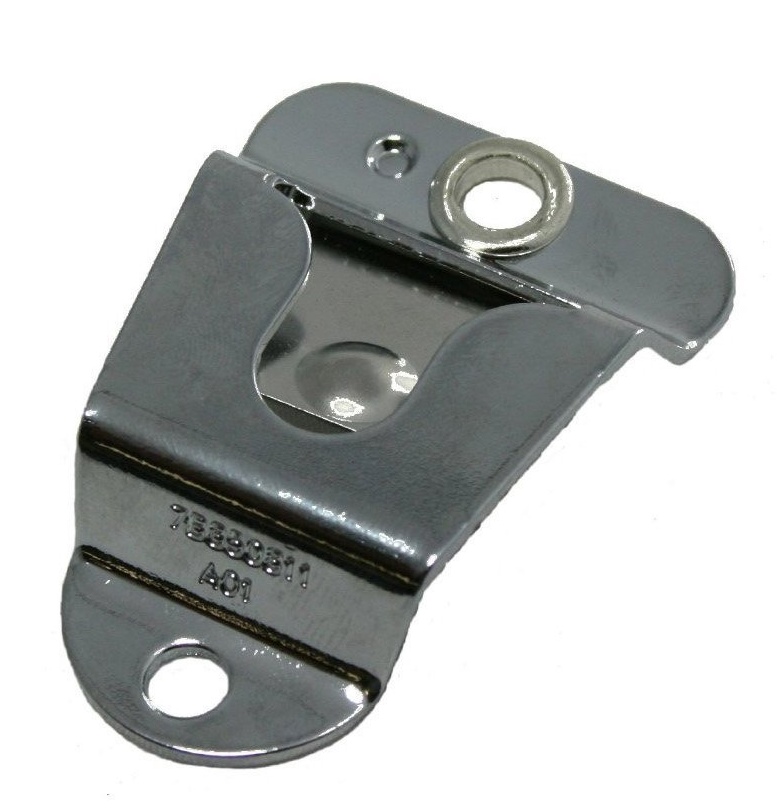
73, Bob K0NR
The post World’s Best Microphone Hanger appeared first on The KØNR Radio Site.













