Author Archive
 What’s In Your Rubber Duck?
 July 10th, 2016 |
  Author:
  Anyone with a VHF or UHF handheld transceiver (HT) probably uses the standard “rubber duck” antenna for casual use. I often refer to the rubber duck as The World’s Most Convenient Crappy Antenna. To be fair, all antennas are a compromise…the rubber duck optimizes small size and convenience at the expense of performance. The Wikipedia entry describes the rubber duck antenna as “an electrically short monopole antenna…[that] consists of a springy wire in the shape of a narrow helix, sealed in a rubber or plastic jacket to protect the antenna.“
Being curious about what really is hiding inside the typical rubber duck antenna, I decided to take a few of them apart. I did not try to assess the performance of the antennas but just examine their construction.
Baofeng UV-5R Stock Antenna
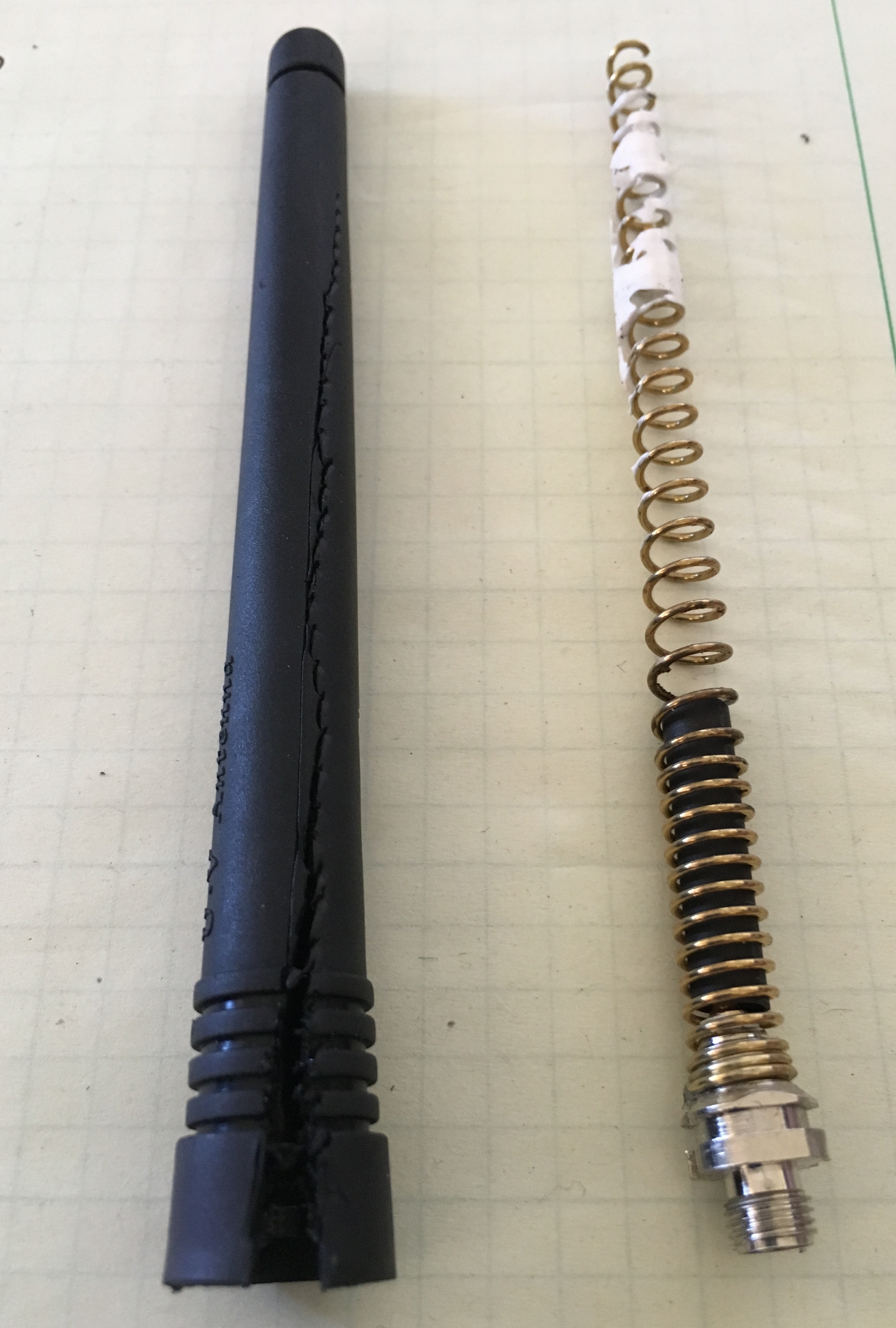
I started by dissecting a Baofeng UV-5R antenna, which took some aggressive action with a diagonal wire cutters to split the rubberized jacket near the bottom. After that, the jacket slid off to reveal the classic spiral antenna element inside. You can see some white adhesive near the top of the spiral element (upper right in the photo).
The Baofeng antenna had a female SMA connector.
Note: You can access high resolution versions of the photos in this article by clicking on them, allowing you to see lots of detail.
Yaesu FT-1DR Stock Antenna
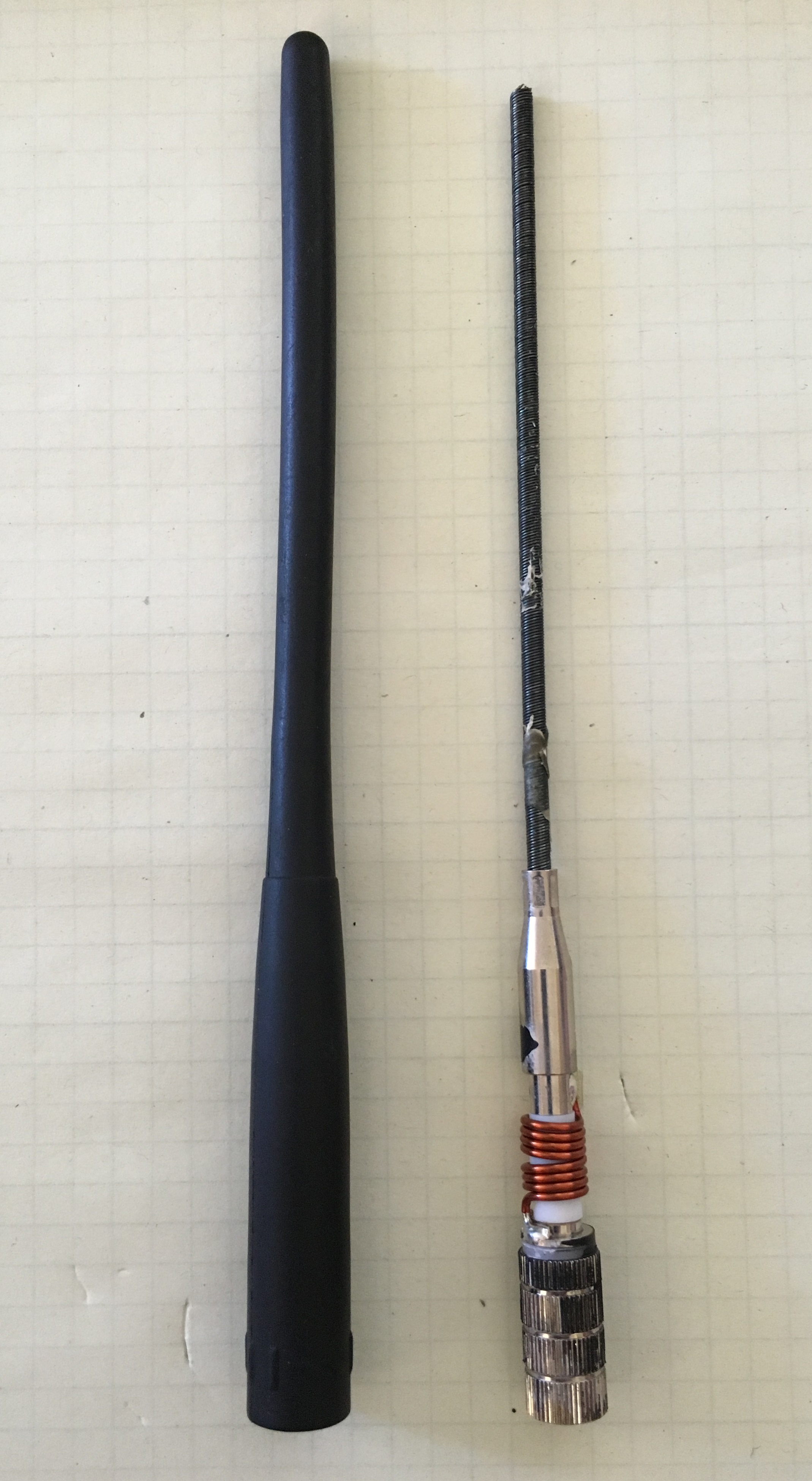
The Yaesu antenna was easy to disassemble. In fact, I chose this antenna because I noticed that the outside jacket had come loose and was starting to slide off the antenna. A steady pull on the cover exposed the antenna elements without any further antenna abuse. (I plan to reinstall the cover with a few dabs of glue and expect that it will continue to work fine.)
The construction of this antenna is quite different from the Baofeng. The main element is a very tightly-wound spring…so tight that I expect that it acts like a solid wire electrically. In other words, it doesn’t have the spiral configuration that makes the antenna act longer electrically. At the bottom of the antenna, there is a coil inserted in series with the radiating element (connects radiating element with the center pin of the SMA connector).
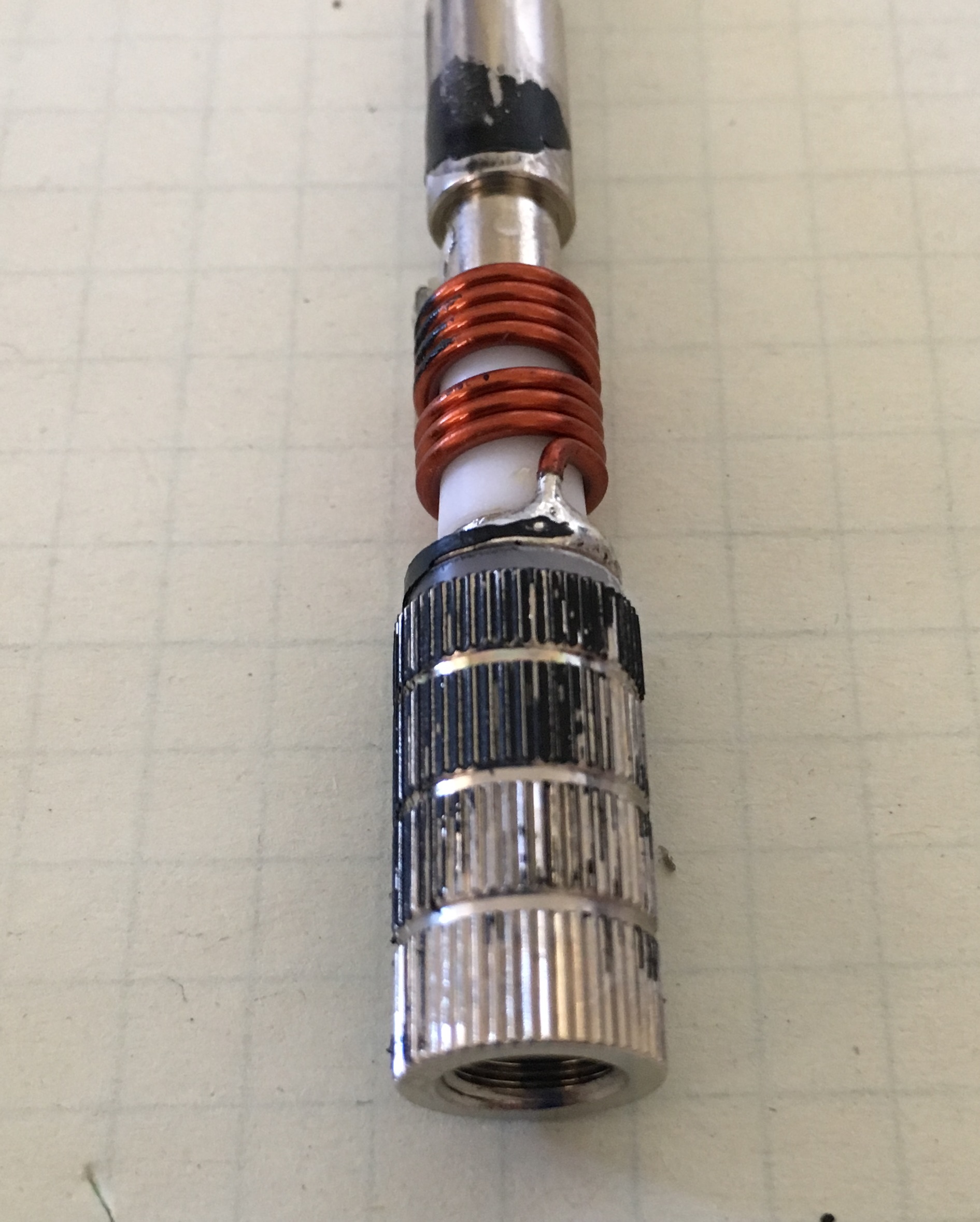
The photo to the right shows a closeup view of the male SMA connector and the coil.
Laird VHF Antenna
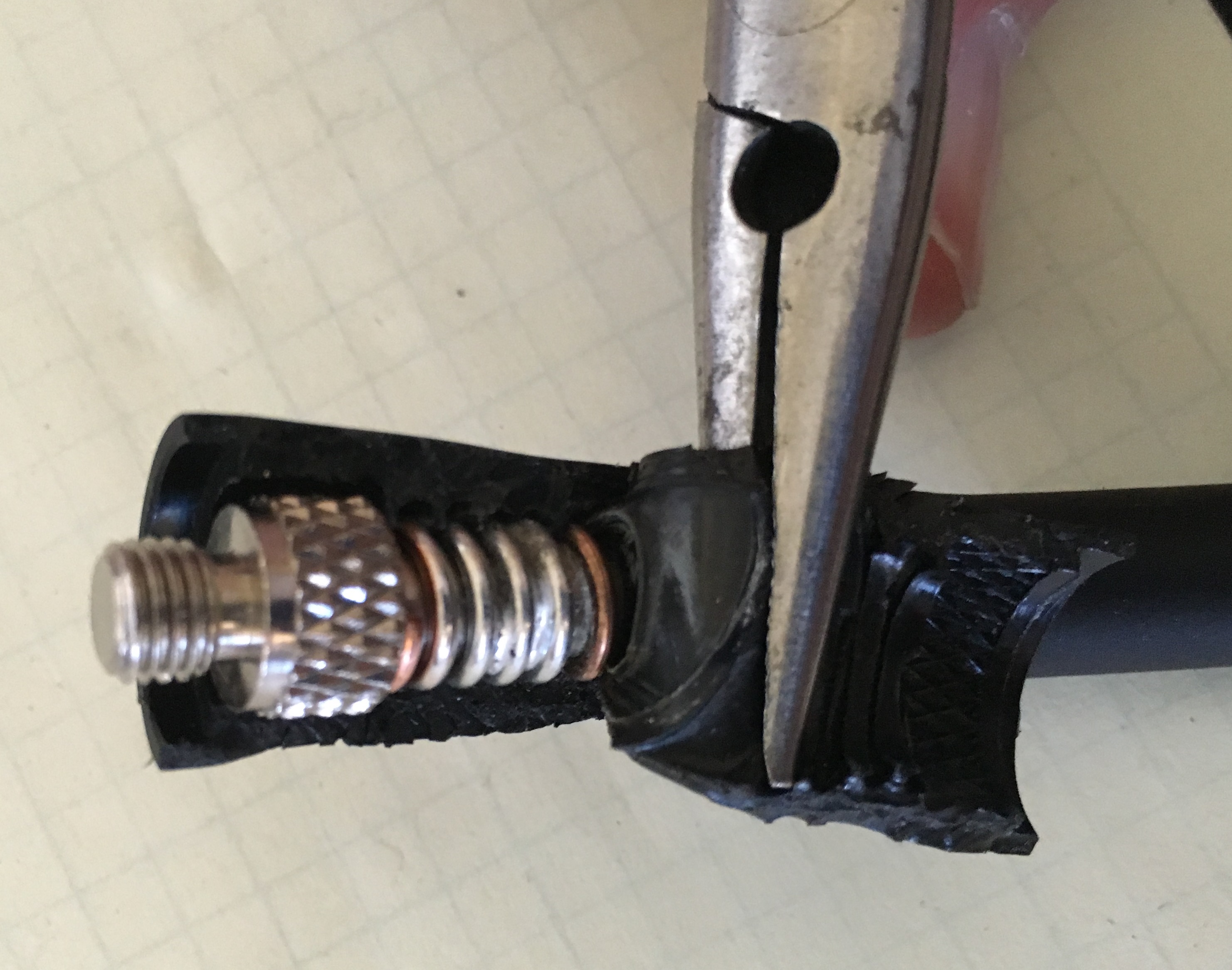
Next, I wondered if antennas for commercial radios had different design or construction techniques. Laird makes high-quality antennas for the mobile radio and other commercial markets, so I purchased one of their VHF rubber duck antennas to dissect. This model is intended for use with Motorola radios requiring a threaded antenna stud.
This antenna was a challenge to cut open. I used a sharp knife and diagonal pliers to cut the rubberized jacket and peeled it back using a needle-nose pliers. The rubberized coating was embedded into the spiral antenna element, so it did not come apart easily. It took over an hour fighting with the antenna and I gave up before getting the entire spiral element exposed.
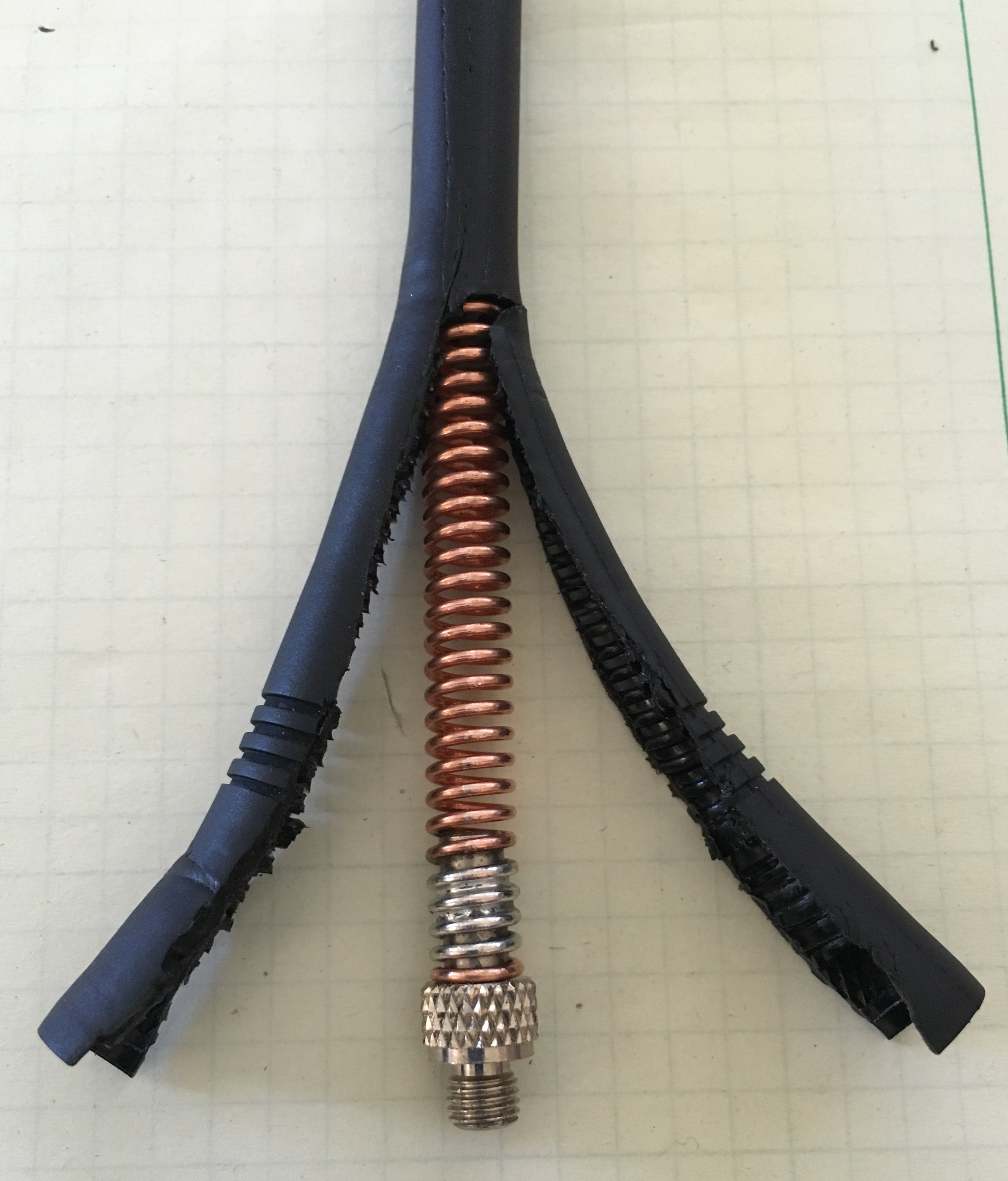
The Laird antenna is clearly the sturdiest of the three antennas. The spiral element is much thicker than the Baofeng and the rubberized coating is tougher and molded tightly into the spiral element.
The Baofeng and Laird antennas use the same design concept…just take a spiral antenna element and apply a protective cover. However, the Laird construction was far superior, but not a surprise given that Baofeng is a low-cost provider in the ham radio (consumer) market.
My disappointment is with the Yaesu antenna. The antenna came apart after one year of not very heavy use. I expect I can put it back together with some adhesive, improving on the design in the process.
Anyway, I found this interesting and wanted to share it with you. What’s in your rubber duck?
73, Bob KØNR
The post What’s In Your Rubber Duck? appeared first on The KØNR Radio Site.
All VHF Shack Sloth
 On June 21st, I worked Steve K7PX on Mount Garfield (W0C/FR-040) using 2m fm to push me over 1000 points to quality for the SOTA Shack Sloth Award using only VHF. This is my first significant SOTA award, which I have been working towards for several years now. I decided to pursue Shack Sloth using only the VHF bands, which is much more difficult than using HF. Why? Something about mountains, Height Above Average Terrain (HAAT) and VHF radio has always intrigued me.
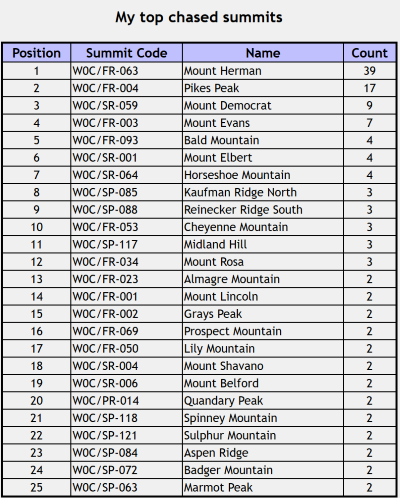
Here’s the line up of my top chased summits, with Mt Herman and Pikes Peak taking the clear lead. Mt Herman is The Most Radio-Active Mountain in Colorado and it is in my backyard. Most of those contacts were with Steve WGØAT and Frank KØJQZ. Thanks, guys! Pikes Peak is also a clear VHF shot from my house and many SOTA activators and tourists like to activate that summit. No surprise, the rest of the summits are various peaks in Colorado, worked from my house or from our cabin near Trout Creek Pass. Quite a few of these are Summit-to-Summit contacts made when activating peaks, often during the Colorado 14er Event.
 Most of my thousand points were contacts made using plain old 2m fm, The Utility Mode. A few contacts were made on 2m ssb along with some 70 cm fm and ssb contacts. I have been encouraging folks to try 2m ssb for huge improvements in weak-signal performance but the universal nature of 2m fm seems to be winning out.
My next goal is Mountain Goat with VHF only. I’ll need to activate a lot of summits to get that done, so it will take me a while. It’s always good to have something to work towards.
73, Bob KØNR
The post All VHF Shack Sloth appeared first on The KØNR Radio Site.
SOTANA May Be Right For You
I have “a friend” that could probably use this.

The post SOTANA May Be Right For You appeared first on The KØNR Radio Site.
How About an Updated FT-817?
The Elecraft KX2 made a big splash with QRP enthusiasts at the Dayton Hamvention this year. HamRadio360 had some good coverage of the product introduction. Basically, the KX2 is a shrunken version of the KX3, covering the HF bands 80m through 10m.
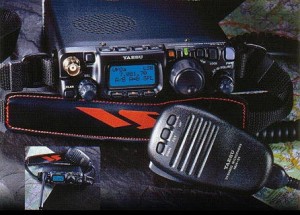
There were rumors circulating that Yaesu would introduce a replacement for the FT-817ND, but that turned out to not be true. It is a good rumor because the original FT-817 was introduced way back in 2001 (according to Wikipedia). Also, Chris Wilson NØCSW was actively soliciting inputs for an 817 replacement at the Central States VHF Conference last summer.
A while back, I did a comparison of the FT-817 and the KX3 (big brother to the KX2). I evaluated the two radios from a VHF/UHF point of view. The FT-817 is the only portable single-radio solution for 50 MHz, 144 MHz and 432 MHz. The KX3 includes 50 MHz standard and 144 MHz is an option. The KX2 leaves out the VHF bands completely to achieve a smaller size.
What’s Next for the FT-817?
Its always fun to speculate on what might be coming in new gear. I expect Yaesu will maintain its position as the QRP transceiver that covers HF/VHF/UHF. It has a long history of delivering cost-effective “do everything” radios. We can look to recent product introductions from Yaesu to get a hint of what might be coming.
The FT-2DR, FT-400DR and FT-991 have all adopted larger touch-screen displays so we can probably expect that for the 817 replacement. However, this will challenge the existing form factor…you can’t just drop a larger display into the existing 817 design. The three newer radios include the System Fusion C4FM digital mode…at this point, I don’t think Yaesu would introduce a VHF/UHF radio without it.
Which raises another question: will the new radio also include a GPS receiver? This capability is a good complement to the C4FM mode in a portable radio. The FT-991 requires you to enter your location manually, which the FT-2DR and FT-400DR use a built-in GPS. But it adds circuitry and complexity so I am going to guess they will leave that out.
I am expecting (hoping?) Yaesu will improve the battery life of the transceiver. (Receive standby current is spec’d at 450 mA.) Even if they don’t improve the current drain, newer battery technology could be used to improve operating time. Also, depending on the form factor changes, it may be wise to dedicate more space for a physically larger battery.
Yaesu will probably improve the overall receiver performance, including advanced DSP features. Many 817 users have complained about the lack of coverage of 162 MHz weather radio in the US. On the transmit side, a little more output power would be nice…maybe match the KX3’s 10 watts on HF. Yaesu could really make the VHF crowd happy (in the US) if they included the 222 MHz band.
Take One Tablet
The radio will surely have a computer I/O port with USB being the most flexible choice. There is an opportunity to innovate a bit here by coupling the radio with Android and iOS tablets. I could see a really nice app that handles logging, CW, PSK31, RTTY, bandscope, and other advanced features. This could take the pressure off having a larger display and loading tons of features into the radio. The most convenient I/O would be wireless, most likely Bluetooth or maybe WiFi. Many of the SOTA and QRP operators already take along a smartphone or tablet for logging and other tasks, so it would be a good fit to that market. The key to this idea is careful human factors design and tight integration with the radio. Do I expect this from Yaesu? Not really. So surprise me and knock my socks off.
Those are my thoughts. Your turn.
73, Bob KØNR
The post How About an Updated FT-817? appeared first on The KØNR Radio Site.
This Spewed Out of the Internet #32
 It has been a while since I’ve done one of these Internet Spewing posts, so I’ve got some catching up to do.
Twitter is heating up with rumors and reports of new ham gear to be introduced at the Dayton Hamvention. Elecraft is introducing the KX2 QRP HF transceiver. I know this one is real because Steve WGØAT got a chance to try out a unit, shown here in this video. Also, see the short review by Frank KØJQZ.
VA3XPR broke the news about a VHF/UHF radio that does DMR, D-STAR and C4FM digital modes. This is exciting stuff but we’ve been here before and nothing materialized. It is definitely achievable…someone just has to do the work.
K3NG comments on the most recent innovation from Heathkit, the Pipetenna. Leixen recently introduced a 25 W UHF handheld radio. Now who thinks THAT is a good idea?
The FCC is thinking about making amateur radio licenses last for a lifetime. See the KB6NU blog and comments on the topic.
The ARRL announced that the August UHF Contest is cancelled, thereby ticking off the hams that like to work that contest. It seems they also ticked off the many hams that have been contemplating participating in the contest for the last decade but just haven’t gotten around to it yet.
Not cancelled but expanded is the Colorado 14er Event, which will go the whole weekend (August 6-7). Check out the ham14er web site for the latest info. Its our 25th year and its going to be fun!
The Atlantic published a decent article on ham radio, focusing on the emergency communication aspect of the radio service. Yay!
Don’t forget to participate in the National Pizza Ovens On The Air (NPOOTA) event. Unfortunately, there’s been some partisan bickering about Obama’s recent activation. In related news, here’s a proposal to abolish the use of Q codes. To which I say, QSL!
After one of our Tech Licensees asked “just how many antennas do I need to cover all these bands?”, I wrote this article at HamRadioSchool.com: Antennas… How Many Do I Need?
Another important question is How Many Digits of Pi Do I Need? It turns out that JPL has figured this out using actual math and the answer is 16 digits. You don’t need anymore than that. Ever.
OK, that’s it for now. No, I am not going to be at Dayton. All of the Cool Kids went to Hamcon Colorado instead.
73, Bob KØNR
The post This Spewed Out of the Internet #32 appeared first on The KØNR Radio Site.
Summits On The Air – Colorado Style
 Summits On The Air – Colorado Style is the title of my presentation at Hamcon Colorado, 2 pm Friday May 13th. I will be discussing the Summits On The Air program and the Colorado 14er Event.
The slides are available here:
Summits On The Air -Colorado Style
The conference will be excellent. I hope to see you there!
73, Bob KØNR
The post Summits On The Air – Colorado Style appeared first on The KØNR Radio Site.
Announcing: 25th Annual Colorado 14er Event
Amateur Radio operators from around Colorado will be climbing many of Colorado’s 14,000-foot mountains and Summits On The Air (SOTA) peaks to set up amateur radio stations in an effort to communicate with other radio amateurs across the state and around the world. Join in on the fun during the 25th annual event and see how many of the mountaintop stations you can contact. This year the event is expanded to include the entire weekend. However, many mountaintop activators will hit the trail early with the goal of being off the summits by noon due to lightning safety concerns.
See the very cool 25 Year Anniversary t-shirts available at http://www.cafepress.com/wg0at
The 14er event includes Summits On the Air (SOTA) peaks, which add over 1700 potential summits! If you aren’t up to climbing a 14er, there are many other summits to choose from (with a wide range of difficulty). See the W0C SOTA web page at w0c-sota.org
Radio operators who plan to activate a summit should post their intent on the ham14er Yahoo Group. To subscribe to the “ham14er” email list, visit the Yahoo groups site at http://groups.yahoo.com/group/ham14er/ . Also, be sure to check out the event information at http://www.ham14er.org It is also a great idea to post an ALERT on the SOTAwatch.org website.
Frequencies used during the event
Activity can occur on any amateur band including HF and VHF. The 2m fm band plan uses a “primary frequency and move up” approach. The 2m fm primary frequency is 147.42 MHz. At the beginning of the event, operators should try calling on 147.42 MHz. As activity increases on that frequency, move on up the band using the 30 kHz steps. Don’t just hang out on 147.42 MHz…move up! The next standard simplex frequency up from 147.42 MHz is 147.45 MHz, followed by 147.48 and 147.51 MHz.
| Frequency (MHz) | Comments | Frequency (MHz) | Comments |
| 147.42 | Primary 2m FM Frequency, then up in 30 kHz steps | 14.060 | 20m CW Frequency |
| 147.45, 147.48, 147.51 | Alternate 2m FM frequencies | 14.345 | 20m SSB Frequency |
| 446.000 | Primary 70 cm FM frequency | 18.092 | 17m CW Frequency |
| 446.025 | Alternate 70 cm FM frequency | 18.158 | 17m SSB Frequency |
| 144.200 | 2m SSB calling frequency | 21.060 | 15m CW Frequency |
| 50.125 | 6m SSB calling frequency | 21.330 | 15m SSB Frequency |
| Other Bands/Modes | Standard calling frequencies and/or band plans apply. | 28.060 | 10m CW Frequency |
| 28.350 | 10m SSB Frequency |
Warning: Climbing mountains is inherently a dangerous activity.
Do not attempt this without proper training, equipment and preparation.
Sponsored by The Colorado 14er Event Task Force
Here’s the event flyer in pdf format: Colorado 14er Event Flyer 2016
The post Announcing: 25th Annual Colorado 14er Event appeared first on The KØNR Radio Site.













