Author Archive
 KE9V.net
 August 17th, 2010 |
  Author:
 Is it just my computer, or has Jeff KE9V’s blog site gone QRT? His last posting in the Blogger “Reading List” feed was to do with the controversy over the Ground Zero mosque, but when I click through the page has gone, as has his entire site except for one placeholder page. I don’t know what Jeff had to say on the subject or whether it had anything to do with his site now being down.

Another great cockup
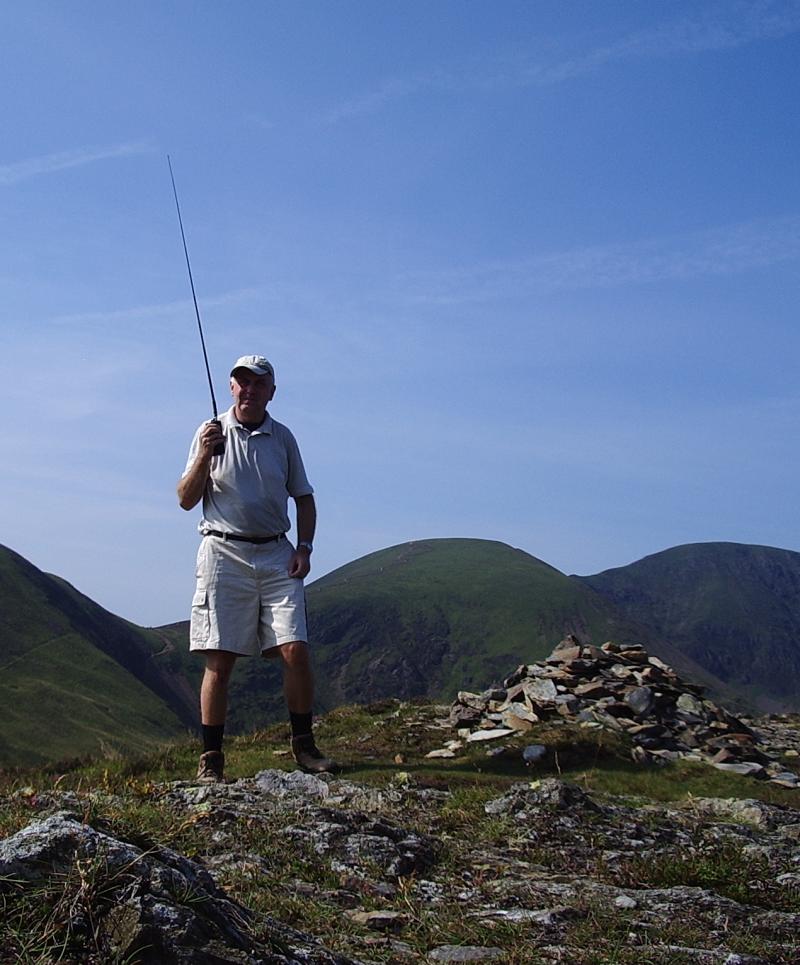
Another weekend of glorious weather. I decided to make an early start on Sunday and try a slightly more ambitious Wainwrights On The Air (WOTA) activation than normal. The plan was to walk over Barrow and Outerside and, if my legs still had enough energy left in them, Causey Pike. Though a much easier walk than those undertaken by Phil, G4OBK, I haven’t done much hill walking since getting married nearly 8 years ago and am not as fit as I used to be. This would be the longest walk I’d done for a long time.
I set off in the warm sunshine at about 9.30 and after about 15 minutes heard “CQ WOTA” from Phil who had arrived on the summit of Dodd, the other side of Bassenthwaite Lake. I was afraid I might have missed him while I was on the road. His expected arrival had been an hour earlier and I’d waited to try to catch him from the home station. But the day was warming up and he might have had a change of plan so I decided I couldn’t wait any longer. Dodd was a new summit worked for me so I was glad to have caught him. It also meant that Phil’s effort hadn’t been in vain because Dodd is a difficult hill to get contacts on.
The path I was taking passed along the flank of Barrow. To reach the summit I would have to backtrack on a higher path. On the map it didn’t look far but in reality it looked quite a long walk so I decided to get Barrow on the way back and started the climb to Outerside. It was a pleasant and not difficult climb, but sweaty work in the growing heat. Eventually I reached the top (first picture) from where I made several contacts on 2m using the telescopic 5/8 wave antenna, including another with Phil G4OBK/P who had by now reached Carl Side.
I was not inclined to hang around on the summit which was plagued with flying ants – as were all the Lakeland summits judging by the comments of other hill-toppers. I descended the other side of the hill and made my way back to the main path from where I saw a track up the side of Causey Pike which looked like a shortcut. I crossed the path and made my way to the track, where I sat down and ate my packed lunch as there were no insects in that area.
Causey Pike is a narrow ridge with several undulations along its length. In fact I seem to remember one walkers guide I read a few years ago referring to it as Causey Pikes. My Ordnance Survey map shows it as a long, narrow island surrounded by the 2,000 foot contour (it’s an old map, made before they went metric.) I have walked along it several times over the years since I first came to the area but I had never given much thought to exactly which of the undulations was the actual summit was because at the time it didn’t matter.
The shortcut looked too short to reach 2,000 feet. I set off, and after about 15 minutes reached the crest. From there it didn’t look like 2,000 feet either. To my left, after a few more feet of climbing, was a small plateau which was followed by a sharp descent into the valley. To my right, the crest of the ridge rose steadily for what looked like another 400 or 500 feet. “The summit must be up that way” I thought, so I turned right and off I went. On the way I stopped to work Ian, 2E0EDX/P on Brim Fell, for another summit that I wouldn’t have worked from home.
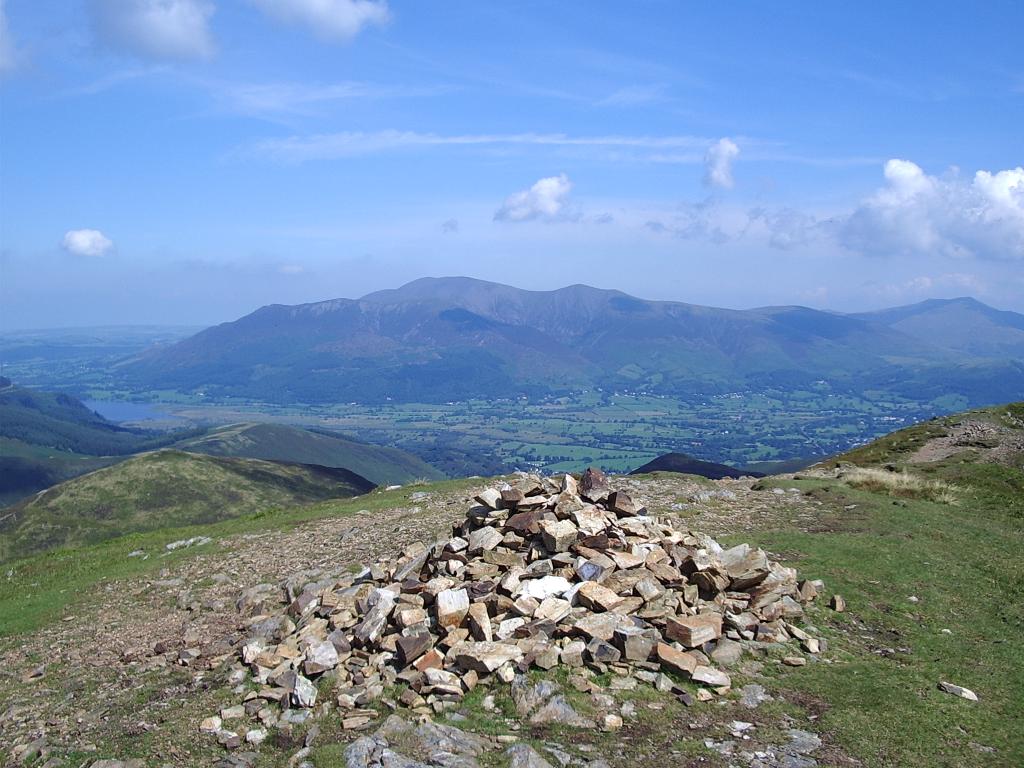
Eventually I arrived at the highest point which was surmounted by a rough stone cairn. I started to call “CQ WOTA” and made several contacts from what I described as the summit of Causey Pike, including one with Colin, 2E0XSD whom I asked to check whether my position was showing on aprs.fi. He confirmed that it was, and the details tallied with what my VX-8GR GPS was showing.
I started to make my way off the fell on my way home by the main footpath when I was called by Phil, G4OBK, to pass on a message that Colin didn’t think I was on Causey Pike when I made the contacts. Since Colin sometimes has a bit of fun at my expense due to an error I made during an earlier activation the thought crossed my mind that he was having a wind-up. Shortly after that I received an APRS message from Colin which stated that I was on Scar Crags, not Causey Pike. I had never heard of Scar Crags but I knew that there was another hill nearby called something Crags (having checked it is Ard Crags) so I thought that perhaps the position of the labels on the map may have caused Colin to mistake my position and decided to carry on descending.
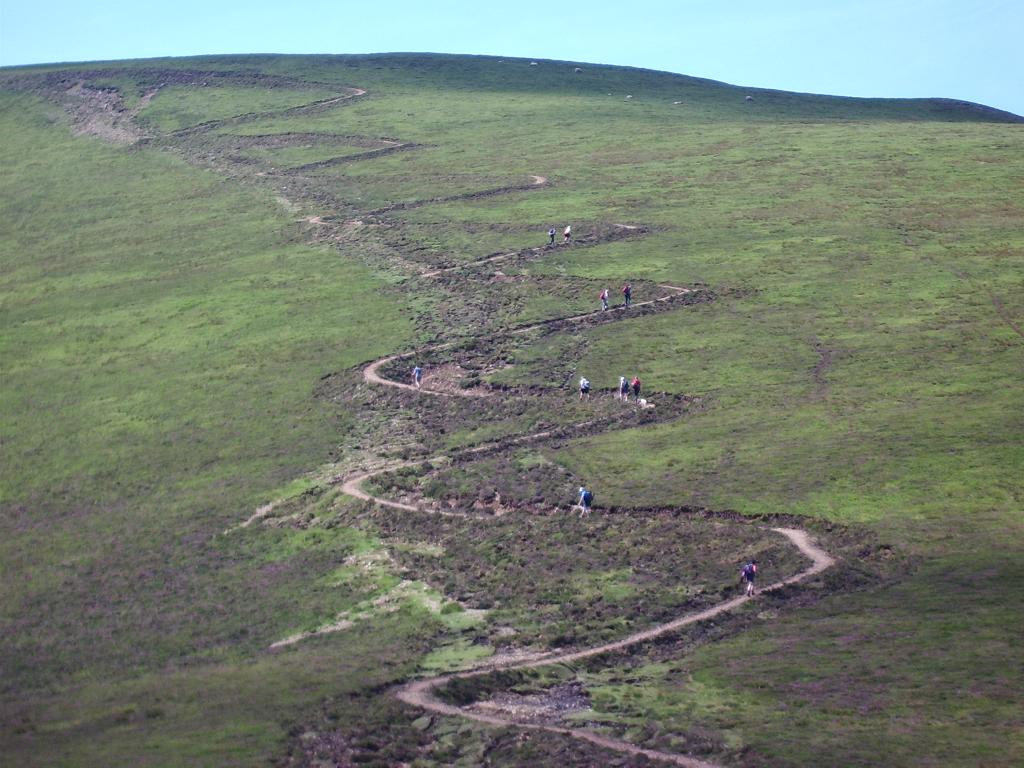
While all this was going on I was watching a couple of mountain bikers zooming down a zig-zag path that had been made on the side of the fell named Sail opposite where I was standing. This unsightly path has been made because the number of boots (and presumably tyres) ascending and descending the fell had destroyed the original path and made it dangerous. Britain is an overcrowded island and the number of visitors, particularly in recent years as more people take holidays at home, is literally causing the hills to wear out!
Further down the path back to the car the surface had been repaired by tipping truckloads of small rocks into the channel caused by thousands of boots, so that instead of a gentle walk down I had to pick my way from rock to rock like on a rocky beach. Not a particularly welcome activity for legs that were becoming tired. The battery of my VX-8GR finally expired during a contact with a SOTA summiteer in Northumberland whose call I heard on the walk down, so there being no point in taking the loop over Barrow I walked straight back to the car and came home.
Back home, examination of my position report on aprs.fi showed that Colin had been right. I had indeed been on Scar Crags when making my “Causey Pike” contacts.
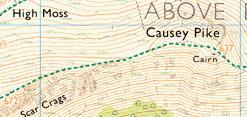
I had never heard of Scar Crags before and was completely unaware that it was the name of a Wainwright summit. However, had I stopped and looked at the map at the time it is unlikely that it would have convinced me that Colin was right. In this small grab from the online version of the map Scar Crags is shown at the bottom of the crags, which would suggest to me that it was the name of the cliffs and not of the actual summit. And the plateau that I now think may have been Causey Pike did not seem as prominent as the contours on the map make it look. Perhaps all the millions of boots have worn it flat, too. Only seeing my GPS position on the map and looking at Wainwright’s book made me realize that this was another great cockup (as distinct from Great Cockup.)
It’s rather embarrassing to make such a public mistake, as well as frustrating to have missed the opportunity to activate the real Causey Pike. I will just have to try again one day. And next time, perhaps I’ll also activate Barrow.

Inconvenient spurious
During the middle of the day here 30m becomes virtually dead and there is nothing to see on HF APRS. I decided to try some digital modes. After a quick tune around I couldn’t hear any digital apart from PSK. These days, if there’s propagation there is PSK activity.
I had quick listen on 15m and even spotted a couple of stations to PSK Reporter, but signals were really weak so I dropped down to 17m. On 17m I have to use the MFJ magnetic loop, which I needed to re-tune from 30m. As I did so I was startled by a loud buzz from the Kenwood TM-D710 on the VHF APRS channel. I turned the volume down, suspecting a spurious but not knowing if it was the fault of the K3 or the Kenwood.
I made several European contacts using PSK31 before lunch including Veljo, ES0OU on Saaremaa Island, which is IOTA EU-034. None of my contacts wanted chat, though you have to realize that English is not the first language for any of these stations, if they speak it at all. I suppose here in Europe we have to be thankful for macros.
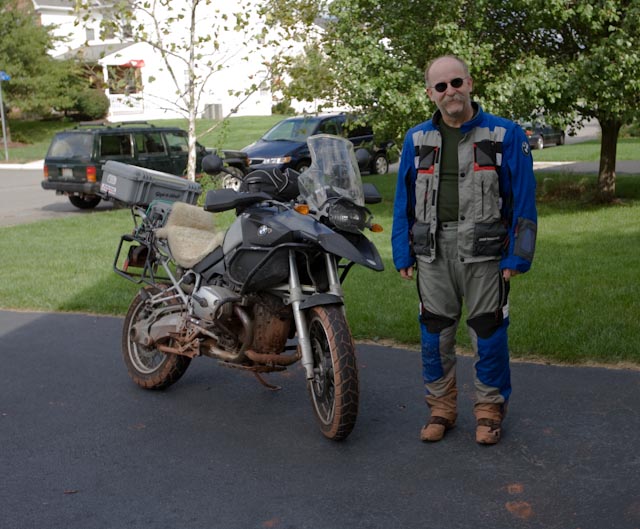
After lunch I walked into town with Olga. On my return the receiver was still on 17m and had spotted a long list of stations to PSK Reporter. KU1T, Zibi from Glengary, WV (pictured above) was one of those spotted. I waited and eventually saw his trace appear on the screen. I gave him a call and he replied. Copy was in and out of QSB so it was one of those contacts where a conversation would not have been possible. KComm told me this was my first USA contact on 17m.
Later, a few seconds with the calculator revealed the reason for the strong interference with the VHF APRS frequency. 18.100MHz, the carrier frequency used when operating in the 17m PSK31 band segment, is exactly one eighth of 144.800MHz!

Rough justice
Some UK readers may already know of the case of Carl Johnson, M3VWP, who was prosecuted for driving without due care and attention, found guilty, fined and received three points on his driving license for operating his 2m mobile rig whilst driving.
In the UK it is, quite rightly, illegal to use a mobile phone whilst driving – though you can see this law being flouted every day of the week. There is, however, an exemption for the use of two-way radio, which applies to ham radio mobile operation. You could argue – and personally I would argue – that if it’s dangerous to use a mobile phone then it is no less dangerous to use a ham radio. But that’s beside the point. It is not illegal to use a ham radio whilst driving and unless he was actually driving dangerously as a result, M3VWP should never have been prosecuted for it.
Nevertheless, he was, and when summoned to court he decided to represent himself. Despite the existence of many holes in the prosecution’s case – according to his letter in Practical Wireless, Carl was stationary at traffic lights when spotted by the officer, who after an hour at the roadside apparently admitted he didn’t know the relevant law himself – M3VWP was found guilty. He decided not to appeal.
Of course, it’s just my opinion, and I know only what I have read, but I feel sure that if M3VWP had been professionally represented in court, or had appealed, he would probably have got off. A good solicitor might have got the point across that the law against using mobile phones did not apply in this case and that Carl could hardly have “not been in proper control of his vehicle” as he was stationary when spotted by the police.
Unfortunately in the UK only the very poor or the very rich have access to justice. If you’re poor, you receive legal aid, but if you have any means at all you have to pay the exorbitant legal fees yourself, and only the very wealthy can afford to take such a hit to their bank balance. One can only feel sorry for M3VWP for being convicted when he did nothing wrong. It seems that it doesn’t matter what the law says, if the police think you’ve broken it then that’s it.
Radio amateurs in the UK take note. Operating your radio whilst mobile could cost you a hefty fine and even, if you already have some points, lose you your driving license.

No improvement
I know that one of the purposes of my website is meant to be to demonstrate that you can play ham radio even if you can’t have outside antennas. But sometimes the frustrations of not quite being able to achieve what you want to make become almost too much.
On Tuesday I replaced my home made ribbon cable Slim Jim 2m antenna with a commercial dual band colinear from Moonraker. I wasn’t sure the home made antenna was working as well as it possibly could. Originally I planned to replace the Slim Jim with a single band 5/8 wave Sirio, but after a month waiting for Radioworld to deliver it I cancelled the order and gave up. Then I got the Kenwood TM-D710 which is a dual band transceiver, so I decided I should have a dual band antenna to give me the option of running a public Echolink node on 70cm.
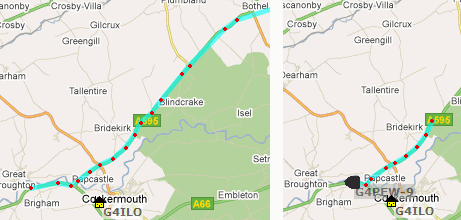
During the last few days I have been searching for signs of improvement in my 2m receive capability, but the signs haven’t been good. I’m hearing a frustrating number of APRS “braaps” that are just not strong enough to decode.
The antenna certainly works. I’m getting almost end-stop signals from the repeaters GB3DG and GB3LA, whilst GB3AS is about S5 with a bit of noise on it. I have had a couple of solid contacts using the antenna but nothing to form a basis for comparison until today, when Noel G4PEW drove past.
On the left of the screengrab you can see his track on Monday, when I was still using the Slim Jim. On the right you can see today’s track, received using the new antenna. It’s a lot shorter. I certainly heard a lot of packets after the last one shown by the grey blob, but none were strong enough to decode.
If only I could have the antenna outside the attic, up above the apex of the roof, I’m sure that extra little bit of height would make all the difference.

Highest activation?
Steve WG0AT, Rich, AC7MA and Guy, N7UN recently returned from their expedition to activate Huron Peak in the Sawatch Range in Colorado, USA, for Summits On The Air (SOTA). Together with their “sherpa” goats Rooster and Peanut, they took a GPS-equipped Yaesu VX-8R so people could track their progress.
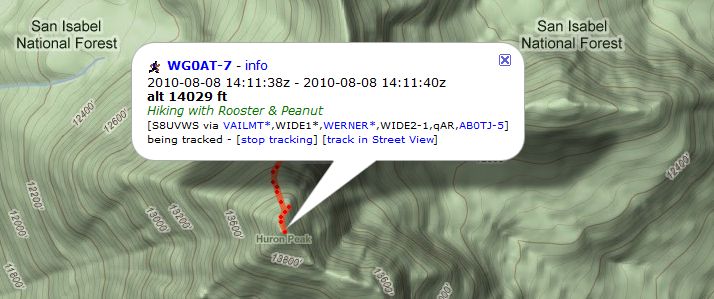
You can see a slide show of the expedition here.
I rather like the idea of using goats to carry the heavy equipment but I think you’d get some funny looks in the hills around here. This has made me wonder what has been the highest SOTA activation to date. Has anyone activated Mount Everest yet? I bet that would create a pile-up!

Logging assistant
When you are out in the field, especially on a windy hilltop, logging the contacts you make can be a bit difficult. One hand holding the radio or microphone leaves only one hand free to hold down the log book and write in it. If you’re using a hand-held and standing up to get the maximum height gain, it’s even more awkward.

A few weeks ago I hit on the idea of using a personal digital voice recorder. Initial researches suggested that they were a bit expensive – many models sell for around £70 or more. But diligent searching on eBay revealed that it was possible to buy them for much less than this.
The one I got is an Olympus VN-100 Digital Voice Recorder and cost £15.99 including free postage. It was described as “refurbished to new condition by Olympus.” This might be an indicator of a product that tends to fail and has a high number of warranty returns. However, this particular one was indistinguishable from new, works fine and is simple to use. It isn’t the colour I’d have picked if I had a choice, but price and functionality were the principal considerations.
I don’t know what the differences are between the VN-100 and the more expensive models apart from colour, probably storage capacity. However this model has capacity for more than 13 hours of recording – more than adequate for my purposes.
I find the VN-100 easy to operate with the hand that isn’t holding the radio. You just press one button to start recording and another to stop. A bar meter shows the level of the audio input. You can either say the callsign, time and whatever else you are interested in logging, or just point the device at the radio and make an off-air recording. At home it could be a handy shack tool for recording unusual DX contacts.
The only problem I found is that the voice recorder is just as sensitive to wind noise as the microphone in the radio. More than once I have returned home to find a recording was unintelligible. However, mishaps like this can probably be avoided with practise.
I’m finding my digital voice recorder to be an indispensable companion on portable outings. It’s also handy for jotting down ideas for blog posts that occur whilst you’re out and about!














