Author Archive
 VOACAP Online
 November 4th, 2010 |
  Author:
 I don’t know how long it has been around but I only discovered this online propagation prediction tool using the VOACAP prediction engine today.
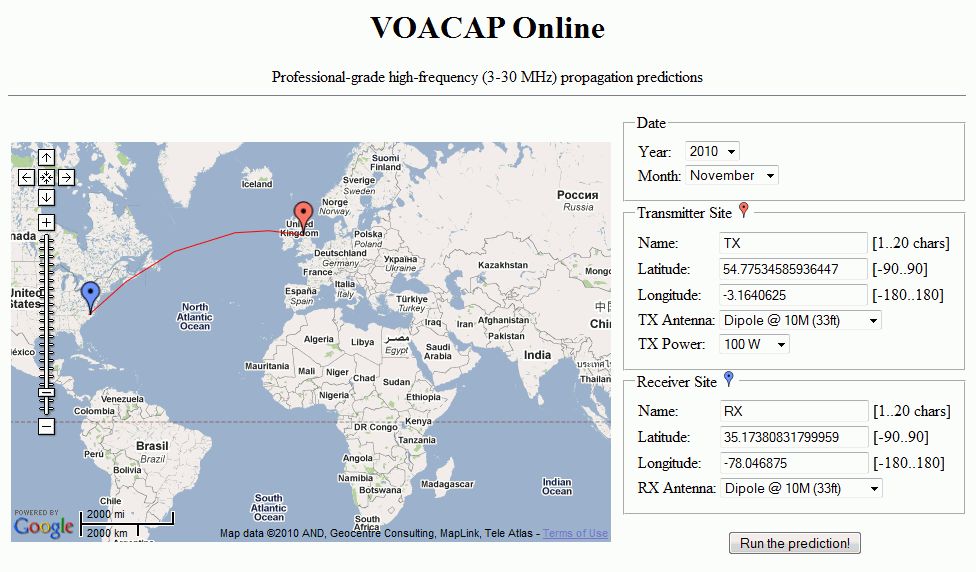
It’s very easy to use, and produces a nice chart showing the best times and frequencies to use to make a contact with a particular region. Of course, the predictions are based on the average expected propagation for the month, it won’t tell you what the bands are like today, which is why it is better not to waste your time on tools like this and turn on the radio.

KComm updated
Today I released a new version of my logging and data communications program for Elecraft transceivers, KComm, on my website. The program is developed in Lazarus / Free Pascal and is released under the GPL.
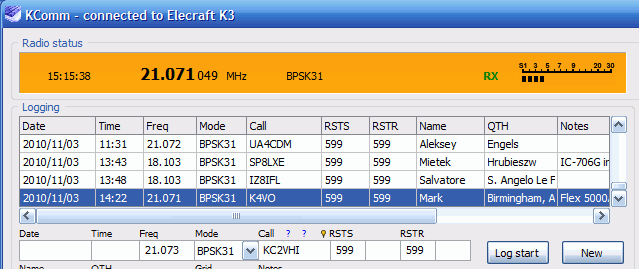
Apart from numerous bug fixes and small improvements I have made in the months since the last release, the new version 1.9 allows the receive and transmit sound devices to be selected separately. This is something that is becoming increasingly necessary, though users will have to play “guess the device number” as I don’t know how to find out the names of the sound devices in Free Pascal in order to display them in a list box. The program also supports the K3 “TB” command which allows it to get the text decoded by the K3 DSP in CW, PSK or RTTY modes and display it on the screen just the same as if you were using a sound card program.
Although I have given up developing ham radio programs in general, I am continuing to update and maintain KComm as it is the only one of my programs that I continue to use regularly. However this will be the last version for which I will be able to provide a compiled Linux binary. The screen of the old Linux laptop that I used to compile it has almost failed so I will not in future have a computer on which I can do this.

Being prepared
We Brits and our friends across the Atlantic may share a common language but sometimes it seems as if we live on different planets. One of the most obvious examples of this is that Americans sometimes seem to act as if Armageddon could happen at any minute, something that doesn’t seem to cause much lost sleep over here.
Perhaps I’m jumping to the wrong conclusion based on the higher emphasis given in the USA to the use of ham radio for emergency communications. Read some issues of QST these days and you might think that “emcomms” is what amateur radio is really all about. Many American hams maintain “go kits” – portable radio stations that they keep charged up and ready to go the moment they are needed. Over here we have something called Raynet, but I get the distinct impression that it is a bunch of people who would like to use ham radio to help in an emergency rather than a volunteer emergency service on the lines of, say, Mountain Rescue that has a clearly defined purpose and meets a genuine need.
In his latest blog “Smoke Curls” Jeff, KE9V recently posed the question of whether a portable QRP HF station was really useful in the context of emergency preparedness. Most of the replies seem to illustrate the extent to which the thought of a major disaster is never far away from the American consciousness. My comment that the only benefit I could see in having battery powered HF ready to use was so I could take advantage of the noise-free bands while the power is out – which in fact I did during the outage that occurred during the local floods a year ago – probably seemed rather flippant, though that wasn’t the intention.
My opinion is that emergency communications is a job for the experts and the last thing they need is a bunch of amateurs trying to help but more than likely getting in the way. The Cockermouth floods were the nearest I have ever come to being directly affected by a disaster and it never even entered my head that as a radio amateur I might be able to help. As for needing HF or any other kind of ham radio for personal emergency communications I still feel the likelihood of something happening in which my radio gear might end up being my only means of getting in contact with anyone I needed to is so remote that I’d cross that bridge if I ever came to it.
I would never assemble a “go kit”. And if I did, I know for sure that I would forget to charge the batteries or raid it for parts I needed for something else so it would never work in the unlikely event it was needed.
Is there a cultural difference between us and Americans in this regard, or is it just me?

Taking part
On Saturday I blew the dust (literally!) off my K3’s microphone. After I had finished sneezing, I started making some contacts in the CQ WorldWide SSB DX Contest.
This was not intended to be a serious competitive effort. My intention was to spend all of the time I could spare that weekend making contest contacts and see how many stations I could work. I spent about an hour on Saturday morning before going with Olga to the garden centre, and a couple of hours in the afternoon. On Sunday I was up earlier than normal because the clocks went back overnight, so I operated for about three hours in the morning before lunch. I had intended to do some operating in the afternoon as well but the three hours in the morning had left me feeling a bit tired and stiff so I went for a walk after lunch and then fell asleep on my return home. Getting old is my excuse!
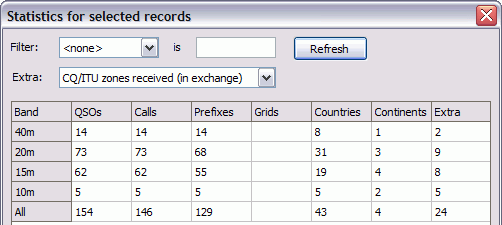
I made a total of 154 contacts in 43 different countries and 4 continents during my six hours or so of operating. The detailed breakdown, for those interested, is shown in the screen grab of the contest statistics dialog from KComm (the Extra field shows the number of CQ zones.) This would give me a claimed score of 17,487 points if my calculations are correct, which by comparison with last year’s results would place me well down the second half of the All Band Single Operator Low Power Unassisted results table.
This was the first time I had made such an effort for an SSB contest. Until now I hated turning on the radio during big SSB contests because the bands sounded like bedlam. But I had never tried with the K3 before. Instead of a mush of intermod, splatter and AGC pumping I could hear everything clearly. Sometimes I could hear two or three stations on the same frequency simultaneously, one in the foreground and a couple in the background. And the superb DSP filtering made it easy to shut out close-by stations so I could copy a weaker one. I often had the passband down to 1.8kHz and copy was still crystal clear.
Initially I started off just working the loud ones because I didn’t want to waste the serious contesters’ time by making them struggle to hear my call. But I found there was no hard and fast rule relating how strong a station was with whether they heard me. One Finnish station, 10dB over 9 with me, just kept on calling as if I wasn’t there. But many weaker ones came right back to my first call.
Frustratingly, a significant number of stations came back to me as “Golf 4 Lima India Oscar” – exactly the same error that was made when I ordered my QRSS beacon kit a couple of weeks ago. What is it about my call? This doesn’t happen on CW (though I used to get replied to as G3ILO very often as the holder of that call is a well known QRP CW operator.)
Conditions didn’t appear to be very good this weekend. I’d hoped to hear some interesting DX on 10m but I heard hardly anyone at all on the band. As always, 20m was the liveliest band, but I made almost as many contacts on 15m, probably because the QRM was less making it easier to make contacts.
I didn’t work any DX and I only worked one all time new DXCC entity – Svalbard, JW5E. I did hear a VK on 15m on Sunday morning but he had a big pileup going and after trying for about five minutes I decided not to waste any more time and move on.
Despite my unspectacular results I thoroughly enjoyed my few hours in the CQ WW DX SSB contest. No doubt QRZ.com and other online forums will be full of grumbles about contests taking over the band for the entire weekend, the only time working people can get on the air etc etc. But if you can’t beat them, why not join them?
My feeling is that contesting is one of the many different activities you can pursue and to get the most from the hobby you should try as many of those different activities as you can. As this post has hopefully shown, having indoor antennas is no obstacle to working a decent number of stations and earning a respectable score for the time spent. It’s not the winning, it’s the taking part that counts. I certainly felt like a real participant in this radiosport event and I look forward to seeing my call in the results table next year.

Foxed
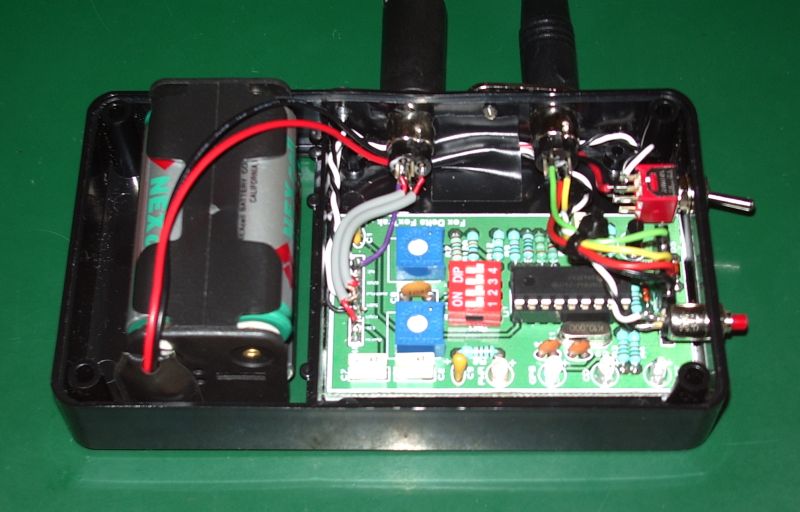
My FoxTrak APRS tracker board is now installed in a plastic case, together with 4 x AA NiMH cells which provide near enough 5V to power both the tracker and the GPS. Two mini-DIN sockets on the side of the case allow connection to a PS/2 GPS or PC for configuration, and to the radio. Now I just have to make up interface cables to my radios and install the top half of the case after drilling it and installing the charger socket for the battery.
I purchased a GlobalSat BR-355 PS/2 GPS receiver on eBay and it works very well indeed with the FoxTrak, much better than the GPS in the Yaesu VX-8GR. It gets a fix within a couple of minutes when it is sitting on the shack window sill, unlike the VX-8GR which often never finds its position indoors at all, and the position remains rock steady unlike the Yaesu which tends to wander about.
I wanted to make a cable to use the tracker with my Motorola GP-300 hand-held. However I found that the jack plugs you can buy from component suppliers have too wide a body and can’t plug all the way in to the sockets on the top of the radio, which are a bit recessed. It appears that you need to use a proper moulded plug with the two pins. A cable for the Motorola GP-300 is available on eBay, so I’m waiting for one to arrive.
I was luckier with the old Kenwood TH-205E. The sockets for external mic, PTT and speaker are flush with the top of the case and the cable I made up using separate plugs works fine. Lacking a deviation meter I adjusted the audio output so the braaps sounded as loud as those from other APRS stations.
However, the TH-205E is a bit big and heavy for portable use, especially as it has a high capacity Ni-Cad battery pack (the original being as dead as a dodo.) I had expected the cable to work just as well with the little TH-F7E, because the Kenwood speaker-mic I have works with both radios. But although PTT works on the smaller Kenwood there is virtually no audio. I have to turn the audio up to maximum on the FoxTrak to get enough signal to be decoded by my gateway, and the deviation is still too low.
I am completely foxed by this problem. The only thing I can think of is that it is something to do with using two separate plugs and not the proper moulded two-pin connector used by the speaker-mic. Perhaps, as with the Motorola, the wide body of the plugs is preventing them from going far enough in to disconnect the internal microphone, which is shorting out the audio. Unfortunately the only way to prove this hypothesis would be to buy a cheap Kenwood speaker-mic or programming cable on eBay and cut the cable off. It’s a bit of a gamble, as I don’t know for sure if that’s the solution, and the cables in some of those cheap mics from China are very poorly screened so I could end up with an RF-induced problem.

Kenwood filter fault fix
As the owner of a Kenwood TM-D710 I was interested to see that Anastasios, SV8YM, has developed a mod to fix the problem of the failing IF filters which causes these radios to go deaf after a couple of years. As explained in admirable detail in his original article describing the problem, it is caused by electromigration due to the fact that Kenwood omitted DC blocking capacitors on the input and output of the ceramic filters. This issue affects the TS2000 as well.
As you can see from Anastasios’ excellent photographs, the mod involves cutting some tiny circuit board tracks, bridging between pairs of them with wire, then soldering 0.1uF SMD capacitors between the bridge and the filter input. The TM-D710 has two receivers, each with two filters (one for wide FM and one for narrow FM) each of which has both an input and an output that needs to be treated. So that is 16 tracks that need to be cut and 8 tiny capacitors inserted. I’m afraid working with these tiny components is beyond me, which is a shame as it is now, while my Kenwood is still only a few months old, that it needs to be treated.
Thanks to SV8YM for sharing the details of the modification.

Xastir update is for geeks
Version 2.0 of Xastir, the open source APRS client, has just been released. The new version now supports OpenStreetMap mapping, the same as is used by APRSISCE. I was interested to see that the project web page claims it runs on Linux/FreeBSD/Solaris/MacOSX/Windows so I thought I would try it out on my shack PC which runs Windows. I was puzzled that there was only one download file instead of different versions for each platform, but thought that perhaps they had recoded it as a Java application. I downloaded the .tar.gz file. opened it in BitZipper and found a load of source code files but no .EXE.
There is a file called readme.W32 which contains a lengthy and complex explanation of how to install the program under Windows which involves compiling it yourself using free software development tools. I seem to recall trying this once with an earlier version and failing. Most other developers of popular free software ham radio apps, such as Fldigi, WSJT and WSPR, now produce ready to run compiled versions for Linux, Windows and any other platform their program runs on. Why can’t Xastir’s developers do this? Most APRS enthusiasts don’t possess a PhD in computing so it’s unrealistic to expect them to do it.














