Author Archive
 VK5 with V4
 September 13th, 2011 |
  Author:
 Looking for something to pique my interest enough to overcome my lethargy I decided to have another look at the V4 Chat digital mode. I tried it first at the end of last year and made one contact with it, but the alpha software was a bit flaky, then the developer Rick KN6KB had a bereavement and nothing happened for a while so I forgot all about it.
What attracted my interest was discovering that the ARQ mode had now been implemented. V4 Chat supports two conversation modes: Forward Error Correction (FEC) in which the data is sent with a lot of checks and redundancy so many receiving errors can be corrected but you have one chance of getting it correctly, and Automatic Repeat reQuest (ARQ) in which the receiver can request a repeat if a transmission is received with errors. Using ARQ a receiver can repeatedly request a repeat (up to a limit) so even if conditions are marginal a QSO is possible as long as propagation is adequate for short periods of time. Under the same conditions conventional (non ARQ) digital modes would print so much garbage that a contact would not be possible. People who own expensive SCS modems like to boast about how Pactor gets through under difficult conditions but V4 ARQ offers the same kind of performance and requires only your PC and a bit of open source donationware.
I re-subscribed to the V4Protocol Yahoo Group (which is where you can get the software from), downloaded and installed the latest version. Then I set my K3 to 14.073MHz (which is the 20m “calling frequency” for experimental narrow data modes) and waited. After a while I heard the sound of V4 ARQ bursts, and found that VK5PO was in QSO. I saw him disconnect from the other station and sent a CQ. He then connected with me and we had (just about) a QSO.

Signals were marginal both ways and I had to crank the K3 up to 50W to help John copy me but over about 10 minutes names and signal reports were exchanged. One of the nice things about the ARQ mode is that when the text prints up you know the other station has received it error free.
OK, it wasn’t much of a chat, but ignoring WSPR spots I have only ever made one contact with Australia before and that was using JT65A which is not a keyboard chat mode. I was pretty chuffed to exchange words with a ham 16,000km away using my stealth radio station!
I think I’ll be spending a lot more time trying out V4 Chat digital mode and I hope you will too because the more people use it the more contacts we can all make. The V4 signal is 200Hz wide so if 14.073 (or 21.073) is busy move up in 250Hz increments to avoid QRMing someone else’s QSO.

9/11
Everyone remembers what they were doing when they found out about the 9/11 attacks. I remember it because I had a bad migraine that day, rather like the one that turned out to be a harbinger of my brain tumour. I switched off the computer, drew the curtains in the bedroom, lay down on the bed and switched on the radio. Instead of the expected classical music there were voices talking about a plane that had crashed into the World Trade Centre. For a few minutes I lay there thinking I was listening to some “mockumentary” radio play like the famous Orson Welles “aliens have handed” spoof. But something told me that wasn’t right, so I went downstairs, turned on the TV and saw that this was all too real.
Today I hope against hope that we get through this anniversary day without another terrorist attack attempt. I just don’t understand why anyone would want to give up their life, and end the lives of other innocent people, for any “cause”. One thing being diagnosed with an incurable brain tumour has made me realize is that life is too short to waste getting angry about things you don’t agree with.. Wouldn’t the world be a better place if we could all banish negative thoughts, focus on enjoying life as best we can with those we love, and make peace even with our enemies?

Two new 2m repeater channels
According to the UK repeaters website, two new 2m repeater channels have been internationally agreed:
- 144.9750MHz input / 145.5750MHz output (RV46)
- 144.9875MHz input / 145.5875MHz output (RV47)
Though these channels are not available for use in the UK yet, the wording of the announcement suggests that they eventually will be.
Looks like we dinosaurs who still insist on calling the calling channel S20 are going to have to give up QSYing to S23!

WOTA Activity Weekend
Next weekend 27 – 29 August is the Wainwrights On The Air Activity Weekend. Many radio amateurs are planning to activate Wainwright summits over this three day Bank Holiday weekend – see the list of currently planned activations here. If you will be in or around the Lake District during this period then be prepared for a lot of activity on all the VHF and UHF bands.
The team that has taken over the running of WOTA following my illness is doing a great job and has come up with several new ideas. There will be a special activation of the summit of Latrigg, one of the lower summits to the north of Keswick, on the Bank Holiday Monday. It’s an easy walk for most people so if you will be in Keswick on that day why not stroll up after lunch and meet some of the team? If you are thinking about a family day out then Keswick Agricultural Show is being held on the same day and is always worth a visit.
I hope to be on the summit of Latrigg myself on Monday afternoon. The team has obtained permission to take a 4×4 on to the fell so I can have a ride to the top and won’t have to climb. I am looking forward to the opportunity to be on a summit again but whether I am able to go will depend on how I feel on the day and, of course, the ever unpredictable Cumbrian weather. I will be well into the chemotherapy regime by then which depresses the immune system so getting cold or wet would not be a good idea at this time.

iGate QRT again
The G4ILO APRS iGate is off the air again. My Android smartphone is on its way back to Motorola for repair so for the time being I need to use the Windows Mobile as a phone again.
I’ll also be running APRSISCE on it as G4ILO-SP while travelling to and from radiotherapy treatment in Carlisle. That is so that Olga can look at aprs.fi and see when I am about to return home. As I am using the volunteer hospital car service, time and route can be somewhat variable. APRS does have its practical uses…

VK on a whip antenna
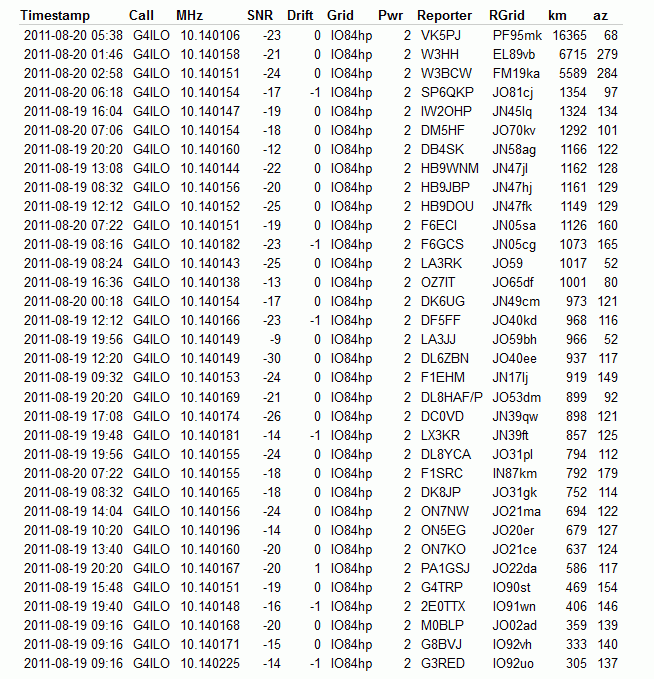
The amazing power of the WSPR mode to enable weak signals to be received over long distances was demonstrated conclusively when my 2 watt signals, transmitted into a 1.3m long telescopic whip antenna from inside the G4ILO shack,were received in Australia and the USA, not once but several times with SNR reports of up to -19dB.
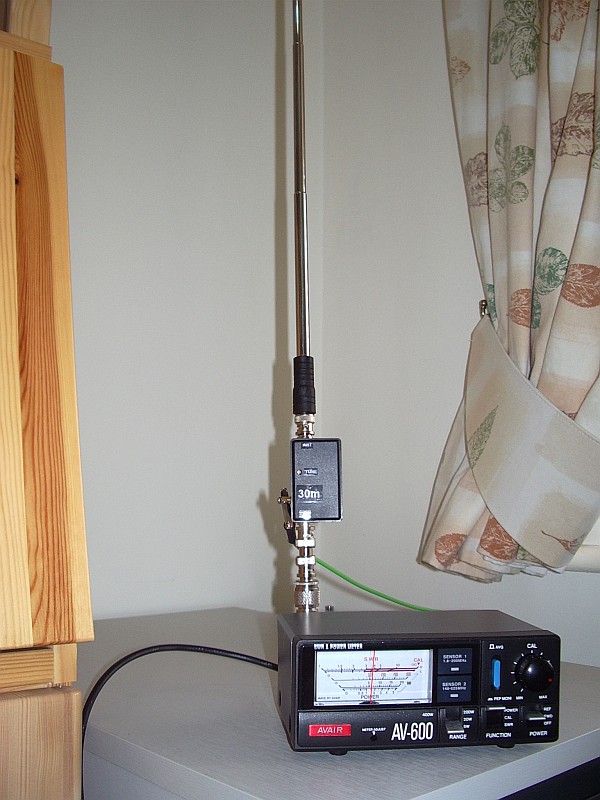
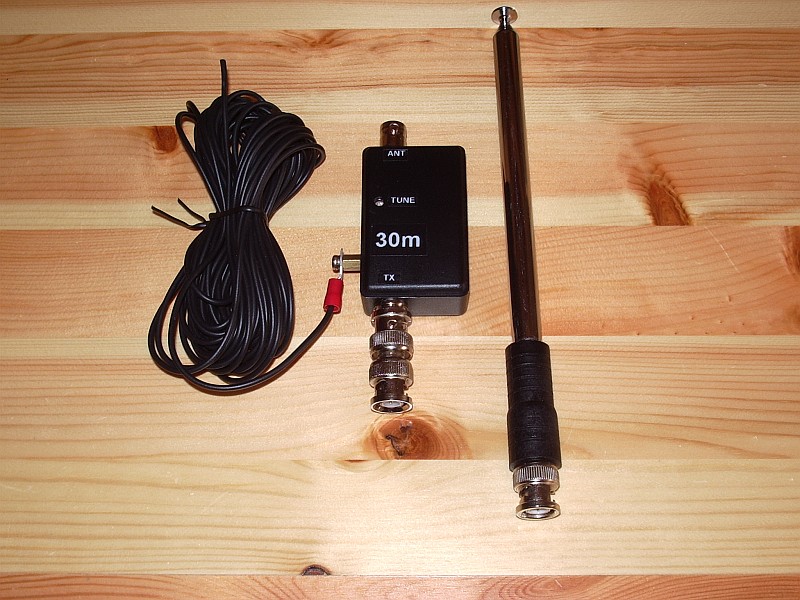
These spots were not achieved using a hand held radio as they occurred early in the morning when I was asleep. But they were made using a home made portable 30m whip antenna that I designed to be used with the VCXO-AXE portable WSPR transmitter I recently built. Here is a picture of the antenna taken during the tests.
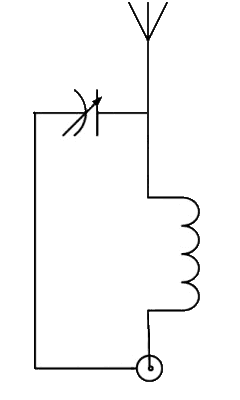
The antenna consists of an L-match mounted in a small plastic project box, with BNC sockets for the transmitter and the whip antenna.
The constructional details can be gleaned from this internal view here. Click the image to see a much larger version.
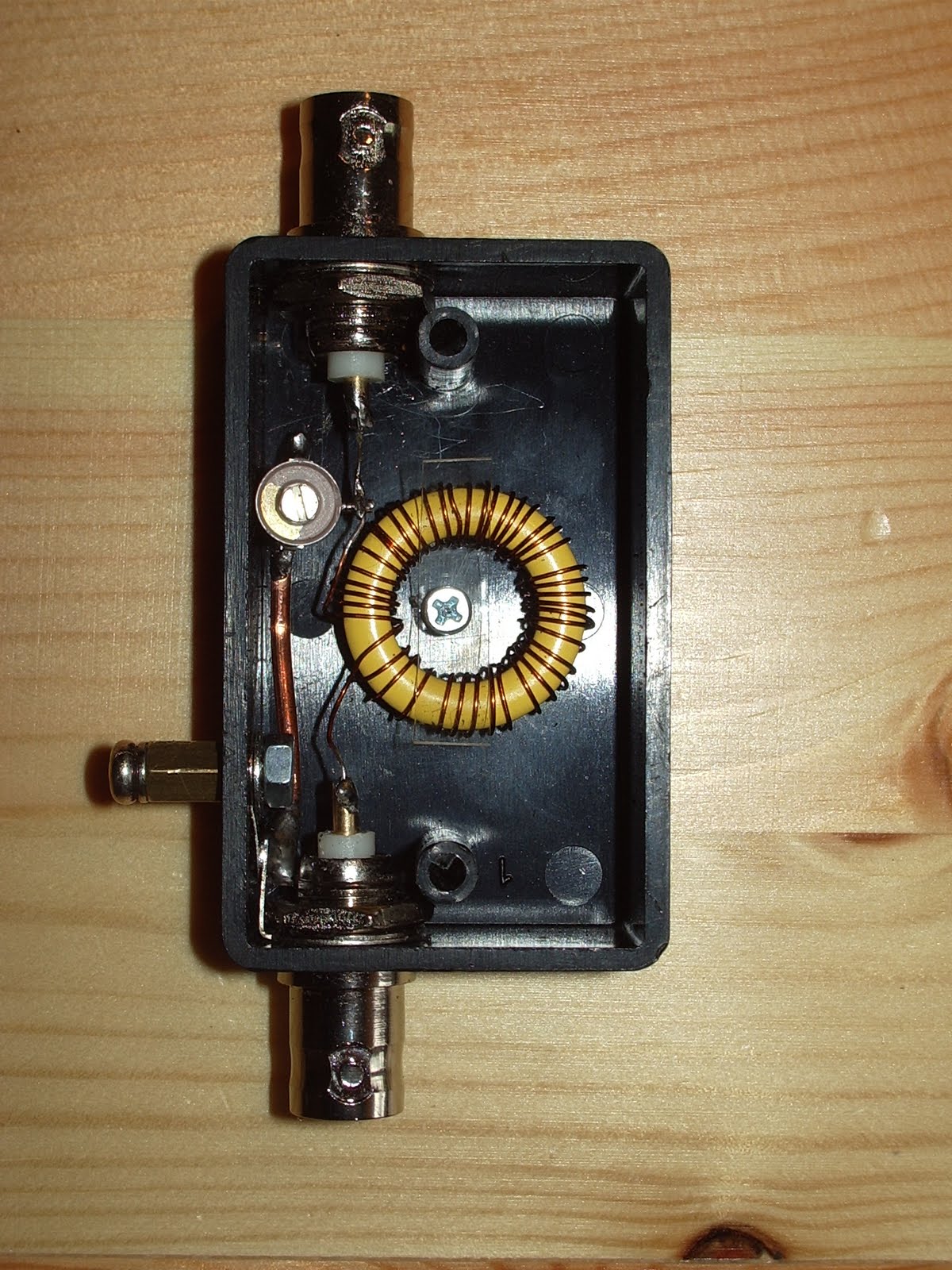
The loading coil consists of about 46 turns of 28SWG wire on a T80-6 toroid. The matching capacitor is a 4 – 40pF trimmer. The number of turns was determined empirically (i.e. using trial and error) so don’t ask me for details of how to make one for other bands. There may be formulas for calculating things like that but I don’t know them.
It would have been difficult to make this antenna without an antenna analyzer like my RigExpert AA-200 which displays the SWR across a range of frequencies graphically. With my first attempt at the inductor it was possible to obtain an SWR null at 10.140MHz but it was rather a broad dip and the minimum was around 3:1. However at lower frequencies I saw that I was able to obtain a much deeper, sharper null. This made it clear that what I needed to do was remove some turns until the deep, sharp null was at the frequency I wanted. A deep null indicates higher Q and therefore better efficiency.
You can see the SWR curve of the final version below.

Note, however, that this was taken inside the shack in the test position where reflections spoiled the SWR and broadened the dip. When measured out of doors the SWR curve dipped deeper and was narrower as long as I stood clear of the antenna. (It was interesting to note how the SWR was affected even if I was a metre away from the telescopic whip. This suggests efficiency would be adversely affected when used in true hand held fashion.)
A good ground or quarter wave counterpoise wire is needed with this antenna. The resonant frequency is affected by the ground system used as well as the length of the whip and the position of the trimmer. If you don’t want to take an antenna analyzer to the field to check and tune the antenna before operation you should use the same counterpoise. So it would be advisable to pair the counterpoise with the antenna.
Further tests would be useful to determine the extent to which a good match is reproducible in different locations using the same whip length and counterpoise without retuning.
In case retuning is needed I added an access hole for the tuning trimmer. The resonant frequency can also be changed (increased) by shortening the telescopic whip a section or two.
This has been an interesting project. As a result of it I now have a completely portable, pocketable, battery powered system capable of sending a radio signal half way round the world, and I have developed a useful monoband 30m antenna.

Motorola Millstone
This weekend I had planned to write about my Android smartphone, a Motorola Milestone 2, which I bought in early July soon after I came out of hospital. It was a fantastic phone with a big, clear screen and a really usable slide-out keyboard. It became my main method of electronic communication. The Android user interface is great – far, far superior to Windows Mobile. It is well integrated with Gmail as you would expect and it has an excellent web browser that can display almost any website, unlike the IE browser in Windows Mobile which is just a piece of s***. I was also intending to write about an Android APRS application called U2APRS. Unfortunately, last night my Milestone turned into a brick.
The one thing I hadn’t got round to doing was install a good app to read the various blogs that I follow. Blogger Dashboard is one of the few sites that doesn’t work well in the Android browser. I decided to install Feedly, found that I liked it, and spent some time going through all the blogs marking all the posts as read. Having done that I was trying to figure out how to get back to the list of blogs now that there were no new posts when the screen froze and refused to respond to touch input.
Thinking that this was just a software crash, I pulled the battery. But when the phone started up again the screen still refused to respond to finger movements. And now I couldn’t get past the lock. This situation persisted after several attempts.
Time to go online. A Google search revealed that problems with the Motorola Milestone 2 touch screen were not uncommon and that the only diagnostic to try was to perform a factory reset to make sure that the trouble was not due to a software glitch. This would, of course, remove all my apps and settings. But there was no alternative. Except that the instructions for performing a hard reset – press and hold the Camera button while powering up the phone – didn’t work. Every time, the phone booted into its normal screen, which was still locked.
After wasting quite a lot of time making several attempts at this I found another forum post that suggested holding the X key on the keyboard whilst powering on the phone. This got me a step nearer to where I was trying to be – a screen with a warning triangle and an Android icon on it – but the instructions to bring up the menu – press and hold the Volume Up button and then the Camera button – did nothing. Again, a lot of time was wasted trying this several times, including different permutations of pressing and holding, and trying both of the Volume buttons since I couldn’t be sure which was Up and which was Down, to no avail. Deep frustration was setting in.
Olga found a forum post which suggested that pressing the keyboard Search button from the Android warning screen would bring up the reset menu. That didn’t work either. Then she found another one that said to use the the @ key. At last, the menu! I was finally able to format the system and wipe all my apps and data. When the phone rebooted it entered the initial configuration sequence, asking what language I wanted it to use. Which I was unable to select because the touch screen still didn’t work.
So my Milestone is currently as much use as a lump of rock. I’m missing it already. It will probably take several days to send it for repair and have it returned, which I can’t even start to do until Monday. But I’d rather do without a phone than go back to Windows Mobile, which may be a very good platform for running apps but is absolutely loathsome as a telephone and is totally useless for Gmail.
Deep frustration. Not to mention irritation over the valuable time I’ll have to spend reinstalling and reconfiguring everything once it’s back. And to add to my annoyance I’ve lost U2APRS because the developer JA7UDE’s web site has been offline for the last couple of weeks for reasons unknown and there is no longer any way to obtain it.
I’m not a happy bunny.














