Author Archive
 Who broke it this time?
 January 30th, 2012 |
  Author:
 I have just finished the heavy dose of chemo for my fourth cycle so for the last week and for several more days it will be more than usually difficult to concentrate or even get motivated to do anything. Mostly over the last week I have just been tinkering with the Parallax Propeller WSPR and Opera beacon code and running the beacon barefoot on the air.
Stupidity seems to dog my programming efforts as much as my attempts at electronics construction. I wasted a couple of hours trying to understand why the Propeller was not doing what I wanted before eventually realizing that it was doing exactly what I had told it. I was nearly at the point of splashing out on ViewPort, an interactive debugger for Spin code that would allow me to step through my programs a line at a time. That would quickly have revealed the error, but it would have been a high price to pay to show me what was staring me in the face.
I had been pleasantly surprised at the reach of my barefoot 20mW Propeller beacon, receiving a number of reports of both Opera and WSPR signals. Today I modified my beacon program to transmit both a WSPR and then an Opera beacon, but frustratingly I have not received a single report of either of them on 30 metres. Have I broken the program again or did someone break the ionosphere? I really need to get motivated enough to build a small PA and boost the signal to at least the hundred milliwatt level.

Propeller takes to the air
Today I have been playing around with MEPT beacon code on my Gadget Gangster Parallax Propeller board. First I wandered over to Jeff, KO7M’s blog and borrowed his WSPR beacon code.
 |
| Gadget Gangster in use as a 25mW WSPR/Opera beacon |
WSPR was the thing I originally wanted to try when I decided to get the Gadget Gangster: I hadn’t even heard of OPERA at that time. But I was unsure whether I would be able to generate the FSK frequencies WSPR uses: four tones separated by about 1.48Hz. Jeff decided to shoot as near as he could and programmed for a 2Hz separation of tones, and found that the signal was decoded by K1JT’s WSPR program. So no problem!
I measured the RF output from the Propeller board and it was somewhere in the region of 25 to 40mW, depending on which measurement method you believe. I also looked at the output using my oscilloscope.
 |
| Output waveform from Parallax Propeller on 80m |
It wasn’t a pure sine wave, there’s obviously some harmonic content there, but it was not as bad as I feared it might be. As I would be using my MFJ magnetic loop on 30m, which has a very narrow bandwidth, I decided not to bother with a low pass filter for the sake of these initial trials. I watched the seconds tick over on my shack radio-controlled clock, started the beacon and was soon rewarded by several WSPR spots!
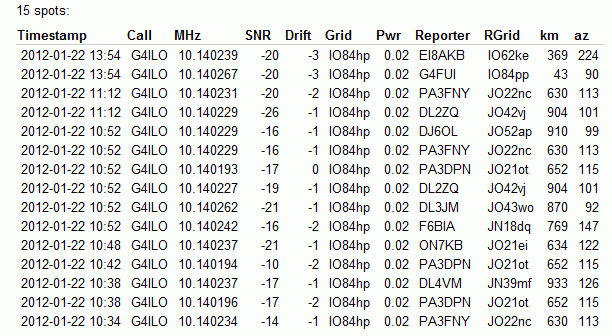 |
| WSPR spots for 25mW Propeller beacon |
Because WSPR is a time-synchronous mode I had to start the beacon when the seconds ticked over to 00. This brought to light a problem Jeff had already observed: the Propeller drifts. The drift seems to be worst during the first few minutes of operation, so leaving the beacon running so it can reach a stable temperature would appear to be the solution. However that is not so easy when you have to power it on at an exact time. I will need to look in to implementing a real-time clock for WSPR, unless I want to interface a GPS receiver to the Propeller – which is certainly possible and something else I hope to try as I’d like to have a go at making an APRS tracker.
An advantage of the OPERA mode is that it is not time synchronous so I can leave the beacon running in that mode with an arbitrary delay between transmissions. My first OPERA transmission also produced several spots, including reports from fellow bloggers PC4T and G4NKX.
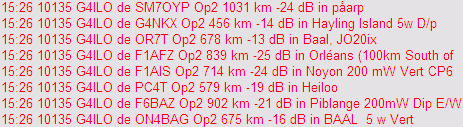 |
| OPERA spots for 25mW Propeller beacon |
I can also generate Morse and QRSS beacons using the Propeller chip. There is still a lot to do to reach my goal of a multimode, frequency-agile beacon, including adding a PA and some switchable bandpass filters. But so far this project has turned out to be easier than I thought it would.

Four metres
There are a number of things I’d like to do radio-wise this year. One of them is to get equipped for SSB on four metres.
I have spent quite a lot over the last two or three years on 2m SSB and have very few contacts to show for it. My QTH in the Cockermouth Black Hole seems to be prevented by the Lake District mountains from receiving good signals from other English stations by normal propagation. I don’t even experience much in the way of tropo openings here. The only real 2m DX I have worked are a handful of Sporadic-E (Es) contacts into Spain and Portugal. One thing I have learned is that 144MHz Es, which is a pretty rare thing in any case, is considerably rarer the further north you get. I was ill and recovering from my brain operation during the peak of the Es season last year but as far as I can tell from DX Sherlock no Sporadic-E openings on 2m reached this far north during 2011 so I didn’t actually miss anything.
Six metres is another matter. I have made lots of contacts on the Magic Band even though my 6m antenna is just the addition of two quarter-wave wire elements to my multi-band attic dipole. Four metres won’t be open as often as Six but it should sustain Sporadic-E propagation a lot more often than Two does. And now that many European countries have granted their amateurs 4m allocations I think there could be a good chance of working some summertime DX.
The plan depends on my finding space in my attic antenna farm for a 4m antenna. One of the first home improvements Olga and I will make this year is to replace the central heating boiler and we’re advised that the most efficient types available now heat the water on demand and don’t need a header tank or pipes in the loft. I’m a bit apprehensive about letting workmen loose in the attic when I’m not sure whether I’m capable of moving around safely up there to check my antennas are OK and repair any damage. But getting rid of the tank and copper pipes will make a bit more space for the antennas and hopefully allow me to mount a 4m Moxon on the rotator where the 2m one currently is.
I will also need a radio for 4m SSB. I guess I’m looking at getting a Spectrum Communications transverter for this. Probably a ready built one as I’m not really sure I can manage to assemble that complex a kit any more. I wonder if anyone has successfully modified an Elecraft XV50 for 70MHz?

Simple keyer complete
At last, I finally got the QRP keyer using KD1JV’s Simple Keyer Chip boxed and working.
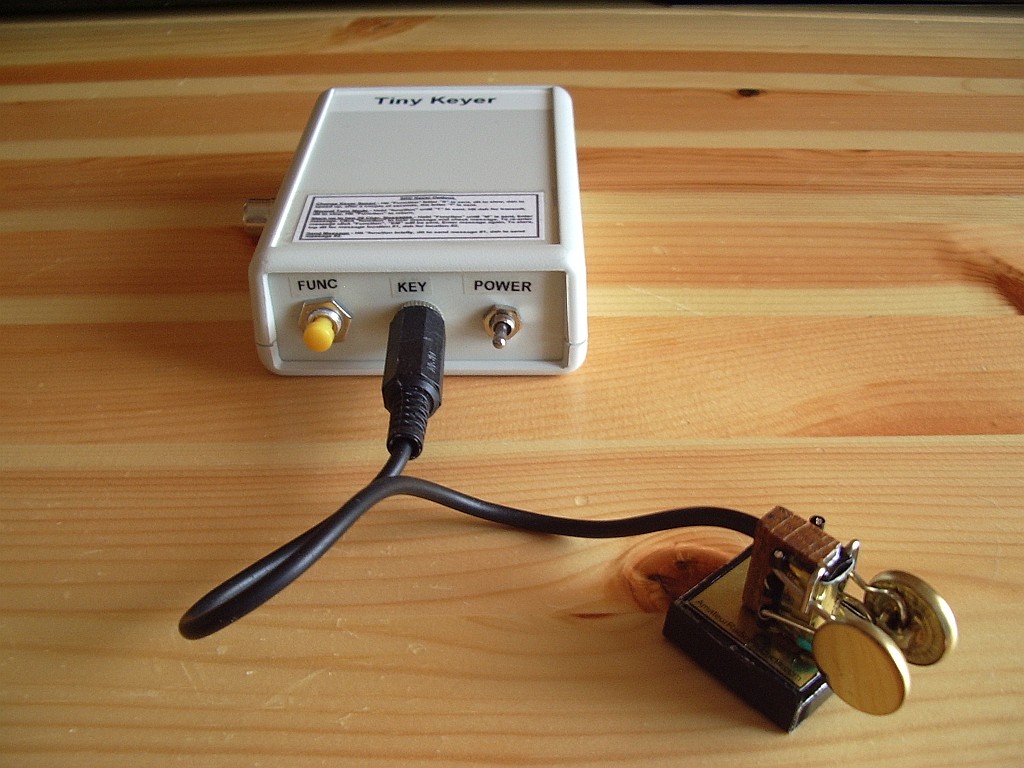 |
| The completed keyer |
As usual, nothing went according to plan. There must be some relative to Murphy’s Law that states for any homebrew project the case will be just too small for comfort. A related rule is the one which guarantees that after you have drilled the case, the position of one of the switches or sockets will be in just the place where it fouls one of the components.
After my first attempt at getting it into the box the keyer was dead as a dodo. This turned out to be because I had forgotten to break one of the tracks on the Veroboard.
After the second attempt the keyer responded to the function button but there was no keying. That turned out to be because one of the connecting wires had broken at just the point where it was soldered. With my eyes as they currently are that took a while to spot.
When I had resoldered the connection and put the board into the case for a third time I noticed that another connecting wire was hanging on by one strand of copper. Lesson: don’t use hookup wire from China, it is made from inferior grade copper.
 |
| View from the front |
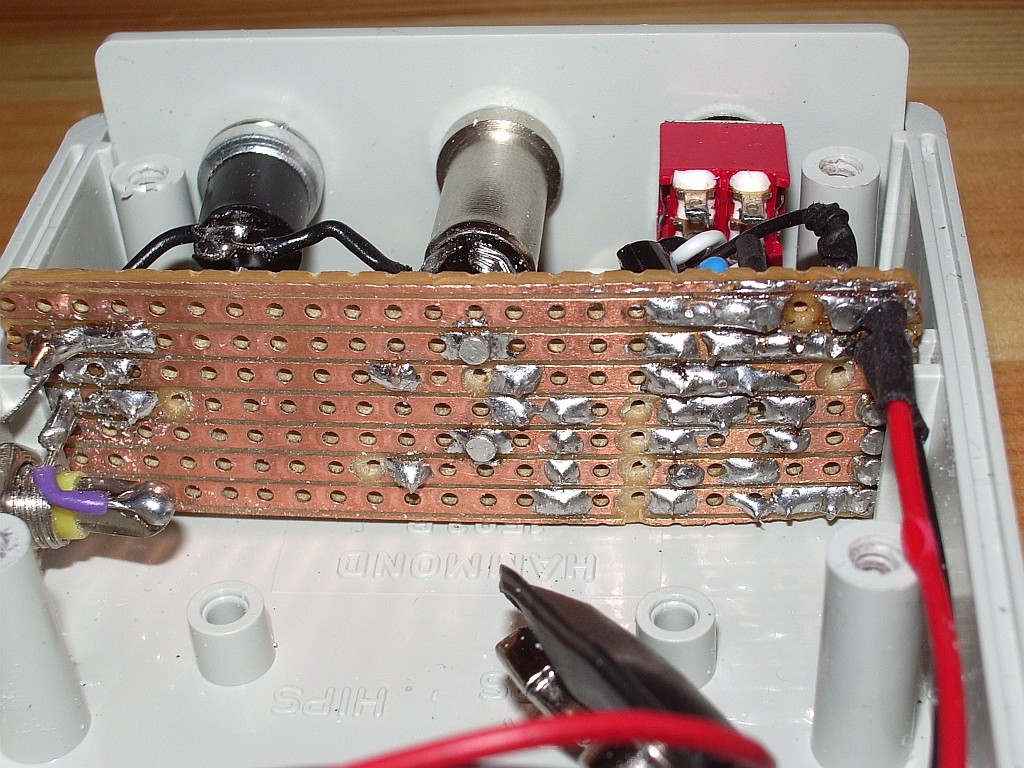 |
| View from the back |
This had taken me a day, so I decided to put the project aside until I felt calmer. The next day I re-made all the connections using new wire, put the board into the case one last time and it actually worked! But Murphy had one last laugh: Now I couldn’t find the four screws for the Hammond case I was using. We searched everywhere. Fortunately my parts box had another Hammond case which sacrificed its screws for the benefit of the keyer. Later, Olga and I managed to find suitable replacements in the local DIY emporium so the other case won’t be wasted.
This Simple Keyer is just what I need for the simple QRP rigs that only work with a straight key. The code speed is easily adjustable and there are two memories, one of which can be repeated as a beacon. I don’t need more sophistication than that for QRP work.

Propeller does WSPR
Through Eldon, WA0UWH I have discovered another blog to add to the blogroll: that of Jeff, KO7M. Jeff is interested in a lot of the same things I have been (including light aviation: an ambition of mine when I was in my 20s but which I could never afford to take up.) But what really piqued my interest was that he has just got a Parallax Propeller to generate a WSPR signal.
This is one of the things I was interested in trying. But I never got further than wondering how to implement the fractional frequency shifts of the WSPR signal, which uses 4 tones shifted by just under 1.5Hz from each other. Jeff has apparently found that a 2Hz shift is good enough to be decoded, allowing WSPR to be sent using the integer frequencies the Propeller chip can easily generate.
Once I have finished the Tiny Keyer project and can get back to the Propeller I will be trying this myself. My ambition at the moment is to make a multi-band multi-mode (OPERA, WSPR and perhaps QRSS as well) standalone beacon with an LCD panel to enable me to choose the band and mode. We’ll see how far I get, but having two other people working on the same ideas should certainly make the task easier!

Trials and tribulations
I’m sorry if you are one of the many people who have sent me email expecting a reply, but unfortunately answering emails is one of the things I very often never get around to. Although it might seem from the blog that I am getting back to normal, everything I do still takes me a lot longer than it did when I was fit and well and I’m more prone to making stupid errors. I’m happy that I’m still able to do some of my ham radio activities but what I achieve is often accomplished only after a lot of frustration.
Today the Simple Keyer Chip from Steve Weber arrived in the post. I verified the behaviour of the chip I’d programmed, then replaced it with the new one. I was pleased to find that it now operated at the correct speed – the sidetone was now audible to humans rather than bats and the default speed was rather more sensible. Obviously I’d messed up some setting of the programmer – but the keyer still ignored the dot paddle. I began to suspect that this meant there was something wrong with my wiring, but between my limited field of focus and my shaky hands it took the entire morning – culminating in a lot of bad language – before it eventually dawned on me what was the trouble.
To cut a long story short, the cause of the problem was the 3.5mm socket I was using for a key jack. It had three terminals which I thought were for tip, ring and sleeve, dash, dot and ground. But it was a mono socket! There was no ring connection. One of the three terminals was linked to the other and disconnected when the plug was pushed in, intended to silence a speaker when phones were plugged in. It took me an entire morning including checking the wiring of two morse keys before I discovered my stupidity.
I hunted in my parts drawers and eventually discovered a proper 3.5mm stereo socket. After connecting that in place of the other one I confirmed that the keyer worked as expected. But the frustrating search for the solution had made me tired so I decided to leave the task of drilling the box and finishing the keyer for another day, thereby adding to the list of unfinished tasks alongside the unanswered emails.
Another thing that annoys me is my Rapid Electronics HY3003D bench power supply. It has a rather inconvenient fault for a power supply that is used in a radio shack. The voltage regulation circuit suffers from RFI. If any of my radios transmits, the voltage increases. In some cases it could increase to a level that could damage the circuit I am testing, though fortunately that hasn’t happened yet.
I don’t always remember to put my APRS gateway or the WSPR (or Opera, which I have been testing today) beacon into receive-only mode whenever I’m working on something. (I’ve tried clamp-on RFI suppression ferrites on the mains lead and they made no difference.)

Anyone for raspberry pi?
There’s a lot of excitement right now in the UK tech community about a new computer called the Raspberry Pi. It’s a bare board computer with an ARM processor that runs Gnu/Linux that is expected to sell for $25. It’s aimed principally at the education market with the intention of getting schools to teach students how to program and build things with computers instead of just learning Word and Excel as they do now.
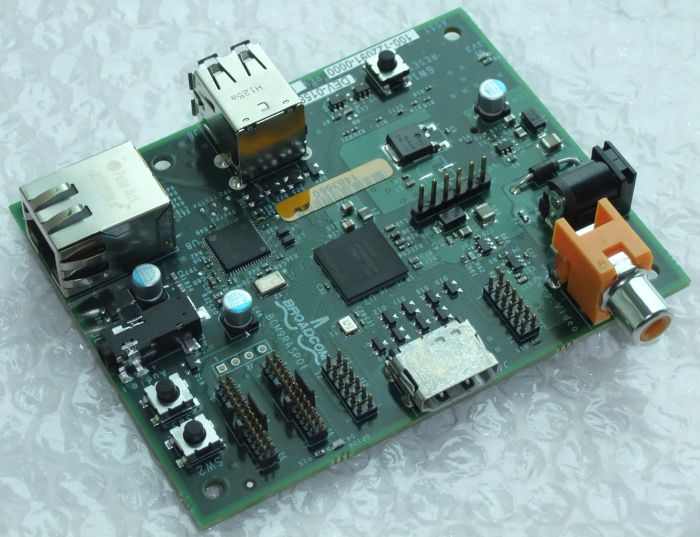
The Raspberry Pi will soon be available for anyone to buy. When they are, I’m tempted to get one. My recently acquired Gadget Gangster has helped me recapture some of the magic and excitement I felt when I first started dabbling in home computers back in the ’80s with things like the Nascom 1, ZX81 and Sinclair Spectrum. I think the Raspberry Pi would do the same.
PCs and Windows are great tools, but they have turned computers into appliances and made computing boring. Microcontrollers are like QRP computers – more of a challenge to use but when you succeed you feel a real thrill at having accomplished something.
I think there has never been a better time than now to have an interest in electronics. I hope the Raspberry Pi is a huge success. Perhaps it will result in more of our young people becoming engineers instead of wanting to be lawyers or salespeople.














