Author Archive
 Project Abandoned
 February 11th, 2012 |
  Author:
 I am abandoning the Propeller Beacon project. Sadly I am forced to accept that in my current state of health the construction of electronics is beyond my ability. All of my recent attempts have resulted in one problem or another due to stupid mistakes that I would never have made when I was well. It’s time to put the soldering iron away.
Yesterday I made up the LCD UI board for the Propeller. It seemed to go well. The instructions were good and I didn’t have any difficulty with the soldering. I thought I had finished, then realized that I had skipped a page and hadn’t soldered a connector to the LCD daughter board. That’s when I made a stupid mistake. I had soldered a male 2×8 header to the main board. Then I went and soldered another male header to the LCD board. And then I wondered what the four 1×4 female headers left over were for. Obviously they were meant to be soldered in two rows of two to make a 2×8 female header to mate with the male I originally installed. Bad words were said.
With the help of Olga I managed to get the header off. We heated all the pins using the soldering iron body which softened the plastic base until it could be pulled off. Then I removed the pins one at a time. I cleaned the holes using one of Olga’s sewing needles and installed the female headers I should have put in. All seemed well and no harm appeared to have been done apart from to my nerves and temper.
I powered up the Propeller board and loaded the LCD UI demo program. It seemed to work. I changed a few things in the program as an experiment. Then I found that the Propeller stopped responding to the buttons. After anything from a minute or so to a couple of seconds the program eventually crashed. Sometimes it would respond to a press of the reset button, sometimes it needed a power on/off. I restored the original unmodified demo program in case it was my changes that had messed things up. No such luck. Each attempt to run the program lasted for a shorter period eventually resulting in an unresponsive board. Sometimes a garbage character would appear on the LCD, sometimes it froze up blank.
I removed the LCD UI board from the main board and re-heated all the solder joints but it didn’t help. I can’t see anything wrong but there is just nothing I can do to make this board run reliably enough to use as a user interface. So it’s time to admit defeat and call it quits. As Olga said, a hobby is supposed to be fun, instead it is just making me stressed. I just wish I had more enthusiasm for operating radio instead of tinkering about.

Kindley advise me
I’ve been thinking about buying an Amazon Kindle. But I’m not sure if it will really be useful for what I want or whether it will just end up sitting on a shelf like my Eee PC and other gadgets of the month.

I know that the real purpose of the Kindle is for reading electronic books purchased from Amazon.com. However I don’t see myself using it for that very much. What I am interested in is reading ham radio and electronics publications that are increasingly being made available in electronic format. Are these magazines viewable on a Kindle or do they use some proprietary format only supported by a special application that needs a PC or Mac?
One of the publications I’d probably use it for is CQ, as I’m not sure it is really worth the international postage. Then there is World Radio, which is only available in electronic form, which I have never read due to the inconvenience of having to use a PC to do it. Now ARRL is bringing out an electronic version of QST. I still look forward to the printed magazine landing on the doormat but I do pay quite a premium for that.
I’d be interested to learn from Kindle users what formats the device supports. A couple of months ago the back issues of the now defunct 73 magazine and Ham Radio were put online. I downloaded the Kindle application for Windows and was disappointed with the results. The magazines were available in Kindle format but it looked as if they had been badly scanned using an OCR system and half of the content was in Greek! The PDFs were huge files and looked more like a poor quality FAX. The best format appeared to be one called Deja Vue. I downloaded a reader for it. Does the Kindle support that?
My eyes might find it easier reading on a device that lets you zoom in and enlarge the font. Does the Kindle let you do that?
How well does the Kindle support PDF files? I expect I would use it for those a lot. With a Kindle could I read PDFs I’ve downloaded and stored on a drive on our network or a memory stick? I’ve often considered, for nostalgic reasons, ordering some electronic back issues of Radio Communication (now RadCom) from the years when I first got interested in ham radio, though so far I have always changed my mind when I see the cost!
So over to my readers. Your thoughts on this, if you would be so kind!

Now output
Everyone who commented to my last post about the lack of output from the Kits and Parts RF amp felt that the problem had to be the QRPer’s curse – the toroid inductor. Normally I don’t have a problem with toroids, but when they are so small that your thumb obscures the whole core while you are holding it, never mind winding it, they are not the easiest of components to work with.
So I gritted my teeth, tried to forget the hour I’d spent yesterday wrestling the thing into position, and yanked it out. One of the wires broke off in the hole leaving nothing to grab on to. I was unable to clear the small plated-through holes in any case. What I was able to do was melt the solder enough to push some bare wire through, creating “pins” that I could solder to. I twisted together the two wires that are connected so I had three ends to solder to the three pins I created. The toroid now stands up on the board a bit but it was easier soldering to the pins than trying to get four thin wires to go through four holes simultaneously. To my joy, on applying power and RF the power meter showed output.
I’m getting about 150mW if the amp is supplied with the recommended 8V, and just about 200mW from a 9V supply. That’s only about 10dB of gain, a bit less than expected but probably enough given that the Propeller does not generate the purest of signals. The WSPR beacon has already been spotted a few times in Germany. But the 2N5109 runs a bit hot to the touch so I’ll have to QRT until the heatsink I ordered arrives. In the meantime I still have the LCD UI board to assemble and play with.

No output
I built the Kits and Parts RF Amplifier. Unfortunately it didn’t work.
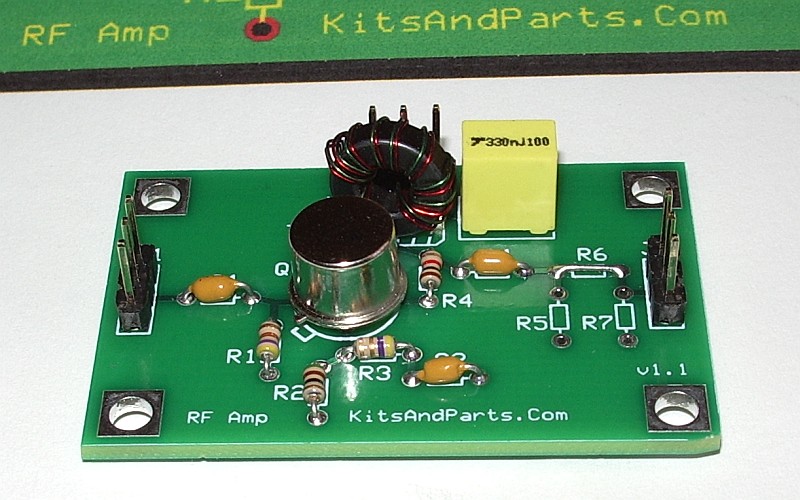
When power is applied the meter in my bench power supply reads 0.01A. As soon as the Propeller beacon starts the current draw increases to 0.03A (at 8V). But the needle on my QRP power meter, which shows more than 25mW from the barefoot Propeller, doesn’t budge.
I don’t understand it. It’s a simple enough circuit, there isn’t anything to go wrong. Unfortunately I find these kit construction failures too demoralizing. I struggle with my vision and shaky hands just to build the board. Desoldering and faultfinding are beyond me at the moment. If I do discover the cause of the problem it’s something really obvious that anyone with a normally functioning brain would spot. I think it is time for me to accept my limitations and stop attempting to do what I used to be able to do before my brain surgery. From now on if I can’t buy what I want ready to go out of the box I’ll just have to do without.

Under the microscope
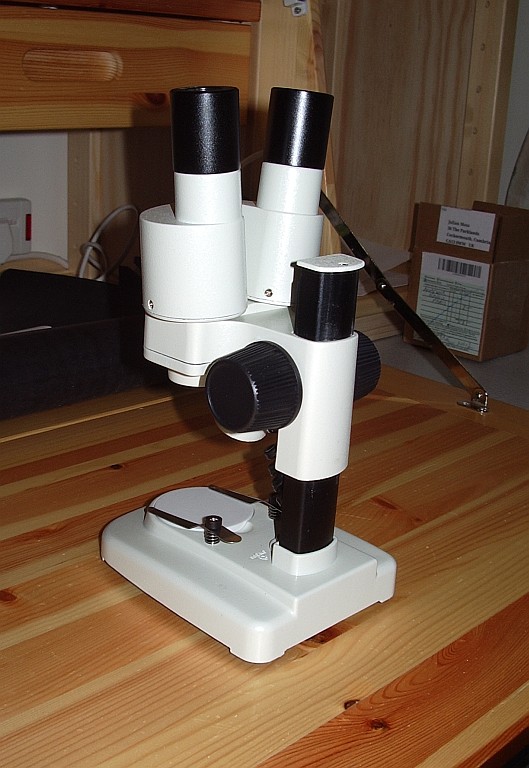 A couple of weeks ago Jeff KO7M wrote that he had acquired a binocular microscope for the workbench to enable him to work with SMT components. Although I have no particular desire to do SMT work at the moment I do have trouble with close-up work due to my eyes’ limited focal range and becoming very far-sighted. So I thought a binocular microscope would be a good addition to my workbench too.
Jeff wrote that his binocular microscope was not cheap and from the look of it I would imagine the cost ran well into three figures. The one I got was £30 from a firm that disposes of liquidated stock on eBay. I’m sure it isn’t as good as the one Jeff got but hopefully it will be useful. If not I can always start another hobby looking at plants and insects or growing bacteria!

Some assembly required
Yesterday a packet from the USA dropped on to the doormat. It was the LCD UI module from Gadget Gangster. The cheap international shipping option is pretty quick!
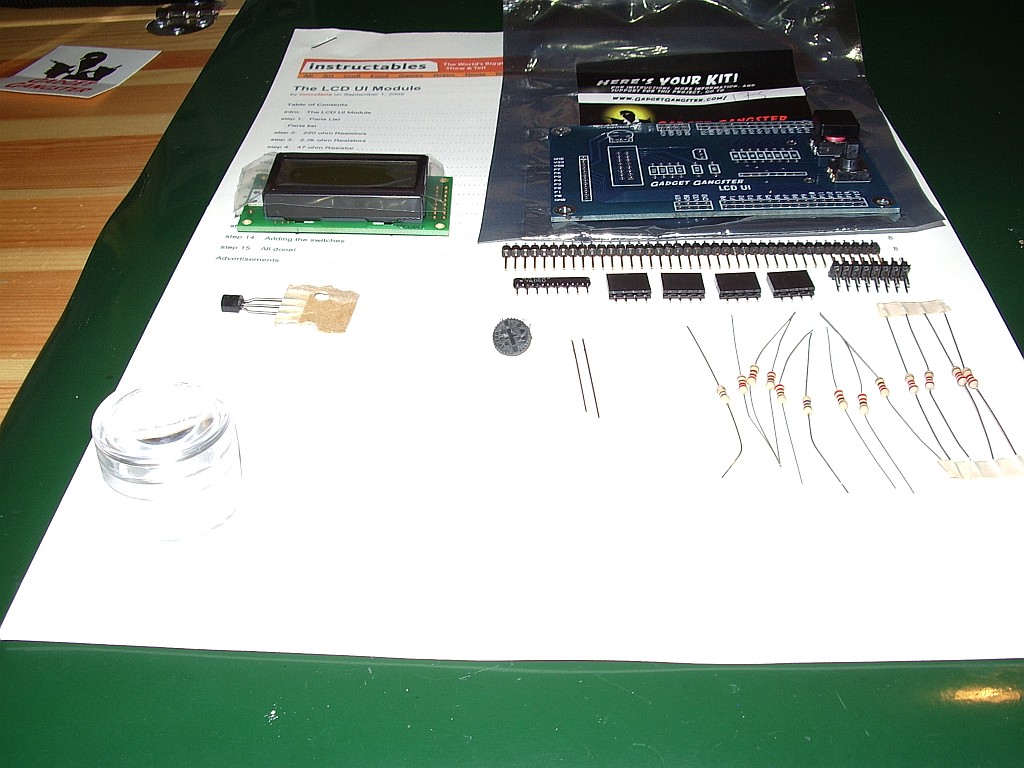 |
| LCD UI module ready for assembly |
On opening the envelope I was taken by surprise as I hadn’t realized the module was a kit. But there aren’t too many components and they are all through-hole so I should be able to manage it. I will take my time and double check everything to ensure I don’t do anything stupid like solder headers on the wrong side of the board. More than a few K2 builders have done that!
The instructions on the Gadget Gangster website are very comprehensive with several colour photos showing different stages of assembly. But on checking the parts against the parts list I found that I was missing one 2×8-pin header socket. Fortunately I found one (a pack of 2 actually) for a couple of quid from a UK based eBay component supplier so I should have it in a couple of days. eBay is my main source of electronic components these days as the usual sources like Farnell or Maplin all have hefty minimum order and postage charges that make ordering the single part you need to complete a project quite uneconomic.
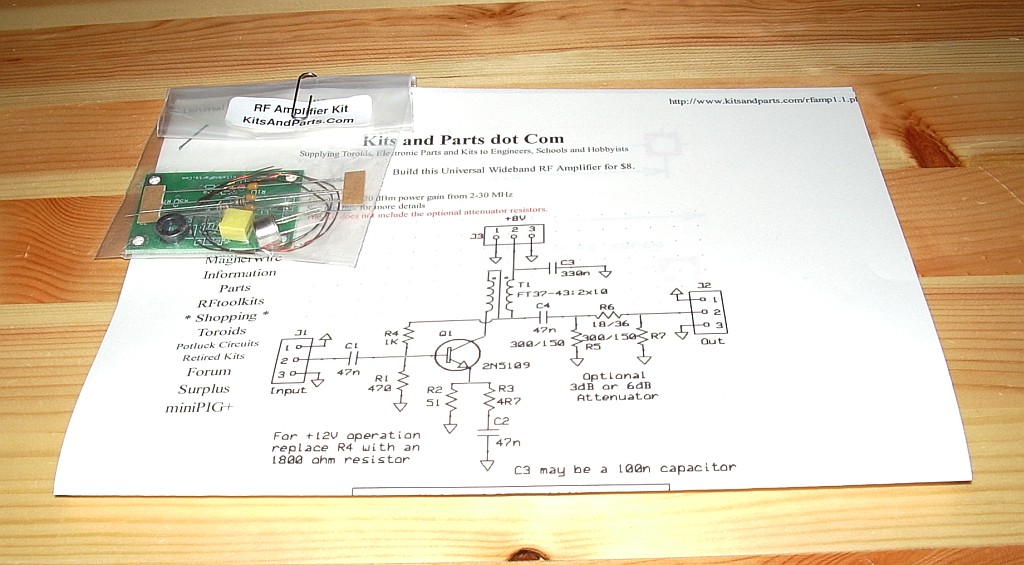 |
| Kits and Parts Universal RF Amplifier |
A few days earlier I received another kit from the USA: a QRP RF amplifier from Kits and Parts. I got this with the idea of using it with my Propeller beacon but it is probably too good for that. The beacon really needs only a simple class C amplifier to raise its output to a couple of hundred milliwatts. I had been tempted to go for a couple of watts but whilst WSPRing on 20m today and monitoring the signal on the K2 I noticed a weak in-band spurious around 14.05 MHz which no low-pass filter will eliminate. So it is probably best to stick to QRPp if using the Propeller as an RF source.
Another new arrival in the G4ILO shack was a GPS module from Hong Kong. This was used, ex-equipment, and cost about £12 including postage. I’m not sure what I am going to use it for but if I don’t put it in the beacon to provide a time reference (and locator) for WSPR it would be interesting to try to make an APRS tracker using the Propeller chip.
So many projects! But I am convinced that having this amateur radio hobby to give me so many different and interesting activities is the reason I remain cheerful and positive unlike so many people who have the same health condition and seem to fall into a slough of despond and hopelessness. I may never complete them but at least they give me something to stop me dwelling on darker thoughts.

A cheap LCD
A packet arrived from China this morning containing a 16×2 LCD module which I purchased for the absurd sum of £1.93 including shipping. That wouldn’t cover the postage from a UK supplier. I don’t know how the Chinese do it and make a profit.

I bought the module with the intention of using it to make a user interface for my Parallax Propeller beacon. Having ordered it I was not sure how to interface the LCD to the Propeller so I chickened out and ordered an LCD UI module from Gadget Gangster. This is rather more expensive (though still a reasonable $29.99) but it includes a 4-way + depress button for menu navigation, plus a separate red button. It plugs straight into the Gadget Gangster board. I reasoned that even with the hardware sorted the software would be enough of a challenge.
I have rather ambitious plans for this beacon. Perhaps over-ambitious. After reading Alex G7KSE’s blog post about his Arduino based MSF 60kHz receiver I’m interested in interfacing one of the inexpensive MSF receiver modules to the Propeller. I could use this to display an accurate clock and also to control the start of WSPR beacons. As I’m a bit of an accurate time nut and have two radio controlled clocks in the shack (and a radio controlled watch) it is really no trouble to press a button to start the beacon at the beginning of an even minute and then keep time from there. But that isn’t the point really, is it? What could be cooler than a shack clock that is also a WSPR beacon?
This microcontroller stuff is new to me and I have a lot to learn about it. One question I have is what do constructors who use Arduino boards or similar things like the Gadget Gangster do when they want to make a finished project? Do you just buy another development board to use for the next project, or are there simpler boards with just the microcontroller and its essential ancillary components which you use for the final version? I guess I’d still want the ability to update the software (firmware?) so there isn’t much of the Propeller Platform board that I wouldn’t be using.














