Author Archive
 Robust Packet Radio
 August 26th, 2012 |
  Author:
 A couple of days ago Chris, HB9DDF sent me an email asking how to configure APRSIS32 to work with the SCS Tracker / DSP TNC. Digging through my configuration files to get the information he needed I thought: why not put the 30m APRS gateway back online? It had been off since I went into hospital last year and the K2 and magnetic loop were hardly ever used.
 |
| SCS Tracker DSP TNC and Elecraft K2 at G4ILO |
I don’t know if propagation is lousy or whether things have changed since I was last on HF APRS but there seemed to be a lot less activity on the 30m APRS frequency today. An hour went by without my receiving anything. I did, however, hear quite often the “whooshing” sound of Robust Packet Radio (RPR) stations a few hundred Hz down. So I decided to configure the TNC to work in RPR mode.
Robust Packet is a mode obtainable in 300baud and 600baud versions that has been designed to take advantage of the capabilities of digital signal processing (DSP) in order to obtain reliable communication over a normal less than perfect HF path. To anyone who has experience only of traditional 300baud FSK packet RPR has too be seen to be believed. Packet after packet was decoded and displayed by APRSIS32 while conventional packet transmissions on the adjacent channel just flickered the DCD lamp and were discarded due to errors.
Robust Packet is a proprietary mode developed by SCS and is only supported by SCS TNCs. As far as I know no description exists that would enable someone to develop a PC implementation that uses a sound card. In that respect it is pretty much like Icom and D-Star. I would much rather use an open standard.
 |
| G4ILO-10 joins the Robust Packet Network |
But RPR works where the old-fangled 300baud FSK invented to work on the analogue modems of 30 years ago doesn’t. I think it is in keeping with the spirit of ham radio to use state of the art technology where it provides clear benefits to communication.
So G4ILO is now part of the Robust Packet Network.

Info needed
Ed, PE5ED and Wijn are developing a project called the IARL. They are trying to collect as much data as they can on repeaters and beacons. This will be freely available via the website and also through an app for smartphones.
They already have quite a lot of information for western Europe though I have already spotted a couple of errors relating to local repeaters. If you can help with corrections or sources of data they would like to hear from you.

KX3 distorted audio problem
KX3 #110 has had a problem ever since I received it. The audio through the speaker has always sounded badly distorted and buzzed at anything above a very low volume. Judging by comments in the KX3 Yahoo group this was not an uncommon problem. A couple of solutions were proposed, including removing the cloth between the speaker and its grille. As I could get perfect audio on headphones I decided to wait until the definitive solution was published and until I plucked up sufficient courage to take a screwdriver to the radio.
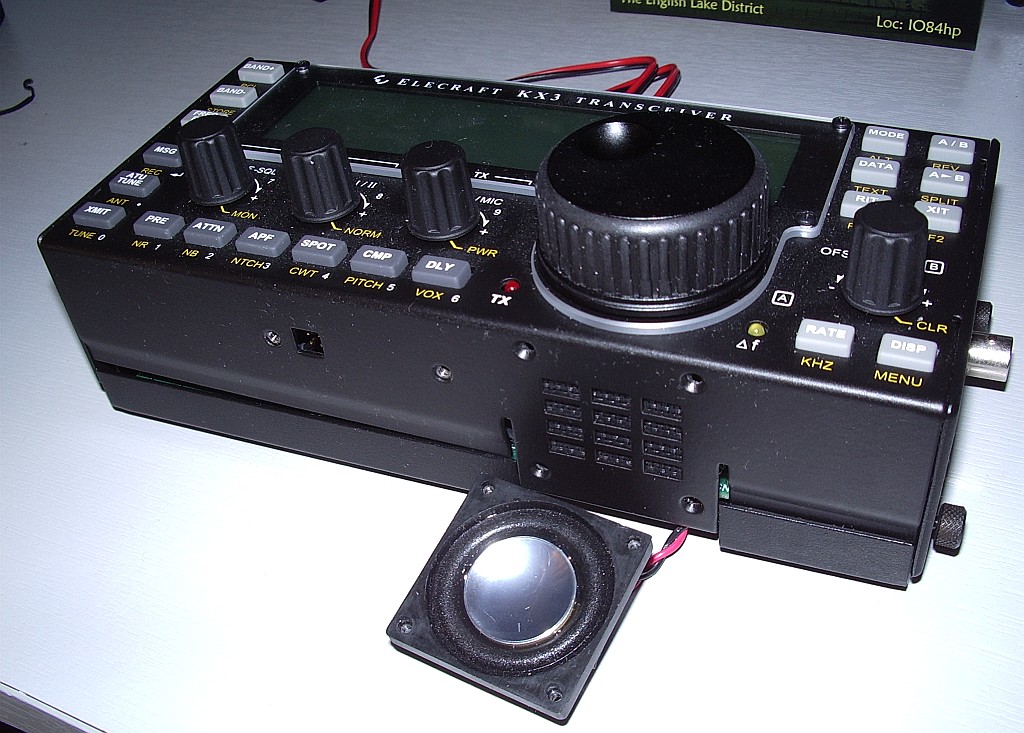 |
| KX3 #110 awaits a replacement speaker |
I opened the case and poked around with a finger to see if I could find what was vibrating. The buzzing was definitely coming from the speaker area so I concluded that the problem was the speaker cone vibrating against the grille cloth. I posted a message on the KX3 Yahoo group to see if I could determine the chances of a successful cure if I removed it. The replies suggested that the prospects were good. I also received an email from KX3 Support offering me a replacement speaker. Excellent customer service!
This morning I was feeling brave so I opened up the case and tried to remove the speaker. I took out the 4 screws but the clearances around the speaker are so tight it looked as if I might have to take the KX3 to pieces to remove it. With a bit more jiggling it came free (phew!) so I partially reassembled the two halves with the speaker poking out the front of the radio. I applied power and attached an antenna and various howling and squawking noises emerged from the speaker.
So the culprit really was the speaker! Perhaps it had been damaged during assembly (not by me, as this was an assembled radio.) I told KX3 Support that I would have to take up their offer of a replacement speaker. The KX3 will remain in two halves until I receive and install it.

cAPS Lock Anguish!
Several times a week I have been on the brink of writing this. It’s time to get it off my chest. I curse whoever it was that decided to place the caps lock key to the left of the A on the keyboard. For what seems like one time in two when I go to type a letter “a” I hit caps lock instead (or as well.) I hAVE USually typed several more letters before I realize my mistake and have to bACKTRack, to the accompaniment of loud cursing.
A couple of decades ago, in the days of MS-DOS, it was possible to write a little program called a TSR (from Terminate and Stay Resident.) This program could intercept your keystrokes and convert them to anything you liked. I wrote one that trapped Shift+3 and turned it into the pound sign instead of the US default hash (#). Microsoft provided a utility called KEYB.COM that could do this but it occupied several K of memory and in those days you counted every byte.
I don’t know if that is possible in Windows. But I’d really love a program that could intercept the caps lock key and turn it into an A (or rather, an a) unless you gave it a long press!

The $3.79 antenna
 |
| The $3.79 antenna |
Among users of the Baofeng dual band UV-5R HT a popular topic of discussion is what antenna to buy for improved performance. The general consensus sees to be that the stock Baofeng antenna is not much good. But no-one wants to spend $30 on a $40 radio to buy an antenna made by Diamond or Comet. The trouble is that half the antennas sold on eBay seem to be fakes that are about as much use as a piece of wet string.
A popular choice recently is known as the “$3.79 antenna.” This antenna – which also goes by the name “$3.42 antenna” after a recent price cut by one eBay vendor, has an SMA-F connector and a very flexible 6.5″ whip. It’s very similar to the Nagoya NA-666 but with a different base. You can find sellers by searching eBay for “female universal antenna for Kenwood”.
Both the Baofeng stock antenna and the $3.79 jobbie appear to be made by the same manufacturer. Printed round the SMA connector of the Baofeng antenna is the words “FM/136-174/400-480MHz”. The $3.79 antenna has the wording “FM/136-174/400-470MHz” in identical print but on a red not a black background.
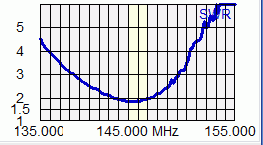 | |
| UV-5R stock antenna |
Despite the aspersions cast on the effectiveness of the UV-5R stock antenna, I found that it isn’t half bad. In fact, it is one of the most accurately tuned rubber duck antennas I have come across and performs remarkably well for a 12cm (4.5in.) long antenna. As the SWR plot shows, the VHF resonant point is exactly at 145MHz. I am unable to plot SWR at UHF but I can measure it at a fixed frequency and it was 2:1 at both 145MHz and 433MHz.
 |
| $3.79 antenna |
The $3.79 antenna appeared to be tuned to 154MHz. The tuning is not as sharp as the Baofeng antenna and the SWR at 145MHz was just over 3:1. I measured a similar SWR at 433MHz. The actual SWR of handheld antennas will vary depending on whether the radio is standing on a desk, being held in the hand or worn on your belt so an SWR of 3:1 is nothing to be alarmed about. Even the best HT antenna will exhibit a poor match in some situations.
Measuring SWR can tell you whether an antenna is working as well as it should but it is no guide to on-air performance. After all, a dummy load will have a perfect 1:1 SWR and yet radiate nothing.
I measured the field strength of the signal radiated by the UV-5R at a distance of 1m using both antennas. I also tried a known genuine Nagoya NA-701 which is about the same length as the $3.79 antenna. There was nothing to choose between any of the three antennas at UHF. On 2m the $3.79 antenna was possibly marginally worse than the Baofeng UV-5R standard antenna. The Nagoya NA-701 was 3dB better, equivalent to doubling the transmitter power.
My conclusion after performing these tests is that buyers of the UV-5R (and the UV-3R which comes with an identical stock antenna) should save their money and use the antenna that came with the radio. To try to improve on this involves dabbling in the shark-infested waters of eBay and risking ending up with a worthless fake antenna that will need to be larger to give any improvement in performance. The $3.79 antenna is easily worth its price but it is 3 inches longer than the stock antenna and offers no significant improvement.

First KX3 mod
I carried out my first modification to the KX3 – or rather to the KXPD3 paddle. It was the mod to solve the missing dah problem. I hadn’t experienced it, but it was one of those issues that would rear its head at the most inconvenient opportunity so I decided to do the mod. This involved disassembling the KXPD3, cutting one track and bridging two pins on the key’s circuit board.
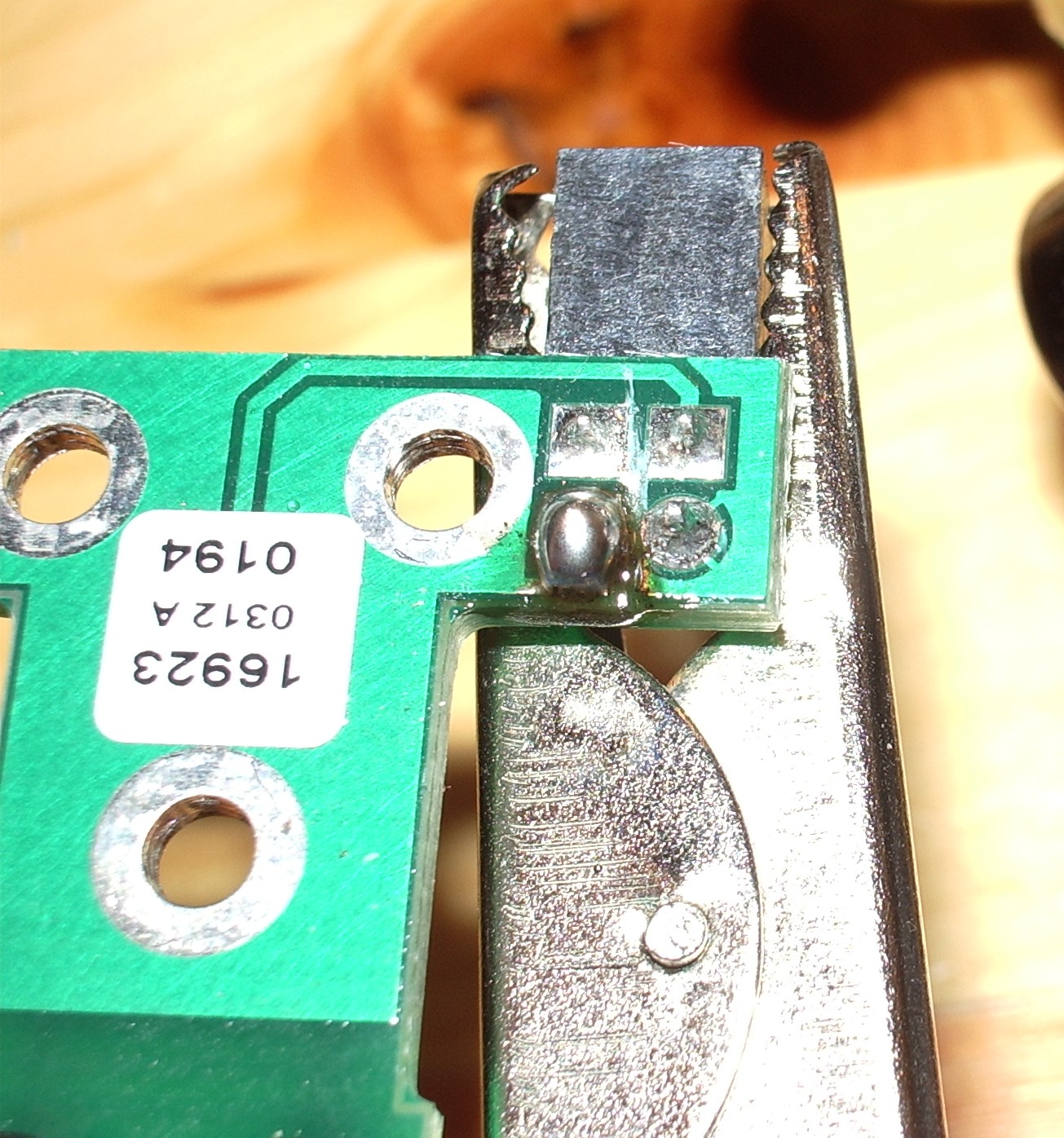
The KXPD3 came apart easily, in fact rather too easily as it disintegrated into its component parts before I had a chance to see how it went together. That’s the trouble with taking apart something that has a spring in it!
I then cut the track indicated and bridged from one pin to the adjoining track. Why is it so difficult to make a solder bridge when you actually want to.
I reassembled the KXPD3. Before I did I dismantled a couple of 409Shop complimentary ball point pens to see if they would provide an alternative spring for the paddle. They did, but they didn’t seem to be weaker than the original (the only way to alter the tension with this key is to change the spring) so I reassembled using the original.
After that I connected the KX3 up to a dummy load to try out the modified key and confirm that I hadn’t broken it. The key still worked, and my sending was still as bad as it was before, so all was as expected.
I hade a tune around on 40m and heard one of the special even stationsfor the Olympics, 2O12L. He was loud enough to be an easy contact with the QRP KX3 – but I was getting no transmit output! Eventually I switched to the K3 and worked 2O12L followed in quick succession by the Welsh Olympic special event station 2O12W.

After I had completed the cotacts I switched back to the KX3 to find out why I was getting no SSB output. I found that VOX was working, the rig was switching to transmit, but I was still getting no output.
Eventually aftter much tearing of hair and playing with settings I discovered the reason for the problem. I had turned the power down to 0.0W when I was testing the keyer…
Words fail me.

A good deal(er)
If you are a UK amateur and you like Chinese radios you’d probably never think of buying them from anywhere other than direct from China or Hong Kong, most likely using eBay. Ham radio dealers in Britain are widely regarded (rightly or wrongly) as rip-off merchants who work out the price by replacing the dollar with a pound sign and then adding on a bit more for good measure. Their pleas that the UK price includes VAT and the cost of providing a warranty usually fall on deaf ears.
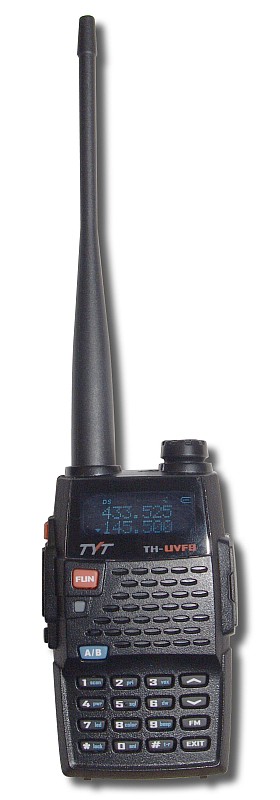
In one of the discussion groups someone mentioned buying a radio from a British firm called Sinotel UK. I went to their web site and saw that they carried several models of hand-helds from China, including a new one I hadn’t seen before: a TYT UVF9 (pictured right.) But what particularly caught my attention was their prices, which were little more than what I have been paying buying on eBay. Their cheapest model, the Vero Telecom UV-X4 (similar to the Baofeng UV-3R) was just £29.99 (yes, a brand new dual band radio for 30 quid.) A UV-5R eas £34.99. The radio that had caught my eye, the TYT UVF9, was £47.99. It would cost me $68.50 from 409shop and I’d have to wait a couple of weeks for it.
I am not associated with Sinotel UK and have not even bought anything from them but if I want yet another Chinese handy to add to my collection I probably will.














