Author Archive
 Double-hop Es?
 September 28th, 2012 |
  Author:
 Thursday brought more great 10m propagation. Take a look at the screen-grab below.
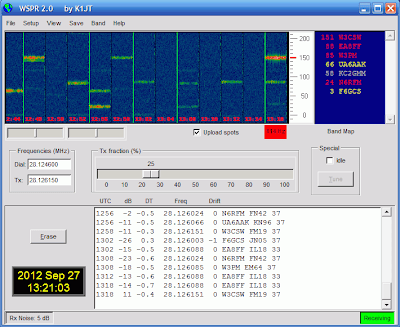 |
| 10m WSPR signals received on G4ILO’s attic dipole |
The bright trace at the top right is the 10 watt signal of W3CSW at 11dB over noise. That is one of the strongest WSPR traces I’ve ever seen, and definitely the strongest signal from a station outside Europe. I think it has to be double-hop Sporadic-E propagation. It is interesting that my previous spot of the same station was 11dB below the noise. My 2 watts produced a positive result from his side as well.
Tuning around the 10m band and there was not the wall of loud signals that such good propagation would suggest. A couple of good old boys from Mississippi and Tennessee were chewing the rag, oblivious to the fact that their signals were bending S meter needles thousands of miles away. But apart from those few stations there was an absence of signals. A station I worked called CQ with no takers for some time afterwards. I tried CQing myself, with no result. To me this also shows that the enhanced propagation was very selective, supporting the theory that it was Sporadic-E propagation.
 |
| 10m signals spotted by G4ILO, 27/9/2012 |
I did make a couple more SSB contacts but once again the digital sector provided the best returns for my efforts.
There is yet more interesting 10m propagation today. I have already spotted stations from VK2 and from Thailand. It’s a shame you can’t WSPR and operate on the same band at the same time. Or rather, it’s a shame that I can’t. So I’ll switch between modes, running WSPR when I’m not actually in the shack and able to use the keyboard or mic.

10m wide open!
Ten metres has been wide open today. Stations have been heard or worked in just about all directions. I ran 2 watts of WSPR during the periods that I wasn’t in the shack and the program screen resembled 30m!
 |
| WSPR spots on 10m at G4ILO, 26/9/2012 |
After a short period of WSPR I switched to voice mode and made a nice SSB contact with Ken, JA2FJP near Nagoya (nothing to do with cheap Chinese antennas!) After a rubber-stamp contact with R100BG I found phone a bit hard going with all the QRM and pileups so I retreated to the more restful pastime of working digimodes.
 |
| Digital stations hrd/wkd at G4ILO, 26/9/2012 |
I made one more Japanese contact – with JI4POR – and made my first-ever China contact – with BG8GAM – all on PSK31. I heard several more stations from those countries and also one from Korea (South, presumably) and one from Indonesia but didn’t manage to work them. Better luck next time!
A session of calling CQ produced an endless succession of Russian stations. Where do they all come from? There is no chance of working interesting DX unless you search and pounce on the DX stations. Even when calling a specific DX station I was being called by Russian stations! Why do they do it? I lost the chance of a couple of first contacts because of it.
As the afternoon wore on many stations from North America and Canada started to be in evidence. My final PSK31 contact for the day was with Bob KZ0G in Missouri which is probably a first for that state for me.
Not a bad haul for a few hours listening / operating using a maximum of 40 watts PSK31 to an attic dipole. I wish there were more days like that!

Derventio
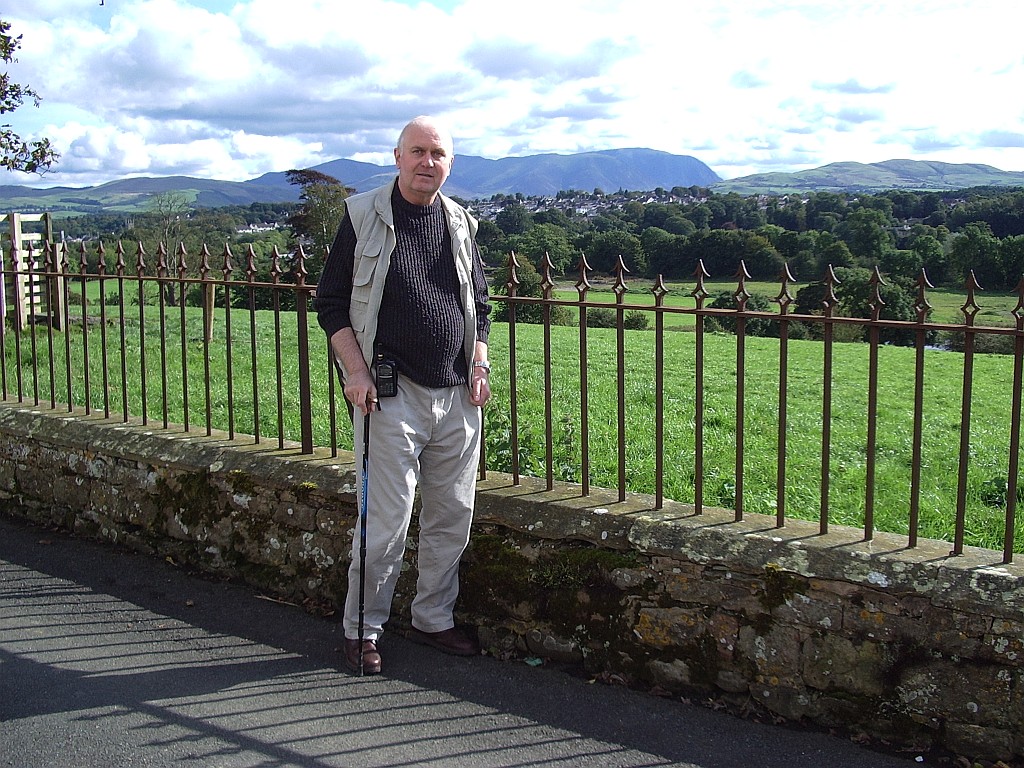
I have been itching to try venturing further afield and thought we might go down to the river Derwent at Papcastle. I carried the Kenwood TH-D72 on my belt to track the walk using APRS and see how far we got. When we reached the path down to the river we saw a paper sign saying “Derventio.” Olga thought – wisely with hindsight – that it would not be a good idea to walk down to the river as we would then have to climb back up again. We walked a bit further along the road and looked down towards the river where we could see substantial excavations were taking place. This looks like being a major archeological site. One day when I’m just a bit fitter we will go down and take a closer look.
We continued our walk with a loop through the village of Papcastle, then returned home the way we had come. On the way I heard and worked Richard G1JTD portable on the summit of Great Calva, and Liz M6EPW on my local SOTA summit of Watch Hill. That will undoubtedly be the first summit I will attempt but at the moment it is still too far – about 3 miles from our front door.
I was pretty tired and very sweaty by the time we got back to Cockermouth but I resisted Olga’s suggestion that we finish the excursion by taxi. Although what we had done was an easy walk by normal standards this was my most ambitious outing since finishing my treatment.

When we got home I could see that our track had been perfectly recorded by APRS. I was happy with that – and with the two contacts I made. I had only been using one of those stubby antennas about 5 cm long which are a couple of dB down on a rubber duck.
I saved the track as a GPX file and then produced a report using one of the online GPX report generators. According to the report we had walked exactly 4 kilometres. 1.5km of this had been climbing for a total ascent of 87m. To me it felt as if I had just climbed Scafell Pike!

Beacon update
I have updated the beacon data file for VOAProp today. The NCDXF/IARU beacons in Kenya (5Z4B) and Argentina (LU4AA) are back on the air after a long absence.
The thought crossed my mind: Now we have WSPR and remote beacon skimmers covering all bands, does anyone use these beacons any more?



PSK31 to Amman, Jordan
Conditions have been good recently on 15m. On that band I have a choice of two antennas – the multiband dipole or the magnetic loop. The multiband dipole doesn’t actually have elements for 15m so on that band I think the 40m element must do the work. The K3 ATU is needed to produce a good match.
There is quite a big difference in performance between the two antennas on 15m. The magnetic loop, surprisingly, has a higher noise level but it also produces stronger signals on some stations. On other stations the dipole seems best. It’s a pity I don’t have a sub-receiver in the K3. It would be interesting to try diversity reception one day.
 |
| Amman, Jordan |
Whenever a band is open you can usually find some PSK31 activity even if you can’t hear any phone. That was the case yesterday on 15 metres when I worked Nart, JY5IB from Amman, Jordan. That’s an all-time new country for me so I was very pleased to get him into the log. On this occasion it was the magnetic loop that did the job.

GB80PW
The magazine Practical Wireless is celebrating 80 years of publication this year and has a permit to use the special call GB80PW. I don’t usually make a point of hunting for special callsigns but as a reader of the magazine I particularly wanted to work this one which I knew would be on today it being the publication date of the October issue and the actual 80th anniversary day.

I switched the K3 to 40 metres which I thought the station would be operating on and and began tuning down the band. Lo and behold, GB80PW was the first station I heard, on 7120kHz, coming in at 5 and 7 at the top of the QSB. I switched the magnetic loop from 30m APRS duty over to the K3 so I had a choice of either the loop or the multiband dipole. Switching between the two there was almost nothing to choose between the two antennas but the magnetic loop just seemed to have the advantage by a whisker so that is what I chose to use.
I cranked the power up to 100 watts. After my first call it was clear that Rob had quite a pile-up of people wanting to work him and he couldn’t pick anything out of the pile. For the second call I gave my call twice, once phonetically, and added “… in Cockermouth, Cumbria.” Straight away Rob came back with “the station in Cockermouth, Cumbria.” I thought that would get his attention as the magazine’s technical editor G1TEX comes from here! I went on to have a very nice, if brief, chat with Rob before letting him get back to the pile.














