Author Archive
 DXMaps needs your support!
 March 24th, 2013 |
  Author:
 The DXMaps website run by Gabriel EA6VQ needs your support. This is the site that plots contacts spotted to the DX Cluster on a map, band by band, to show propagation in real-time. It is especially invaluable during the summer Sporadic-E season to track the rapidly-moving band openings.
 |
| DXMaps plots DX contacts band by band in real time |
The trouble with any web site is that if it becomes very popular the costs of running it grow beyond what most people can afford as a hobby. According to EA6VQ the cost of a new dedicated server for the site will be $250 a month. So he is asking users to become “supporter users” by donating $33 US per year. But any donation is welcome.
If you are an active operator, especially on six metres and up, you will know how invaluable DXMaps.com is. Hopefully hams will step up to the plate and send Gabriel a donation.
Is this progress?
Is this progress? Give me a computer with a proper keyboard any time.
A rant about RTTY
I just worked Iraq for the first time. YI1RZ on 20m using JT9-1 mode.
 |
| YI1RZ |
What was remarkable about this QSO is that I worked YI1RZ despite the presence of heavy RTTY QRM. My Elecraft K3 has great filtering but it can do nothing about a RTTY signal that is straddling the QSO frequency.
Why, in this age of DSP, do people persist in using this antiquated mode? Dating from the 1930s and the age of mechanical teleprinters and analog modems, RTTY is by any definition an outmoded mode. It requires far too much power and occupies far too much bandwidth for the data transmission rate (45 baud.) PSK31 has existed for more than a decade and is a far more efficient mode. If PSK31 is too slow then there is PSK63 which is faster than RTTY and yet still manages to occupy less bandwidth. Not to mention the plethora of other modes such as MFSK and Olivia that have been invented in the last 10 years offering far greater reliability than RTTY and, like PSK, the ability to use the entire character set not just capital letters, numbers and a few punctuation symbols. And which don’t print up garbage because a shift character wasn’t decoded.
It feels good to get that off my chest! I’d better put my asbestos suit on! It is interesting to note that as I have been typing this WSJT-X has been pulling JT9-1 out of the air in the teeth of RTTY interference so great that you cannot even see the JT9-1 signal traces. JT9 rocks! I doubt if the RTTY operators even know the JT9-1 signals are there.
New page for JT9 modes
JT9 just got even better. Thanks to Laurie, VK3AMA, JT9 has a new page to show current activity or general chat at hamspots.net.

As far as I can tell, the spots are generated from the spots to PSK Reporter, which the latest WSJT-X program does automatically if you tick the appropriate box. So you don’t have to do anything extra for your spots to show up on this page. This is a great facility that I am sure will increase the growing popularity of the JT9 mode.
Fix for "Gmail app unreachable" in Google Chrome
This morning when I started up Google Chrome and tried to log in to Gmail the page kept coming up “Gmail app unreachable”. Curiously, when using Firefox Gmail loaded up fine.
I found a solution to this issue that works for me. Right-click the shortcut that you use to start Google Chrome, then on the Shortcut tab in the box marked Target which contains the full path to chrome.exe, append a space followed by –ssl-version-max=tls1 (that last character is a number 1.)

I have no idea what this does but as I say, it worked for me.
New WSJT-X update
Hot news. I’ve just had an email from Joe Taylor K1JT informing me that a new version of WSJT-X, v0.6 r3045, has just been made available for download from the WSJT home page.
This is a must-have update which now includes spotting of JT9 signals decoded to the PSK Reporter website. (Tip: This needs to be enabled in Settings.)
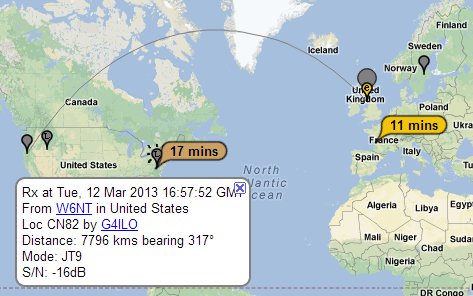
Still to come are rig control – which I will hazard a guess will use hamlib – and integration with VK3AMA’s JT-Alert. Hopefully this will encourage current users of JT65 on HF to try the new JT9-1 mode which is 2dB more sensitive than JT65A and occupies less than 10% of the bandwidth.
Thanks Joe for giving us these great programs.
Iler 40 arrives!
It took its time getting here, but the Iler 40 QRP SSB transceiver kit from Spain has finally arrived! Opening the package confirmed my expectations that this is a very high quality kit indeed.
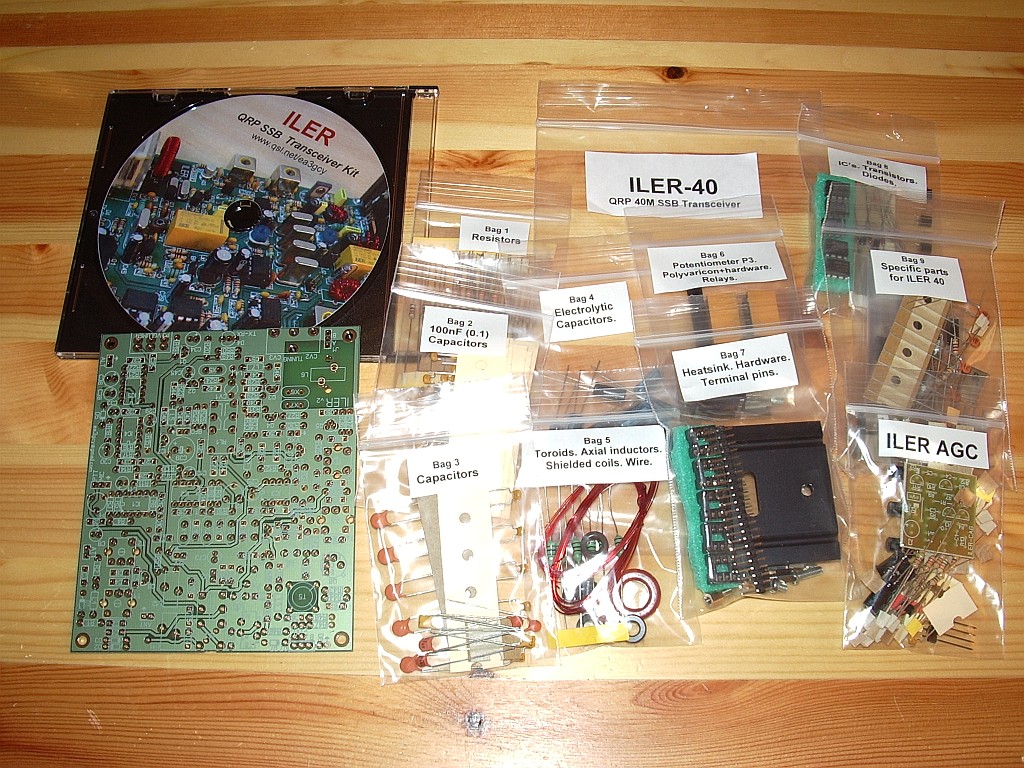 |
| Iler 40 kit contents |
The printed circuit board is top quality and screen printed with plated through holes. Quite a contrast to some kits of UK origin that look as if the board has been etched and drilled in someone’s garage.
The components of each type are individually bagged. The CD containing PDF manuals in both English and Spanish has a custom colour printed label. A quick glance inside showed that the assembly instructions have been professionally produced and are of the a similar standard as the manuals for kits by Heathkit and Elecraft – if not better. Javier has even included data sheets for all the active components making this the most fully documented kit I’ve ever encountered. I’m going to enjoy building this.
It’s going to be a while before I can get started, though. There are some major home improvements going on at the moment chez G4ILO and with all the hammering and sawing I’ll have to wait for a peaceful and relaxed atmosphere. I also need to print off a copy of the 39-page assembly manual so I can cross steps off as I go along – and as you may have read our printer doesn’t want to play ball.













