Author Archive
 W(h)ither JT65A?
 April 11th, 2013 |
  Author:
 I was looking at all the stuff in my ham software folder and thought about deleting JT65-HF. I no longer see the point in continuing to use JT65A when an alternative exists which uses the same messages and takes the same amount of time but is more sensitive and much narrower. The fact that this alternative has come along at the same time as W6CQZ, the author of JT65-HF, has stated that he can no longer develop it seems to me very fortuitous.
Okay, there are still a lot more stations to work with JT65A but that is surely only temporary. Like Tim, G4VXE I can see activity switching from JT65A to JT9-1 over time and JT65A activity on HF withering away from lack of use. JT65A has been a lot of fun but it can also be frustrating when you can’t find space to operate within it’s 2kHz or when a very strong signal stops the software from decoding anything. JT9-1 has people using too much power too, but the decoder seems more robust and a lot more stations can concurrently use the same bandwidth. It just seems an all round better solution.
I expressed this opinion in one of the Yahoo! groups this morning and several people replied to disagree with me. As one person put it “if I am half way to WAS (worked all states) using JT65A then I am not going to stop using it until I have finished it.”
To me, I can see no reason to continue using a mode once a better alternative exists, which is why I have no interest at all in using RTTY, for which there are several superior alternatives. The idea of making contacts just to put a tick in a box in a matrix ordered by band, mode and prefix/country/state makes me quite depressed. I will use JT9 until something even better comes along, after which I will lose interest in it just as I have lost interest in JT65A.
Ghostly signals
I have been puzzled and mildly irritated by the ‘ghost’ traces that appear at plus and minus 100Hz when I receive a very strong signal with WSJT-X. Torben OZ1TMK wrote to me after we had a JT9-1 QSO to ask if his signal had been OK. He had received requests from a couple of local stations to reduce power because he was ‘causing harmonics’. I hadn’t noticed anything wrong with Torben’s signal but it hadn’t been strong enough. It looked to me as if it was the same effect I and a few other JT9-1 users had observed when very strong signals were received, so I decided to investigate.
I had a theory that the +/-100Hz spurious outputs ( +/-120Hz observed in the USA) were caused by ripple modulating the transmitted carrier. I used my general purpose signal generator, otherwise known as the FT-817ND, to transmit a low power carrier (CW key down) into an unscreened dummy load (Elecraft DL-1). I repeated this with the transceiver powered from my bench power supply and then on its internal batteries with the power cable removed. The results in the WSJT-X spectrum display window are shown below.
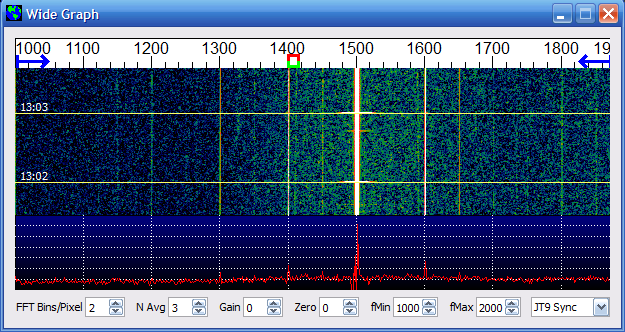 |
| K3 RX, FT-817 TX on mains supply. |
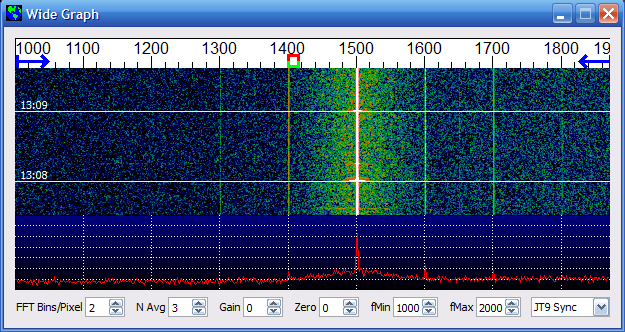 |
| K3 RX, FT-817 on battery power |
As can be seen, there are traces at +/-100Hz and at 100Hz intervals on both signals, but the ghosts seem a bit stronger on the signal when the TX is powered from the main supply.
I recalled an issue a few years ago when someone sending CW using their K3 had reports of spurious signals +/- the sidetone frequency. This turned out to be audio modulation of the synthesizer by the sound of the sidetone from the K3 speaker. Elecraft provided a fix in the form of a stiffener for the synthesizer board. My K3 is an old one and does not have this modification. You can see that the synthesizer is affected by physical vibration looking at the trace produced when I rapped on the K3 case.
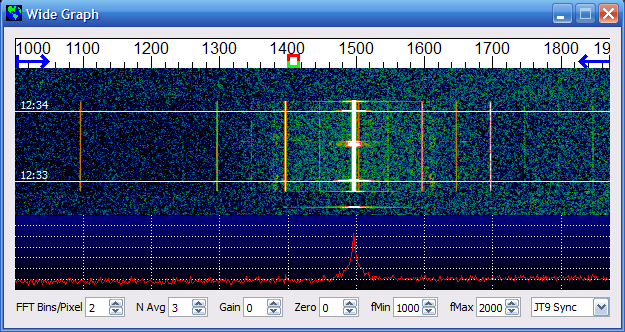 |
| K3 RX showing the effect of vibration (knock on the case) |
My K3 sits on a shelf next door to a heavy linear power supply. Could slight vibration of the mains transformer be modulating the receiver’s local oscillator so as to create weak sidebands at +/- double the mains frequency?
To answer that question I repeated the tests using my Elecraft K2 as a receiver, feeding the headphone output at low level into the cheap USB audio dongle I use for computer sound. You can see the result below.
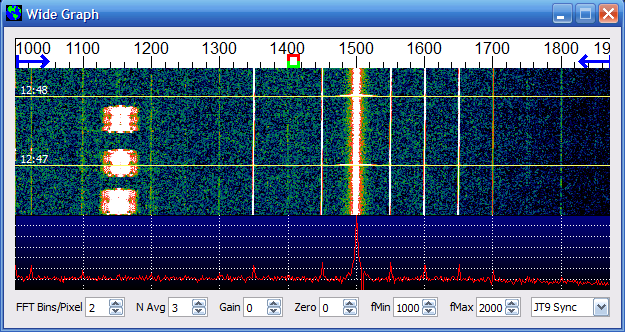 |
| K2 on RX, FT-817 on mains power. |
 |
| K2 RX, FT-817 on battery power |
You can see that the sidebands are much reduced when the signal is produced by a transmitter running on battery power. In fact, some weak +/- 50Hz sidebands are present – possibly the effect of 50Hz AC hum on the un-isolated cable used to connect the K2 headphone output to the sound card.
I’m not sure what to make of all this. It does appear that the ‘harmonics’ – which are really sidebands – that accompany a strong JT9-1 signal are caused mainly by AC ripple modulating the transmitted carrier, but that hum on the receive side can produce a decodable signal as well. The WSJT-X software is extremely sensitive and can detect these components even if they are 30dB or more below the fundamental carrier.
I would appreciate hearing of other theories or tests carried out to explain this phenomenon. It seems to be that this issue is going to be almost unavoidable when mains-powered equipment is used to generate signals that are decoded by very sensitive software.
Comparing activity of popular digimodes
 |
| PSK31 activity in last 2 hours |
 |
| RTTY activity in last 2 hours |
 |
| JT65 activity in last 2 hours |
 |
| JT9 activity in last 2 hours |
 |
| ROS activity in last 2 hours |
Norbreck 2013
On Sunday I went with Derek 2E0MIX to the NARSA radio rally at the Norbreck Castle Hotel in Blackpool. Olga came too to keep an eye on me and make sure I remembered to take my tablets on time. She also took the photos (which is why there isn’t a picture of her, oops!)
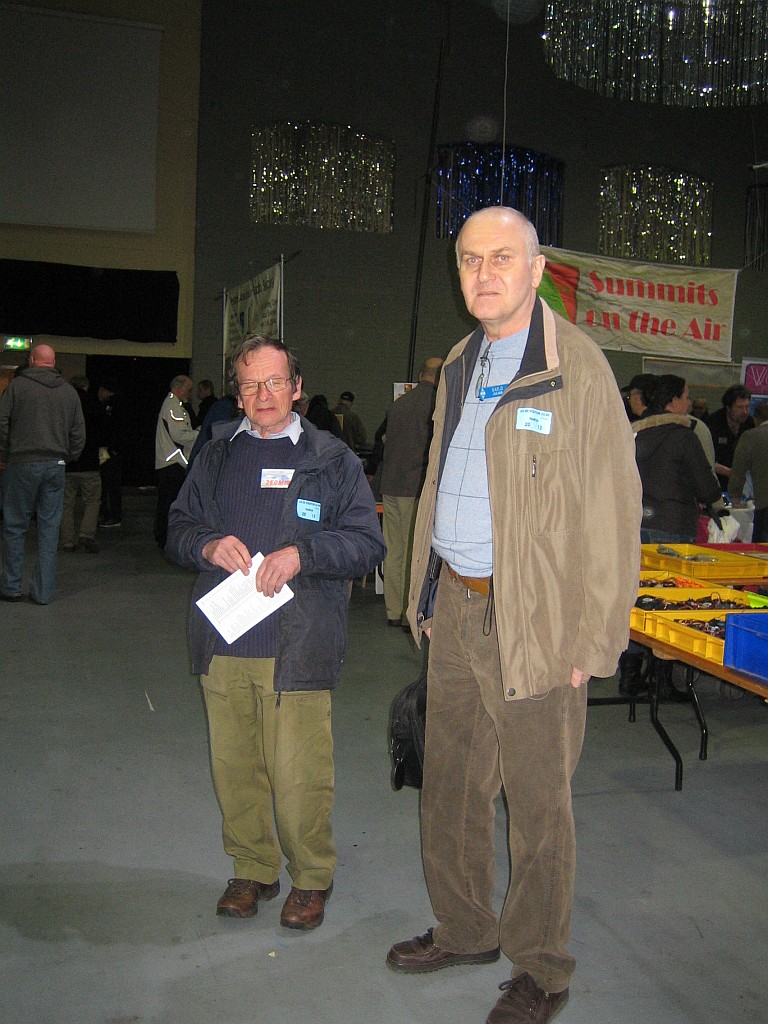 |
| G4ILO and Derek 2E0MIX |
It was good to be able to do something I would normally have done in years gone by. I met friends and also people who only know me (and Olga!) from my blog, spotted my callsign badge and came up to say hello.
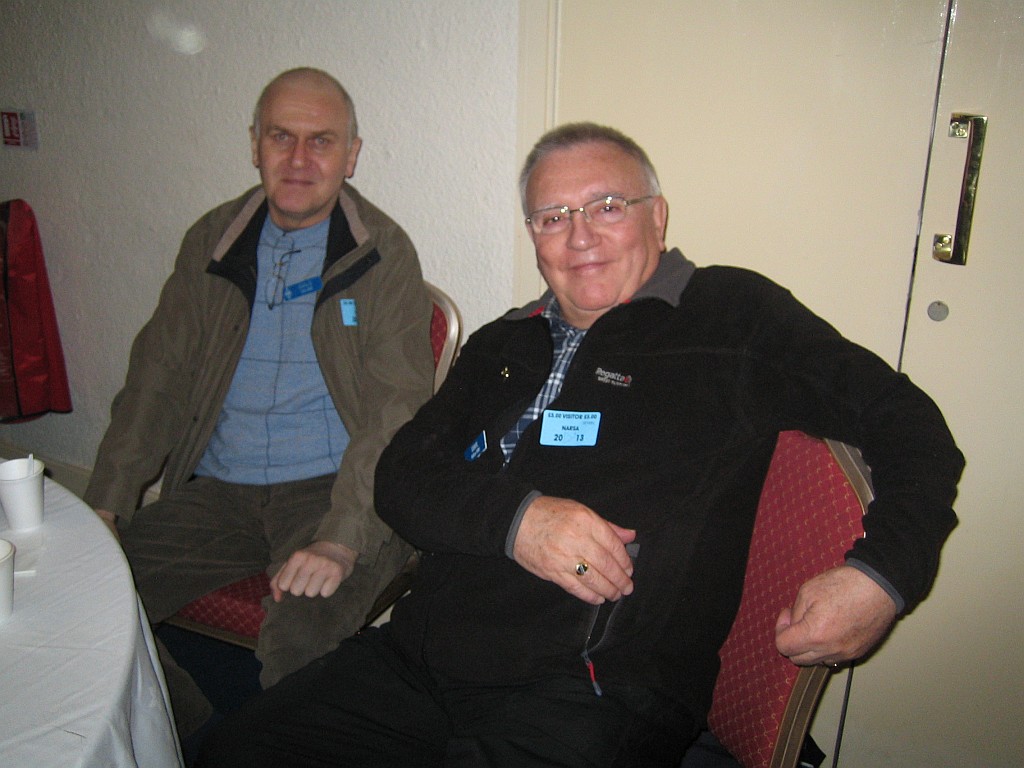 |
| G4ILO and Hylton G6AVL |
I didn’t go to the show with any specific goal, just to have a look round. The only thing that I would have liked to go home with was the magnificent Kenwood TS990S on the Waters and Stanton stand. It was in a plexiglass cage so I was unable to get “hands-on” or even get a decent photograph of it.
There seemed to be surprisingly little interest in this very expensive radio. I suppose most people looked at it, realised it was unattainable and moved on. I dropped a few hints to Olga that it would make a nice present for my 60th birthday in a few weeks time but she, ever practical, pointed out that it would be too big for my operating desk. Oh well, it was worth a try!
Waters and Stanton were also showing a number of Elecraft products, including the K3 and KX3. It was good to see these excellent radios on display at this show for the first time.
 |
| G4ILO and Jim G3ZPD on the Workington Radio Club stand |
WOTA (Wainwrights on the Air) didn’t have its own stand but I was pleased to see that Workington Radio Club had a poster about WOTA on their stand.
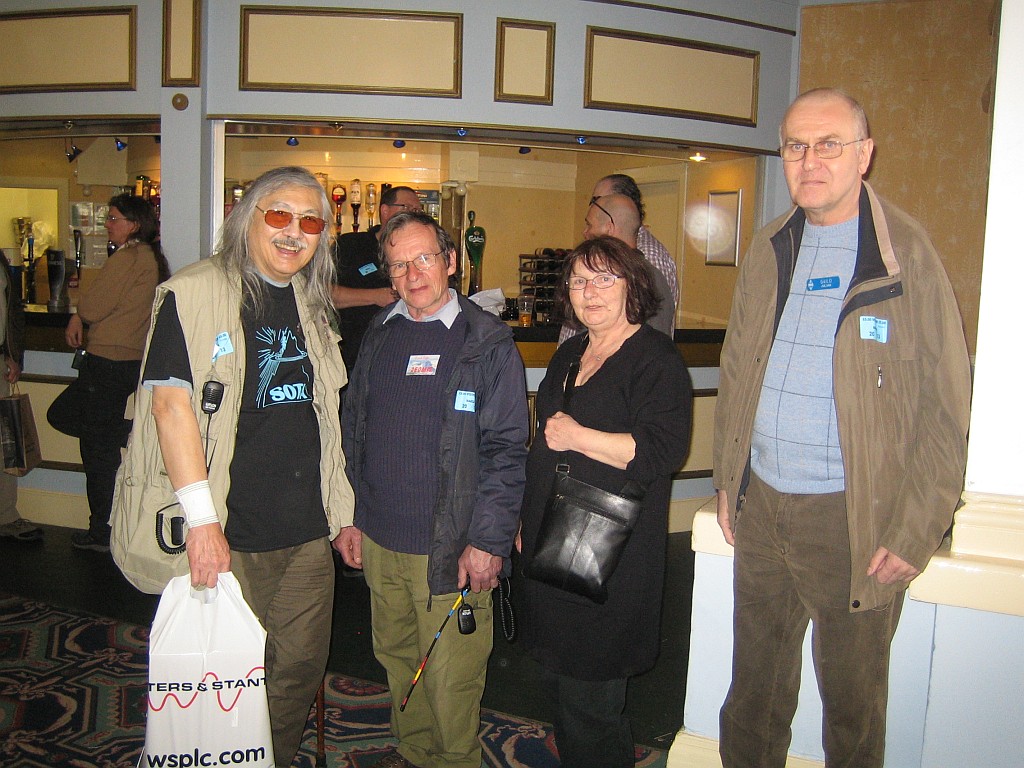 |
| Discussing WOTA |
It was good to meet some of the people I had worked on activations and put a face to the call. Several people came up to thank me for starting WOTA, saying that it had given them a new interest or got them visiting parts of the Lake District they would never have gone to before. It isn’t often that you get a chance to change people’s lives but for some activators and chasers WOTA has done just that. (I suppose some of the credit should go to SOTA (Summits On The Air) for having the original idea.)
It was a good day out. Thanks to Derek for the ride.
EX8MT Kyrgyzstan
This afternoon JT9-1 gave me my first contact into Kyrgyzstan, with EX8MT.

Looks a bit like the English Lake District!
Far East DX
After yesterday’s disappointing session on 15m PSK31 I tried JT9-1 again. The new JT mode showed its superiority by giving me two contacts with Japan. I nearly worked more as one JA replied to my CQ but disappeared after I sent his report. I was also spotted on HamSpots by two other JAs whom I have never seen on my screen. Another nice contact was with HS0ZBS. This is not the first time I have worked Thailand, but all my contacts with that country have been on 15m.

In another direction I worked PJ2MI – a familiar callsign. Checking my log we first worked in 2003 using PSK63 – quite an achievement as I would have been using my K2 and 4W output. More recently I have worked Jose using PSK31 and JT65A. On 20m I worked K8CZC who from the look of his eQSL would have been using low power (QRP).
Elusive DX on 15m
I checked the JT9 operating frequencies and downloaded a new version of the programmer but I was still seeing the same old calls so I switched to PSK31. 15m seemed quite lively. There were a few JA’s, a couple of stations from China and one from South Korea. Later on I heard a sation in Indonesia. But could I work any of them? Could I heck.
I did manage to make a couple of far eastern contacts: Alexander RD9OA from near Novosibirsk, and Lee BG6CJR from Ningguo in China, but I failed to make any impression on the others. All I got was a couple of QRZs then they called CQ again. Together with the antics of some of the Russian operators – sending their calls over and over and over again so the DX had no chance of hearing anyone else call – it got a bit frustrating. I was running 40W but it didn’t seem to be enough to reach stations I was getting solid copy on. If I didn’t have to go stealth I think I’d be seriously considering a KPA500 at this point! It must be nice to flip a switch and blast over the top!
Some of the Russians seemed to be in a rush. One actually sent PSE SHRT K to me as if trying to have a friendly QSO would keep him from something more important. DX seems to bring out the worst in many operators. Sheesh, it’s only a hobby.













