Author Archive
 I Couldn’t Stand it Anymore
 November 21st, 2013 |
  Author:
 The past few weeks have been one of the best "rare DX" runs I can remember in a long time. Rare DXCC entities, good operators and excellent propagation have all come together for a lot of radio fun. I've had my share of the fun, picking up a couple of new 160m countries and numerous band counters. However, I suppose you never can get enough of good DX.
Last weekend I missed the opportunity to work XZ1J during a 10m LP opening into Texas, not only on 10m, but also on 12m. I was just not paying attention and by the time I realized I needed XZ on those bands, the opening was closed. So all week I've watched the DX cluster from my office as these LP openings have become daily happenings. Very frustrating, as there have been no evening SP openings. To make matters worse, I will be out of town this weekend and will not have a chance to work them then.
So, this morning, my oldest son Michael, AB5EB, who lives about 30 miles from me, sent me a text tell me he worked S21ZBC on 10m SSB and 17m RTTY. I checked the spots quickly to see that XZ1J was coming in as well. Well that put me over the top. If you remember the Popeye character from cartoons who used to say, "I've had all I can stands and I can't stands no more". I had a couple of hours clear on my work calendar, so back to the house I went.
The drive home is about 30 minutes and I got behind every slow car in the area. Finally I get to the house sprint to the shack to go the XZ 10m frequency. He's there and loud. Quick, find the station he's working in the pile-up, right there, make the call, de AD5A AD5A...... AD5A 5NN.....sweet. First call. Now the S21, which I also need is a few KC's up the band. He isn't as strong, working up two. I put in my call....... AD5A 5NN, sweet again. Two new ones on 10m in a matter of a minute, each on the first call. Now what about 12m? No spots, I tune the band, no XZ or S21. I text my son to post my response to his DXploits and comment that now they need to move to 12m. I tune the CW portion and hear CQ CQ CQ de S21ZBC up 2, what???? I put in my call 4 or 5 times and then, AD5A 5NN...ecstasy. I text my son who needs S21 on 12m. He had to turn around and go back home to make the QSO.
So, I drove back to work feeling satisfied and accomplished. Even though no XZ on 12m, one can't get greedy, save a little fun for later.
I do like this radio stuff.
Last weekend I missed the opportunity to work XZ1J during a 10m LP opening into Texas, not only on 10m, but also on 12m. I was just not paying attention and by the time I realized I needed XZ on those bands, the opening was closed. So all week I've watched the DX cluster from my office as these LP openings have become daily happenings. Very frustrating, as there have been no evening SP openings. To make matters worse, I will be out of town this weekend and will not have a chance to work them then.
So, this morning, my oldest son Michael, AB5EB, who lives about 30 miles from me, sent me a text tell me he worked S21ZBC on 10m SSB and 17m RTTY. I checked the spots quickly to see that XZ1J was coming in as well. Well that put me over the top. If you remember the Popeye character from cartoons who used to say, "I've had all I can stands and I can't stands no more". I had a couple of hours clear on my work calendar, so back to the house I went.
The drive home is about 30 minutes and I got behind every slow car in the area. Finally I get to the house sprint to the shack to go the XZ 10m frequency. He's there and loud. Quick, find the station he's working in the pile-up, right there, make the call, de AD5A AD5A...... AD5A 5NN.....sweet. First call. Now the S21, which I also need is a few KC's up the band. He isn't as strong, working up two. I put in my call....... AD5A 5NN, sweet again. Two new ones on 10m in a matter of a minute, each on the first call. Now what about 12m? No spots, I tune the band, no XZ or S21. I text my son to post my response to his DXploits and comment that now they need to move to 12m. I tune the CW portion and hear CQ CQ CQ de S21ZBC up 2, what???? I put in my call 4 or 5 times and then, AD5A 5NN...ecstasy. I text my son who needs S21 on 12m. He had to turn around and go back home to make the QSO.
So, I drove back to work feeling satisfied and accomplished. Even though no XZ on 12m, one can't get greedy, save a little fun for later.
I do like this radio stuff.
Wake Island on 160m
Yesterday morning I worked K9W (KH9) on 160m, but it wasn't QRP. Only in my dreams could that happen, but I'm always excited to get a new one on Top Band. The QSO was at 12:45z, just before my sunrise, which is the primo time for 160m propagation.
The one notable comment on my 160m set-up is that my antenna is a simple Alpha-Delta DX-A mounted on a 55 ft. tower, no beverages or listening antenna of any sort, just the DX-A. I have worked and confirmed 170+ countries on 160m with this antenna. So it still falls into the category of accomplishing a lot with a little.
AE5X also blogged about his 160m contact with K9W, so I guess I'm just trying to keep up;-)
Lots of good DX on, so now is the time to work the new ones.
The one notable comment on my 160m set-up is that my antenna is a simple Alpha-Delta DX-A mounted on a 55 ft. tower, no beverages or listening antenna of any sort, just the DX-A. I have worked and confirmed 170+ countries on 160m with this antenna. So it still falls into the category of accomplishing a lot with a little.
AE5X also blogged about his 160m contact with K9W, so I guess I'm just trying to keep up;-)
Lots of good DX on, so now is the time to work the new ones.
QRP Fun; 2 Out of 3 Isn’t Bad
Sunspots are up and the DX-peditioner's are out. This is a great formula for getting some nice QRP DXCC counters. I had a free evening after a very busy run over the last few weeks so I sat down in front of the KX3 to work a little DX or at least try to work some new QRP DXCC countries. On the menu were K9W from Wake Island (KH9), XR0YY from Easter Island and 5J0R from San Andreas. Not a bad selection of nice DX on Monday night.
My first target was K9W. Wake Island isn't on very often, so if you have a chance to work them you should, you never know when the island will be on again. At my QTH, northeast of San Antonio, TX, all three stations were coming in nicely, but with good propagation they are heard by many and the pile-ups were significant. I started chasing K9W on 12m, working up, however the operator wasn't paying much attention to NA, so I moved up to 10m where they were working NA/SA. After 10 minutes of chasing him up and down the band, I got them in the log at 00:59z. One down, two to go.
Next up 5J0R on 30m. I called for 15 minutes, no luck and the pile-up was huge. There was then a spot for XR0YY on 10m SSB working simplex. A quick QSY netted a QSO on the first call at 01:18z. Cool. Two new QRP DXCC counters in 20 minutes. Only one more for the trifecta, so back to 5J0R on 30m. Another 20 minutes of calling and no QSO. I stepped away from the radio for a while and came back to their 20m SSB station. I had him in the clear a couple of times, but couldn't manage the QSO, so I called it quits for the night.
Overall a successful night of QRP DXing, my QRP DXCC count is now up to 159. Upward and onward.
QRP/DX IS
My first target was K9W. Wake Island isn't on very often, so if you have a chance to work them you should, you never know when the island will be on again. At my QTH, northeast of San Antonio, TX, all three stations were coming in nicely, but with good propagation they are heard by many and the pile-ups were significant. I started chasing K9W on 12m, working up, however the operator wasn't paying much attention to NA, so I moved up to 10m where they were working NA/SA. After 10 minutes of chasing him up and down the band, I got them in the log at 00:59z. One down, two to go.
Next up 5J0R on 30m. I called for 15 minutes, no luck and the pile-up was huge. There was then a spot for XR0YY on 10m SSB working simplex. A quick QSY netted a QSO on the first call at 01:18z. Cool. Two new QRP DXCC counters in 20 minutes. Only one more for the trifecta, so back to 5J0R on 30m. Another 20 minutes of calling and no QSO. I stepped away from the radio for a while and came back to their 20m SSB station. I had him in the clear a couple of times, but couldn't manage the QSO, so I called it quits for the night.
Overall a successful night of QRP DXing, my QRP DXCC count is now up to 159. Upward and onward.
QRP/DX IS
More Summits
It's been a while since I sat down to blog a little. In the interim I've made a trip to California and New Mexico and suffered through a kidney stone. The trips were great, the kidney stone is not recommended.
The California trip was a golf oriented trip with a business associate of mine, so no radio. We stayed in Huntington beach which is gorgeous this time of year; mid 70's, no wind, perfect.
This past weekend I was at my Santa Fe, NM QTH with a mission to activate some SOTA peaks. Mission accomplished. Below I'll share some of the fun.
Barrillas Peak W5N/PW-022
Barillas Peak is the home of an abandon fire tower, so as you might guess there is a road to the top. This summit is about 1.5 hour drive from my QTH because the roads leading to it are not the best. My old backpacking buddy Jeff came with me and our plan was to knock this off in the morning and be back shortly after lunch. I had been told that this one was simple. Accordingly I didn't do much homework and entered the coordinates in the GPS which generated a route that took me the base of the summit, on the wrong side of the mountain. We could get the Jeep to within a couple of miles of the summit, but it was a bushwhack and we had no knowledge of the mountain, so we decided to drive around to the other side, a 60 mile trip.
Now the, "getting done early", scenario was gone so we stopped in Las Vegas, NM to have lunch. When we found the summit there were some beautiful views. I chose to use my AlexLoop and FT-817 since I didn't have a long hike to the top. I also wanted to try some of the higher bands given that the flux numbers were good.
Calling CQ from Barillas Peak
The activation went well with 27 QSO's on 20m, 15m and 12m including a QSO with G4OBK.
Polvadera Peak W5N/SE-003
Polvadera Peak in in the Jemez Mountains, northeast of Santa Fe. The Jemez range is a beautiful range of mountains full of adventurous peaks. Polvadera in one such peak. It's elevation is at 11,232 ft, so the peak is about as high as you can go and still have trees on the summit. I did the peak with Fred, KT5X, who had done it before and served as the guide. It is about a hour drive to the end of the road to start the climb. There are no man made trails up Polvadera, only game trails. So there is a fair amount of bushwhacking required and some challenging climbs. We walked through several patchs of snow on the way up, a signal that this area will be snow covered soon. There were elk tracks, bobcat and coyote tracks in snow, a reminder that we aren't the only ones there. It took us an hour to reach the summit and we were rewarded with both nice views and some good operating locations. For this summit and most all summits that require a reasonable hike I carry my ATS-4 and an EFHW for 10-20-40m. I run the wire from a selected tree limb to my 21' carbon fiber telescoping pole and the down to the matching device. Today I would tune this antenna with an elecraft tuner on 15m. Fred, aka WS0TA, would handle the lower bands and I would operate on 15m. Propagation was excellent and I logged 18 QSO's including OH9XX. The EFHW tuned very well on 15m as I received many nice signal reports.
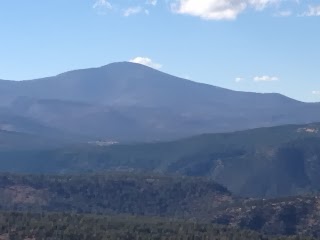 |
| View of Polvadera Peak from Clara Peak |
Clara Peak W5N/SE-033
The road to Clara Peak is on the drive back toward Santa Fe, so it is an easy add on to Polvadera. There is a road to the top, but walking might be faster. It is definitely 4WD only and I had to put the Jeep in 4WD low. I used the AlexLoop again and the FT-817 as I wanted to give 12m a shot. However I only netted 3 QSO's on 12m and finished up on 15m and 20m, and totalled 13 QSO's for the activation. The views from Clara are phenomenal (I keep saying that) and on this day there was no wind. A clear day, 55 degrees, no wind, calling CQ from a SOTA summit, it doesn't get much better.
After tearing down the station, Fred and I headed back to Santa Fe feeling satisfied. We had chalked up 18 Activator points while enjoying a wonderful day of hiking, radio and fellowship.
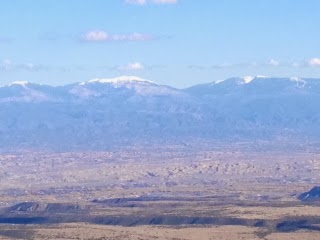
View of Santa Fe Baldy from Clara Peak
This SOTA stuff is fun.
More Fun With the Rock Mite
Last night I had a few minutes to operate, so I thought I would call CQ with my 20M Rock Mite. I did a little more than CQ however, as I wanted to know how the radio was getting out. First, I measured the output power. I had assumed 500 mw of output during my first QSO's with the radio but after measuring the output, it was closer to 300 mw. Secondly, I wanted to see where the radio was being heard using the Reverse Beacon Network, www.reversebeacon.net. If you've never played around with this, it is pretty cool. There is an entire network of skimmers out there that will post your frequency and callsign if you are copied calling CQ on CW.
So I called CQ with the beam pointed due north from my Boerne, TX QTH. Withing seconds the RBN spotted me calling CQ on the east coast and shortly thereafter on the west coast. Pretty cool. So clearly I was getting out fine with my 300mw. After a few CQ's, AB4QL, Barry in Alabama, called me. I swung the beam and he was a solid 559 running his KX-3. He gave me a 329, but he didn't seem to miss anything. The contact was just short of a rag chew but we had nice QSO.
After we signed with each other, I looked up Barry on QRZ.com and learned that his QTH was 820 miles from mine. At 300mw that comes out to 2,733 miles per watt. Any way you slice it, that's good mileage.
So I called CQ with the beam pointed due north from my Boerne, TX QTH. Withing seconds the RBN spotted me calling CQ on the east coast and shortly thereafter on the west coast. Pretty cool. So clearly I was getting out fine with my 300mw. After a few CQ's, AB4QL, Barry in Alabama, called me. I swung the beam and he was a solid 559 running his KX-3. He gave me a 329, but he didn't seem to miss anything. The contact was just short of a rag chew but we had nice QSO.
After we signed with each other, I looked up Barry on QRZ.com and learned that his QTH was 820 miles from mine. At 300mw that comes out to 2,733 miles per watt. Any way you slice it, that's good mileage.
Tidbits From the QRP History Book
I've been reading, in small doses, "The History of QRP in the U.S., 1924 - 1960" by Adrian Weiss, W0RSP. So after reading about some of the beginnings of the QRP movement it is interesting to note in 1924, QST Technical Editor, Robert S. Kruse, 1XAM, went on the offensive in promoting low power operation. His methods however were a little different than might be tried today.
It seems that Kruse felt that American operators had become too enamored with high power operation and that the QRM and inefficiencies of high power operation were precluding the "grassroots" operator from even hearing DX stations. Weiss writes,
"QST continually derided the abuse of power among American amateurs by coining a long list of derogatory epithets for the high power types. Such names as "watt-hog", "ether buster", "tribe of ampere hounds", "ampere chaser", "thunder factory', "watt burner" and "most miles per gallon" flowed across the pages of QST, leaving little doubt as to the attitude of the QST staff, and presumably the ARRL, to combat the developing dependence upon brute power by American amateurs in place of the ideals embodied in the QRP Operator...."
In, December 1923, the very first QRP contest, The Station Efficiency Contest, was announced with this subtitle, "Miles Per Watt: An Argument For The Small Set and For Intelligence In Place of Brute Force" Weiss comments, "In other words, the use of low power was inextricably linked with intelligence and diametrically opposite to high power"
Further Kruse argued, "...what if his brute power does let him cover 4,000 miles, isn't he still inferior to the other man who handled his power correctly and went twice as far per watt?"
So there you have it, QRP operation = Intelligence.
Need we say more;-)
The book goes into much more detail about the attack on high power operation and rising credibility of the QRP operator in those early days. Interesting reading and entertaining as well.
It seems that Kruse felt that American operators had become too enamored with high power operation and that the QRM and inefficiencies of high power operation were precluding the "grassroots" operator from even hearing DX stations. Weiss writes,
"QST continually derided the abuse of power among American amateurs by coining a long list of derogatory epithets for the high power types. Such names as "watt-hog", "ether buster", "tribe of ampere hounds", "ampere chaser", "thunder factory', "watt burner" and "most miles per gallon" flowed across the pages of QST, leaving little doubt as to the attitude of the QST staff, and presumably the ARRL, to combat the developing dependence upon brute power by American amateurs in place of the ideals embodied in the QRP Operator...."
In, December 1923, the very first QRP contest, The Station Efficiency Contest, was announced with this subtitle, "Miles Per Watt: An Argument For The Small Set and For Intelligence In Place of Brute Force" Weiss comments, "In other words, the use of low power was inextricably linked with intelligence and diametrically opposite to high power"
Further Kruse argued, "...what if his brute power does let him cover 4,000 miles, isn't he still inferior to the other man who handled his power correctly and went twice as far per watt?"
So there you have it, QRP operation = Intelligence.
Need we say more;-)
The book goes into much more detail about the attack on high power operation and rising credibility of the QRP operator in those early days. Interesting reading and entertaining as well.
Cool 12m SOTA contact
As we all know the high bands have been less than stellar during this solar cycle peak. I was reminded how busy 10m used to be during "real" solar cycle peaks of the past by a recent article on AE5X's blog. As I remember it you could hardly find a place to call CQ on the novice segment of the band. However, even at lesser solar flux values, the high bands can still produce a lot of fun.
The past Saturday I had a rare weekend with not much on the schedule so I was chasing SOTA summits among other things. It was a fun day on the radio and I worked several Europeans on 12m. Currently the SOTA program has a 12m challenge in place which encourages activity on this band and when open, provides some fairly long haul DX for these QRP summit operations. I wasn't operating QRP, I was using my FT5000 and my Log Periodic Antenna up about 50 ft, however there are always several summit to summit QSO's among the activators that are QRP both ways across the pond. However this wasn't the most fun of the day.
Around 0130z on Saturday evening a SOTA spot came up for VK3ZPF, Peter, on a Mt. St. Phillack in Victoria, Australia on 12m SSB. I swung the beam around, not expecting to hear a peep. I wouldn't be writing the article if that is how it ended;-) I could hear the CQ faintly, but there was deep QSB. Finally on the peak I called and he came right back. We exchanged reports I had him in the log. A few minutes later, Glenn, VK3YY, who was with Peter was calling and I worked him as well. Glenn sent me an email saying that he was using a 40m EFHW antenna through an Elecraft T1 tuner and an FT817. Pretty cool and on SSB as well.
This radio stuff is fun.
The past Saturday I had a rare weekend with not much on the schedule so I was chasing SOTA summits among other things. It was a fun day on the radio and I worked several Europeans on 12m. Currently the SOTA program has a 12m challenge in place which encourages activity on this band and when open, provides some fairly long haul DX for these QRP summit operations. I wasn't operating QRP, I was using my FT5000 and my Log Periodic Antenna up about 50 ft, however there are always several summit to summit QSO's among the activators that are QRP both ways across the pond. However this wasn't the most fun of the day.
Around 0130z on Saturday evening a SOTA spot came up for VK3ZPF, Peter, on a Mt. St. Phillack in Victoria, Australia on 12m SSB. I swung the beam around, not expecting to hear a peep. I wouldn't be writing the article if that is how it ended;-) I could hear the CQ faintly, but there was deep QSB. Finally on the peak I called and he came right back. We exchanged reports I had him in the log. A few minutes later, Glenn, VK3YY, who was with Peter was calling and I worked him as well. Glenn sent me an email saying that he was using a 40m EFHW antenna through an Elecraft T1 tuner and an FT817. Pretty cool and on SSB as well.
This radio stuff is fun.













