Posts Tagged ‘Uncategorized’
 CW Part 2
 June 27th, 2019 |
  Author:
In 2016, I posted that I was learning CW by taking the CW Ops level 1 course. I did complete the class, made two on air QSO’s then life got in the way of the ham radio hobby and until recently, I left CW alone. In January this year, I decided to get started again and set a goal to make 100 CW QSO’s by the end of the year.
I started reviewing the CW Ops materials I had from 2016. I also copied the all the K7QO code course mp3 files to my phone so I could listen to that while in the car. In addition to those two things, I am also trying to listen to live QSO’s on the radio. Most of them go too fast for me to not miss a bunch of characters. Some QSO’s are difficult due to timing or no spacing. I heard a CQ call that sounded like “CQCQdeCallSignk”. There were no spaces in between the characters or words. One long string of dits and dahs.
So far, I am making progress. I relearned the alphabet, numbers and a few punctuation marks, and am trying to gain faster recognition so I can understand more.
I did make my first CW QSO of the year last week. It was a bit of a mess but we managed to actually exchange enough info to make an official QSO! That lead to an exchange of emails and this fellow ham and I made another scheduled QSO and he’s going to help me make more so I can practice CW! Gotta love the ham radio community!
If anyone is thinking of trying to learn CW, do it! If I can do it, then I think most people could do it as well. It’s going to take some effort and time but what doesn’t? 73.
My Last Post Ever Regarding ARRL?
In the past I’ve been a strong proponent of ARRL. I often mentally tied the past and future success or failure of amateur radio to the organization. I’ve come to the conclusion that this just isn’t the case, and in my evolving opinion the organization is becoming less relevant as time goes on. The elected leadership hierarchy to me seems archaic. I tend to doubt the slate of new blood “change” candidates which got elected will change much, as long as the majority of ARRL leadership, and to some extent the general population of amateurs in the US, continues to have the demographic makeup that it does. My life membership has essentially become a good deal on a perpetual magazine subscription, assuming that I don’t get hit by a bus anytime soon. I’m convinced it’s non-centralized grass roots efforts from individuals that are going to make or break amateur radio in the coming decades.
So, one of my 2019 “amateur radio resolutions” is to stop worrying and pontificating about ARRL, and be that individual that leads my own grass root effort.
K5A Special Event Station

On Saturday, August 11, 2018, the Bella Vista Radio Club will be operating a special event station at the Shiloh Museum of Ozark History in Springdale Arkansas. This is to celebrate the 50th year anniversary of the museum. We will be operating on the museum grounds from the General Store. Listen for us on the air starting Aug 11, at 1300Z. Operations will conclude at 2300Z. Two stations, one SSB and the other CW, will be operating on or near 14.250, 14.035, 7.250 and 7.035.
I will be participating part of the day, likely on the SSB station. I may spend some time trying to listen to CW to see if I can decode it yet! Gotta work on that!
For more information see the following links:
ARRL Link
Bella Vista Radio Club Link
Looking forward to having a QSO with you on Saturday!
DMR Hotspot
There is a lot of blogs, forums and place to get information about various aspects of our hobby. Ham Radio, as you all know, is a diverse hobby with a lot of different ways to enjoy it. This post is going to be about my learning and stepping in DMR. As with most of my posts, this is aimed at someone just looking at and thinking about diving into DMR. If you are a seasoned DMR operator, then you likely know all this already.
A friend of mine brought an inexpensive TYT MD-380 DMR radio to a club meeting and told us about DMR. He uses it a lot when he travels around a two state are for his job and loves it. After that, I decided to order the same radio and see what DMR was all about. This friend sent me his code plug and when I looked at it I was lost. He had all the repeaters for two states, lots of talk groups and lots of operator call signs. It was a lot to digest for someone who didn’t know how to program a DMR radio.
I decided to take a step back and learn some more about how DMR works and how to do the programming. I wanted to start simple and begin my code plug from scratch. The closest DMR repeater to my house is about 20 miles away and with all the hills around Arkansas, I cannot hear it with the HT antenna. I figured putting together my own hotspot would be the ticket as I have three Raspberry Pi’s sitting around doing nothing but collecting dust, so acting on some advice from more experienced hams, I ordered a DVMega board to go with one of the Pi’s.
I asked a friend with a 3D printer to print this case for the Pi and DVMega from Thingiverse.

The completed Pi, DVMega combination put together and ready to go. Yes there are two screws missing. I don’t know that I need them so I left them out.
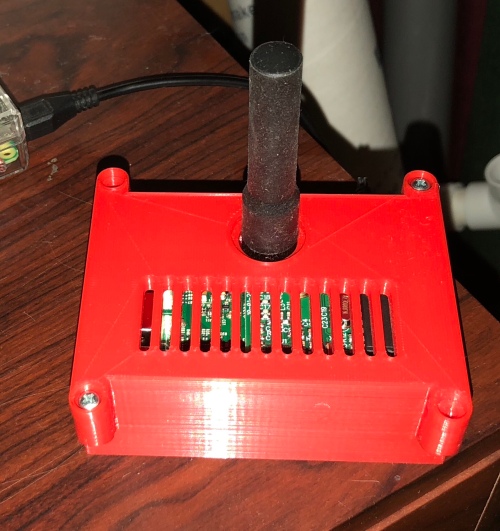
For storage for the Pi, I used a Sandisk class 10 32GB micro SD card that I already had. It is important to use a decent storage card so the performance isn’t worse than it needs to be. One of these cards is less than $15, so it is not very expensive compared to the cost of the entire hotspot project.
One could download Raspian and install all the software separately but there is an image already created that is very popular called Pi-Star. It is essentially Raspian with MMDVMHost, DStarRepeater and other software included. It is an easy way to get everything you need for DMR, DStar, P25 and more digital voice modes.
Pi-Star can be downloaded from here. Once the image was downloaded, I used the Linux dd command to write the image to the card.
After inserting the card into the Pi and booting it up, there are two very important steps. The first is to expand the image to use the entire card. When first written, a small portion of the space is used and a command needs to be run to expand the file system to use the rest of the space. That command is pistar-expand. The second important thing to do is to make sure the image is updated. The Pi-Star creators provide two commands for doing that. pistar-update / pistar-upgrade which are similar to the Raspian apt-get-update and apt-get upgrade commands but do so for the operating system and the software included in pi-star.
To setup the Pi-Star software, I followed along with this page:
https://www.toshen.com/ke0fhs/pi-star.htm
There is a lot of information on this site in addition to this page related to DMR. It was worth browsing around and finding information that I didn’t know.
After configuring the hotspot, I was able to verify that it connected to the BrandMeister Network.
The next step was to program the TYT MD-380. I had to choose a simplex 70cm frequency. After consulting the band plans and looking at the Arkansas repeater council page, I was able to choose one to use.
I won’t go into a lot of detail on programming the radio as there are a lot of YouTube videos and web pages describing that process.
I listen to the Hamradio 360 Workbench podcast and they use a talk group that I programmed into a channel and was able to hear some of that traffic. I also made a call and confirmed that I was able to transmit on the talk group as well as receive.
My next step is to find other talk groups that I might want to listen to, and determine how I will use DMR going forward. I am planning on taking the hotspot on business trips and possibly use it in the car for DMR mobile. I’ll figure that out as I go along.
Overall the process was not difficult, but took some time researching how DMR worked so I could understand the programming better. I used many web resources along with several YouTube videos. I still have a few more bookmarked to watch but I am getting a handle on it.
Comments and questions are welcome.
Meh
No doubt you’ve seen the recent ARRL proposal to increase Technician HF privileges and the expected ensuing online debate over it. In general I’m not opposed to the proposal, however I find myself indifferent. As others have pontificated, it’s not much of a hurdle these days to upgrade to General to acquire more privileges. I was very supportive of the code test elimination and various changes over the years that have simplified licensing. However, to some extent I think we’re at a point of diminishing returns with benefits from licensing changes and privilege increases. There’s perhaps one specific area I see the ARRL-proposed changes increasing on air activity: FT8. If Techs are given HF digital privileges on lower bands, I suspect we’ll see a lot of Techs end up there, and stay there, like a lot of Techs do today with 2 meter repeaters, unfortunately. With new radio amateur recruiting, participation, and retention, where should our focus be, what are the real stumbling blocks, and where is the opportunity? It’s not privileges. In thinking about the ARRL proposal, I’m kind of left thinking, “Meh.”
We need to look where the bulk of amateur technology hobbyist activity is today. It’s the Maker movement. These are intelligent, innovative, and inquisitive people who would be a great asset in amateur radio. It’s often been said that amateur radio and its perhaps dated technology can’t compete with the Internet, Xboxes, and cell phones. That may apply to your grandkids, but with Makers it’s not an issue. Makers enjoy playing with retro technology, like Nixie tubes, for example. They like building stuff and experimenting. They also like cutting edge technology, like satellites. Amateur radio has the perfect blend of retro and modern technology, and it has the opportunity to take Makers beyond the typical Maker fare of microcontrollers, single board computers, 3D printing, and robotics. Unlike “preppers” coming into the hobby for a specific application for their own purposes, Makers will be active and contributing participants and arguably are more likely to advance the radio art, as amateur radio was intended to do. But we need to have a culture that welcomes them, on their turf, and their venues, not just ours.
The Maker movement is a potential goldmine for amateur radio, one that needs to tapped, right now. This goes beyond having an amateur radio display at a Maker Faire stocked with pamphlets. If we really want to increase participation and new licensee retention, we need to pull out all the stops and target this demographic with technology, exhibitions, publications, and venues that tie amateur radio into their curiosities, interests, and projects. We need to be seen as innovators, not preservationists or on air retirement communities. There needs to be cultural change within amateur radio. While more kilohertz for newcomers is nice, and fairly easy to implement, it’s not going to get sizable returns in participation and retention. Targeting Makers will.
This article originally appeared on Radio Artisan.
Yet Another ARRL Opinion
For the first time in my amateur radio career, I’m beginning to look upon ARRL unfavorably. About 15 years ago after I acquired a lifetime subscription, my grandfather chastised me saying I’d eventually grow tired of the League and would regret my subscription. I’m sad to say I think that day may have come.
Over the years I’ve defended ARRL, in both in person conversations and online. ARRL attracts a lot of haters, often unfairly, for wrong reasons. For example, I’ve witnessed many hams hate ARRL, claiming they don’t like CW and worked to eliminate it, despite ARRL supporting code testing for Extra licensing in their FCC comments filings years ago, and offering daily code bulletins and practice over the air. Despite ARRL’s faults and shortcomings, amateur radio would not be where it is today, and perhaps not even exist, if it wasn’t for ARRL.
With the recent Code of Conduct and censure incident and the proposed voting and membership changes, I’m left with the impression of an organization that is closed, secretive, adverse to dissent, and focused on self-preservation. The Force of 50 debacle points to an organization eager to project to the public a disaster response “photo-op” image that neither the organization or the amateur radio service supports or deserves. Over the years I’ve personally seen other examples that support these two impressions but never dwelled on them as ARRL garnered my utmost respect as I felt that the League, despite its flaws, in general was taking amateur radio in the right direction. I no longer have that confidence in the organization.
While I could end my diatribe with the paragraph above, I really want to explore or ask, what is the solution to “fixing” ARRL? ARRL does a great job with publications and education, contesting, and lobbying the FCC. Does the large and seemingly complicated hierarchal governance structure really serve a purpose today? It appears that structure is geared more towards emergency communications initiatives than an effective membership feedback vehicle or advancing the radio art. Is this structure the problem and ARRL needs to be transformed into more of a flat, responsive, grass-roots kind of organization?
This article was originally published at Radio Artisan.














